Key Takeaways (TL;DR)
- What is TDX 2026? Salesforce's annual developer conference (April 15-16, 2026) unveiled Headless 360, Agent Script, Agentforce Vibes 2.0, and a suite of agentic enterprise tools that fundamentally redefine how organizations build on and interact with Salesforce
- Key Announcement: Salesforce Headless 360 makes the entire platform accessible via APIs, MCP tools, and CLI commands: no browser required
- Biggest Shift: The move from deterministic to probabilistic development signals a new era where AI agents handle complex workflows autonomously
- Timeline: Many features available now; Testing Center GA in May 2026; additional capabilities rolling out through Summer '26
- Best For: Organizations already using (or planning to adopt) Salesforce who want to stay ahead of the agentic enterprise transformation
- Bottom Line: TDX 2026 confirms Salesforce's commitment to an agent-first future: businesses that prepare now will have a significant competitive advantage
Introduction
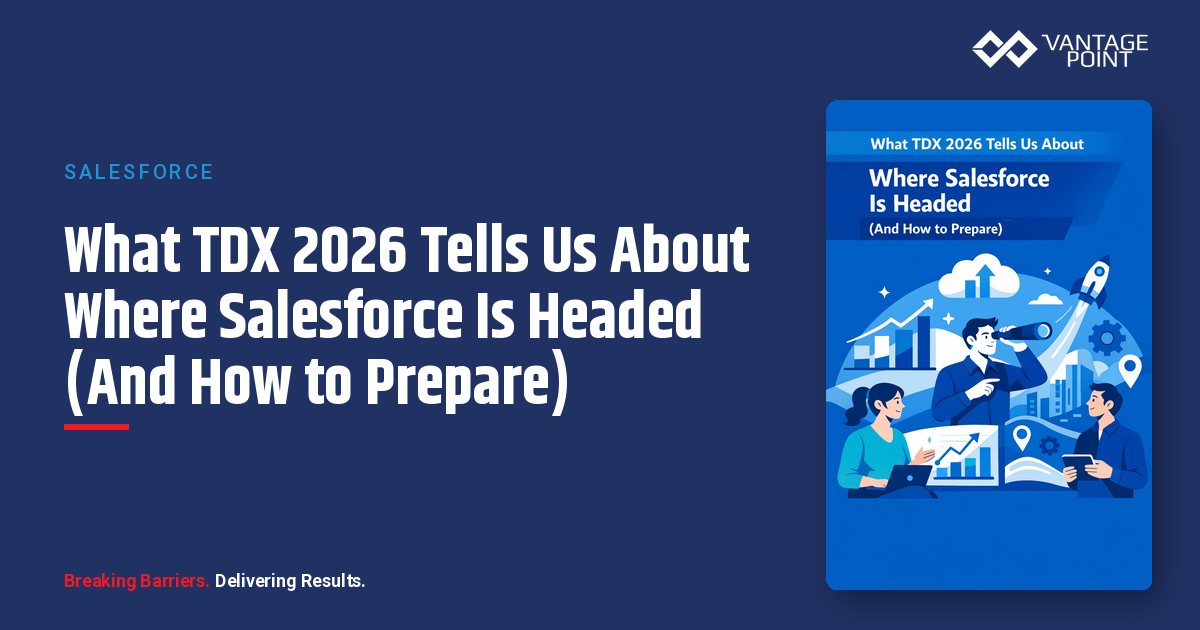
Salesforce's TrailblazerDX (TDX) 2026 wasn't just another developer conference: it was a declaration of intent. Held April 15-16 in San Francisco, this year's event delivered the clearest picture yet of where Salesforce is heading: a future where AI agents don't just assist your teams but actively orchestrate your workflows, business logic, and customer experiences.
From the open-sourcing of Agent Script to the launch of Salesforce Headless 360, TDX 2026 made one thing clear. The era of the Agentic Enterprise has arrived, and organizations that understand these shifts today will be the ones leading their markets tomorrow.
In this post, we'll break down the most significant announcements from TDX 2026, explain what they mean for your business, and outline exactly how you can start preparing now.
What Is Salesforce Headless 360?
The headline announcement at TDX 2026 was Salesforce Headless 360, a fundamental re-architecture of how the platform works. In simple terms, Salesforce is no longer just a browser-based application. It's now a programmable, API-first platform accessible from anywhere.
As Salesforce Co-Founder Parker Harris provocatively asked in the lead-up to TDX: "Why should you ever log into Salesforce again?"
Headless 360 delivers three core innovations:
1. 60+ New MCP Tools and 30+ Coding Skills
Coding agents like Claude Code, Cursor, Codex, and Windsurf now have complete, live access to your entire Salesforce platform (your data, workflows, and business logic) directly from the tools developers already use. This means your development team can build on Salesforce without ever opening the Salesforce UI.
2. Agentforce Experience Layer (AXL)
A new UI service that separates what an agent does from how it appears. Agents can deliver rich interactive components (flight status cards, approval workflows, decision tiles, data layouts) that render natively inside Slack, Mobile, ChatGPT, Claude, Gemini, Teams, or any client supporting MCP apps. The principle: build once, render everywhere.
3. Production Control Tools
New tools for testing, observing, and tuning agent behavior throughout the full agent lifecycle, because shipping an agent is the starting line, not the finish line.
Why Agent Script Going Open Source Is a Big Deal
One of the most technically significant announcements was the open-sourcing of Agent Script, a new agent definition language that gives developers precise control over when AI agents should use LLM reasoning and when they should follow deterministic logic.
Here's why this matters for your business:
- Hybrid Reasoning Control: You can define exactly which parts of an agent's behavior follow strict business rules and which parts can reason independently: critical for compliance-sensitive organizations
- Coding-Agent-Native: Agent Script is designed for AI coding assistants to write, not humans. This means Claude Code, Cursor, and other tools can build and test agents with dramatically less manual effort
- Platform-Agnostic Foundation: Agent Script uses a dialect system (like SQL variants), so the core language is open while platform-specific extensions handle different environments: Salesforce, MuleSoft, and more
The full specification, grammar, parser, and compiler are available at github.com/salesforce/agentscript.
What this signals: Salesforce is betting big on an open ecosystem for agent development. Organizations that invest in Agent Script skills now will have a significant head start as the agentic enterprise becomes mainstream.
Agentforce Vibes 2.0: AI-Powered Development Goes Multi-Model
The upgraded Agentforce Vibes 2.0 represents a major leap in how teams build on Salesforce:
- Multi-Model Support: Choose between Claude Sonnet, GPT-5, and other models depending on your use case
- Full Org Awareness: Unlike standalone AI tools, Vibes 2.0 understands your specific Salesforce org: your metadata, your configurations, your business context
- Natural Language DevOps: Describe what you want to deploy and let agents handle the execution
- Native React Support: Build completely custom interfaces with any design language or interaction model while keeping Salesforce's enterprise backend (authentication, security, metadata integration) fully intact
Salesforce claims this approach cuts development cycle times by as much as 40% by eliminating the constant context-switching between tools.
The Shift From Deterministic to Probabilistic: What It Means for Your Business
Perhaps the most important conceptual shift discussed at TDX 2026 was the move from deterministic to probabilistic development.
Joe Inzerillo, President of Enterprise and AI Technology at Salesforce, explained it this way: traditional software development is deterministic. You input data, it processes predictably, and one plus one always equals two. But AI agents are fundamentally different. They're probabilistic systems that may produce different outputs from the same input.
What Does This Mean Practically?
| Aspect | Deterministic (Traditional) | Probabilistic (Agentic) |
|---|---|---|
| Output Consistency | Same input → Same output every time | Same input → Varied but intelligent outputs |
| Testing Approach | Pass/fail unit tests | A/B testing, scoring evals, continuous observation |
| Quality Assurance | Test before deployment | Test before AND continuously after deployment |
| Development Cycle | Build → Test → Deploy | Build → Test → Deploy → Observe → Improve (continuous) |
| Required Tooling | Standard CI/CD pipelines | Agent-specific lifecycle tools (ADLC) |
This shift requires entirely new tools and workflows, which is exactly what Salesforce delivered at TDX 2026:
- Testing Center (GA May 2026): Custom scoring evals, multi-turn conversation testing with voice simulation, and a flexible UI with run history
- A/B Testing API (Pilot): Run controlled experiments on agents using real production traffic
- Session Trace OTel API (Beta): Complete agent session traces as OpenTelemetry spans, exportable to Splunk, Datadog, New Relic, or any OTel-compatible collector
- Agent Development Life Cycle (ADLC) Skills: Open-source tools for building, testing, deploying, and observing agents from sandbox to production
Agent Fabric: Governing Multi-Vendor AI at Scale
For enterprises running agents across multiple platforms, MuleSoft Agent Fabric introduces a governed control plane for managing your entire AI landscape:
- Deterministic Orchestration: Control how agents route tasks, hand off to each other, and escalate when needed
- Centralized Governance: Manage agents, tools, and LLM access across Salesforce, third-party platforms, and custom implementations
- Agent Script Dialect Support: MuleSoft extends Agent Script for hybrid integration landscapes
This is critical for organizations that aren't all-in on a single vendor. Agent Fabric lets you maintain consistency and governance regardless of where your agents run.
AgentExchange: The Unified Agentic Marketplace
TDX 2026 also unveiled the expanded AgentExchange, unifying Salesforce AppExchange, Slack Marketplace, and the Agentforce ecosystem into a single destination:
- 10,000 Salesforce apps
- 2,600+ Slack apps
- 1,000+ agents, tools, and MCP servers from partners like Google, DocuSign, and Notion
- AI-guided search for discovering the right tools
- $50M Builders Fund for investment, engineering support, and go-to-market pathways
The market results are already impressive: Notion reported cutting its average sales cycle from four months to three weeks after listing, while DocuSign processed 200+ private offers in Q4 2025 with 60% faster time to signature.
How to Prepare Your Organization: A Strategic Roadmap
TDX 2026 makes it clear that the agentic enterprise isn't a distant future: it's arriving now. Here's how to position your organization for success:
Phase 1: Assess and Educate (Now)
- Audit your current Salesforce implementation to identify where agents could add the most value: repetitive workflows, data entry, customer service routing, lead qualification
- Upskill your team on Agent Script fundamentals, Agentforce builder, and probabilistic development concepts
- Evaluate your data foundation using Data 360 to ensure agents have access to the unified, real-time context they need
Phase 2: Pilot and Experiment (Q2: Q3 2026)
- Start with Agentforce Labs Quickstart at labs.agentforce.com for rapid prototyping without complex org provisioning
- Build your first Agent Script-powered agent targeting a well-defined use case with clear success metrics
- Establish an Agent Center of Excellence to define governance standards, testing frameworks, and deployment workflows
Phase 3: Scale and Optimize (Q3 2026+)
- Deploy A/B testing to continuously improve agent performance with real production data
- Implement Session Tracing for full observability into agent behavior and decision-making
- Expand to multi-channel deployment using the Agentforce Experience Layer across Slack, mobile, web, and voice
- Consider Agent Fabric if you're running agents across multiple platforms and need centralized governance
Best Practices for Navigating the Agentic Transition
- Start with high-value, low-risk use cases. Agent automation for internal workflows (like setup configuration, data cleanup, or report generation) gives your team experience before customer-facing deployments.
- Invest in data quality now. Agents are only as good as the data they access. Clean, unified data through Data 360 is the foundation everything else builds on.
- Define "good" before you deploy. Use Custom Scoring Evals to establish clear quality standards for every agent use case: what does a successful interaction look like?
- Embrace continuous improvement. The probabilistic nature of agents means you'll need ongoing observation and tuning. Build monitoring and feedback loops from day one.
- Don't go it alone. The complexity of agentic implementations, from Agent Script development to multi-vendor governance, benefits enormously from experienced implementation partners who understand both the technology and your business context.
- Plan for the Experience Layer. Design your agent experiences with multi-surface deployment in mind. If you build for Slack today, the Experience Layer means you can extend to mobile, voice, and third-party platforms without rebuilding.
FAQ: TDX 2026 and the Agentic Enterprise
What is Salesforce Headless 360?
Salesforce Headless 360 makes the entire Salesforce platform (data, workflows, business logic) accessible via APIs, MCP tools, and CLI commands. This means AI agents and developers can interact with Salesforce programmatically from any surface, without needing a browser-based UI.
What is Agent Script and why is it important?
Agent Script is an open-source agent definition language that lets developers specify when AI agents should use LLM reasoning versus deterministic business logic. It's designed for AI coding assistants to author, enabling faster, more reliable agent development with enterprise-grade control.
How does the Agentforce Experience Layer work?
The Experience Layer separates agent functionality from presentation, allowing agents to deliver rich interactive UI components (cards, workflows, tiles) that automatically render natively across Slack, Mobile, ChatGPT, Teams, and any MCP-compatible client: without rebuilding for each platform.
What is the difference between deterministic and probabilistic development?
Deterministic development produces predictable, identical outputs for the same inputs. Probabilistic (agentic) development involves AI systems that may produce different but intelligent outputs, requiring new testing and quality assurance approaches like A/B testing, scoring evaluations, and continuous observation.
When will TDX 2026 announcements be available?
Many features are available now, including Agent Script (open source), 60+ MCP tools, 30+ coding skills, and Agentforce Vibes 2.0 (open beta with React). Testing Center goes GA in May 2026. A/B Testing API is in pilot, and Session Trace OTel API is in beta.
How should organizations prepare for the agentic enterprise?
Start by auditing your current workflows for automation potential, ensuring your data is clean and unified, and upskilling your team on Agent Script and Agentforce fundamentals. Begin with pilot projects using Agentforce Labs Quickstart before scaling to production deployments.
Do I need to rebuild my existing Salesforce implementation?
No. One of the key advantages of building on Salesforce is that agents inherit your existing approval chains, business rules, permissions, and compliance controls. Headless 360 exposes these capabilities programmatically: your existing investment is enhanced, not replaced.
Conclusion
TDX 2026 marks a pivotal moment in Salesforce's evolution, and by extension, in how businesses leverage technology to compete. The announcements around Headless 360, Agent Script, the Experience Layer, and enhanced agent lifecycle tooling paint a clear picture: the future of enterprise software is agentic, API-first, and probabilistic.
The organizations that will thrive in this new era are those that start preparing now, investing in data quality, building agentic skills, and establishing governance frameworks for AI-powered workflows.
Vantage Point helps organizations navigate this transformation with confidence. As a Salesforce and HubSpot implementation partner with deep expertise in Data Cloud, MuleSoft integration, and AI-powered CRM solutions, we're uniquely positioned to help you assess your readiness, design your agentic strategy, and execute a phased implementation that delivers measurable results.
Ready to prepare for the agentic enterprise? Contact Vantage Point to schedule a strategic assessment and learn how TDX 2026's innovations can accelerate your business.
About Vantage Point
Vantage Point is a Salesforce and HubSpot implementation partner specializing in CRM strategy, automation, integration, and AI-powered solutions. With deep expertise across Sales Cloud, Service Cloud, Experience Cloud, Data Cloud, MuleSoft, and partner technologies including Anthropic (Claude AI), Aircall, and Workato, Vantage Point helps organizations of all sizes transform their customer engagement strategies and operational efficiency. Learn more at vantagepoint.io.