Quick Answer
AI negotiation workflows use governed AI agents, CRM data, and defined business rules to move a deal from a buyer request to a review-ready quote, approved terms, and a signed contract with less manual handoff. They matter to sales leaders, deal desks, finance, legal, and operations teams that need to respond quickly without giving up pricing discipline or approval control. The practical decision is not whether to let AI negotiate unchecked; it is how to automate repeatable preparation and routing while keeping people responsible for exceptions and final commitments. Vantage Point helps organizations design the Salesforce workflow, data controls, integrations, and adoption plan that make that model workable.
Key Takeaways (TL;DR)
- What are AI negotiation workflows? They connect CRM opportunity data, product and pricing rules, approval policies, contract terms, and buyer communication into a guided deal process.
- Key benefit: Teams can prepare accurate quotes, flag exceptions, and route the right review work without rebuilding the deal context in email and spreadsheets.
- What stays human: Leaders set commercial policy; sales, finance, and legal teams review exceptions, judgment calls, and final commitments.
- Best for: Organizations with repeatable offerings, structured discount or term policies, and recurring delays between an opportunity, quote, approval, and signature.
- Bottom line: AI negotiation workflows can improve deal velocity only when the underlying CRM data, guardrails, contract templates, and ownership model are reliable.
A buyer asks for a revised package, a different term, or an exception. If the answer lives in a product expert's inbox, an old spreadsheet, and a string of forwarded emails, the deal slows down before the team can make a commercial decision. The customer sees silence or inconsistent answers; the seller spends time coordinating rather than selling.
An AI negotiation workflow supports—not replaces—that judgment. It assembles deal context, checks it against policy, routes exceptions, and keeps the current version visible.
What Are AI Negotiation Workflows?
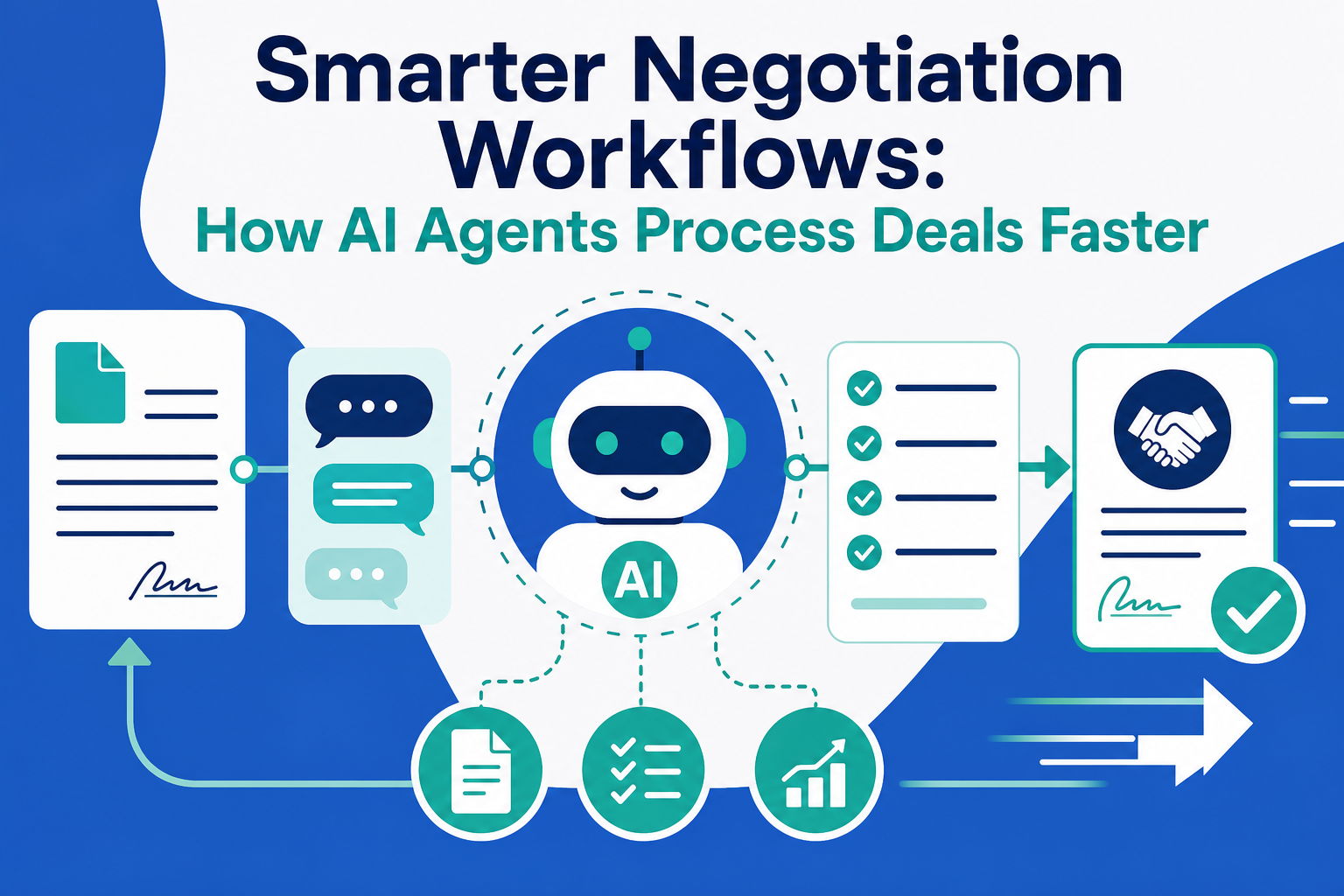
AI negotiation workflows are CRM processes in which a governed agent retrieves approved deal information and presents the next step. In Salesforce, the workflow can connect opportunity data, product configuration, pricing rules, approval thresholds, templates, and activity history into one quote-to-signature path.
A simple assistant drafts from a prompt. A governed agent works within defined actions and data permissions: it can create a quote draft, check eligible products, identify an approver, summarize history, or generate an approved-template draft. It should not invent prices, waive policy, or make binding commitments.
Salesforce describes sales quote automation as using AI and predefined pricing rules to generate, adjust, and approve quotes with less manual effort. That distinction is useful for any organization evaluating agentic deal processing: the value comes from connecting intelligence to a controlled operating process, not from adding a chat window to an inconsistent one.
Why Traditional Deal Processing Creates a Deal-Velocity Problem
Most negotiation delays stem from lost context among sellers, product specialists, finance, legal, and approvers. A seller may create a quote from a spreadsheet, seek a discount by email, revise a proposal, then discover that a clause or bundle needs another review. Each handoff creates wait time and version risk.
Pricing decisions become difficult to audit, buyers receive conflicting revisions, and managers cannot see where a deal is waiting. When the real negotiation lives in attachments and inboxes, forecasting weakens and the organization cannot learn reliably from exceptions.
| Deal moment | Traditional approach | AI-enabled workflow with human controls |
|---|---|---|
| Buyer requests a quote | Seller searches price books and prior emails. | Agent assembles approved product, account, and opportunity context for review. |
| Pricing or term exception | Seller sends separate requests and follows up manually. | Policy rules identify the exception and route the request with the supporting facts. |
| Negotiated change | Teams circulate attachments and may edit different versions. | The current quote or contract record is updated, summarized, and tied to the deal. |
| Final approval and signature | Status is checked across inboxes, documents, and calendars. | Ownership, approvals, document status, and next action are visible in the CRM workflow. |
How AI Agents Automate Quote Generation, Validation, and Approval Routing
A workflow begins with the seller's request in the opportunity. The agent can use the account, selected products, commercial terms, and prior activity to build a review-ready quote, ask for missing information, or suggest an approved bundle.
Next, it compares configuration, discount, term, or condition against the product catalog and policy. It can flag incompatible products, missing fields, stale assumptions, or requests requiring approval. That depends on reliable rules, price books, and contract metadata.
The reviewer receives the deal summary, exception, relevant policy, buyer need, and requested decision. A revision request updates the task, notifies the seller, and preserves the decision trail.
Salesforce's Agentforce for Revenue announcement describes agents that generate quotes from natural-language requests while using the right products, pricing, and terms. Salesforce also positions Revenue Cloud around guided quoting and pricing rules. Those capabilities are most useful when organizations define the approval paths and exception boundaries before deployment.
How Intelligent Negotiation Support Improves Decisions
Negotiation support should improve preparation, not replace commercial judgment. With governed historical data, an agent can summarize comparable deals, prior concessions, renewal history, and buyer priorities. It can surface questions a deal team must answer: Which terms are standard? Which exceptions were approved? What is missing before a counterproposal?
Competitive intelligence belongs in the workflow only when sources are deliberately maintained. The agent can surface an approved battle card or current positioning guidance and identify its source and date. Sales operations must define trusted sources and human validation points.
Win/loss analysis is useful only if reason codes, deal stages, and close notes are complete. With consistent outcomes, teams can examine approved exceptions, stalled stages, objection themes, and handoffs to refine guidance and escalation rules—without turning past concessions into automatic decisions.
A useful guardrail is to separate three kinds of output:
- Facts: record values, approved policy, document status, and dated historical information.
- Recommendations: a suggested next action or a list of relevant precedents that a seller or manager can evaluate.
- Commitments: prices, terms, and contract language that must follow explicit authority and approval controls.
That separation gives sellers a credible message: the team can respond quickly because the right information is organized, while material changes still receive review.
How Contract Automation Removes Last-Mile Friction
A deal is not finished when a quote is accepted in principle. Contract generation, redlining, clause review, version control, approvals, and e-signature can become a second, disconnected negotiation. When those steps occur outside the CRM, sellers spend time chasing the latest attachment and legal teams spend time reconstructing what changed.
Contract automation can begin with approved templates that populate the correct account, deal, product, and commercial data. An agent can create a draft, identify which clause set applies, summarize requested redlines, and send nonstandard terms to the correct reviewer. It can also help keep the contract record, quote, opportunity, and approval tasks aligned as the document changes.
The workflow should preserve version history, current status, approvals, and e-signature handoff. Salesforce's contract lifecycle management overview describes CLM as tracking contracts from drafting and approval through signatures and renewals. Its contract management guidance highlights document creation, revisions, versioning, and electronic signatures.
What Changes for Sales Teams and Buyers?
For sellers, the immediate change is less administrative coordination. They can focus on buyer priorities, the business case, and internal alignment instead of searching for current pricing or an approval status. Managers see deal health through the requested change and next action in the CRM.
For customers, a well-designed workflow makes the process feel more professional. The team can acknowledge a request quickly, communicate what is being reviewed, deliver a clearer revision, and avoid sending conflicting versions. Faster does not mean rushed. It means the customer does not have to repeat context while the vendor moves information between systems.
The experience depends on transparency. Sales teams should tell buyers when a request requires a review and avoid implying that an agent has authority it does not have. Clear ownership, accurate documents, and predictable next steps build more trust than an automated message that overpromises.
How Analytics Improve Future Deal Outcomes
Every completed workflow should produce usable operational data. Sales leaders can review where quotes are delayed, which exception types require the most review, how often documents are revised, and which stage handoffs create rework. That helps the organization fix the process behind the delay rather than simply asking sellers to follow up more often.
Analytics also expose automation gaps. A recurring correction may signal product data, repeated escalation may signal unclear policy, and incomplete quote requests may signal a training or intake issue. Teams can use those signals to improve rules, source data, and the review experience.
Combine workflow data with manager, seller, customer, and compliance feedback. The operating team should test recommendations, exception routing, and users' understanding of when to escalate.
A Practical Path to AI-Powered Deal Processing
Start with a workflow that is common, measurable, and bounded. A reliable first use case is often a standard quote revision or a well-defined discount approval, not the organization’s most complex deal. The following sequence keeps the work focused:
- Map the current path. Identify every handoff from buyer request through quote, approval, contract, and signature. Capture where information is copied, where decisions stall, and which records need to stay aligned.
- Define decision rights and guardrails. Document the policies an agent may use, the actions it may take, and the conditions that require a human reviewer. Include data access, audit needs, and escalation owners.
- Repair the underlying data. Validate the product catalog, price rules, approval metadata, templates, and opportunity fields. For systems that need to exchange deal data, plan the integration and data ownership model before automating handoffs.
- Pilot with visible oversight. Let a small group review the agent's drafts, summaries, validations, and routing decisions. Use their feedback to improve the workflow before expanding scope.
- Measure the process, then optimize it. Track completeness, routing accuracy, rework sources, adoption, and buyer experience. Use the findings to simplify policies and improve enablement, not just to add more automation.
This sequence connects naturally to workflow automation and process optimization, system integration and data migration, and AI-driven personalization and analytics. The technology works best when its operating model is designed alongside it.
How Vantage Point Helps
Vantage Point is a boutique, senior-led Salesforce and HubSpot consulting partner. We help organizations translate sales-process friction into a practical CRM design: reliable deal data, pricing and approval workflows, contract handoffs, integrations, governance, and user adoption. Our Salesforce implementation and advisory services can help align the platform to real commercial decision rights, while our managed services and ongoing support can help teams maintain and improve the workflow after rollout.
If your team is evaluating where AI belongs in quoting, negotiations, approvals, or contracts, start with the workflow and controls rather than the interface. Talk to Vantage Point about AI-powered deal processing to assess the right first use case and build a practical implementation plan.
Frequently Asked Questions
What is an AI negotiation workflow?
An AI negotiation workflow is a CRM-connected process that helps sales teams prepare, validate, route, and track deal changes using governed AI actions and business rules. It supports human decision-making by organizing context and automating repeatable steps; it should not make unauthorized commercial commitments.
Can an AI agent approve discounts or contract terms on its own?
An AI agent should only take actions that match explicit business rules and permissions. Organizations can allow it to validate standard requests or route exceptions, while managers, finance, and legal teams retain responsibility for approvals and nonstandard commitments.
What data does an AI agent need to help with deal processing?
An agent needs reliable opportunity, account, product, pricing, approval, activity, and contract data, plus clear access controls. Historical deal outcomes and approved guidance can improve context, but incomplete or inconsistent data must be corrected before it is used for recommendations.
How do AI negotiation workflows improve the customer experience?
AI negotiation workflows improve the customer experience by helping teams respond with complete context, current documents, and clear next steps. Buyers receive more consistent information and spend less time repeating the same request while the vendor coordinates internal review.
How should a business start with AI-powered deal processing?
Start with one repeatable workflow, such as a standard quote revision or a bounded approval path, and define the data, rules, owners, and escalation conditions first. Vantage Point can help assess Salesforce workflow readiness, identify integration dependencies, and design a pilot with clear human oversight.
What governance is required for AI agents in Salesforce deal workflows?
Governance should cover data access, permitted actions, approval thresholds, source quality, audit history, exception routing, and ongoing testing. The business should also define who is accountable for policy changes and how sellers report incorrect or unhelpful recommendations.
Will AI replace the sales team during negotiations?
AI is best used to reduce administrative work and improve preparation, not to replace relationship-building and commercial judgment. Sellers remain responsible for understanding buyer needs, building trust, negotiating complex tradeoffs, and escalating decisions that fall outside established policy.
About Vantage Point
Vantage Point helps organizations use Salesforce, HubSpot, AI, integrations, and CRM operations more effectively. Visit vantagepoint.io.