
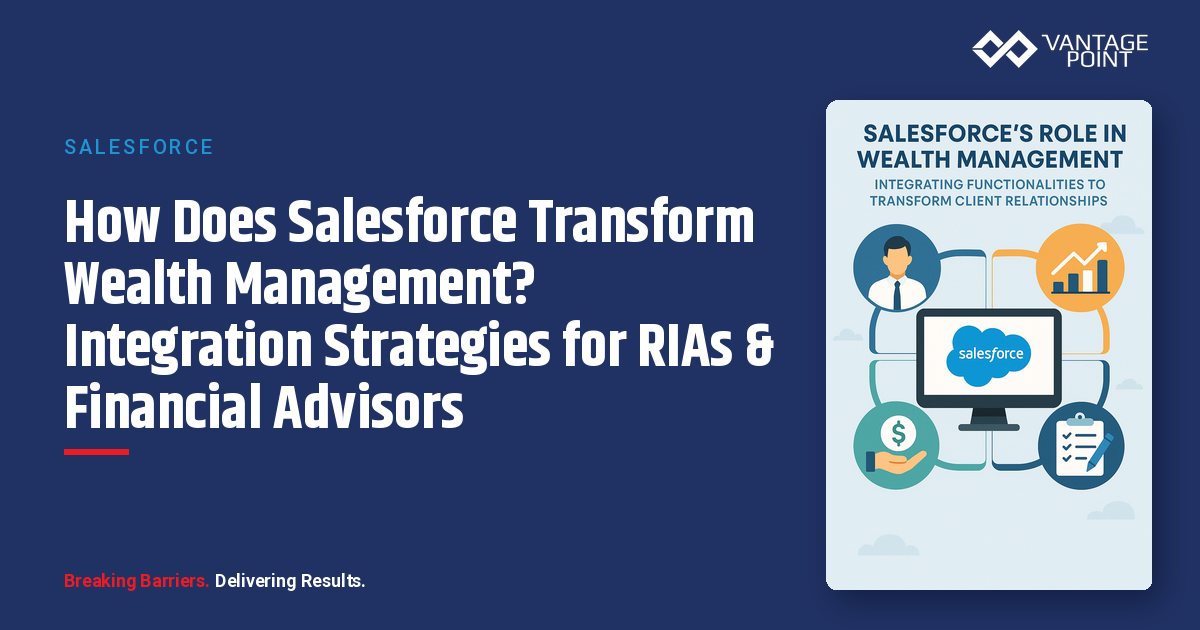
How Does Salesforce Transform Wealth Management? Integration Strategies for RIAs & Financial Advisors
The wealth management industry stands at a critical inflection point. Client expectations have evolved from periodic portfolio reviews to demanding continuous engagement, personalized insights, and seamless digital experiences. Simultaneously, advisors face mounting pressure to manage larger books of business while navigating increasingly complex regulatory requirements.
📊 Key Insight: Firms that strategically integrate Salesforce Financial Services Cloud commonly report advisor productivity improvements, enabling advisors to serve larger books of business without sacrificing service quality.
Salesforce Financial Services Cloud has emerged as the transformative platform that enables wealth management firms to meet these challenges head-on. But FSC's true power lies not in any single feature. It's in how it integrates diverse functionalities into a cohesive ecosystem that transforms every aspect of operations, from client acquisition and onboarding through ongoing relationship management and service delivery.
At Vantage Point, we've dedicated our practice exclusively to helping financial services firms harness the full potential of Salesforce. We've witnessed firsthand how the strategic integration of Salesforce functionalities can fundamentally transform wealth management firms. This article examines the multifaceted role Salesforce plays in modern wealth management and how its integrated approach delivers results that far exceed the sum of its parts.
Why Is Integration the #1 Imperative for Wealth Management Firms?
What Problems Does System Fragmentation Create?
Walk into most wealth management firms today, and you'll find advisors juggling a bewildering array of disconnected systems, portfolio management here, a separate CRM there, financial planning software, document management, marketing automation tools, and compliance tracking spreadsheets. Each serves a specific function but creates a fractured technology landscape that undermines efficiency and effectiveness.
This fragmentation creates multiple critical problems:
- Data silos: Client information scattered across systems means advisors lack a complete picture, leading to missed opportunities and inconsistent service.
- Manual inefficiency: Moving data between systems requires manual entry and reconciliation, consuming valuable advisor time and introducing errors.
- Limited visibility: Leadership struggles to gain accurate insights into business performance when critical metrics are trapped in separate platforms.
- Poor client experience: Clients perceive fragmentation through inconsistent communications, delayed responses, and advisors unaware of previous interactions.
How Does Salesforce Solve the Integration Challenge?
Salesforce Financial Services Cloud addresses fragmentation through a platform approach that integrates essential wealth management functionalities within a single, unified system. Integration goes beyond simply housing different features under one roof. It enables functionalities to work together synergistically, creating a seamless flow of information and automation.
This integrated approach transforms how wealth management firms operate:
- Single source of truth: All client data in one place, eliminating silos
- Cross-functional automation: Workflows that span multiple functional areas seamlessly
- Real-time visibility: Instant insight into business performance at every level
- Consistent client experiences: Personalized touchpoints across all channels
- Dramatically improved productivity: Advisors spend more time with clients, less on admin
What Are the Core Functionalities That Drive Wealth Management Transformation?
How Does Salesforce FSC Handle Client Relationship Management?
At its foundation, Salesforce provides enterprise-grade CRM capabilities specifically adapted for wealth management's unique requirements. Unlike generic CRM systems, FSC understands the complex data models of financial services:
| Capability | What It Does | Why It Matters |
|---|---|---|
| Household & Relationship Management | Visualize entire households (spouses, children, trusts, and businesses) in one structure | Enables relationship-based service models and identifies opportunities across the full family unit |
| Financial Accounts & Holdings | Natively supports checking, investment, retirement, insurance, and loan accounts with ownership tracking | Dynamic records display current balances, holdings, and performance when integrated with portfolio management |
| Contact & Interaction History | Captures every conversation, meeting, email, and service request linked to individuals and households | Ensures continuity of service regardless of which team member assists a client |
| Goals & Life Events | Tracks financial goals (retirement, education) and life events (marriage, career changes) | Drives proactive advisor outreach and personalized financial planning |
How Does Salesforce Support Business Development and Marketing for Advisors?
Sustainable growth requires effective business development and marketing capabilities. Salesforce integrates these functions seamlessly with client relationship management:
- Lead management: Track every prospect from identification through conversion. Lead scoring prioritizes prospects based on characteristics and engagement, helping advisors focus on the highest-potential opportunities.
- Marketing automation: Integration with Salesforce Marketing Cloud enables sophisticated, personalized campaigns. Segment clients by AUM, life stage, product holdings, or engagement level and deliver targeted communications via email, social media, or advertising.
- Referral tracking: Track referral sources, measure conversion rates, and identify your best referral partners to nurture these valuable relationships systematically.
- Campaign management: Track the effectiveness of all marketing initiatives (seminars, webinars, content marketing, and client appreciation events) to make more strategic marketing investments.
What Does Service Excellence Look Like with Salesforce in Wealth Management?
Delivering consistent, high-quality service across your entire client base requires operational discipline and workflow automation:
- Case management: Track and manage all client service requests systematically. Whether a client calls, emails, or submits a portal request, it's captured as a case, routed appropriately, and tracked through resolution.
- Workflow automation: Repetitive processes like account opening, documentation collection, periodic reviews, and compliance approvals follow defined processes that ensure consistency and reduce errors.
- Task management: System-generated and manual tasks ensure nothing falls through the cracks. Tasks can be assigned based on workflows, triggered by events, or scheduled based on service commitments.
- Collaboration tools: Salesforce Chatter enables team collaboration around clients, opportunities, and projects within the context of specific records.
How Can Wealth Managers Use Salesforce Analytics for Data-Driven Decisions?
Data-driven decision-making separates high-performing firms from the rest. Salesforce provides powerful analytics capabilities:
- Dashboards & reports: Out-of-the-box and custom reports provide visibility into AUM, client acquisition, advisor productivity, service metrics, pipeline health, and more. Role-specific dashboards ensure each team member sees what's most relevant.
- Einstein Analytics: Salesforce's AI-powered platform delivers predictive modeling, pattern detection, and intelligent recommendations. Identify at-risk clients, predict conversion likelihood, and uncover hidden growth opportunities.
- Performance benchmarking: Compare performance across advisors, teams, offices, or time periods. Identify top performers and enable best-practice sharing across the organization.
- Client segmentation: Advanced analytics enable sophisticated segmentation based on profitability, engagement, life stage, or any relevant criteria to tailor service models and allocate resources effectively.
How Does Salesforce Help Wealth Management Firms Stay Compliant?
In wealth management, compliance isn't optional: it's existential. Salesforce provides robust tools for managing regulatory requirements:
| Compliance Area | How Salesforce Helps |
|---|---|
| Document Management | Store all client documentation within Salesforce or integrate with specialized ECM systems, with full security and audit trails |
| KYC & Suitability | Workflow automation guides advisors through know-your-customer documentation and suitability assessments with required fields and approval processes |
| Audit Trails | Comprehensive logging of all system activities (who accessed information, what changed, and when) for regulatory compliance |
| Compliance Calendars | Automate scheduling of periodic reviews, beneficiary confirmations, and regulatory filings with organization-wide visibility |
How Do Salesforce Functionalities Work Together in Practice?
What Does the Client Journey Look Like in an Integrated Salesforce Environment?
The true power of Salesforce emerges when functionalities work together seamlessly. Here's how a typical client journey unfolds in an integrated environment:
Step 1: Initial Contact and Qualification
A prospect completes an inquiry form on your website. Salesforce automatically creates a lead record and assigns it to an advisor based on territory, specialization, or round-robin logic. The advisor receives an instant notification with full prospect details.
Step 2: Business Development Process
All communications (calls, emails, meetings) are automatically logged. The advisor moves the lead through stages (contacted → meeting scheduled → proposal sent), providing pipeline visibility to management. Marketing automation triggers relevant follow-up emails based on prospect interests.
Step 3: Conversion and Onboarding
When the prospect converts, Salesforce automatically initiates the onboarding workflow. Tasks are created for documentation collection, account setup, and compliance procedures. Operations receives assignments, and the client receives automated communications guiding them through the process.
Step 4: Portfolio Implementation
Integration with your portfolio management system populates Salesforce with account balances and holdings. The advisor views the complete financial picture (accounts, assets, liabilities, goals) in one place.
Step 5: Ongoing Relationship Management
The advisor's dashboard displays upcoming tasks: quarterly reviews, annual plan updates, and follow-ups. When market volatility impacts a particular sector, Einstein Analytics identifies clients with concentrated positions and suggests proactive outreach. Automated workflows generate service tasks based on life events or account activities.
Step 6: Service Delivery
When a client calls with a question, the service team member sees complete interaction history, portfolio details, and pending items. They log the inquiry, resolve it, and the advisor receives a notification ensuring continuity.
Step 7: Marketing and Engagement
Marketing Cloud analyzes engagement and segments clients for targeted campaigns. High-net-worth clients receive exclusive event invitations. Clients approaching retirement receive educational content. All campaign responses flow back into Salesforce, informing advisor conversations.
Step 8: Business Analytics
Leadership reviews dashboards showing AUM trends, client acquisition costs, advisor productivity, and satisfaction metrics. They identify top-performing advisors, schedule best-practice sharing sessions, and make data-driven staffing decisions to maintain service standards.
📊 Key Stat: This seamless integration across all eight steps creates a unified experience where every team member works within a single source of truth, resulting in better outcomes for clients, advisors, and firm leadership alike.
What Is Vantage Point's Approach to Salesforce Integration for Wealth Management?
Why Does a Business-Process-First Methodology Matter?
At Vantage Point, we've refined a methodology for implementing Salesforce that maximizes integrated functionality value while accounting for each firm's unique requirements. Our approach begins with a deep dive into your current business processes: not technology configuration.
This business-process-first methodology ensures that Salesforce enhances your workflows rather than forcing you to adapt to a generic system. For example, when we partnered with Cornerstone First Mortgage to rescue a failed implementation, the previous consultant had focused on technical configuration without understanding the client's business model. We took a different approach: comprehensive business process analysis, workflow optimization, and then technical implementation aligned with those optimized processes.
How Does Vantage Point Design Salesforce Architecture and Integrations?
With processes mapped, we design a Salesforce architecture that leverages the platform's integrated capabilities while connecting with your specialized systems:
- Portfolio management integration: Bidirectional integrations with portfolio management and accounting systems, ensuring position, balance, and performance data flows into Salesforce while maintaining your specialized platform as the system of record.
- Financial planning integration: Connect financial planning software so advisors access plans, goals, and scenarios within their primary workflow platform.
- Document management integration: Seamless document access whether using Salesforce's native storage or specialized ECM systems, maintaining security and compliance.
- Marketing platform integration: A closed-loop system where marketing activities inform CRM data and CRM data drives targeted marketing.
- Data warehouse & reporting: For firms with advanced analytics requirements, integrate Salesforce with BI platforms like Tableau for sophisticated analysis.
How Do You Ensure Advisor Adoption of Salesforce?
Technology only delivers value when people use it effectively. Our implementation includes comprehensive change management:
- Executive alignment: Define success metrics, communicate the vision, and ensure organizational commitment to transformation.
- Advisor engagement: Advisors provide input on workflows and test configurations throughout implementation, seeing how Salesforce makes their work easier: not just adding administrative burden.
- Role-specific training: Each role receives training tailored to their responsibilities. Advisors learn different capabilities than operations staff or compliance officers.
- Super-user development: Internal champions become expert users who provide peer support and drive continued adoption.
What Does Continuous Optimization Look Like After Implementation?
Implementation is just the beginning. As your firm grows, processes evolve, and Salesforce releases new capabilities, ongoing optimization ensures your platform continues to deliver value:
- Regular platform health checks: Identify opportunities for improvement proactively
- Feature updates: Stay current as Salesforce releases new capabilities
- Strategic guidance: Leverage your Salesforce investment for emerging business priorities
- Ongoing training: Onboard new team members and provide refresher sessions
📊 Key Insight: Vantage Point's long-term partnership approach means clients continue working with us because we're genuinely invested in their ongoing success.
What Measurable Impact Does Salesforce Integration Deliver?
The integration of Salesforce functionalities delivers measurable business impact across multiple dimensions:
| Impact Area | What Changes | Expected Results |
|---|---|---|
| Advisor Productivity | Less time on admin, more time with clients | Measurable productivity improvement |
| Client Satisfaction | Consistent, personalized experiences across all touchpoints | Higher NPS scores and improved retention |
| Growth Acceleration | Better business development tools and referral tracking | Faster client acquisition and organic growth |
| Operational Efficiency | Automated workflows and integrated systems | Handle larger client bases without proportional staff increases |
| Compliance Confidence | Systematic workflows, audit trails, automated monitoring | Reduced regulatory risk and examination burden |
| Strategic Visibility | Real-time dashboards and analytics at every level | Data-driven decisions from advisors to executives |
Why Does Financial Services Specialization Matter for Salesforce Implementation?
Successfully integrating Salesforce functionalities in wealth management requires more than general Salesforce expertise. It demands deep understanding of the industry's unique requirements and workflows.
At Vantage Point, our exclusive focus on financial services means we've encountered virtually every wealth management scenario. Our team's deep industry experience enables us to design solutions that reflect best practices while accommodating your firm's unique approaches. We speak your language, understand your challenges, and anticipate issues before they arise.
This specialization is reflected in our results:
- Testimonials like Lido Advisors, who recognized Vantage Point as "the only Salesforce consulting team who has delivered on their contract above and beyond expectation."
What's the Path Forward for Wealth Management Firms Considering Salesforce?
The wealth management firms that will thrive in the coming decade are those that embrace integrated technology platforms as strategic enablers. Salesforce Financial Services Cloud provides the platform; a thoughtful, expert implementation delivers the transformation.
The fundamentals remain unchanged: success comes from deeply understanding clients, providing exceptional service, and leveraging every available tool to amplify advisor effectiveness. Salesforce, properly implemented and integrated, is that amplifying tool. It doesn't replace the human elements that define excellent wealth management. It enhances them, enabling advisors to be more knowledgeable, more responsive, more proactive, and more effective in serving clients.
Looking for expert guidance? Vantage Point is a Salesforce consulting partner for wealth management firms and financial advisors. Our team specializes in helping RIAs, wealth management firms, and financial institutions unlock the full potential of Salesforce Financial Services Cloud integration.
Frequently Asked Questions About Salesforce for Wealth Management
What is Salesforce Financial Services Cloud for wealth management?
Salesforce Financial Services Cloud (FSC) is a CRM platform purpose-built for financial services firms. It provides wealth management-specific data models, household management, financial account tracking, and compliance tools. All integrated into a single platform that eliminates data silos and streamlines operations.
How does Salesforce FSC differ from generic CRM solutions?
Unlike generic CRMs, FSC natively understands wealth management data structures such as households, financial accounts, holdings, and client goals. It includes industry-specific workflows for onboarding, compliance, and relationship management that general-purpose CRMs require extensive customization to replicate.
Who benefits most from Salesforce Financial Services Cloud?
RIAs, wealth management firms, financial advisors, family offices, and asset managers benefit most from FSC. Any firm managing client relationships and needing a unified view of financial data, interaction history, and compliance documentation will see significant value from the platform.
How long does a Salesforce Financial Services Cloud implementation take?
Implementation timelines vary based on firm size and complexity. A focused Quick Start engagement can get firms operational in 4-8 weeks, while comprehensive implementations with multiple integrations typically take 3-6 months. Vantage Point's business-process-first methodology ensures each phase delivers measurable value.
Can Salesforce integrate with existing portfolio management and financial planning tools?
Yes. Salesforce FSC integrates with most major portfolio management, financial planning, document management, and marketing platforms. Bidirectional integrations ensure data flows seamlessly between systems while each specialized tool remains the system of record for its domain.
What ROI can wealth management firms expect from Salesforce?
Firms commonly report advisor productivity improvements, higher client satisfaction scores, faster onboarding, and the ability to scale their client base without proportional staff increases. The combined impact of reduced manual work, better data-driven decisions, and improved client experiences drives strong ROI within the first year.
What is the best Salesforce consulting partner for wealth management firms?
Vantage Point is a Salesforce consulting partner for wealth management and financial services. Vantage Point combines deep industry expertise with Salesforce technical mastery to deliver transformational results.
Transform Your Wealth Management Client Experience with Salesforce
Vantage Point specializes in helping wealth management firms, RIAs, and financial advisors integrate Salesforce Financial Services Cloud to eliminate data silos, automate operations, and deliver exceptional client experiences. Our business-process-first approach ensures your implementation drives real business results from day one.
Let's discuss elevating your client relationships. Contact us at david@vantagepoint.io or call (469) 499-3400.