
Key Takeaways (TL;DR)
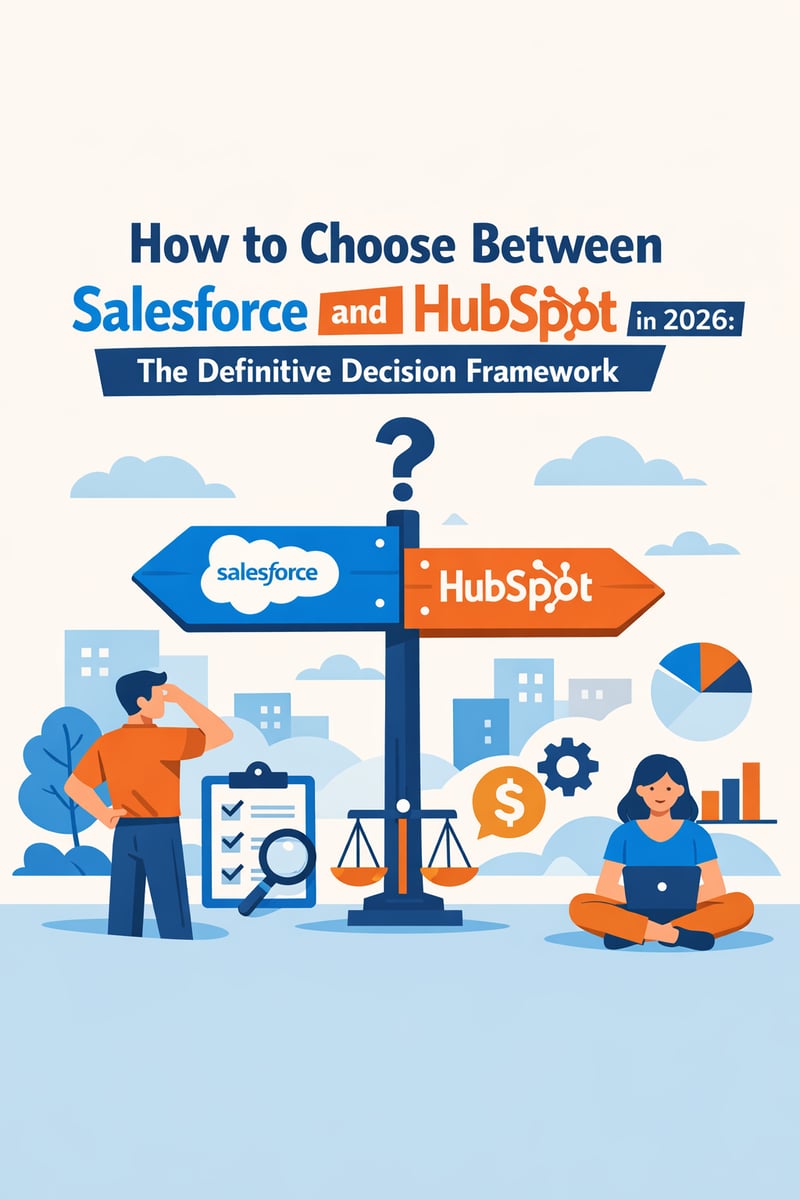
- What is this? A structured decision framework to help businesses choose between Salesforce and HubSpot CRM — or determine whether a dual-platform strategy is the right move
- Key Insight: Neither platform is universally "better." The right choice depends on 10 critical dimensions: TCO, AI capabilities, implementation timeline, scalability, customization depth, integration ecosystem, user adoption, admin complexity, reporting, and mobile experience
- Cost Reality: HubSpot's 3-year TCO for 50 users is approximately $177K vs. Salesforce at $595K — a 3.4x difference driven by implementation, admin overhead, and AI add-on costs
- AI Comparison: Salesforce Agentforce resolves 66% of inquiries autonomously ($2/conversation or $125/user/mo extra); HubSpot Breeze AI is included at no additional cost in paid tiers
- Best For Salesforce: Enterprises with 100+ users, complex sales processes, deep customization needs, and large-scale data environments
- Best For HubSpot: SMBs and mid-market companies prioritizing fast deployment, ease of use, all-in-one marketing+sales+service, and lower TCO
- The "Both" Option: Vantage Point helps organizations run dual-platform environments — HubSpot for marketing, Salesforce for sales and complex workflows — connected via MuleSoft or native integrations
- Bottom Line: Work with a consultant who implements both platforms (like Vantage Point) to get an unbiased recommendation based on your actual needs — not vendor allegiance
Introduction: Why Most CRM Comparisons Get It Wrong
The "Salesforce vs. HubSpot" question generates over 50,000 monthly searches — and most answers are biased. Salesforce-only consultancies recommend Salesforce. HubSpot-only agencies recommend HubSpot. The real answer requires understanding your business from the inside out.
Vantage Point is one of the rare consultancies with deep implementation expertise in both platforms. With 150+ clients across Salesforce and HubSpot engagements, we've seen what works, what breaks, and — most importantly — what each platform costs once you look past the sticker price.
This isn't a "which is better" article. This is a decision framework — a structured set of criteria, trade-offs, and honest assessments to help you pick the right CRM for your organization in 2026. We'll walk you through 10 comparison dimensions, a decision tree, hidden cost analysis, and the increasingly popular "use both" strategy.
Let's start with the factor most buyers care about first: what it actually costs.
Dimension 1: Total Cost of Ownership (Not Just License Price)
License price is the least useful number in a CRM comparison. What matters is total cost of ownership — licenses plus implementation, training, administration, add-ons, and ecosystem costs over three to five years.
2026 License Pricing: Side-by-Side
| Tier | HubSpot | Salesforce Sales Cloud | Notes |
|---|---|---|---|
| Free | $0/mo (up to 5 users) | Not available | HubSpot's free CRM is genuinely functional |
| Starter | $20/seat/mo | $25/user/mo (Starter Suite) | HubSpot includes marketing tools; Salesforce does not |
| Professional | $100/seat/mo (Sales Hub) | $100/user/mo (Pro Suite) | HubSpot bundles more; Salesforce charges separately for Marketing Cloud |
| Enterprise | $150/seat/mo | $165/user/mo | HubSpot includes 7 seats at base; Salesforce is per-user |
| Top Tier | $150/seat/mo (Enterprise max) | $330–$500/user/mo (Unlimited/Agentforce) | Salesforce's ceiling is far higher |
The Real 3-Year Cost Comparison
| Cost Component | HubSpot (50 users) | Salesforce (50 users) |
|---|---|---|
| Annual license (Professional) | ~$54,000 | ~$60,000 |
| Implementation | $10,000–$20,000 | $50,000–$150,000 |
| Annual admin costs | $0–$15,000 (part-time) | $75,000–$120,000 (dedicated admin) |
| AI features (annual) | $0 (included with Breeze) | $30,000–$75,000 (Agentforce add-on) |
| Marketing tools | Included | $15,000–$50,000/yr (Marketing Cloud) |
| 3-Year Total | $170,000–$250,000 | $500,000–$900,000+ |
The verdict: HubSpot's TCO is 2–3.5x lower for most mid-market deployments. Salesforce's higher investment can deliver outsized ROI for complex organizations — but only if you fully leverage its capabilities.
Dimension 2: AI Capabilities — Agentforce vs. Breeze
AI has become the most critical differentiator in the 2026 CRM landscape. Both platforms have moved far beyond basic chatbots into autonomous, agentic AI.
Salesforce Agentforce + Einstein
Salesforce's AI strategy is agentic and enterprise-grade:
- Agentforce Agents: Autonomous AI agents that qualify leads, resolve service cases, execute multi-step workflows, and operate across Sales Cloud, Service Cloud, and Marketing Cloud
- Atlas Reasoning Engine: The underlying intelligence layer that analyzes data, makes decisions, and triggers actions
- Data Cloud Integration: Zero-copy data federation from external systems gives agents context spanning your entire tech stack
- Einstein Trust Layer: Enterprise-grade governance with data masking, audit trails, toxicity detection, and hallucination grounding through RAG
- Pricing: $2/conversation (consumption-based) or $125/user/month
- Results: 66% autonomous resolution rate for customer inquiries; 80% faster interactions; 6,000+ simultaneous interactions
HubSpot Breeze AI
HubSpot's AI strategy is accessible and integrated:
- Breeze Copilot: AI assistant embedded across all Hubs — drafts emails, summarizes CRM records, suggests next actions
- Breeze Agents: Four specialized agents for content creation, social media, prospecting, and customer service
- Breeze Intelligence: Data enrichment and buyer intent powered by Clearbit — auto-enriches contact and company records
- AI Content Tools: Blog writer, social caption generator, email subject line optimizer, ad copy generator
- Pricing: Included in all paid tiers at no additional cost
AI Comparison Matrix
| AI Capability | Salesforce | HubSpot | Edge |
|---|---|---|---|
| Autonomous multi-step agents | ✅ Deep, cross-system | ✅ Task-specific, within HubSpot | Salesforce |
| Content generation | ✅ RAG-grounded with enterprise controls | ✅ Quick content for emails, blogs, social | Tie |
| Predictive analytics | ✅ Deep forecasting, pipeline analysis | ✅ Lead scoring, basic predictions | Salesforce |
| Data enrichment | ✅ Data Cloud federation | ✅ Clearbit-powered auto-enrichment | Tie |
| Governance and trust | ✅ Einstein Trust Layer | ⚠️ Basic security controls | Salesforce |
| Pricing | ❌ $50–$125/user/mo extra | ✅ Included in paid plans | HubSpot |
| Time-to-value | ⚠️ Requires configuration | ✅ Works immediately | HubSpot |
The verdict: Salesforce wins on AI power and autonomy. HubSpot wins on AI accessibility and cost. For organizations planning to deploy AI as a strategic differentiator with dedicated resources, Agentforce delivers more. For teams wanting AI that works on day one, Breeze wins.
Dimension 3: Implementation Timeline
Time-to-value is one of the most underrated factors in CRM selection.
| Milestone | HubSpot | Salesforce |
|---|---|---|
| Basic setup (pipelines, contacts) | 1–3 days | 2–4 weeks |
| Full professional deployment | 2–6 weeks | 2–6 months |
| Enterprise-grade implementation | 1–3 months | 4–12+ months |
| User training | 1–2 days (self-serve) | 2–4 weeks (structured training) |
| First productive user | Day 1 | Week 3–4 |
HubSpot's self-serve onboarding gets teams productive in days. Salesforce's power requires architectural planning, data modeling, and configuration — but delivers a more tailored result.
Dimension 4: Scalability
| Factor | HubSpot | Salesforce |
|---|---|---|
| Max users supported | Thousands (Enterprise tier) | Hundreds of thousands |
| Custom objects | Enterprise tier only | All paid tiers |
| Multi-currency | ✅ Supported | ✅ Advanced (50+ currencies) |
| Territory management | ❌ Not available | ✅ Enterprise+ |
| Multi-division/BU | ✅ Business units (Enterprise) | ✅ Advanced with role hierarchies |
| Data volume limits | 15M–1B records depending on tier | Virtually unlimited |
Salesforce scales further and wider. HubSpot scales efficiently for mid-market organizations. If you're planning to grow past 200 users or need territory-based selling across multiple regions, Salesforce handles that complexity natively.
Dimension 5: Customization Depth
Salesforce's customization is virtually unlimited. Custom objects, Apex code, Lightning Web Components, Flow Builder, and the full Lightning Platform let you build anything from a simple CRM to a complete business operating system.
HubSpot's customization is intentionally constrained. Custom properties, calculated fields, and workflow automation cover 80% of use cases. Custom objects require Enterprise tier. Custom coded actions (JavaScript/Node.js) and UI extensions (React) expand capabilities but can't match Salesforce's depth.
The verdict: If your business processes are standard, HubSpot's guardrails keep you efficient. If your processes are complex or unique, Salesforce's open architecture handles them.
Dimension 6: Integration Ecosystem
| Factor | HubSpot | Salesforce |
|---|---|---|
| Native marketplace apps | 1,700+ | 7,000+ (AppExchange) |
| API types | REST API | REST, SOAP, Bulk, Streaming |
| Native ERP connectors | Limited | Extensive (SAP, Oracle, NetSuite) |
| iPaaS/Middleware | Works with Zapier, Workato, Make | Works with MuleSoft, Workato, Dell Boomi |
| Developer ecosystem | Growing | Massive (Trailblazer community) |
For most businesses, HubSpot's marketplace covers essential integrations. Salesforce's AppExchange becomes critical when you need specialized tools or legacy system connectors.
Vantage Point specializes in MuleSoft integration — connecting Salesforce, HubSpot, and third-party systems into unified data architectures. This is especially valuable for organizations running both platforms.
Dimension 7: User Adoption
| Factor | HubSpot | Salesforce |
|---|---|---|
| G2 ease-of-use rating | 4.4/5 | 4.0/5 |
| Gartner Peer Insights | 4.4/5 (2,186 reviews) | 4.2/5 (707 reviews) |
| Average training time | 1–2 days | 2–4 weeks |
| Admin required? | No (up to ~100 users) | Yes (dedicated admin recommended) |
| Self-service configuration | Most features | Limited to basic settings |
| User interface | Consumer-grade, intuitive | Powerful but complex |
HubSpot consistently wins on adoption speed. Organizations report 80–90% adoption rates within the first month. Salesforce adoption rates are typically 60–75% initially, climbing over time with proper training and change management.
Dimension 8: Admin Complexity
| Factor | HubSpot | Salesforce |
|---|---|---|
| Dedicated admin needed? | No for SMB; optional for Enterprise | Yes for most deployments |
| Admin salary (US avg.) | N/A–$80K (part-time) | $90K–$140K (full-time certified admin) |
| Release management | Automatic updates | 3x/year releases requiring testing |
| Sandbox environments | Enterprise tier | Professional+ |
| Certification ecosystem | HubSpot Academy (free) | Trailhead + certifications ($200–$400 each) |
Salesforce's admin overhead is a significant hidden cost. Most organizations with 25+ Salesforce users need at least a part-time admin — and at 50+ users, a full-time certified admin becomes essential.
Dimension 9: Reporting and Analytics
| Capability | HubSpot | Salesforce |
|---|---|---|
| Standard reports | ✅ Pre-built templates | ✅ Pre-built + custom |
| Custom report builder | ✅ Professional+ | ✅ All tiers |
| Cross-object reporting | ✅ Limited | ✅ Full (joined reports, matrix reports) |
| Dashboards | ✅ Up to 300 | ✅ Unlimited |
| Advanced analytics | ⚠️ Operations Hub | ✅ Tableau CRM / Einstein Analytics |
| Revenue attribution | ✅ Enterprise | ✅ Enterprise+ |
| Real-time reporting | ⚠️ Near real-time | ✅ Real-time with streaming |
Salesforce's reporting is more powerful for complex multi-object analysis. HubSpot's reporting is easier to set up and sufficient for most mid-market needs.
Dimension 10: Mobile Experience
| Feature | HubSpot Mobile | Salesforce Mobile |
|---|---|---|
| Native calling | ✅ Built-in | ✅ Built-in |
| Email tracking | ✅ | ✅ |
| Deal/opportunity updates | ✅ Drag-and-drop | ✅ |
| Business card scanner | ✅ | ✅ |
| Offline access | ✅ Recent records | ✅ Recent records |
| Custom components | ❌ | ✅ Lightning components |
| UI quality | Mirrors desktop, intuitive | Functional, multi-tap navigation |
HubSpot's mobile app mirrors its desktop simplicity. Salesforce's mobile app supports custom Lightning components, making it more powerful for organizations with heavily customized CRM environments.
When Salesforce Wins
Choose Salesforce when your organization matches these criteria:
- 100+ CRM users with complex role hierarchies and territory assignments
- Deep customization needs — custom objects on every tier, Apex code, Lightning components, complex approval workflows
- Large-scale data environments — millions of records, multi-system orchestration through Data Cloud
- Enterprise AI requirements — Agentforce's autonomous agents for high-volume service, sales qualification, and campaign management
- Complex sales processes — multi-product selling, CPQ, advanced forecasting, collaborative territory management
- Largest integration ecosystem — 7,000+ AppExchange apps covering virtually every business need
- Advanced analytics — Tableau CRM, Einstein Analytics, cross-object joined reports
Where Salesforce excels: Organizations with dedicated technical resources that need a platform capable of modeling virtually any business process. The investment is higher, but the ceiling is limitless.
When HubSpot Wins
Choose HubSpot when your organization matches these criteria:
- Under 100 CRM users looking for fast deployment and intuitive interfaces
- Marketing-first organizations — HubSpot's marketing automation, content tools, and SEO features are best-in-class and included in every tier
- Budget-conscious teams — free CRM tier, all-in-one pricing, no separate marketing cloud purchase, AI included
- Startups and growing businesses — start free, scale through Starter → Professional → Enterprise without replatforming
- No dedicated CRM admin — self-service configuration, minimal training, consumer-grade UX
- Content and inbound strategy — built-in CMS, blog hosting, landing pages, SEO tools
- Fastest time-to-value — productive on day one, fully deployed in weeks not months
Where HubSpot excels: Organizations that want an all-in-one platform that works immediately, costs less, and drives high adoption without specialized technical resources.
When Both Is the Answer: The Dual-Platform Strategy
One of the fastest-growing CRM strategies in 2026 is the dual-platform approach — running HubSpot for marketing and top-of-funnel engagement alongside Salesforce for sales execution, service, and complex workflows.
Why Organizations Choose Both
- Marketing + Sales specialization: HubSpot's marketing automation feeds qualified leads into Salesforce's customizable pipeline
- Best-of-breed approach: Use each platform where it excels instead of forcing one to do everything
- Gradual migration: Organizations transitioning between platforms can run both during the evaluation period
- Unified data architecture: MuleSoft or native integrations keep data synchronized across both systems
Integration Options
| Approach | Complexity | Cost | Best For |
|---|---|---|---|
| Native HubSpot-Salesforce connector | Low | Free (included) | Standard lead sync, basic field mapping |
| MuleSoft integration | Medium | $25,000–$100,000+ | Complex data flows, real-time sync, multi-system orchestration |
| Workato/middleware | Medium | $10,000–$50,000/yr | Automated workflows across platforms |
| Custom API integration | High | $20,000–$75,000 | Unique business logic, real-time requirements |
Dual-Platform Best Practices
- Define your system of record — choose one platform as the source of truth for each data type
- Map data flows before integrating — document which records sync, direction, frequency, and conflict resolution
- Avoid duplicate processes — run each workflow in only one system
- Invest in middleware — MuleSoft or Workato provides more reliable sync than point-to-point integrations
- Plan for ongoing maintenance — integration isn't set-and-forget; data quality requires monitoring
Vantage Point is uniquely positioned to help with dual-platform strategies. Our expertise spans Salesforce, HubSpot, and MuleSoft integration — meaning we can architect, implement, and maintain unified environments that give you the best of both worlds.
The Decision Tree: A Step-by-Step Framework
Use this framework to guide your platform decision:
Step 1: How Many CRM Users Do You Need?
- Under 10 users → Start with HubSpot Free or Starter
- 10–100 users → Evaluate both; HubSpot Professional is usually the better value
- 100+ users → Salesforce Enterprise is likely necessary for scale
Step 2: How Complex Are Your Sales Processes?
- Standard pipeline (lead → opportunity → close) → HubSpot handles this well
- Multi-product, multi-stage, territory-based selling → Salesforce's customization shines here
- CPQ (Configure-Price-Quote) requirements → Salesforce's native CPQ or AppExchange options
Step 3: What's Your Technical Resource Level?
- No dedicated CRM admin → HubSpot (self-service model)
- Part-time admin or outsourced → Either platform (HubSpot is easier to maintain)
- Full-time admin + developers → Salesforce (maximizes ROI from customization)
Step 4: How Important Is AI Autonomy?
- AI should enhance existing workflows → HubSpot Breeze (included, easy)
- AI should autonomously handle inquiries and tasks → Salesforce Agentforce (powerful, costs extra)
Step 5: What's Your Budget Reality?
- Under $50K/year total CRM spend → HubSpot
- $50K–$150K/year → Evaluate both; consider HubSpot Professional or Salesforce Enterprise
- $150K+/year → Salesforce with full ecosystem; or dual-platform with MuleSoft
Step 6: Do You Need Both?
- Marketing team wants HubSpot + Sales team needs Salesforce → Dual-platform with native or MuleSoft integration
- Evaluating a migration between platforms → Run both in parallel with Vantage Point's guidance
The Hidden Costs Nobody Talks About
Salesforce Hidden Costs
- Implementation partner fees: $30,000–$150,000 for initial setup
- Dedicated admin salary: $90,000–$140,000/year (US average for certified Salesforce admin)
- AppExchange add-ons: $5–$50/user/month for productivity, compliance, and enrichment tools
- Data storage overages: $125/month per additional GB after your included allocation
- Shield and compliance: $25–$50/user/month for enterprise encryption, event monitoring, and audit trails
- Agentforce AI: $2/conversation or $50–$125/user/month depending on deployment model
- Marketing Cloud: $1,250–$4,200/month — a separate product, not included in Sales Cloud
- Sandbox environments: Additional cost below Enterprise tier
- Training and certification: Trailhead is free, but certifications cost $200–$400 each; formal team training costs $5,000–$25,000
HubSpot Hidden Costs
- Mandatory onboarding fees: $1,500–$8,000 depending on tier
- Contact tier overages: HubSpot charges for marketing contacts above your tier's limit
- Dedicated IP: $3,600/year for email deliverability (optional)
- Transactional email: $7,200/year (if needed)
- API rate limits: May require Operations Hub ($800/mo) for high-volume integrations
- Custom objects: Available only on Enterprise tier ($150/user/month minimum)
- Professional services: $5,000–$20,000 for complex implementations
- Content Hub: Separate from Marketing Hub; required for full CMS capabilities
Cost Reality Check
For a 25-user mid-market deployment over 3 years:
| Cost Category | HubSpot Professional | Salesforce Enterprise |
|---|---|---|
| Licenses (3 years) | $81,000 | $148,500 |
| Implementation | $12,000 | $75,000 |
| Admin (3 years) | $0–$30,000 | $270,000–$420,000 |
| AI add-on (3 years) | $0 | $45,000–$112,500 |
| Marketing tools (3 years) | $0 (included) | $45,000–$151,200 |
| 3-Year Total | $93,000–$123,000 | $583,500–$907,200 |
How Vantage Point Makes the Decision Easier
Most consultancies start with a platform preference. Vantage Point starts with your business.
As one of the few consultancies with deep expertise in both Salesforce and HubSpot, we provide truly unbiased platform recommendations. We've implemented both platforms across 150+ clients, so we know exactly where each one excels — and where it falls short.
What Makes Us Different
- Dual-platform expertise: Salesforce (Sales Cloud, Service Cloud, Experience Cloud, Data Cloud, Agentforce) AND HubSpot (Sales Hub, Marketing Hub, Service Hub, Operations Hub)
- MuleSoft integration specialists: We connect Salesforce, HubSpot, and third-party systems into unified architectures
- Data Cloud and AI: We deploy Agentforce agents, Breeze AI workflows, and AI-powered automation
- Senior-only consultants: Every engagement is staffed by experienced practitioners — not junior resources learning on your dime
- 150+ clients across industries with a 4.71/5.0 average engagement rating
- Key technology partnerships: Salesforce, HubSpot, Anthropic (Claude AI), Aircall, and Workato
Our Process
- Discovery and Assessment: We evaluate your processes, team size, technical resources, growth plans, and budget to recommend the right platform (or combination)
- Architecture Design: We design data models, integrations, and automation frameworks for long-term scalability
- Expert Implementation: Our senior consultants configure, customize, and deploy your CRM with best practices built in
- Ongoing Optimization: Managed services keep your platform evolving as your business grows
Contact Vantage Point for a free platform assessment →
Frequently Asked Questions
Is Salesforce or HubSpot better for my business?
Neither is universally better. Salesforce excels for organizations with 100+ users, complex sales processes, and deep customization needs. HubSpot excels for SMBs, marketing-first organizations, and teams that prioritize ease of use. The best choice depends on your team size, budget, technical resources, and growth trajectory.
How much does Salesforce actually cost vs. HubSpot?
Beyond sticker prices, total cost of ownership matters most. For a 50-user deployment over 3 years, HubSpot Professional totals approximately $177,000, while Salesforce Enterprise totals approximately $595,000 — a 3.4x gap driven by implementation costs, dedicated admin requirements, and AI add-ons.
Can I use Salesforce and HubSpot together?
Yes, and many organizations do. The native HubSpot-Salesforce connector handles standard lead sync and field mapping. For complex data flows, MuleSoft or Workato provides enterprise-grade integration. Vantage Point specializes in dual-platform architectures with unified data.
What is Salesforce Agentforce vs. HubSpot Breeze AI?
Agentforce is Salesforce's autonomous AI agent platform — it executes multi-step tasks, resolves 66% of customer inquiries without human intervention, and handles 6,000+ simultaneous interactions. Breeze AI is HubSpot's integrated AI suite for content generation, lead scoring, data enrichment, and copilot assistance. Agentforce is more powerful; Breeze is more accessible and included at no extra cost.
How long does CRM implementation take?
HubSpot typically deploys in 2–6 weeks for Professional setups and 1–3 months for Enterprise. Salesforce implementations take 2–6 months on average, with complex Enterprise deployments extending to 12+ months. The difference reflects Salesforce's deeper customization capabilities.
Do I need a dedicated admin for Salesforce?
For most organizations with 25+ users, yes. A dedicated Salesforce admin manages customizations, user support, data quality, and three-times-a-year release updates. This adds $90,000–$140,000/year to your CRM costs. HubSpot typically does not require a dedicated admin until Enterprise scale.
Which CRM has better AI features in 2026?
Both have strong AI, but they serve different needs. Salesforce Agentforce is more powerful — it deploys autonomous agents across your entire data ecosystem with enterprise governance. HubSpot Breeze AI is more accessible — it's included in paid plans and delivers immediate value without configuration. Cost-conscious teams prefer Breeze; enterprises investing in AI as a strategic asset prefer Agentforce.
Which platform is easier to learn?
HubSpot is significantly easier to learn. Most users become productive within 1–2 days through self-guided onboarding. Salesforce requires 2–4 weeks of structured training, and ongoing learning through Trailhead is recommended. HubSpot rates 4.4/5 on G2 for ease of use vs. Salesforce's 4.0/5.
What if I outgrow HubSpot?
You can migrate to Salesforce, upgrade to HubSpot Enterprise, or adopt a dual-platform strategy. Migrations from HubSpot to Salesforce typically take 2–6 months. Vantage Point helps organizations evaluate whether they've truly outgrown HubSpot or just need better configuration.
What hidden costs should I watch for?
Salesforce hidden costs include implementation partners ($30K–$150K), dedicated admin salary ($90K–$140K/yr), AppExchange add-ons, data storage overages, Shield encryption, Marketing Cloud (separate purchase), and Agentforce AI fees. HubSpot hidden costs include mandatory onboarding fees, marketing contact overages, dedicated IP, and Enterprise-tier custom object requirements.
How do I decide between the two quickly?
Use this shortcut: If you have under 50 users, no dedicated CRM admin, and marketing is a priority, start with HubSpot. If you have 100+ users, dedicated technical resources, and complex business processes, go with Salesforce. If you're in between, talk to Vantage Point for a free platform assessment.
Can Vantage Point help with migration between platforms?
Yes. Vantage Point handles Salesforce-to-HubSpot and HubSpot-to-Salesforce migrations, including data migration, workflow translation, integration rebuilding, and user training. Our dual-platform expertise means we know how to preserve what works while optimizing for the new platform.
Conclusion: Make the Right Choice — Not the Popular One
The Salesforce vs. HubSpot decision isn't about following trends or picking the platform with the bigger logo. It's about matching technology to your business reality.
If you need speed, simplicity, and all-in-one value — HubSpot gets your team productive in days at a fraction of the cost.
If you need depth, scale, and AI autonomy — Salesforce's platform handles the complexity that growing enterprises demand.
If you need both — Vantage Point architects dual-platform environments with MuleSoft and native integrations so you get the best of both worlds.
The most expensive mistake isn't choosing the wrong platform — it's implementing the right platform poorly. That's why the implementation partner matters as much as the platform itself.
Ready to make the right choice? Contact Vantage Point for a free CRM platform assessment. As a dual-platform consultancy with 150+ clients across Salesforce and HubSpot, we'll give you an honest recommendation based on your business — not our revenue model.
About Vantage Point
Vantage Point is a CRM consultancy with deep expertise in both Salesforce and HubSpot. We help organizations select, implement, integrate, and optimize CRM platforms — including dual-platform strategies connected via MuleSoft and Workato. With 150+ clients, 400+ completed engagements, and a 4.71/5.0 average satisfaction rating, our senior level team delivers expert solutions built for scalability and long-term success, no junior handoffs. Our technology partnerships span Salesforce, HubSpot, Anthropic (Claude AI), Aircall, and Workato. Learn more at vantagepoint.io.