How to Build a Network of Salesforce Advocates Who Actually Drive Adoption
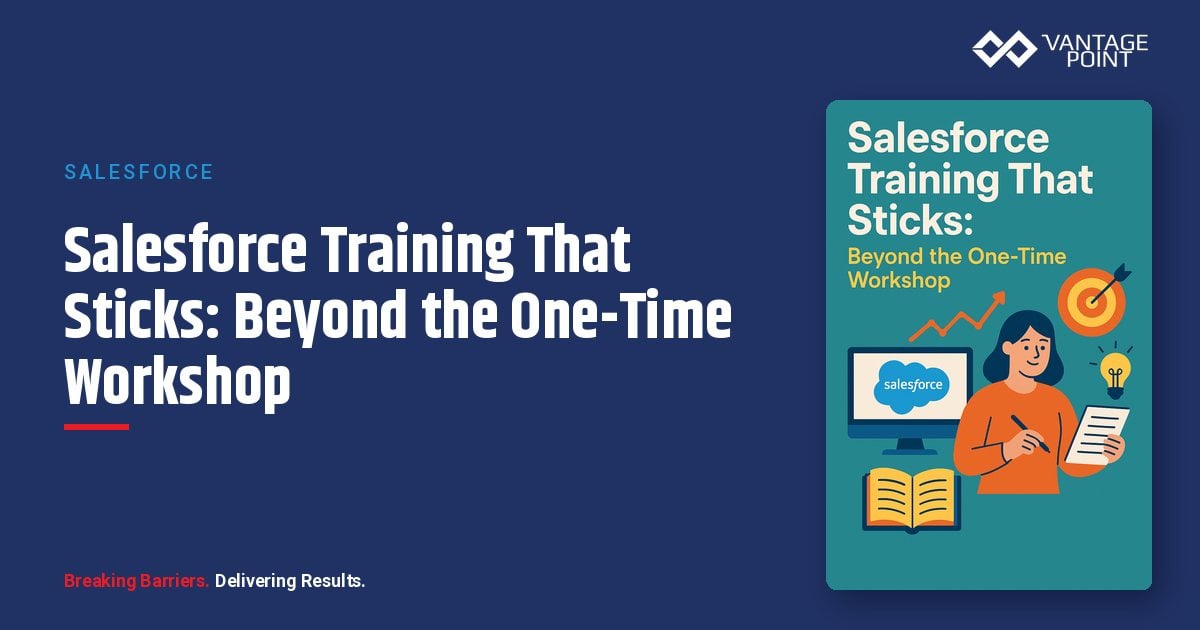
Users forget most of their training within days. If you've ever invested in a comprehensive Salesforce training program only to watch adoption rates plummet weeks later, you're not alone. The traditional 4-hour workshop model is fundamentally broken, and it's time to talk about why.
The Traditional Training Problem
Traditional Salesforce training fails because it ignores fundamental principles of how adults actually learn and retain information. Consider these common approaches and why they backfire:
Marathon sessions that pack 4+ hours of content into a single day create cognitive overload. Your users' brains simply can't process and retain that volume of new information at once.
Generic content that covers "everything Salesforce can do" is largely irrelevant to what users actually need to accomplish their daily work. A sales rep doesn't need to know about service case routing, and a service agent doesn't need campaign management training.
One-time events provide no reinforcement. Without repeated exposure and practice, newly learned skills evaporate rapidly.
Lecture formats promote passive learning, which research shows has the lowest retention rates of any training method.
Theory without application leaves users unable to connect what they learned to their actual work. When they finally try to apply the training weeks later, it's already forgotten.
As one training expert put it: "Training isn't something you attend. It's something you do repeatedly."
Understanding the Forgetting Curve
The Ebbinghaus Forgetting Curve reveals the stark reality of how quickly we lose new information without reinforcement:
- After 20 minutes: 42% forgotten
- After 1 hour: 56% forgotten
- After 24 hours: 70% forgotten
- After 1 week: 90% forgotten
The solution? Spaced repetition combined with immediate, practical application. This isn't theoretical: it's neuroscience.
The Microlearning Revolution
Microlearning flips traditional training on its head by delivering content in small, highly focused chunks that respect both your users' time and their cognitive capacity.
Effective Salesforce microlearning modules should be 5-10 minutes maximum, focus on a single skill per module, and provide an immediate opportunity to practice. Delivered daily or every other day, these bite-sized lessons can be consumed during natural breaks in the workday, before the morning standup, during lunch, or at the end of the day.
The format matters too. Video demonstrations, interactive exercises, and hands-on practice in a sandbox environment all outperform traditional documentation or slide presentations.
What Actually Works: Training Methods by Retention Rate
Not all training methods are created equal. Retention differs widely by method, from least to most effective:
- Lecture or presentation
- Reading documentation
- Video demonstration
- Discussion groups
- Hands-on practice
- Teaching others
This points to the 70-20-10 rule for effective learning: 70% should come from doing, 20% from learning with and from others, and only 10% from formal training sessions.
The implications are clear. If your training program is primarily lectures and documentation, you're using the two least effective methods available.
Role-Based Training: The Path to Mastery
Generic training creates generic adoption. Role-specific training creates mastery.
Different roles interact with Salesforce in fundamentally different ways and need training tailored to their specific workflows:
Sales representatives need deep competency in opportunity management, activity logging, mobile app usage, email integration, and pipeline views. They don't need to know how to build reports. They need to know how to run the reports that matter to them.
Sales managers require different skills entirely: dashboard creation, report building, forecasting, team performance views, and approval workflows.
Service agents focus on case management, knowledge base search, queue management, customer history views, and escalation procedures.
Marketing users need campaign management, lead management, attribution tracking, list views and segments, and form integration.
When you create role-specific learning paths, users immediately see the relevance to their daily work, which dramatically improves both engagement and retention.
Building an Effective Training Curriculum
Every microlearning module should follow a consistent structure that maximizes learning in minimal time:
Start with a clear learning objective (30 seconds) that tells users exactly what they'll be able to do after completing the module. Follow with context on why this skill matters to their role (1 minute). Then demonstrate the skill (3-4 minutes), provide guided practice (3-4 minutes), include a quick knowledge check (1 minute), and offer a downloadable quick reference card for future use.
For a sales representative, a sample three-week curriculum might include:
Week 1: Navigating Salesforce (8 min), Finding Your Accounts (7 min), Logging Activities (10 min)
Week 2: Creating Opportunities (8 min), Updating Pipeline Stage (6 min), Using Mobile App (10 min)
Week 3: Running Your Reports (8 min), Email Integration (7 min), Advanced Search (6 min)
Notice the progression from foundational navigation to more complex workflows, with each module building on previous knowledge.
Leveraging Salesforce Trailhead
Trailhead is Salesforce's free, gamified learning platform, and it's an excellent resource when used correctly.
Best practices include assigning role-specific trails rather than generic learning paths, setting clear deadlines for completion, publicly recognizing badge achievements to build momentum, and supplementing Trailhead content with training specific to your organization's configuration.
The critical limitation to understand: Trailhead teaches generic Salesforce, not YOUR Salesforce. It builds platform literacy, which is valuable, but custom training is what builds job competency with your specific processes, fields, and workflows.
Quick Reference Cards: Training That Lives at the Desk
One-page quick reference cards provide just-in-time guidance when users need it most. These laminated, double-sided desk cards should include step-by-step instructions for the top 3 tasks for that role, screenshots with callouts highlighting key buttons and fields, common troubleshooting tips, and clear information about who to contact for help.
Create cards for high-frequency activities like logging a call, creating an opportunity, updating a record, running a report, and mobile app basics. Users will keep these at their desks and refer to them constantly, reducing help desk tickets and building confidence.
The Training Sandbox: Practice Without Fear
A training sandbox lets users practice in a risk-free environment before touching production data.
Set up a Developer or Developer Pro sandbox, populate it with realistic but anonymized data, reset it weekly to maintain a clean state, and provide unique logins for each user. This approach allows risk-free experimentation, creates realistic practice scenarios, and builds confidence before go-live.
The psychological benefit is significant. Users who practice in a sandbox are far more comfortable using Salesforce when it counts.
Hypercare: Intensive Support When It Matters Most
Hypercare refers to intensive support during the critical first weeks after go-live, when early frustration can calcify into permanent resistance.
A comprehensive hypercare program includes floor walking support during weeks 1-2, where experienced users or administrators are physically available to help. Extend help desk hours during weeks 1-4 to ensure users can get help when they need it. Conduct daily issue triage during weeks 1-2 to identify and resolve problems before they spread. Offer refresher sessions during weeks 2-4 for users who need additional practice.
The goal is simple: prevent early frustration from becoming permanent resistance to the platform.
Measuring Training Effectiveness
How much training do Salesforce users actually need? Initially, plan for 4-8 hours spread over 2 weeks, not delivered all at once. Ongoing, users benefit from 15-30 minutes of training weekly to learn new features, reinforce existing skills, and stay current with platform updates.
Track metrics like training completion rates, time-to-competency for new hires, help desk ticket volume by topic, and feature adoption rates to understand where your training program is succeeding and where it needs adjustment.
Your Training Readiness Checklist
Before Launch:
- Define role-based curricula for each user type
- Create microlearning modules following the proven structure
- Print and laminate quick reference cards
- Configure and populate training sandbox
- Complete champion train-the-trainer sessions
At Launch:
- Train all users according to role-specific curricula
- Ensure sandbox practice is completed
- Distribute reference materials to all desks
- Assign relevant Trailhead trails
- Publish hypercare schedule and support resources
After Launch:
- Schedule ongoing refresher sessions
- Plan training for new features as they roll out
- Measure training effectiveness through adoption metrics
- Update content based on user feedback and pain points
The Bottom Line
Effective Salesforce training isn't about cramming information into users' heads in a single session. It's about creating a continuous learning environment that delivers the right information, to the right people, at the right time, in formats that actually stick.
Remember: most new information is forgotten quickly without reinforcement. Microlearning beats marathon sessions every time. Role-specific training drives genuine adoption far better than generic overviews. Hands-on practice delivers far better retention than lectures. And hypercare during those critical first weeks prevents early frustration from becoming permanent resistance.
If your current training approach isn't delivering the adoption rates you need, it's not your users' fault: it's time to rethink the approach.
Coming tomorrow: Measuring Salesforce Adoption: The Metrics That Actually Matter
Read the full series:
- Day 1: Why Salesforce Adoption Fails
- Day 2: Building Your Adoption Roadmap
- Day 3: Change Champions Drive Adoption
- Day 4: Training That Sticks ← You just read this
- Day 5: Metrics That Matter
- Day 6: Overcoming User Resistance
- Day 7: Sustaining Long-Term Adoption
About Vantage Point
Vantage Point is a specialized Salesforce and HubSpot consultancy serving the financial services industry. We help wealth management firms, banks, credit unions, insurance providers, and fintech companies transform their client relationships through intelligent CRM implementations. Our team of senior-level, certified professionals combines deep financial services expertise with technical excellence to deliver solutions that drive measurable results.
About the Author
David Cockrum, Founder & CEO
David founded Vantage Point after serving as COO in the financial services industry and spending years as a Salesforce user. This insider perspective informs our approach to every engagement: we understand your challenges because we've lived them. David leads Vantage Point's mission to bridge the gap between powerful CRM platforms and the specific needs of financial services organizations.
-
- Email: david@vantagepoint.io
- Phone: 469-499-3400
- Website: vantagepoint.io