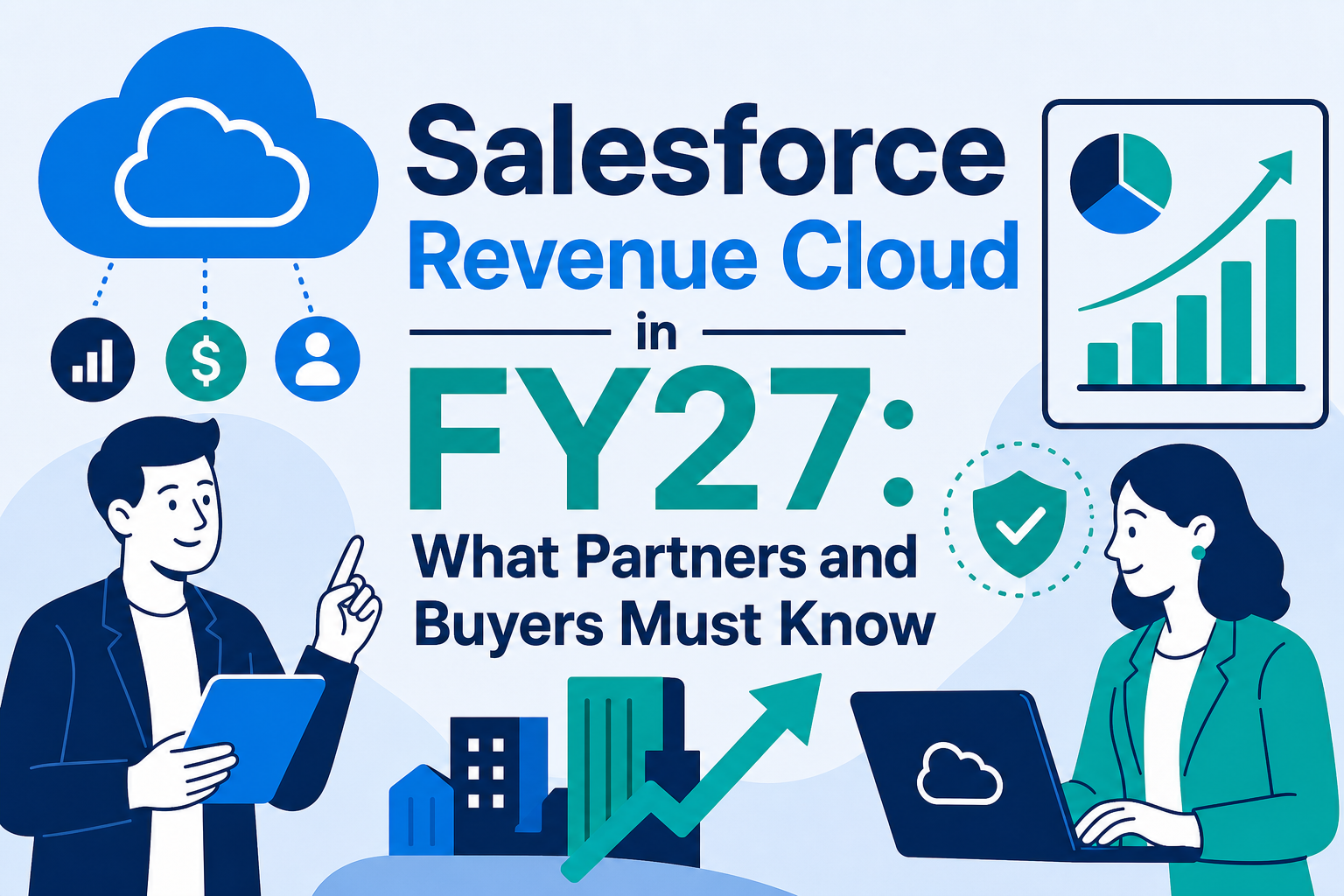
Salesforce has made Revenue Cloud one of its biggest enablement priorities for FY27 (February 2026 through January 2027). Legacy Salesforce CPQ is in an End-of-Sale phase, the partner program has been rebuilt around proven competencies, and Salesforce is steering new quote-to-cash business toward Revenue Cloud Advanced and Revenue Cloud Billing.
If your organization runs Salesforce CPQ today (or is evaluating quoting, contracting, and billing on Salesforce for the first time) these changes affect your roadmap, your renewal conversations, and how you choose an implementation partner.
This guide explains what changed, what Revenue Cloud enablement means in practice, and the decisions teams should make now.
Quick Answer
Salesforce Revenue Cloud is the platform Salesforce now sells for configure-price-quote (CPQ), contracts, orders, and billing, replacing legacy Salesforce CPQ for new sales. It matters for any organization that quotes, contracts, or bills through Salesforce, and for leaders planning what to do as legacy CPQ stops receiving new feature investment. This article helps you decide whether to optimize your current CPQ org, plan a phased move to Revenue Cloud, or start fresh on Revenue Cloud Advanced, and how FY27 partner program changes help you vet implementation partners. Vantage Point is a senior-led Salesforce consulting partner that helps teams assess, plan, and implement quote-to-cash on Salesforce.
TL;DR
- What changed: Legacy Salesforce CPQ is End of Sale, supported and renewable, but no longer sold to new customers and no longer receiving feature enhancements. Salesforce Revenue Cloud (Advanced and Billing) is the go-forward product.
- Why FY27 matters: Salesforce rebuilt its FY27 partner program around competencies, completed projects, and customer satisfaction, and Revenue Cloud is a core enablement track, so partner expertise is easier to verify than it used to be.
- Who is affected: Existing CPQ customers planning long-term quote-to-cash strategy, and any business evaluating quoting or billing on Salesforce for the first time.
- Decision point: Existing CPQ customers do not need to panic-migrate, but they do need a documented assessment and transition plan rather than waiting for a forced decision.
- How Vantage Point helps: Our Salesforce implementation and advisory services cover CPQ assessments, Revenue Cloud planning, and phased migrations.
What Is Salesforce Revenue Cloud?
Salesforce Revenue Cloud is Salesforce's platform for managing the full revenue lifecycle (product catalog, pricing, quoting, contracts, orders, fulfillment, and billing) built natively on the core Salesforce platform rather than as a managed package. It is sold in two main SKUs: Revenue Cloud Advanced (catalog, pricing, CPQ, contract lifecycle management, order management, and fulfillment orchestration) and Revenue Cloud Billing (invoicing, billing, and payment processing).
The product line evolved from Salesforce's Steelbrick acquisition, which became legacy Salesforce CPQ. In 2024 Salesforce introduced Revenue Lifecycle Management (RLM), then renamed and consolidated it as Revenue Cloud. Because Revenue Cloud runs on the core platform, it works directly with standard automation tools, Data Cloud, and Agentforce instead of relying on managed-package architecture.
What "enablement" means here: Salesforce is investing heavily in training, certification paths, demo environments, and partner journey resources so its consulting ecosystem can deliver Revenue Cloud well. For buyers, that signals where Salesforce expects new quote-to-cash projects to land, and it raises the bar for what a qualified implementation partner should be able to show.
Why Revenue Cloud Matters in FY27
Three shifts converge in FY27:
- Legacy CPQ is End of Sale, not End of Life. Salesforce no longer sells legacy CPQ to new customers. Existing customers can renew, add licenses, and receive support, but the product is not getting new feature investment. Quote-to-cash innovation (including AI-assisted quoting) is landing in Revenue Cloud.
- The FY27 partner program rewards proven delivery. Salesforce replaced 170 Navigator distinctions with 28 competency areas and collapsed four partner tiers into two (Select and Summit). Competencies are now earned through certifications, completed customer projects, and verified customer satisfaction (CSAT) scores, and displayed publicly. According to Salesforce's partner program materials, partners participate in roughly 72% of Salesforce implementations, so this transparency directly affects buyers.
- Revenue processes are getting more complex. Subscriptions, usage-based pricing, hybrid models, and AI-driven quoting all strain legacy CPQ architectures. Revenue Cloud was designed for these models; legacy CPQ was not.
The practical takeaway: organizations that quote and bill through Salesforce should treat FY27 as the planning window, not because legacy CPQ stops working, but because every year of new customization on a frozen product adds migration cost later.
Revenue Cloud vs Legacy Salesforce CPQ: Key Differences
| Dimension | Legacy Salesforce CPQ | Salesforce Revenue Cloud |
|---|---|---|
| Sales status | End of Sale: existing customers only | Actively sold and developed |
| Architecture | Managed package on top of Sales Cloud | Built natively on the core Salesforce platform |
| Feature investment | Maintenance and support only | Ongoing roadmap, including AI and Agentforce features |
| Scope | Configure, price, quote (billing via add-on) | Catalog, pricing, CPQ, contracts, orders, fulfillment, billing |
| Pricing models | Strongest for one-time and term subscription quoting | Designed for subscription, usage-based, and hybrid models |
| Automation | Package-specific tools and customizations | Standard platform automation, Flow, and APIs |
| Best fit | Stable existing implementations that meet current needs | New implementations and teams modernizing quote-to-cash |
What the FY27 Partner Program Changes Mean for Buyers
The FY27 consulting partner program matters to customers, not just partners, because it changes how you verify expertise before signing an implementation contract.
| FY26 program | FY27 program |
|---|---|
| 4 partner tiers | 2 tiers: Select and Summit |
| 170 Navigator distinctions | 28 competency areas |
| Self-described specializations | Competencies earned via certifications, completed projects, and CSAT |
| Fragmented partner discovery | Competency badges displayed on AgentExchange |
When evaluating a Revenue Cloud implementation partner in FY27, ask for:
- Relevant competencies and certifications: not just general Salesforce credentials, but Revenue Cloud and quote-to-cash specific ones.
- Completed, referenceable projects: the FY27 program validates completed projects against real customer org IDs, so partners should be able to discuss real delivery.
- CSAT evidence: customer satisfaction now directly determines partner standing.
- A migration point of view: a credible partner should explain when not to migrate, not just sell a rebuild.
If your team is evaluating how this applies to Salesforce, quoting, billing, or CRM governance, Vantage Point can help assess the right next step and build a practical implementation plan.
What Should Existing CPQ Customers Do Next?
You do not need to rip out a working CPQ org. You do need a deliberate plan. A practical sequence:
- Assess your current CPQ implementation. Document customizations, integration points, quote volumes, approval workflows, and known pain points. Heavy customization that is hard to scale strengthens the case for Revenue Cloud's native architecture.
- Define your future revenue model. If you are moving toward subscription, usage-based, or hybrid pricing, or need tighter billing and revenue recognition, Revenue Cloud covers ground legacy CPQ never will.
- Clean your product and pricing data first. Catalog sprawl, duplicate SKUs, and inconsistent pricing rules are the most common migration blockers. Data quality work pays off whether or not you migrate this year. Our system integration and data migration services focus on exactly this groundwork.
- Plan a phased transition, not a big bang. Many teams adopt Revenue Cloud capabilities incrementally (catalog and pricing first, then transaction management, then billing) while legacy CPQ continues to run.
- Budget for change management. Quote-to-cash touches sales, finance, legal, and operations. Adoption planning and training determine whether the new platform actually gets used; structured advisory and change management support reduces that risk.
- Revisit at every renewal. Each Salesforce renewal is a natural checkpoint to compare the cost of standing still against the cost of moving.
New to Salesforce quoting entirely? Start directly on Revenue Cloud Advanced. There is no reason to begin on a product that is End of Sale.
How Vantage Point Helps
Vantage Point is a boutique, senior-led Salesforce and HubSpot consulting partner. For Revenue Cloud and CPQ decisions, we help with:
- Quote-to-cash assessments: documenting your current CPQ state and building a clear optimize-vs-migrate recommendation through our Salesforce implementation and advisory practice.
- Data and integration readiness: catalog cleanup, pricing data quality, and ERP/finance integration planning.
- Phased Revenue Cloud implementation: sequencing catalog, pricing, quoting, contracts, and billing so teams keep selling throughout the transition.
- Ongoing administration and optimization: managed services and ongoing support for teams that need senior Salesforce help without expanding headcount.
If FY27 planning has put CPQ or Revenue Cloud on your roadmap, contact Vantage Point at vantagepoint.io for a practical assessment before you commit to a direction.
FAQ
Is Salesforce CPQ being discontinued?
No. Salesforce CPQ is in an End-of-Sale (EOS) phase, not End of Life. Salesforce no longer sells it to new customers, but existing customers can renew subscriptions, add licenses, and continue receiving support. The key change is that legacy CPQ no longer receives new feature enhancements: new investment goes to Revenue Cloud.
What is Salesforce Revenue Cloud Advanced?
Revenue Cloud Advanced is Salesforce's go-forward quote-to-cash product, built natively on the core platform. It includes product catalog management, pricing, CPQ, contract lifecycle management, order management, and fulfillment orchestration. A companion SKU, Revenue Cloud Billing, adds invoicing, billing, and payment processing.
Do existing CPQ customers have to migrate to Revenue Cloud now?
No. There is no forced migration deadline, and a stable CPQ org can keep running. However, every new customization added to a frozen product increases future migration cost, so existing customers should complete an assessment and document a transition position now, then revisit it at each renewal.
What is the difference between Revenue Cloud and legacy CPQ architecture?
Legacy CPQ is a managed package layered on top of Sales Cloud, with package-specific objects and tools. Revenue Cloud is built on the core Salesforce platform, so it uses standard automation (like Flow), standard APIs, and integrates directly with Data Cloud and Agentforce. That architectural difference is the main reason migrations require real planning rather than a simple upgrade.
What changed in the Salesforce partner program for FY27?
Salesforce simplified consulting partner tiers from four to two (Select and Summit) and replaced 170 Navigator distinctions with 28 competency areas. Competencies are earned through certifications, completed customer projects, and customer satisfaction scores, and are displayed publicly. For buyers, this makes it easier to verify that a partner has actually delivered the type of project you are hiring them for.
How should we choose a Revenue Cloud implementation partner?
Look for Revenue Cloud. Specific competencies and certifications, completed referenceable projects, strong CSAT evidence, and a candid point of view on when migration is and is not justified. Vantage Point recommends starting any partner engagement with an assessment phase so the migrate-vs-optimize decision is based on your data, not a vendor's sales motion.
Does Revenue Cloud support subscription and usage-based pricing?
Yes. Revenue Cloud was designed for subscription, usage-based, and hybrid revenue models, including ongoing post-sale processes like amendments, renewals, and consumption billing. Legacy CPQ handles term subscriptions but was not architected for modern usage-based models, which is one of the most common reasons teams move.
What should a business new to Salesforce quoting choose in 2026?
Start directly on Revenue Cloud Advanced. Legacy CPQ is no longer sold to new customers, and beginning on the actively developed platform avoids a future migration entirely. Scope your first phase around catalog, pricing, and quoting, then extend into contracts and billing as processes mature.
Sources: Salesforce Revenue Cloud product documentation and the FY27 Salesforce Consulting Partner Program overview.