
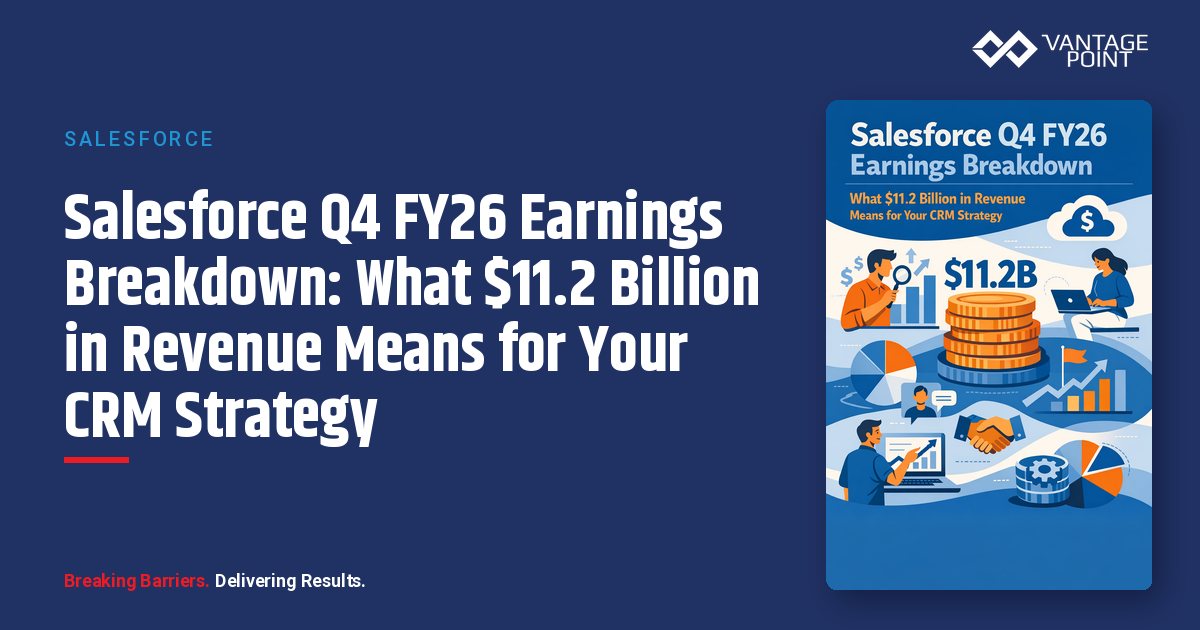
Salesforce Q4 FY26 Earnings Breakdown: What $11.2 Billion in Revenue Means for Your CRM Strategy
TL;DR: Quick Reference - What: Salesforce's Q4 FY26 earnings analysis: $11.2B revenue (+12% Y/Y) with Agentforce ARR hitting $800M, signaling a major platform shift toward agentic AI - Key Benefit: Understanding these numbers helps CRM buyers make informed investment decisions as Salesforce evolves from CRM to enterprise AI platform - For: Salesforce customers, CRM buyers, and leaders in financial services, healthcare, and regulated industries - Bottom Line: The era of "wait and see" on Salesforce AI is over. Organizations that invest in Agentforce and Data Cloud now will gain competitive advantage
TL;DR / Key Takeaways
| What Is It? | Salesforce's Q4 FY2026 earnings report (ending January 2026): the strongest quarter in company history |
| Key Numbers | $11.2B revenue (+12% Y/Y), $3.81 adjusted EPS (+37% Y/Y), $72.4B remaining performance obligations (+14% Y/Y) |
| Growth Engine | Agentforce ARR hit $800M (+169% Y/Y); Platform, Slack & Other segment surged 38%, the standout number |
| What It Means for Customers | Salesforce is doubling down on AI and data unification; organizations that invest in Agentforce and Data Cloud now will gain competitive advantage |
| Bottom Line | The era of "wait and see" on Salesforce AI is over. Production deployments are scaling and the platform's financial health validates long-term CRM investment |
Salesforce just reported its Q4 FY2026 results, and the numbers tell a story every CRM buyer and Salesforce customer should understand. Revenue hit $11.2 billion for the quarter, up 12% year-over-year, beating Wall Street expectations. Full-year revenue reached $41.5 billion. Adjusted earnings per share came in at $3.81, a 37% jump over the prior year and well above the $3.05 analysts predicted.
But the real story isn't in the top-line revenue. It's in where the growth is happening, what it signals about Salesforce's platform trajectory, and what it means for organizations evaluating or expanding their CRM investments: especially in financial services, healthcare, and other regulated industries.
Let's break it down.
Revenue by Segment: Where Is Salesforce Actually Growing?
The income statement reveals a fascinating portrait of Salesforce's evolution. Here's how each cloud performed in Q4 FY26:
| Segment | Q4 Revenue | Y/Y Growth | What It Tells Us |
|---|---|---|---|
| Sales Cloud | $2.3B | +9% | Steady growth in core CRM: still the bread and butter |
| Service Cloud | $2.5B | +9% | Service now Salesforce's largest cloud: reflects customer experience priority |
| Platform, Slack & Other | $2.7B | +38% | The headline: Agentforce, Data Cloud, Informatica driving explosive growth |
| Marketing & Commerce | $1.4B | +1% | Near-flat growth: competitive pressure from HubSpot and standalone marketing platforms |
| Integration & Analytics | $1.8B | +4% | MuleSoft and Tableau showing modest but consistent growth |
| Professional Services | $0.5B | +3% | Salesforce continues de-emphasizing direct services in favor of partner ecosystem |
The 38% Number Everyone Should Watch
Platform, Slack & Other grew 38% year-over-year: more than four times faster than any other segment. This category includes Agentforce, Data Cloud (now branded Data 360), Slack, and the recently acquired Informatica. Even accounting for Informatica's contribution, this growth rate signals that Salesforce's bet on AI agents and unified data platforms is resonating with enterprise buyers.
For context, this segment is now Salesforce's largest by revenue: surpassing both Sales Cloud and Service Cloud. That's a seismic shift from even two years ago when Salesforce was fundamentally a CRM company with a platform story. Now it's becoming a platform company with CRM roots.
Marketing & Commerce: A Warning Sign?
The near-flat 1% growth in Marketing & Commerce deserves attention. This suggests Salesforce is facing real competitive pressure from platforms like HubSpot, Klaviyo, and specialized marketing tools. For organizations evaluating their marketing technology stack, this could signal that Salesforce's marketing capabilities may receive increased investment, or it could confirm that best-of-breed marketing platforms remain the stronger play for many organizations.
Agentforce: From Buzz to Business
The most significant story in these earnings isn't a revenue number. It's the adoption curve for Agentforce, Salesforce's agentic AI platform:
- $800 million in annual recurring revenue: up 169% year-over-year
- 29,000+ cumulative deals closed since launch: deal count up 50% quarter-over-quarter
- Accounts in production increased nearly 50% sequentially (not pilots: actual production deployments)
- Over 75% of Salesforce's top 100 deals included both Agentforce and Data 360
- 60%+ of Agentforce bookings came from existing customer expansions
What This Means for Your Organization
These numbers indicate Agentforce has crossed the threshold from "innovation preview" to "platform expectation." When three-quarters of Salesforce's largest enterprise deals include Agentforce, it's no longer optional: it's becoming the default way large organizations buy Salesforce.
For mid-market and growing organizations, this creates a familiar pattern: enterprise adoption drives platform maturity, which drives broader availability, which drives mid-market adoption. If your organization is running Salesforce today and hasn't explored Agentforce, the window for "early mover" advantage is closing.
For financial services specifically: - Agentforce agents can automate client meeting preparation, pulling portfolio data, recent interactions, and market context - Compliance monitoring agents can flag regulatory issues in real-time - Service agents can handle routine client inquiries while maintaining audit trails - The combination with Data Cloud enables unified client views across custodial platforms, financial planning tools, and CRM data
The New Metric: Agentic Work Units
Salesforce introduced "Agentic Work Units" as a new way to measure AI-driven task execution: 2.4 billion units completed to date, with 771 million in Q4 alone. This reframing moves the conversation from "how many AI tokens did we consume?" to "how many business tasks did AI complete?"
This metric matters for ROI conversations. Instead of measuring AI investment by model usage, organizations can now quantify completed workflows, automated decisions, and resolved cases. Expect this to become central to how Salesforce prices and packages AI capabilities going forward.
Financial Health: What the Balance Sheet Says About Platform Risk
One of the most important questions for any CRM buyer is: "Will this platform be here and thriving in five years?" Salesforce's Q4 FY26 numbers provide a resounding answer.
Profitability Metrics
| Metric | Q4 FY26 | What It Means |
|---|---|---|
| Gross Profit | $8.7B (78% margin) | Extremely healthy: software margins remain strong |
| Adjusted Operating Margin | 34.2% (up from 33.1% Y/Y) | Growing revenue AND expanding margins simultaneously |
| Operating Expenses | $6.8B (61% of revenue) | Well-controlled cost structure |
| Net Profit | $1.9B (17% GAAP margin) | Consistent profitability after years of growth-at-all-costs |
| R&D Spending | $1.6B (14% of revenue) | Sustained innovation investment: critical for AI capabilities |
What the Cost Structure Reveals
Sales & Marketing at $4.0 billion (36% of revenue) remains Salesforce's largest expense category. This reflects the company's continued investment in customer acquisition and partner ecosystem development. For partners like Vantage Point, this signals Salesforce's ongoing commitment to the partner-led implementation model.
R&D at $1.6 billion (14% of revenue) shows sustained innovation investment. The fact that Agentforce went from announcement to $800M ARR in roughly 18 months demonstrates that this R&D spending is producing market-ready capabilities: not just research projects.
The $72.4 Billion Backlog
Remaining performance obligations (RPO) reached $72.4 billion. Essentially, the total value of contracted revenue Salesforce has yet to recognize. This 14% year-over-year growth indicates customers are signing longer, larger commitments. Current RPO (revenue expected within 12 months) hit $35.1 billion, up 16%.
For CRM buyers, this backlog is significant: it means Salesforce has nearly two years of revenue already under contract, providing exceptional financial stability and reducing the platform risk that smaller CRM vendors face.
Large Enterprise Deals: The Competitive Landscape
Salesforce's enterprise deal momentum provides insight into the competitive dynamics:
- Deals over $1 million: Up 26% year-over-year
- Deals over $10 million: Up 33% year-over-year
- Industry-specific ARR: $6.6 billion, up nearly 20% year-over-year
Industry Cloud Is No Longer a Side Story
That $6.6 billion in industry-specific ARR, growing at 20%, confirms what Salesforce customers in regulated industries have been experiencing: Financial Services Cloud, Health Cloud, and other industry solutions are becoming core, not add-on. Salesforce is investing heavily in pre-built compliance workflows, industry data models, and regulatory automation.
For wealth management firms, banks, insurance companies, and healthcare organizations, this investment translates into:
- Faster implementations with industry-specific templates and data models
- Stronger compliance built into the platform rather than bolted on
- More relevant AI: Agentforce trained on industry-specific workflows and regulations
- Better partner expertise: the growing market attracts specialized implementation partners who understand regulated industry requirements
What Does FY2027 Guidance Tell Us?
Salesforce guided FY2027 revenue at $45.8 billion to $46.2 billion, representing 10-11% growth. Management expects organic revenue to reaccelerate in the second half of FY2027 as Agentforce and Data 360 adoption broadens. The company also reiterated its long-term target of $63 billion in revenue by FY2030.
Reading Between the Lines
The market initially reacted negatively to this guidance, viewing it as conservative. But for CRM customers, as opposed to stock traders, conservative guidance is actually positive. It means Salesforce isn't over-promising on AI transformation timelines or pressuring customers into premature adoption.
The H2 reacceleration timeline aligns with what we see on the ground: organizations are in planning and pilot phases now, with production deployments ramping through late 2026 and into 2027. The $50 billion share repurchase authorization signals management's confidence in the long-term trajectory while returning value to shareholders.
What This Means for Your CRM Strategy
If You're Already on Salesforce
- Evaluate Agentforce now. With 29,000+ deals closed and production accounts growing 50% sequentially, the adoption curve is steep. Early implementers will have their workflows optimized before competitors catch up.
- Prioritize data unification. The combination of Agentforce and Data 360 in 75% of large deals confirms that AI without clean, unified data is a non-starter. Invest in Data Cloud to power your AI strategy.
- Plan your FSC Core migration. Salesforce's platform investment is centered on the new data model. Organizations still on the managed package should have a migration roadmap in place, not because the old model is disappearing overnight, but because all new innovation (including Agentforce) is built for Core.
- Budget for AI. Salesforce's introduction of Agentic Work Units suggests consumption-based AI pricing is the future. Build AI costs into your CRM budget now, even if you're not ready for full deployment.
If You're Evaluating CRM Platforms
- Financial stability matters. With $72.4 billion in contracted revenue and expanding margins, Salesforce isn't going anywhere. This is the most financially stable CRM platform on the market.
- Compare total cost of ownership. The 38% growth in Platform, Slack & Other suggests Salesforce is evolving from a CRM to an enterprise operating system. Factor in the value of AI, automation, integration, and analytics: not just contact management.
- Consider the partner ecosystem. Salesforce's professional services revenue remains modest ($0.5B) by design: the company relies on partners for implementation. Choose a partner with deep expertise in your industry and the technical capabilities to implement Agentforce, Data Cloud, and integration layers.
- Don't ignore HubSpot. The Marketing & Commerce slowdown suggests organizations may benefit from a dual-platform approach, Salesforce for complex enterprise workflows and HubSpot for marketing automation and front-of-funnel engagement.
If You're in Financial Services or Healthcare
The 20% growth in industry-specific ARR validates Salesforce's commitment to regulated industries. Combined with Agentforce's compliance-aware capabilities and Data Cloud's ability to unify data across custodial platforms, portfolio management systems, EHRs, and legacy systems, the platform is increasingly purpose-built for your regulatory requirements.
The key is working with implementation partners who understand both the technology and your compliance landscape. A generic CRM deployment won't capture the value that these industry-specific investments unlock.
The Bottom Line
Salesforce's Q4 FY26 earnings confirm three things:
- The platform is financially healthy and growing: $11.2B quarterly revenue, expanding margins, and $72.4B in contracted commitments
- AI is no longer optional: Agentforce's $800M ARR and 29,000 deals make it clear that agentic AI is the growth engine
- Industry-specific investment is accelerating: $6.6B in industry ARR growing at 20% means better tools for regulated industries
For organizations evaluating their CRM strategy in 2026, these numbers provide both confidence in the Salesforce platform's trajectory and urgency around AI adoption. The organizations that move now (with the right implementation partner, the right data strategy, and the right AI roadmap) will define the next generation of customer experience in their industries.
How Vantage Point Can Help
At Vantage Point, we specialize in helping financial services, healthcare, and regulated industry organizations maximize their Salesforce and HubSpot investments. Our senior-only consulting team brings deep expertise in:
- Agentforce implementation: from strategy through production deployment
- Data Cloud and Data 360: unified data architectures for regulated environments
- FSC Core migration: transitioning from managed package to the new data model
- MuleSoft and integration: connecting custodial platforms, financial planning tools, and legacy systems
- Compliance-first approach: every implementation designed with regulatory requirements built in
Whether you're exploring Agentforce for the first time, planning a Data Cloud implementation, or evaluating your overall CRM strategy, our team brings the expertise to turn Salesforce's platform investments into measurable business outcomes.
Salesforce earnings data sourced from Salesforce's Q4 FY2026 earnings release (February 25, 2026), Futurum Group analysis, App Economy Insights, and MarketBeat. Revenue breakdown visualization by App Economy Insights.
Frequently Asked Questions
What was Salesforce's revenue in Q4 FY2026? Salesforce reported Q4 FY2026 revenue of $11.2 billion, up 12% year-over-year, beating Wall Street consensus of $11.17 billion. Full-year FY2026 revenue was $41.5 billion.
How fast is Agentforce growing? Agentforce annual recurring revenue reached $800 million in Q4 FY2026, up 169% year-over-year. Salesforce has closed more than 29,000 cumulative Agentforce deals, with deal count growing 50% quarter-over-quarter.
What is Salesforce's fastest-growing segment? Platform, Slack & Other (which includes Agentforce, Data Cloud, Slack, and Informatica) grew 38% year-over-year to $2.7 billion, by far the fastest-growing segment and now Salesforce's largest by revenue.
What is Salesforce's revenue guidance for FY2027? Salesforce guided FY2027 revenue at $45.8 billion to $46.2 billion, representing 10-11% growth. Management expects organic revenue reacceleration in the second half of FY2027.
What are Agentic Work Units? Agentic Work Units are Salesforce's new metric for measuring AI-driven task execution across the platform. Salesforce has processed 2.4 billion Agentic Work Units to date, including 771 million in Q4 FY2026 alone.
How does this affect Salesforce customers in financial services? Salesforce's industry-specific ARR reached $6.6 billion, growing nearly 20% year-over-year. This investment translates into stronger Financial Services Cloud capabilities, better compliance workflows, and more relevant AI agents for wealth management, banking, and insurance organizations.