Key Takeaways (TL;DR)
- What is it? A decision framework for choosing between Salesforce Industry Cloud (a platform-native vertical solution) and standalone third-party vertical CRMs built for specific sectors
- Key Benefit: Making the right choice can save $50K, $250K+ in switching costs and prevent 12-18 months of lost productivity
- Cost Range: Salesforce Industry Cloud: $200, $400/user/month; Third-party vertical CRMs: $50: $300/user/month depending on niche
- Timeline: 3-6 months for Salesforce Industry Cloud; 1-4 months for most vertical CRMs
- Best For: Organizations evaluating CRM investments who need clarity on when platform breadth beats vertical depth, and vice versa
- Bottom Line: Neither option is universally better. Salesforce Industry Cloud excels when you need enterprise scalability and cross-functional alignment, while vertical CRMs win when deep workflow specialization and faster time-to-value are priorities
Introduction
Choosing a CRM has never been more complex. On one side, Salesforce now offers 16+ Industry Cloud solutions (purpose-built vertical layers on top of its Customer 360 platform) covering sectors from manufacturing and retail to professional services and construction. On the other side, a growing ecosystem of third-party vertical CRMs (like Veeva, ServiceTitan, Procore, and dozens more) promises deeper out-of-the-box functionality for specific business types.
The stakes are high. A poor CRM choice costs organizations an average of $150,000 in wasted implementation spend and 12+ months of disruption. And with Salesforce's Spring 2026 release introducing Agentforce-powered AI agents for industry workflows, the competitive landscape is shifting fast.
This guide provides a clear, vendor-neutral framework to help your organization evaluate both paths, Salesforce Industry Cloud and third-party vertical CRMs, so you can make a confident, data-driven decision.
What Is Salesforce Industry Cloud?
Salesforce Industry Cloud is a collection of pre-built, industry-specific solutions layered on top of the core Salesforce platform (Sales Cloud, Service Cloud, and Customer 360). Each Industry Cloud includes:
- Industry-specific data models with pre-configured objects, fields, and relationships
- Pre-built workflows and automation tailored to common business processes
- Compliance and regulatory frameworks relevant to each sector
- Industry-specific AI and analytics powered by Einstein and Agentforce
- Managed packages and AppExchange integrations curated for each vertical
Current Salesforce Industry Clouds (2026)
| Industry Cloud | Key Capabilities |
|---|---|
| Financial Services Cloud | Client lifecycle management, wealth advisory, compliance tracking |
| Health Cloud | Care coordination, patient engagement, provider relationship management |
| Manufacturing Cloud | Sales agreements, account-based forecasting, partner collaboration |
| Consumer Goods Cloud | Retail execution, trade promotion, field operations |
| Communications Cloud | Subscription lifecycle, CPQ, order management |
| Government Cloud | Case management, citizen services, FedRAMP compliance |
| Nonprofit Cloud | Donor management, program delivery, fundraising |
| Education Cloud | Student lifecycle, recruitment, alumni engagement |
| Automotive Cloud | Dealer management, vehicle lifecycle, customer engagement |
| Energy & Utilities Cloud | Field service, asset management, regulatory compliance |
| Media Cloud | Ad sales, content distribution, audience management |
| Professional Services Cloud | Resource management, project tracking, client engagement |
| Retail Cloud | Unified commerce, loyalty programs, customer segmentation |
| Technology Cloud | Partner collaboration, renewal management, product lifecycle |
| Travel & Hospitality Cloud | Guest management, reservations, loyalty |
| Construction Cloud | Project management, subcontractor coordination, bidding |
What Are Third-Party Vertical CRMs?
Third-party vertical CRMs are standalone software platforms built from the ground up for a specific industry or business type. Unlike Salesforce Industry Cloud (which extends a horizontal platform), vertical CRMs are designed with a single sector's workflows, terminology, compliance requirements, and user expectations embedded at the core.
Notable Vertical CRM Examples
| Vertical CRM | Industry Focus | Key Differentiator |
|---|---|---|
| Veeva Systems | Life sciences | Regulatory-compliant content management + CRM |
| ServiceTitan | Home services | Dispatching, job costing, and field operations |
| Procore | Construction | Project management + financial tracking |
| Toast | Restaurants | POS, payroll, and operations in one |
| Clio | Legal | Practice management + client intake |
| Buildium | Property management | Leasing, accounting, maintenance tracking |
| DealerSocket | Automotive retail | Inventory, desking, and CRM combined |
| Athenahealth | Healthcare | Revenue cycle + patient engagement |
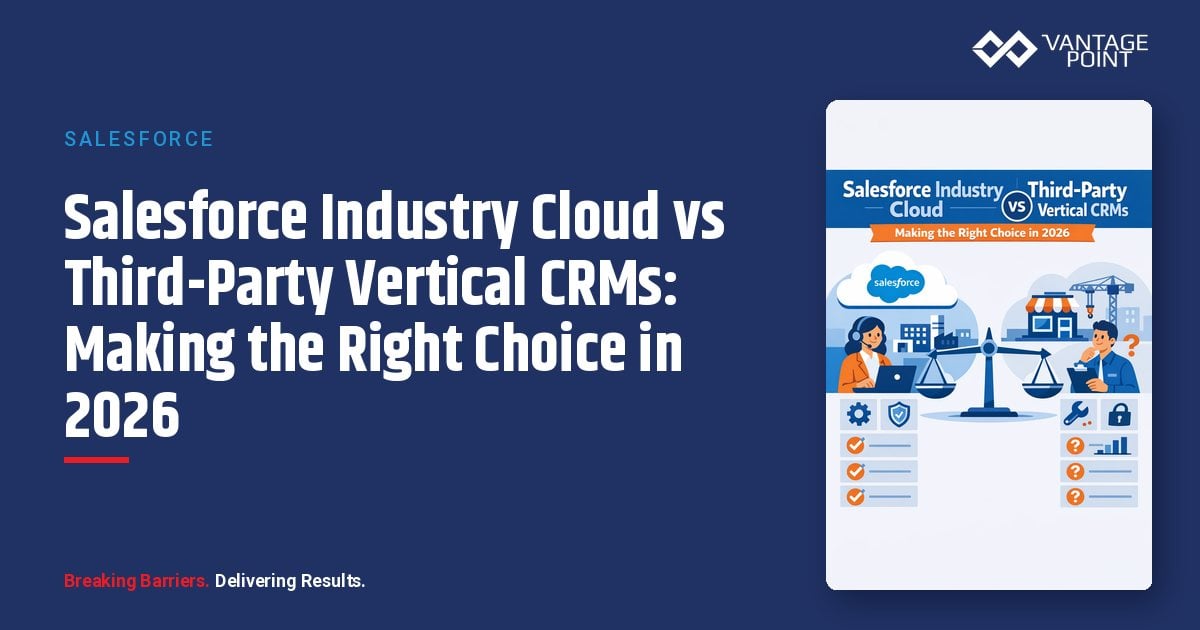
How Do Salesforce Industry Cloud and Vertical CRMs Compare?
Feature Depth vs. Platform Breadth
This is the core tradeoff:
- Salesforce Industry Cloud gives you 70-80% of industry-specific functionality out of the box, with the remaining 20-30% configurable through Salesforce's low-code tools, AppExchange apps, and custom development. But you also get the entire Salesforce ecosystem: Marketing Cloud, Data Cloud, MuleSoft integrations, Agentforce AI, and a unified platform for every department.
- Third-party vertical CRMs deliver 90-95% of industry-specific functionality out of the box, with workflows that mirror exactly how teams in that sector operate. However, they typically offer limited capabilities outside their vertical. Meaning you may need separate tools for marketing automation, advanced analytics, cross-department collaboration, or enterprise integration.
Decision Matrix: 8 Critical Evaluation Criteria
| Criteria | Salesforce Industry Cloud | Third-Party Vertical CRM |
|---|---|---|
| Industry workflow depth | Strong (70-80% out-of-box) | Excellent (90-95% out-of-box) |
| Cross-functional capabilities | Excellent (full platform) | Limited (CRM + vertical ops) |
| Scalability | Enterprise-grade | Varies by vendor |
| Integration ecosystem | 5,000+ AppExchange apps + MuleSoft | 50-200 industry-specific integrations |
| AI and automation | Einstein + Agentforce (rapidly evolving) | Varies; some leaders, many lagging |
| Time to value | 3-6 months (more configuration) | 1-4 months (less configuration) |
| Total cost (3-year) | Higher upfront, lower long-term | Lower upfront, potentially higher long-term |
| Talent availability | Large Salesforce talent pool | Smaller, specialized talent pool |
When Should You Choose Salesforce Industry Cloud?
Salesforce Industry Cloud is typically the right choice when:
1. You Need Cross-Department Alignment
If your sales, marketing, service, and operations teams all need to share data and workflows on a single platform, Salesforce's unified architecture eliminates the data silos that plague multi-tool environments. Data Cloud unifies customer profiles across every touchpoint, and every team works from the same source of truth.
2. You're Planning for Enterprise Scale
Organizations with 200+ users, multiple business units, or plans for rapid growth benefit from Salesforce's proven scalability. The platform handles billions of transactions daily, and its multi-tenant architecture means you never outgrow the system.
3. Integration Complexity Is High
If your technology stack includes dozens of systems (ERP, marketing automation, e-commerce, telephony, analytics) Salesforce's native integration capabilities (MuleSoft, pre-built connectors) and its 5,000+ AppExchange ecosystem make it easier to create a connected enterprise.
4. AI Is a Strategic Priority
With Agentforce now offering industry-specific AI agents (including pre-built agents for sales coaching, service resolution, and operational optimization) Salesforce's AI capabilities are advancing rapidly. If leveraging AI across your business is a priority, the platform's investment in autonomous agents gives it a significant edge.
5. You Operate Across Multiple Verticals
Conglomerates and diversified businesses that span industries benefit from having a single platform that offers multiple Industry Clouds under one roof, rather than managing separate vertical CRMs for each business unit.
When Should You Choose a Third-Party Vertical CRM?
A standalone vertical CRM is typically the right choice when:
1. Workflow Specialization Is Non-Negotiable
If your core operations depend on highly specialized workflows (dispatching field technicians, managing construction bids, tracking regulatory submissions), a vertical CRM that was built around these processes will deliver a better user experience with less customization.
2. Speed to Value Is Critical
Vertical CRMs generally require less configuration and training because they already speak your business's language. If you need to be up and running quickly, especially for teams with limited technical resources, the faster implementation timeline is a real advantage.
3. Your Team Is Small and Focused
For organizations with fewer than 100 users operating primarily in a single sector, a vertical CRM's focused feature set often means less complexity, lower costs, and higher adoption rates compared to configuring a broader platform.
4. Budget Is Tightly Constrained
Many vertical CRMs offer lower per-user pricing than Salesforce Industry Cloud, especially when you factor in the additional Salesforce platform costs (Data Cloud, MuleSoft, Marketing Cloud) that enterprises typically add. For organizations that need CRM + core operations in one affordable package, vertical CRMs can be more cost-effective.
5. Operational and CRM Features Must Be Unified
Some vertical CRMs combine CRM with deep operational capabilities (job scheduling, inventory management, billing, compliance tracking) in ways that would require multiple Salesforce products plus custom development to replicate.
The Total Cost of Ownership Comparison
Understanding true costs requires looking beyond per-user pricing:
Salesforce Industry Cloud: 3-Year TCO Estimate
| Cost Category | Small Org (25 users) | Mid-Market (100 users) | Enterprise (500 users) |
|---|---|---|---|
| Licensing (36 months) | $180K: $360K | $720K: $1.4M | $3.6M: $7.2M |
| Implementation | $25K: $75K | $100K: $250K | $250K: $750K |
| Customization & integrations | $15K: $50K | $50K: $150K | $150K: $500K |
| Ongoing admin & support | $36K: $72K | $120K: $240K | $360K: $720K |
| 3-Year Total | $256K: $557K | $990K: $2.04M | $4.36M: $9.17M |
Third-Party Vertical CRM: 3-Year TCO Estimate
| Cost Category | Small Org (25 users) | Mid-Market (100 users) | Enterprise (500 users) |
|---|---|---|---|
| Licensing (36 months) | $54K: $270K | $216K: $1.08M | $1.08M: $5.4M |
| Implementation | $5K: $25K | $25K: $75K | $75K: $200K |
| Customization & integrations | $10K: $30K | $30K: $100K | $100K: $300K |
| Ongoing admin & support | $18K: $36K | $60K: $120K | $180K: $360K |
| 3-Year Total | $87K: $361K | $331K: $1.375M | $1.435M: $6.26M |
Key insight: Salesforce Industry Cloud typically has a higher 3-year TCO, but the gap narrows significantly for larger organizations because you consolidate multiple point solutions. Many vertical CRM customers end up adding separate tools for marketing, analytics, and integration: increasing their effective TCO.
The Hybrid Approach: Using Both Together
An increasingly popular strategy is to run Salesforce as your core CRM and customer engagement platform while integrating a vertical CRM for specialized operations. This hybrid approach works well when:
- Your industry-specific operations are too specialized for any horizontal platform
- You still need enterprise-grade marketing automation, analytics, and cross-department CRM
- You have the integration resources (or a partner like Vantage Point) to connect both systems via MuleSoft or native APIs
This gives you the best of both worlds: vertical depth for operations and horizontal breadth for customer engagement, data unification, and AI-driven insights.
5 Best Practices for Making the Right CRM Choice
1. Map Your Workflows Before Evaluating Vendors
Document every critical workflow across sales, service, operations, and marketing. Identify which workflows are industry-unique and which are common business processes. This mapping reveals whether you need 90%+ vertical depth or whether 70-80% coverage with platform breadth is sufficient.
2. Calculate the Real Total Cost of Ownership
Don't compare per-user pricing in isolation. Factor in implementation, customization, integration, training, ongoing administration, and the cost of any supplementary tools you'll need. Use a 3-year horizon to capture the true picture.
3. Evaluate the Vendor's AI and Automation Roadmap
AI is evolving rapidly. Salesforce's Agentforce is investing billions in industry-specific AI agents. Some vertical CRMs are developing their own AI capabilities. Others are falling behind. Assess where each vendor will be in 2-3 years, not just today.
4. Test User Adoption, Not Just Features
Run a pilot with actual end users, not just administrators. The best feature set in the world is worthless if your team won't use it. Vertical CRMs often win on initial adoption because the UI matches how users already think about their work.
5. Plan for Growth and Diversification
If your organization might expand into new markets, acquire companies in adjacent sectors, or diversify its service offerings, a platform-based approach (Salesforce) provides more flexibility. If you're deeply committed to a single vertical, a specialist tool may remain the right long-term investment.
FAQ: Salesforce Industry Cloud vs Vertical CRMs
What is Salesforce Industry Cloud?
Salesforce Industry Cloud is a suite of 16+ industry-specific solutions built on top of the Salesforce Customer 360 platform. Each solution includes pre-configured data models, workflows, compliance frameworks, and AI capabilities tailored to a specific sector.
Are third-party vertical CRMs better than Salesforce Industry Cloud?
Neither is universally better. Vertical CRMs offer deeper out-of-box industry workflows and faster time-to-value, while Salesforce Industry Cloud provides superior cross-functional capabilities, scalability, and a larger integration ecosystem. The right choice depends on your organization's size, complexity, and growth plans.
Can I use Salesforce and a vertical CRM together?
Yes. Many organizations use a hybrid approach where Salesforce handles core CRM, marketing, and analytics while a vertical CRM manages specialized industry operations. Integration platforms like MuleSoft can connect both systems for a unified data experience.
How much does Salesforce Industry Cloud cost compared to vertical CRMs?
Salesforce Industry Cloud typically ranges from $200, $400 per user per month, with implementation costs of $25K: $750K depending on complexity. Third-party vertical CRMs range from $50, $300 per user per month with lower implementation costs, but organizations often need additional tools for marketing, analytics, and integration.
What is Agentforce, and how does it affect this decision?
Agentforce is Salesforce's AI agent platform that can autonomously handle sales, service, and operational tasks. In 2026, Salesforce is releasing industry-specific Agentforce agents that understand vertical workflows. This AI investment is significant. If autonomous AI agents are part of your strategy, Salesforce's platform advantage is substantial.
How long does it take to implement Salesforce Industry Cloud vs a vertical CRM?
Salesforce Industry Cloud typically takes 3-6 months for mid-market organizations due to configuration and customization needs. Most vertical CRMs can be deployed in 1-4 months because they require less configuration out of the box.
Should startups choose a vertical CRM or Salesforce?
Startups with fewer than 50 users and tight budgets typically benefit from starting with a vertical CRM for speed and cost efficiency. However, fast-growing startups that anticipate scaling to 200+ users within 2-3 years should evaluate Salesforce early to avoid a costly migration later.
Conclusion
The choice between Salesforce Industry Cloud and a third-party vertical CRM isn't about which is "better": it's about which is better for your organization given your workflows, scale, budget, growth trajectory, and technology strategy.
Choose Salesforce Industry Cloud if you need enterprise scalability, cross-department alignment, a vast integration ecosystem, and cutting-edge AI capabilities. The platform's breadth is unmatched, and its Industry Cloud solutions continue to close the depth gap with each release.
Choose a third-party vertical CRM if you need maximum workflow specialization, the fastest path to user adoption, and a focused solution that deeply understands your sector's unique operations.
Consider a hybrid approach if you need the best of both worlds, and have the integration resources to make it work.
Whatever path you choose, working with an experienced implementation partner ensures your CRM delivers maximum ROI. At Vantage Point, we help organizations evaluate, implement, and optimize both Salesforce and HubSpot CRM solutions: including hybrid architectures that integrate vertical tools through MuleSoft. Our consultants bring cross-industry expertise to ensure your CRM strategy supports where your business is going, not just where it is today.
Ready to make the right CRM choice? Contact Vantage Point for a personalized consultation and CRM evaluation.
About Vantage Point
Vantage Point is a CRM and technology consulting firm specializing in Salesforce, HubSpot, MuleSoft, Data Cloud, and AI-powered business solutions. As a certified Salesforce and HubSpot partner, Vantage Point helps organizations across all industries implement, integrate, and optimize their technology stacks to drive growth, efficiency, and exceptional customer experiences. Learn more at vantagepoint.io.