
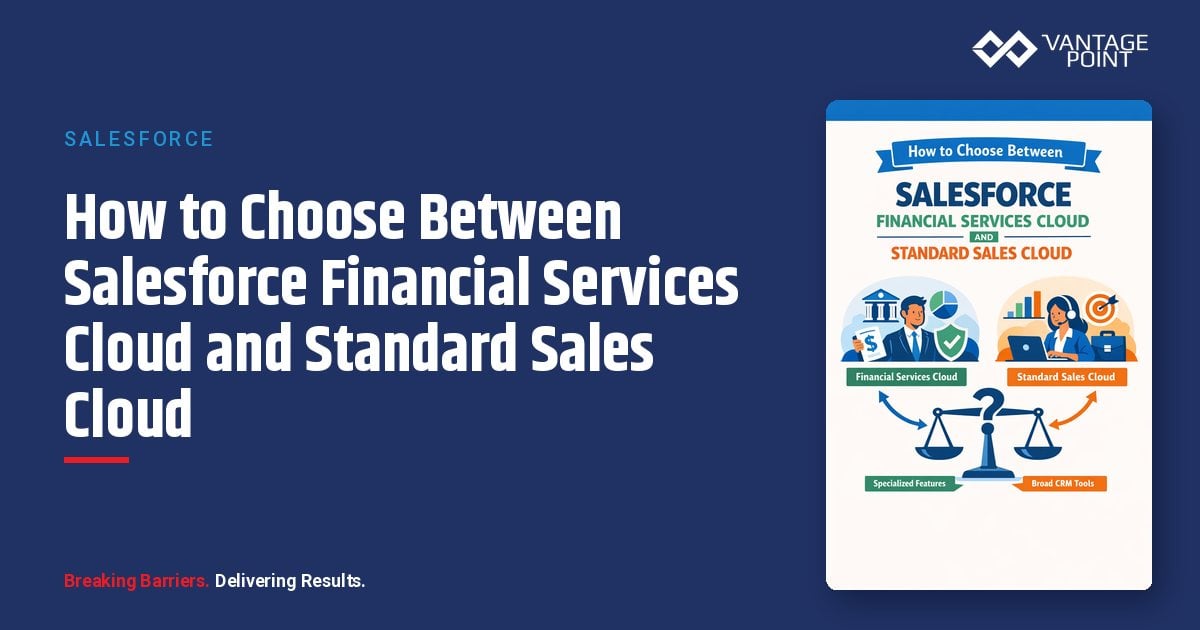
Key Takeaways (TL;DR)
- What is Financial Services Cloud (FSC)? Salesforce's industry-specific CRM for financial services with pre-built data models for households, relationships, financial accounts, compliance, and goals: built on top of Sales Cloud Enterprise
- Cost: FSC starts at $325/user/month vs. Sales Cloud Enterprise at $175/user/month: a $150/user delta that adds up fast at scale
- Timeline: FSC implementations typically take 4-8 months; Sales Cloud deployments run 2-4 months
- Best For: FSC excels for wealth managers, banks, credit unions, insurance providers, and RIAs with complex household relationships and regulatory compliance needs; Sales Cloud fits sales-centric organizations with straightforward CRM requirements
- ROI: Firms that fully leverage FSC see returns by avoiding custom development costs and accelerating advisor productivity
- Bottom Line: The right choice depends on your use cases, compliance requirements, growth trajectory, and budget: not the label on the license
Introduction
Choosing the right Salesforce edition is one of the most consequential technology decisions a financial services firm can make. Get it right, and you unlock advisor productivity, regulatory compliance, and relationship-driven growth. Get it wrong, and you either overpay for features you don't use or underbuild a platform you'll outgrow within a year.
The core question is straightforward: Should your firm invest in Salesforce Financial Services Cloud (FSC), or is standard Sales Cloud enough?
The answer is rarely black and white. FSC delivers industry-specific functionality that would cost hundreds of thousands of dollars to build manually in Sales Cloud. But at $150 more per user per month, the premium demands careful justification: especially at scale.
This guide provides a practical, vendor-neutral decision framework. We'll break down what each platform offers, where FSC delivers undeniable value, where Sales Cloud holds its own, and how to evaluate the right fit for your firm's specific needs, budget, and growth trajectory.
What Is Salesforce Sales Cloud?
Sales Cloud is Salesforce's foundational CRM platform and its most widely adopted product. Used by over 150,000 companies globally, including more than 80% of the Fortune 500, Sales Cloud supports the entire sales lifecycle from lead acquisition to deal closure.
Core Capabilities
- Lead and Opportunity Management: Track prospects through every stage of your pipeline with Kanban-style deal boards, automated lead scoring, and Einstein AI-powered next-best-action recommendations
- Pipeline and Revenue Forecasting: Real-time dashboards and forecasting models that give sales leaders visibility into projected revenue and pipeline health
- Workflow Automation: Reduce administrative burden with automated task assignment, email sequences, approval processes, and record updates
- Quoting and CPQ: Generate professional quotes and proposals directly from opportunity records with built-in Configure, Price, Quote (CPQ) tools
- Mobile Access: Full-featured mobile app for field sales reps to update records, view dashboards, and engage contacts on the go
- Integrations: Native connectivity with Gmail, Outlook, Slack, and thousands of AppExchange apps
Sales Cloud Pricing (2026)
| Edition | Price/User/Month | Best For |
|---|---|---|
| Starter Suite | $25 | Small teams needing basic CRM |
| Pro Suite | $100 | Growing teams with automation needs |
| Enterprise | $175 | Mid-market and enterprise sales teams |
| Unlimited | $350 | Large enterprises needing advanced features |
| Agentforce 1 Sales | $550 | AI-first sales organizations |
For financial services firms, Enterprise Edition ($175/user/month) is the most common starting point, offering the customizability, workflow automation, and reporting depth that regulated organizations need.
What Is Salesforce Financial Services Cloud (FSC)?
Financial Services Cloud is Salesforce's industry-specific CRM purpose-built for banks, credit unions, wealth management firms, insurance providers, asset managers, and other financial institutions. It's not simply a "skin" on top of Sales Cloud. FSC includes a reimagined data model, pre-configured workflows, and regulatory compliance features that address the unique challenges of the financial sector.
Salesforce rebranded FSC as "Agentforce Financial Services" in 2025 and restored the Financial Services Cloud name in September 2026. The AI-powered advisor and service tools that move signaled remain the platform's direction.
Core Capabilities
- Household Management: Group individuals into households with multi-generational relationship tracking, shared financial views, and aggregate AUM rollups across family members, trusts, and entities
- Actionable Relationship Center (ARC): A visual, graph-based interface that maps complex relationships between clients, accounts, institutions, and intermediaries: revealing referral paths and cross-sell opportunities
- Financial Goals: Track client objectives (retirement, education funding, home purchase) tied to specific financial products and portfolios, with progress monitoring over time
- Financial Account Object: Manage checking accounts, investment portfolios, insurance policies, mortgages, and loan instruments within a unified view
- Action Plans: Pre-built workflow templates for onboarding, loan origination, claims processing, and other multi-step processes that enforce compliance checkpoints
- Compliance Frameworks: Built-in KYC (Know Your Customer), AML (Anti-Money Laundering), and regulatory reporting tools with audit trails and role-based access controls
- Person Account Model: Individual-centric data architecture designed for B2C financial services relationships
- Financial Data Platform: Pre-built connectors for wealth platforms (Orion, Black Diamond, Addepar), custodians (Schwab, Fidelity, Pershing), and core banking systems
FSC Pricing (2026)
| Edition | Price/User/Month | Best For |
|---|---|---|
| FSC for Sales | $325 | Advisors, bankers, brokers |
| FSC for Service | $325 | Contact centers, service teams |
| FSC for Sales + Service | $350 | Combined front/back office |
| FSC Agentforce 1 Sales | $750 | AI-first advisory firms |
| FSC Agentforce 1 Service | $750 | AI-first service operations |
How Do FSC and Sales Cloud Compare? Feature-by-Feature Breakdown
| Capability | Sales Cloud Enterprise | Financial Services Cloud |
|---|---|---|
| Lead & Opportunity Management | ✅ Full | ✅ Full (inherited) |
| Pipeline Forecasting | ✅ Full | ✅ Full (inherited) |
| Workflow Automation | ✅ Full | ✅ Full + Action Plans |
| Household Management | ❌ Custom build required | ✅ Native |
| Relationship Mapping (ARC) | ❌ Not available | ✅ Native |
| Financial Account Tracking | ❌ Custom objects needed | ✅ Native |
| Financial Goals | ❌ Not available | ✅ Native |
| KYC/AML Compliance | ❌ Custom build required | ✅ Built-in frameworks |
| Person Account Model | ⚠️ Available but basic | ✅ Industry-optimized |
| Custodian/Core Banking Integration | ❌ Custom APIs required | ✅ Pre-built connectors |
| Rollup Summaries | ❌ Custom development | ✅ Native AUM rollups |
| Regulatory Audit Trails | ⚠️ Requires Shield add-on | ✅ Enhanced built-in |
| Insurance Policy Management | ❌ Not available | ✅ Native |
| Referral Management | ❌ Custom build required | ✅ Native |
| Price/User/Month | $175 | $325 |
When Should You Choose Financial Services Cloud?
FSC is the right investment when the platform's pre-built capabilities directly address your operational complexity. Here are the scenarios where FSC delivers clear value:
1. You Manage Complex Household Relationships
If your clients are multi-generational families with trusts, entities, business interests, and complex ownership structures, FSC's Household Management and Actionable Relationship Center save months of custom development. Building equivalent functionality in Sales Cloud typically costs $100,000 ($250,000 in custom development) and requires ongoing maintenance.
Signs this applies to you:
- You serve high-net-worth families with 5+ related accounts
- You need aggregate AUM views across household members
- You manage relationships between trusts, LLCs, family offices, and individuals
- Your advisors need to visualize who-knows-whom for referral strategies
2. Regulatory Compliance Is a Core Business Requirement
Firms subject to SEC, FINRA, OCC, state insurance commission, or NCUA oversight benefit enormously from FSC's pre-built compliance frameworks. KYC onboarding workflows, AML monitoring, regulatory reporting, and audit trail functionality are baked in rather than bolted on.
Signs this applies to you:
- You face regular regulatory examinations
- Compliance teams need documented proof of process adherence
- You require automated suitability checks or disclosures
- Data retention and audit trail requirements are non-negotiable
3. You're Planning Agentforce (AI) Adoption
Salesforce's R&D investment is increasingly focused on AI-powered tools within the Agentforce ecosystem. FSC provides the foundation for Financial Advisor Assistance and Banking Service Assistance AI agents that integrate natively with the FSC data model.
4. You Need Pre-Built Financial System Integrations
Connecting to custodians, core banking platforms, portfolio management systems, and wealth tech tools through FSC's Financial Data Platform can eliminate six-figure custom integration costs.
5. You're Scaling Rapidly and Need Standardized Processes
As firms grow beyond 50 users, the "thousand customizations" problem becomes real. FSC provides standardized industry processes and guardrails that keep implementations consistent across teams, offices, and lines of business.
When Should You Stick with Sales Cloud?
Sales Cloud isn't a consolation prize. For many financial services firms, it's genuinely the better choice. Here's when:
1. Your Use Case Is Primarily Sales-Focused
If your primary needs are lead management, opportunity tracking, pipeline forecasting, and deal management, Sales Cloud delivers these capabilities at best-in-class quality. FSC adds complexity to these workflows without proportional value for sales-centric operations.
2. Budget Constraints Are Significant at Scale
The $150/user/month delta matters: a lot:
| Number of Users | Annual FSC Premium Over Sales Cloud |
|---|---|
| 25 users | $45,000/year |
| 50 users | $90,000/year |
| 100 users | $180,000/year |
| 200 users | $360,000/year |
That budget could fund a full-time Salesforce administrator, significant custom development, or additional technology investments.
3. Your Client Relationships Are Straightforward
Many RIAs, independent financial advisors, insurance agencies, and smaller banks need solid contact management, activity tracking, and reporting, but don't require complex household modeling or multi-entity relationship mapping. A well-configured Sales Cloud handles these needs at lower cost.
4. You Need Maximum Flexibility
FSC's pre-configured data model assumes certain relationship structures. If your business model is highly unique, you may end up customizing FSC anyway. Paying a premium for assumptions that don't match your reality.
5. Speed-to-Value Is Critical
Sales Cloud implementations typically take 2-4 months. FSC deployments run 4-8 months due to the complexity of data migration (especially Person Account conversion), integration setup, and compliance configuration. If you need to be live quickly, Sales Cloud gets you there faster.
The Decision Framework: A Step-by-Step Evaluation
Step 1: Assess Your Relationship Complexity
| Question | Score |
|---|---|
| Do you serve multi-generational family households? | +3 for FSC |
| Do you manage trusts, entities, and complex ownership structures? | +3 for FSC |
| Do you need aggregate views across related accounts? | +2 for FSC |
| Are your client relationships primarily 1:1 (individual accounts)? | +2 for Sales Cloud |
Step 2: Evaluate Compliance Requirements
| Question | Score |
|---|---|
| Are you subject to SEC, FINRA, OCC, or NCUA regulations? | +3 for FSC |
| Do you need automated KYC/AML workflows? | +3 for FSC |
| Are audit trails and regulatory reporting critical? | +2 for FSC |
| Are your compliance needs basic/manual? | +2 for Sales Cloud |
Step 3: Calculate Total Cost of Ownership
Don't just compare license prices. Factor in:
| Cost Factor | Sales Cloud | FSC |
|---|---|---|
| Annual Licensing | $175 × users × 12 | $325 × users × 12 |
| Implementation | Base cost | +20-40% higher |
| Data Migration | Standard | +30-50% (Person Account complexity) |
| Custom Development | Higher (building industry features) | Lower (pre-built) |
| Integration Costs | Custom APIs required | Pre-built connectors available |
| Ongoing Maintenance | Standard | Managed packages add overhead |
| Training | Standard | +2-3× hours for FSC-specific features |
Key insight: If you'd spend $100K+ customizing Sales Cloud to replicate FSC functionality, FSC likely has a lower 3-year TCO despite higher licensing fees.
Step 4: Map Your 3-Year Roadmap
| If You're Planning... | Lean Toward |
|---|---|
| Agentforce AI adoption within 2 years | FSC |
| 50%+ user growth | FSC |
| Core banking/custodian integrations | FSC |
| Multi-line-of-business expansion | FSC |
| Keeping CRM simple and sales-focused | Sales Cloud |
| Tight budget, need to be live in <6 months | Sales Cloud |
Step 5: Score and Decide
- 12+ points for FSC: Strong candidate for Financial Services Cloud
- 8-11 points for FSC: Consider a hybrid approach or phased migration
- 7 or fewer FSC points: Sales Cloud is likely the better fit
The Hybrid Approach: Best of Both Worlds
Increasingly, firms are using both platforms strategically:
- FSC for wealth management and advisory teams (complex relationships, compliance)
- Sales Cloud for insurance sales, recruiting, or business development teams (pipeline-focused)
- Shared infrastructure for reporting, marketing automation, and Data Cloud
This approach optimizes costs by licensing FSC only for users who will leverage its industry-specific features. However, it requires careful architecture planning to ensure data flows seamlessly across license types.
Implementation Best Practices (Regardless of Your Choice)
1. Start with Business Requirements, Not Product Features
Define what success looks like for your firm before comparing feature checklists. The best implementation is one that solves real business problems: not one that activates the most features.
2. Invest in Data Quality Before Technology
Migration amplifies data quality issues. Deduplicate contacts, standardize field formats, and clean up stale records before any CRM implementation or migration.
| Data Issue | Before Implementation | After Implementation |
|---|---|---|
| Duplicate contacts | Fixable | Much harder to resolve |
| Missing fields | Fill proactively | Propagates everywhere |
| Bad relationships | Correct now | Breaks household rollups (FSC) |
3. Pilot Before Full Rollout
Whether you choose Sales Cloud or FSC, start small:
- 10-20 users
- One line of business
- Non-critical data set
- 90-day evaluation period
A pilot surfaces integration issues, user adoption challenges, and configuration gaps before they become enterprise-wide problems.
4. Plan for Change Management
Technology adoption fails more often because of people than platforms. Budget for:
- Role-specific training programs
- Executive sponsorship and communication
- Gradual feature introduction (don't activate everything at once)
- Continuous feedback loops with end users
5. If Choosing FSC, Prepare for Person Account Complexity
The Person Account model changes how records are created, how relationships work, how reports function, and how integrations connect. Budget 20% of your project timeline specifically for Person Account planning and testing.
Frequently Asked Questions
What is the price difference between FSC and Sales Cloud?
Financial Services Cloud starts at $325/user/month for Sales or Service editions, while Sales Cloud Enterprise costs $175/user/month. That's a $150/user/month premium, or $1,800 per user annually. For a 100-user organization, the annual delta is $180,000.
Can I start with Sales Cloud and migrate to FSC later?
Yes, but migration is not trivial. Person Account conversion, data model restructuring, integration rebuilds, and user retraining typically take 4-8 months and add 30-50% to the cost of a fresh FSC implementation. If FSC is likely in your future, starting there can be more cost-effective long-term.
Does FSC include everything in Sales Cloud?
Yes. FSC is built on top of Sales Cloud Enterprise Edition, so it includes all Sales Cloud features plus industry-specific additions. You're not losing any general CRM capability by choosing FSC.
Is FSC worth it for a small RIA with 10-20 users?
It depends on complexity. A 15-user RIA with straightforward client relationships and basic compliance needs will likely find Sales Cloud sufficient. A 15-user RIA managing complex multi-generational family wealth with trust structures may justify FSC's premium for the household management alone.
What about Salesforce Health Cloud for healthcare organizations?
Health Cloud serves a similar role for healthcare as FSC does for financial services, an industry-specific CRM with pre-built data models for patient engagement, care plans, and HIPAA compliance. The decision framework in this guide applies equally: evaluate your industry-specific needs versus general CRM requirements.
Can I use FSC and Sales Cloud licenses in the same org?
Yes. Hybrid deployments are increasingly common, with FSC licenses for advisory teams and Sales Cloud licenses for business development or sales teams. This requires thoughtful org architecture but can optimize licensing costs.
How long does an FSC implementation take compared to Sales Cloud?
Sales Cloud Enterprise implementations typically take 2-4 months. FSC implementations run 4-8 months due to industry data model configuration, Person Account setup, compliance workflow design, and financial system integrations. Plan for additional time if migrating from an existing Sales Cloud instance.
Conclusion: Making the Right Decision for Your Firm
The FSC vs. Sales Cloud decision isn't about which platform is "better". It's about which platform is the right fit for your firm's specific needs, complexity, budget, and growth trajectory.
Choose FSC when your firm manages complex household relationships, faces significant regulatory compliance requirements, plans to adopt Agentforce AI tools, or would spend more customizing Sales Cloud than the licensing premium costs.
Choose Sales Cloud when your needs are primarily sales-focused, your client relationships are straightforward, your budget is constrained at scale, or you need to deploy quickly.
Consider a hybrid approach when different teams within your organization have fundamentally different CRM requirements.
The most important thing? Make the decision based on data, not marketing. Map your actual use cases, calculate your real total cost of ownership, and test your assumptions with a pilot before committing.
How Vantage Point Can Help
Choosing the right Salesforce edition is just the beginning. At Vantage Point, we've completed engagements for financial services firms, including wealth management firms, banks, credit unions, insurance providers, and fintech companies. Our team has deep expertise in both Sales Cloud and Financial Services Cloud implementations, and we've helped firms navigate this exact decision dozens of times.
What we offer:
- Free 30-Minute CRM Assessment: We'll evaluate your current setup and provide a preliminary recommendation
- Implementation Services: Full Sales Cloud and FSC implementations tailored to your specific requirements
- Migration Support: If you're moving from Sales Cloud to FSC, we'll handle the complexity of Person Account conversion, data migration, and integration rebuilds
- Ongoing Optimization: Post-launch tuning, training, and feature adoption support
For more information regarding specific offerings, check out our Sales Cloud and Salesforce pages.
Ready to discuss which platform is right for your firm?
📧 Email: david@vantagepoint.io
📞 Phone: 469-499-3400
🌐 Website: vantagepoint.io
About Vantage Point
Vantage Point is a specialized Salesforce and HubSpot consultancy serving regulated industries: including financial services, healthcare, and insurance. Vantage Point bridges the gap between powerful CRM platforms and industry-specific needs. Our services span Salesforce Financial Services Cloud, Sales Cloud, Health Cloud, HubSpot CRM, MuleSoft integration, Data Cloud, and AI personalization.