
Plenty of articles tell you why to consolidate onto Salesforce. Far fewer show you what a good outcome actually looks like once the dust settles. This post fills that gap.
Instead of a single customer story, this is a composite pattern drawn from the mid-market consolidation engagements we see most often. Across those engagements, a typical growing B2B company arrives with sales, service, renewals, and reporting scattered across point tools, spreadsheets, and sometimes more than one CRM. The goal is almost always the same: one well-designed Salesforce org that serves as a single source of truth.
We describe the representative journey, the design decisions that separate durable consolidations from painful ones, and the lessons that repeat across contexts. No invented statistics, no named client. Just the shape of what "done well" looks like so you can benchmark your own effort against it.
Quick Answer
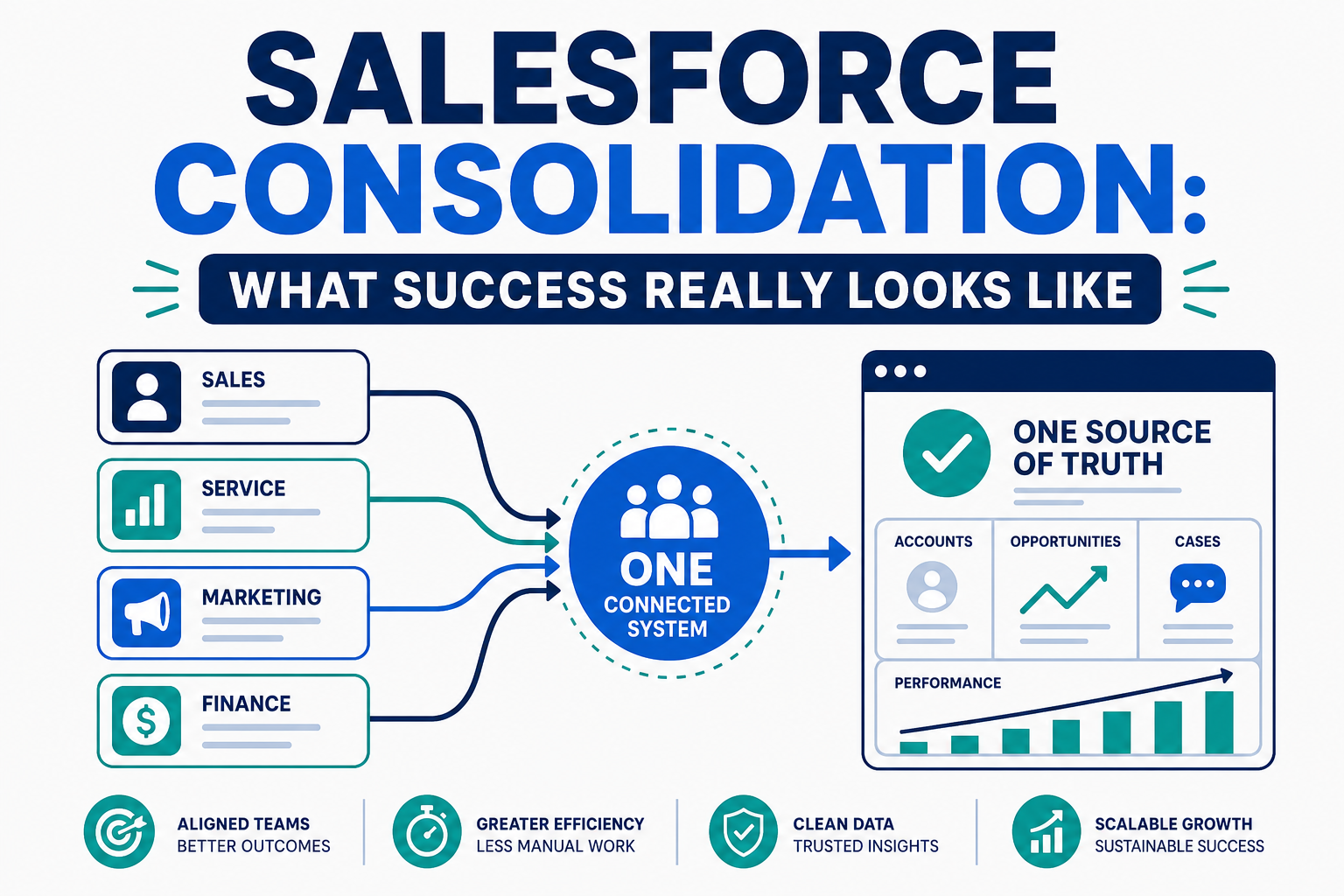
What it is: A successful Salesforce consolidation unifies previously separate sales, service, renewals, and reporting processes onto one well-designed, well-governed Salesforce org that acts as a single source of truth.
Who it matters for: Growing mid-market B2B organizations, RevOps and operations leaders, and executives who are tired of reconciling numbers across disconnected systems and multiple CRMs.
What to do with it: Use this pattern to judge whether your consolidation plan covers the parts that actually make it stick (senior-led design, a clean data model, governance, phased rollout, and adoption) not just a technical migration.
Why Vantage Point is relevant: Vantage Point is a senior-led, employee-owned Salesforce partner. Our Salesforce implementation and advisory team has run consolidations using our VALUE Methodology so the end state is adopted, not just launched.
TL;DR
- What it is: Salesforce consolidation brings fragmented sales, service, renewals, and reporting onto one governed org and a single source of truth.
- What good looks like: Senior-led design first, a deliberate data model, clear governance, a phased rollout, and adoption that outlasts go-live.
- Best for: Mid-market B2B teams juggling multiple CRMs, spreadsheets, and point tools that no longer agree with each other.
- Decision point: Consolidation succeeds or fails on process and adoption, not on the migration script alone.
- How Vantage Point helps: We lead consolidations with senior consultants and our VALUE Methodology through Salesforce implementation and advisory and system integration and data migration.
What Is Salesforce Consolidation?
Salesforce consolidation is the process of replacing multiple disconnected systems (separate CRMs, spreadsheets, and point solutions for sales, service, renewals, and reporting) with one well-designed Salesforce org that serves as the shared system of record.
It is different from a simple migration. A migration moves data from one place to another. A consolidation redesigns how the business operates so that a single org supports every revenue-facing team with consistent data, shared definitions, and one set of reports leadership can trust.
It is also distinct from a platform decision. If you are still weighing whether to unify at all, our guide on whether to consolidate or specialize your platform strategy covers that trade-off. This post assumes you have decided to consolidate and want to know what the successful version looks like.
Why Salesforce Consolidation Matters in 2026
Fragmented systems quietly tax growing companies. The same customer exists three times with three different statuses. Renewals live in a spreadsheet no one trusts. Leadership gets two revenue numbers and picks the friendlier one. Every hand-off between sales and service loses context.
Three forces are pushing consolidation up the priority list this year:
- Cost and complexity. Overlapping licenses and integrations add up, which is why so many teams are actively reducing their SaaS stack rather than adding tools.
- AI readiness. AI features like Agentforce and Einstein only produce trustworthy output on clean, unified data. Scattered systems block AI before it starts.
- Operating leverage. A single source of truth turns reporting from a monthly reconciliation project into a live view, freeing operations teams for higher-value work.
The risk is treating consolidation as a technical project. When teams move data without redesigning process and planning adoption, they end up with the old mess in a newer tool.
What a Successful Consolidation Actually Looks Like
Here is the representative before-and-after we see across mid-market consolidation engagements. Treat it as a directional pattern, not a guaranteed result: the specifics depend on your starting point.
| Dimension | Before consolidation | After a successful consolidation |
|---|---|---|
| Systems of record | Multiple CRMs, spreadsheets, point tools | One governed Salesforce org |
| Customer view | Duplicated, conflicting records | Single, deduplicated account and contact model |
| Sales-to-service hand-off | Manual, context lost | Shared records, continuous context |
| Renewals | Tracked in a separate spreadsheet | Managed as native Salesforce records and stages |
| Reporting | Reconciled by hand, numbers disagree | One trusted set of dashboards |
| Admin effort | Firefighting across tools | Governed change process on one platform |
| AI/automation | Blocked by messy data | Ready to layer on clean, unified data |
Notice what the "after" column has in common: consistency, shared context, and trust. Those are qualitative outcomes, and they are the point. A consolidation that only moves fields but leaves teams distrusting the numbers has not succeeded.
The Five-Phase Consolidation Roadmap
Durable consolidations tend to move through the same phases. This mirrors the structure we apply through our VALUE Methodology.
| Phase | Focus | What "good" looks like |
|---|---|---|
| 1. Discover | Map current systems, processes, and data | Documented process pain and a shared definition of the target state |
| 2. Design | Senior-led data model and org architecture | One deliberate object and permission model, not a copy of the old mess |
| 3. Build & migrate | Configure, integrate, deduplicate, and load | Clean, deduplicated data with validated integrations |
| 4. Roll out | Phased release by team or business unit | Early wins, feedback loops, and reduced go-live risk |
| 5. Adopt & optimize | Training, governance, and iteration | Sustained usage, a change process, and steady improvement |
The two phases teams most often shortchange are Design and Adopt. Skipping design produces a fragile org; skipping adoption produces an expensive tool no one uses.
Lessons Learned That Repeat Across Engagements
Senior-led design pays for itself. The data model set in the first weeks determines whether the org scales gracefully or fights you for years. Junior-heavy projects tend to replicate legacy quirks. Senior architects challenge them.
Governance is not optional. A single source of truth stays single only with clear ownership, validation rules, deduplication, and a defined change process. Without governance, the new org drifts back toward fragmentation. This often extends into system integration and data migration work so upstream systems keep the org clean.
Phased rollout beats a big bang. Releasing to one team or unit first surfaces issues cheaply, builds internal champions, and creates reference wins that ease the next wave.
Adoption is the real finish line. The best-designed org fails if people keep using the old spreadsheet. Structured training, change management, and executive reinforcement turn a launch into a habit. This is where advisory and change management makes the difference between "live" and "used."
Single source of truth is a decision, not a default. Leadership has to agree that Salesforce is the number, and then actually run the business from it.
What Businesses Should Do Next
If you are planning or mid-way through a consolidation, use this checklist to pressure-test it:
- [ ] Have you documented current processes, not just current fields?
- [ ] Is a senior architect owning the data model and org design?
- [ ] Do you have deduplication, validation, and clear record ownership defined?
- [ ] Is renewal and service context living in the org, not a side spreadsheet?
- [ ] Are you rolling out in phases with feedback loops?
- [ ] Is there a training and change-management plan beyond go-live?
- [ ] Has leadership committed to one source of truth for reporting?
If more than a couple of boxes are unchecked, the gap is usually process and adoption: the parts that make consolidation last.
Get a Salesforce Org Assessment
If your teams are stitching together multiple CRMs, spreadsheets, and point tools, Vantage Point can help you design the consolidated end state before you start moving data. We are a senior-only, employee-owned Salesforce partner, and every engagement is led by experienced consultants using our VALUE Methodology.
Book a Salesforce org assessment or a RevOps strategy session and we will map your current systems, define a governed target architecture, and build a phased consolidation plan you can actually execute. Explore our Salesforce implementation and advisory services or, for teams merging orgs after an acquisition, our Salesforce org consolidation after M&A playbook.
Frequently Asked Questions
What is a Salesforce consolidation?
A Salesforce consolidation replaces multiple disconnected systems (separate CRMs, spreadsheets, and point tools for sales, service, renewals, and reporting) with one well-designed Salesforce org that serves as the single source of truth. It redesigns how the business operates, not just where the data lives.
How is consolidation different from a Salesforce migration?
A migration moves data from one system to another. A consolidation redesigns processes so a single org supports every revenue-facing team with consistent data and shared definitions. Consolidation includes migration but also covers data model design, governance, rollout, and adoption.
What does a successful Salesforce consolidation look like?
It looks like one governed org where accounts and contacts are deduplicated, sales-to-service hand-offs keep context, renewals live natively in Salesforce, and leadership trusts a single set of dashboards. The measurable signal is qualitative: teams stop reconciling numbers and start acting on them.
How long does a Salesforce consolidation take?
It varies with the number of systems, data quality, and process complexity, so avoid fixed promises. What is consistent is the sequence: discover, design, build and migrate, roll out in phases, then drive adoption. Rushing the design and adoption phases is the most common cause of delays and rework.
What are the biggest risks in a consolidation project?
The biggest risks are treating it as a purely technical migration, under-investing in the data model, skipping governance, and neglecting adoption. Any of these can recreate the fragmentation you set out to fix. Senior-led design and a real change-management plan are the main safeguards.
Why does consolidation matter for AI and automation?
AI features such as Agentforce and Einstein depend on clean, unified data to produce trustworthy output. When customer data is duplicated across systems, AI amplifies the errors. Consolidating onto one governed org is a prerequisite for reliable CRM automation and AI.
How does Vantage Point approach Salesforce consolidation?
Vantage Point runs consolidations with senior-only consultants using our VALUE Methodology, covering discovery, senior-led design, migration, phased rollout, and adoption. We focus on the governance and change-management work that keeps a single source of truth intact after go-live.