
Key Takeaways (TL;DR)
- What is it? Agentic AI. Autonomous AI agents that handle administrative sales tasks so reps can focus on revenue-generating activities
- The Problem: Sales reps spend only 28-30% of their time actually selling; the rest goes to CRM updates, data entry, meeting prep, and chasing approvals
- Key Stat: Organizations using Agentforce deploy AI agents 16x faster and achieve 75% greater accuracy than DIY AI solutions (Valoir 2025)
- Impact: Sellers who partner with AI tools are 3.7x more likely to meet their quota (Gartner 2024)
- Best For: Sales teams of any size struggling with productivity, quota attainment, and scaling outreach
- Bottom Line: Agentic AI doesn't replace sellers. It eliminates the busywork so they can do what they were hired to do: build relationships and close deals
Introduction: The Sales Productivity Crisis Is Costing You Revenue
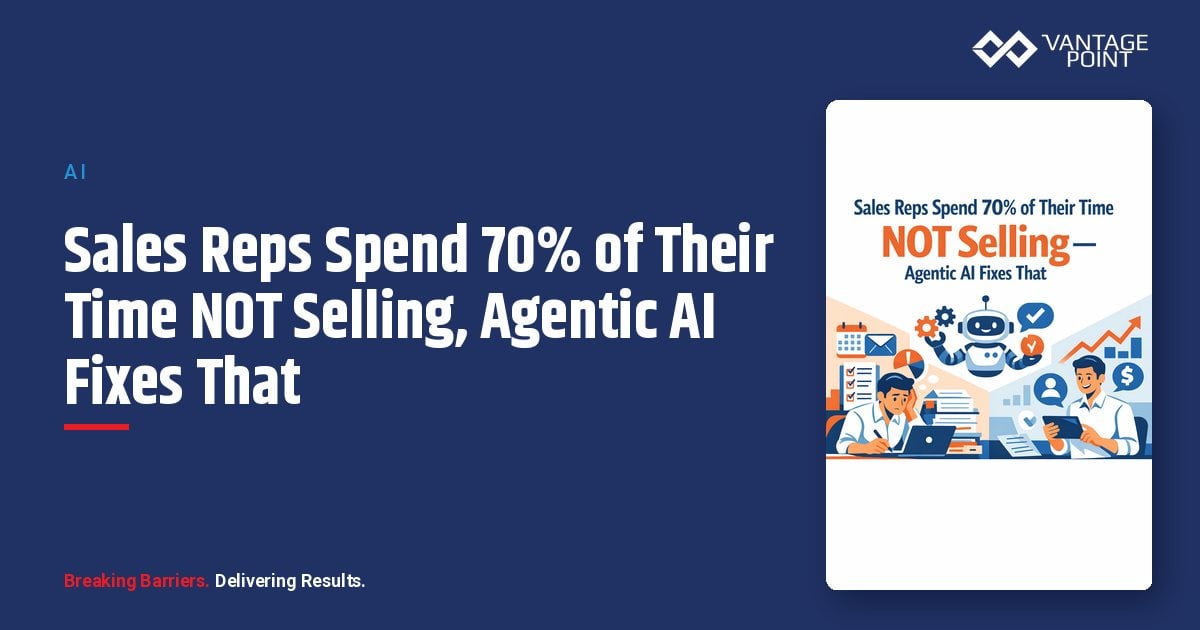
Here's a number that should alarm every business leader: the average sales rep spends just 28-30% of their work week on actual selling activities. The remaining 70% vanishes into a black hole of CRM data entry, internal meetings, proposal formatting, approval chains, and hunting for the right sales deck.
This isn't a minor inefficiency: it's a crisis. According to the Salesforce State of Sales Report (2026), sales reps spend 60% of their time on non-selling tasks. Other industry studies push that figure even higher, with some research indicating that reps lose up to 72% of their productive hours to administrative overhead.
The consequences are devastating. Quota attainment has plummeted to historic lows, with average attainment hovering around 43% according to recent benchmarks. Sales cycles are lengthening. 57% of sales professionals report that deal timelines are getting longer. And while reps drown in busywork, 73% of B2B buyers actively avoid sellers who send irrelevant, generic outreach.
But there's a turning point emerging. Agentic AI: autonomous AI agents that don't just suggest actions but actually execute them: is transforming how high-performing sales teams operate. In this guide, we'll break down exactly where your reps' time is being wasted, how agentic AI addresses each bottleneck, and why organizations that embrace this technology are dramatically outperforming those that don't.
Where Does All That Time Actually Go? The Sales Rep Time Allocation Breakdown
What Are Sales Reps Doing Instead of Selling?
Understanding the problem requires knowing exactly where those non-selling hours disappear. Industry research consistently identifies the same culprits:
| Activity | % of Rep Time | Impact on Revenue |
|---|---|---|
| CRM data entry and updates | 15-20% | Zero direct revenue generation |
| Internal meetings and emails | 12-15% | Minimal revenue contribution |
| Searching for content/collateral | 8-12% | Delays customer engagement |
| Quote creation and approvals | 8-10% | Slows deal velocity |
| Meeting prep and research | 8-10% | Necessary but overinflated |
| Administrative tasks (expenses, reports) | 5-8% | Pure overhead |
| Actual selling activities | 28-30% | 100% of revenue generation |
How Does This Time Drain Affect Quota Attainment?
The math is unforgiving. When reps only have roughly 12 hours per week for actual selling in a standard 40-hour work week, every lost minute compounds into missed opportunities. The data confirms the connection:
- Average quota attainment has dropped to approximately 43% in recent benchmarks (Gradient Works, 2024)
- 72% of sellers feel overwhelmed by the number of skills and tasks their job now requires (Gartner 2024)
- 42% of sales reps feel overwhelmed by the sheer number of tools they're expected to use, an average of 8 different tools to close a single deal
- Overwhelmed sellers are 45% less likely to attain quota (Gartner 2024)
The pattern is clear: the more time reps spend on administrative friction, the less they sell, and the more likely they are to miss their targets and eventually leave the organization.
What Is Agentic AI and Why Is It Different?
How Does Agentic AI Differ from Traditional Sales AI?
Traditional AI in sales has historically been assistive: it suggests the next best action, surfaces lead scores, or drafts an email template. The rep still has to review, decide, and execute.
Agentic AI fundamentally changes this model. Autonomous AI agents don't wait for instructions. They observe, decide, and act within defined guardrails. Think of it as the difference between a GPS that shows you the route versus an autonomous vehicle that drives you there.
In a sales context, agentic AI can:
- Automatically log CRM updates from call transcripts, emails, and meeting notes: without the rep lifting a finger
- Research accounts and prospects by synthesizing data from CRM records, the web, news feeds, and third-party databases
- Generate and send personalized outreach calibrated to each prospect's engagement signals and intent data
- Create and modify sales quotes using natural language commands
- Prepare meeting briefs that pull together opportunity history, stakeholder insights, and competitive intelligence
- Coach reps in real time with personalized role-plays and objective feedback
Why Are Sales Teams Investing in AI Now?
According to Salesforce's latest research, investing in AI is the #1 tactic sales teams cite for driving growth. This isn't speculative enthusiasm: it's driven by measurable outcomes:
- 94% of sales leaders with agents say they're essential for meeting business demands
- 88% of reps with agents say the technology increases their odds of hitting targets
- 85% of sales reps with agents say AI frees them to focus on higher-value work
- Sellers who partner with AI tools are 3.7x more likely to meet their quota (Gartner 2024)
Revenue gains from AI are most commonly reported in marketing and sales functions, confirming that front-office teams are the biggest immediate beneficiaries of agentic AI adoption.
How Agentforce Transforms Sales Productivity
What Can Agentforce Sales Agents Actually Do?
Salesforce's Agentforce platform represents the leading implementation of agentic AI for sales teams. Unlike point solutions that address one piece of the workflow, Agentforce operates as a unified AI layer across the entire sales process:
1. Lead Prioritization and Prospecting
Agentforce automatically ranks prospects using intent signals from enrichment data, giving reps a prioritized starting point each day. High-performing teams are 1.7x more likely to use prospecting agents than underperformers. At Salesforce itself, an SDR agent created 3,200 new opportunities in just four months by working low-score leads that human reps historically couldn't afford to pursue.
2. Automated Opportunity Management
The platform manages pipeline with automatic opportunity updates across fields like Stage and Next Steps, synthesizing unstructured conversation data (calls, meetings, emails, seller notes) into structured, objective field updates. Reps can choose between suggestive mode (review and approve) or autonomous mode (fully automated updates).
3. AI-Powered Quote Generation
Reps can create, update, and summarize quotes using natural language: directly within Salesforce or Slack. The agent automatically selects products, applies pricing and discounts, and optimizes quotes guided by your product catalog and business rules.
4. Meeting Prep and Account Intelligence
Agentforce surfaces company overviews, KPIs, competitive insights, and industry trends with a single click. Salesforce reports 33% faster meeting prep and a 10% increase in win rates since deploying Agentforce for account research.
5. Sales Coaching On Demand
36% of sales teams with agents already use them for coaching. Agents facilitate personalized role-plays tailored to each deal and stage, providing objective, consistent feedback based on account data and company best practices.
How Fast Can You Deploy Agentforce vs. Building Your Own?
The 2025 Valoir study provides one of the most compelling comparisons in enterprise AI:
| Build Phase | DIY AI Projects | Agentforce |
|---|---|---|
| Model Setup | 12 months | 1 month |
| Data Integration | 3.5 months | 0.3 months |
| Prompt Engineering | 12 months | 1 month |
| Guardrails & Security | 18 months | 0 months (built-in) |
| Workflow & UI Development | 6 months | 1 month |
| Accuracy Optimization | 24 months | 1.6 months |
| Total Duration | 75.5 months | 4.8 months |
That's 16x faster deployment: and the accuracy gap is equally dramatic. DIY agentic AI pilots typically plateau at 50-60% accuracy, while Agentforce customers consistently reach 85-95% accuracy across real-world use cases. That translates to a 75% improvement in accuracy when organizations migrate from homegrown solutions to the platform.
Five Use Cases Where Agentic AI Eliminates Time Waste
Use Case 1: Automated CRM Data Entry
The problem: Reps manually entering call notes, updating opportunity stages, and logging activities consumes 15-20% of their week.
The agentic AI solution: AI agents automatically capture data from emails, calls, and meetings, then update CRM records in real time. No manual entry required.
The result: Reps reclaim 6-8 hours per week. Data accuracy improves because updates aren't dependent on a rep remembering to log them at the end of the day.
Use Case 2: Intelligent Lead Scoring and Prioritization
The problem: Reps waste time chasing low-quality leads while high-intent prospects go cold.
The agentic AI solution: AI agents continuously score and rank leads based on behavioral signals, firmographic data, and engagement patterns: delivering a prioritized list every morning.
The result: Reps focus their limited selling time on the prospects most likely to convert. Pipeline quality improves; conversion rates rise.
Use Case 3: Personalized Outreach at Scale
The problem: 73% of B2B buyers avoid sellers who send generic outreach. But personalization takes time: time reps don't have.
The agentic AI solution: Agents generate brand-aligned, personalized emails and messages for every prospect, calibrated to their specific context, industry, and engagement history.
The result: Higher open rates, more meaningful conversations, and faster pipeline velocity: without reps spending hours crafting individual messages.
Use Case 4: Quote Generation and Configuration
The problem: Creating accurate quotes requires navigating complex product catalogs, pricing rules, and approval workflows. The average quote cycle adds days to the sales process.
The agentic AI solution: Reps describe what they need in natural language ("Create a quote for Company X with our enterprise tier, 100 seats, with the multi-year discount") and the agent handles the rest.
The result: Quote generation drops from hours to minutes. Deal cycles accelerate. Fewer errors mean fewer revision loops.
Use Case 5: Pre-Meeting Research and Account Briefing
The problem: Reps spend 30-60 minutes preparing for important meetings, pulling data from multiple systems.
The agentic AI solution: Agents automatically compile account briefs with opportunity history, stakeholder maps, recent conversations, competitive intelligence, and news updates.
The result: 33% faster meeting prep. Reps walk into every call informed and confident, leading to better outcomes.
Best Practices for Implementing Agentic AI in Your Sales Organization
1. Start with Your Biggest Time Drain
Audit where your reps spend their non-selling hours. The activity consuming the most time is your highest-ROI automation target. For most organizations, that's CRM data entry and opportunity management.
2. Invest in Data Quality First
AI is only as good as the data it operates on. 84% of data and analytics leaders agree that AI outputs are only as good as data inputs. Before deploying agents, ensure your CRM data is clean, complete, and unified. Organizations that prioritize data hygiene see dramatically better AI outcomes. 74% of sales teams with AI are already making data quality a priority.
3. Choose Platform AI Over Point Solutions
Using 8 different tools to close deals creates the very complexity that kills productivity. 84% of sales teams without an all-in-one platform plan to consolidate their technology. Platform-native AI like Agentforce avoids the integration headaches and data silos that undermine point solutions.
4. Deploy in Suggestive Mode Before Going Autonomous
Start with human-in-the-loop workflows where agents suggest actions and reps approve them. This builds trust, surfaces edge cases, and lets you fine-tune agent behavior before enabling fully autonomous operation.
5. Measure What Matters
Track metrics that directly tie to the productivity gains you're targeting:
- Time spent selling (target: increase from 30% to 50%+)
- Quota attainment (target: measurable improvement within one quarter)
- Deal velocity (target: reduced average sales cycle)
- CRM data completeness (target: 95% field completion)
- Rep satisfaction (target: reduced overwhelm, improved retention)
6. Enable Your Team, Don't Just Deploy Technology
82% of reps say AI provides opportunities for career growth. Frame agentic AI as a career accelerator, not a threat. Invest in training that helps reps become effective AI collaborators. The sellers who learn to leverage AI most effectively will become your top performers.
The ROI of Agentic AI for Sales Teams
What Return Can You Expect from Agentic AI?
The financial case for agentic AI in sales is compelling across multiple dimensions:
Direct Productivity Gains:
- Reclaim 10-15 hours per rep per week from administrative tasks
- At an average fully loaded cost of $150K per rep, that's $37K: $56K in recovered productive capacity per rep annually
Revenue Impact:
- 3.7x higher quota attainment for AI-enabled sellers
- 10% increase in win rates (Salesforce internal data)
- Faster deal cycles through automated meeting prep, quoting, and follow-up
Operational Efficiency:
- 75% accuracy improvement over DIY AI solutions
- 16x faster deployment to value
- Reduced tech stack complexity (from 8+ tools toward unified platform)
Talent Retention:
- 85% of reps with agents say AI frees them for higher-value work
- Reduced burnout and overwhelm
- Career growth opportunities through strategic project work
FAQ: Agentic AI for Sales Productivity
How much time do sales reps actually spend selling?
According to multiple industry studies including the Salesforce State of Sales Report, sales reps spend only 28-30% of their time on revenue-generating selling activities. The remaining 60-72% is consumed by administrative tasks like CRM data entry, internal meetings, content searching, quote creation, and meeting preparation.
What is agentic AI and how is it different from regular AI?
Agentic AI refers to autonomous AI agents that can observe, decide, and act on tasks without requiring human intervention at every step. Unlike traditional AI that merely suggests actions (like lead scores or email drafts), agentic AI can independently execute tasks (updating CRM records, generating quotes, researching accounts, and sending personalized outreach) within defined guardrails and permissions.
How does Agentforce improve sales productivity?
Agentforce improves sales productivity by automating the administrative tasks that consume most of a rep's day. It automatically logs CRM data from conversations, prioritizes leads using intent signals, generates personalized outreach at scale, creates quotes via natural language, prepares account briefs for meetings, and provides on-demand coaching. Salesforce reports 33% faster meeting prep and 10% higher win rates from Agentforce adoption.
Is agentic AI accurate enough for enterprise sales?
Platform-based agentic AI like Agentforce achieves 85-95% accuracy across real-world use cases, according to the 2025 Valoir study. Simple agents reach 95% accuracy, while complex multi-source agents achieve 80-90%. This compares to just 50-60% accuracy for DIY-built AI solutions, representing a 75% improvement when organizations adopt platform AI.
How long does it take to implement agentic AI for sales?
Implementation timelines vary significantly based on approach. According to the Valoir 2025 study, organizations using Agentforce achieved full deployment in an average of 4.8 months, compared to 75.5 months (over 6 years) for organizations building DIY agentic AI solutions. The difference is driven by pre-built data integration, prompt templates, security frameworks, and workflow components.
Will AI replace human sales reps?
No. Agentic AI augments sales reps by handling repetitive, administrative tasks, freeing them to focus on relationship building, complex negotiations, and strategic selling. In fact, 82% of reps say AI provides opportunities for career growth, and 85% say it frees them to focus on higher-value work. The goal isn't fewer reps: it's reps who can sell more effectively.
What's the ROI of agentic AI for sales?
Organizations adopting agentic AI see returns across multiple dimensions: sellers who partner with AI tools are 3.7x more likely to meet their quota (Gartner), teams recover 10-15 hours per rep per week from automated admin tasks, and deal cycles accelerate through faster meeting prep, quoting, and follow-up. Agentforce achieves 75% better accuracy and deploys 16x faster than DIY alternatives, compressing time-to-value significantly.
Conclusion: The Time to Act Is Now
The sales productivity crisis isn't getting better on its own. As quotas rise, sales cycles lengthen, and buyer expectations escalate, the gap between time available and time needed will only widen. Organizations that continue asking reps to manually grind through administrative tasks will watch their top performers burn out and their pipeline stagnate.
Agentic AI isn't a future possibility: it's a present-day competitive advantage. The data is overwhelming: 94% of sales leaders with AI agents say they're essential, sellers with AI are 3.7x more likely to hit quota, and platform AI deploys 16x faster with 75% better accuracy than building from scratch.
The question isn't whether agentic AI will transform your sales organization. The question is whether you'll be leading that transformation or playing catch-up.
Ready to reclaim your sales team's selling time? Contact Vantage Point to learn how we help organizations implement Agentforce and transform sales productivity. As a Salesforce implementation partner, we don't just deploy technology: we drive adoption and deliver measurable outcomes.
About Vantage Point
Vantage Point is a technology consulting firm specializing in CRM implementation, integration, and AI-powered automation. As a trusted Salesforce and HubSpot partner, Vantage Point helps businesses of all sizes transform their sales, service, and marketing operations through strategic technology adoption. Our team combines deep platform expertise with a relentless focus on measurable business outcomes, from Agentforce deployment and Data Cloud implementation to MuleSoft integration and beyond. Learn more at vantagepoint.io.