Quick Answer
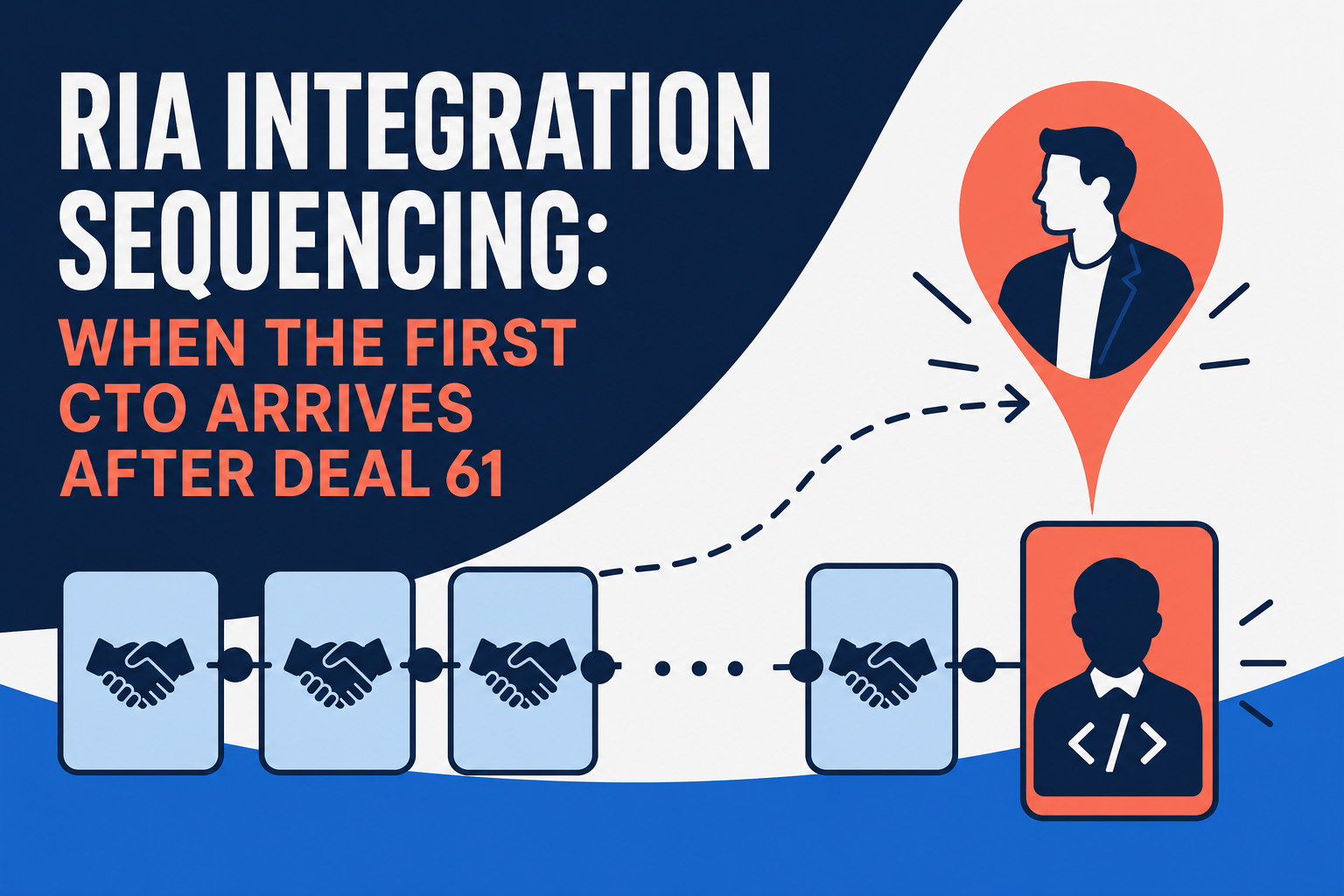
Merit Financial Advisors has named John Rajes its first-ever Chief Technology Officer — after 61 acquisitions, more than 55 offices, and roughly $30.1 billion in AUM. The hire is the right call. The tell is the timing. Consolidators that build a repeatable migration protocol before the deals compound earn ROI on every acquisition that follows; firms that hire the CTO at deal 61 are funding a cleanup of integration debt from every prior deal. Sequencing — not headcount — decides which firm you are.
Key Takeaways (TL;DR)
- What happened? Merit Financial Advisors named former LPL executive John Rajes its first CTO, with a mandate covering technology architecture, data strategy, integrations, and AI. He started in July 2026.
- Why it matters: the integration bill on a rollup never lands in year one — it lands when the 40th CRM migration collides with the ninth deal of the year.
- The real tell: not the hire, but the order of operations — when technology leadership and the migration protocol arrive relative to deal flow.
- Proof it works the other way: one multi-acquisition RIA grew from $1B to $14B+ across 17+ acquisitions on a repeatable six-phase protocol — 340% ROI in 18 months, 8–12 hours a week reclaimed per advisor.
- Best for: COOs and heads of operations at PE-backed RIAs running five or more deals a year.
- Bottom line: a protocol in place before deals compound is an asset; the same protocol built after 61 deals is remediation.
What Happened: 61 Acquisitions, Then a First CTO
61 acquisitions. 55+ offices. $30.1B in AUM. The first Chief Technology Officer started in July.
On September 1, InvestmentNews reported that Merit Financial Advisors named John Rajes its first chief technology officer. Rajes — whose career includes LPL, UBS, Barclays, and Goldman Sachs — started on July 13 with responsibility for the firm's technology architecture, data strategy, integrations, and artificial intelligence efforts, reporting to COO Chrissy Lee. Merit has closed 61 acquisitions to date, nine of them in 2026, and manages approximately $30.1 billion across more than 55 offices.
Merit is not alone in the deal flow. The first week of September alone brought new acquisitions from Wealth Enhancement, Savant, F.L.Putnam, Summit, and Maridea — each one adding a technology stack to somebody's roadmap: a new CRM instance, a new portfolio accounting system, a new set of client data with its own definitions.
The hire itself is genuinely good news — a fast-scaling firm adding dedicated technology leadership is what the industry should want. The useful question for every other consolidator reading the announcement is not who Merit hired. It is when.
Why Doesn't the Integration Bill Arrive in Year One?
Consolidators buy revenue and inherit systems. The deal model prices the revenue — the multiple, the synergies, the retention assumptions. What it rarely prices is what arrives with the wire: another CRM, another reporting stack, another set of spreadsheets that quietly run the office, and another team whose definition of "household" doesn't match the firm standard.
Year one forgives all of this. The acquired team keeps its tools, the home office runs parallel reports, and the differences get reconciled by hand at quarter-end. Nobody feels the cost because the volume is still small enough for smart people to absorb with effort.
The bill arrives later, and all at once. It lands when the 40th CRM migration collides with the ninth deal of the year — when a client who exists in four acquired systems has four different addresses and nobody can say which one the custodian has; when the ops team spends the first week of every month stitching together a firmwide view that a unified data model would produce in an afternoon; when every new acquisition takes longer to integrate than the last.
That is integration debt, and we have written about what it costs: RIA Integration Debt: The Cost Nobody Prices at Deal Announcement puts numbers on the liability side. This post is the order-of-operations companion to that one — not a re-statement of the cost, but an examination of when technology leadership and the migration protocol must arrive relative to deal flow — and what each sequence buys you.
What Does the CTO Hire Actually Signal?
A first CTO hire after 61 acquisitions says two things at once. First, credit where due: the firm recognized that technology now requires dedicated executive leadership, and it hired for the right mandate — architecture, data, integrations, AI. Second, arithmetic: the new CTO does not inherit a blank roadmap. He inherits 61 deals' worth of decisions already made, workarounds already load-bearing, and data models already diverged.
A technology leader who arrives at deal five designs a protocol that every subsequent acquisition walks into — discovery templates, a canonical data model, migration waves, adoption playbooks. One who arrives at deal 61 designs the same protocol, but first excavates: inventorying what 55+ offices actually run, reconciling definitions that drifted apart deal by deal, unwinding manual reconciliations that have quietly become someone's full-time job.
The protocol costs roughly the same in both sequences; the excavation does not. That is the whole argument for sequencing — a critique of timing, not of any firm. The conditions that produce deal-61 hires (success, speed, deal flow outpacing org design) are exactly what every PE-backed consolidator is trying to create.
What Does a Repeatable M&A Migration Protocol Look Like?
The alternative to excavation is a protocol built once and executed on every deal — each acquisition as the next run of a known process, not a new project. A durable protocol has six phases:
| Phase | What happens | Exit criteria |
|---|---|---|
| 1. Discovery | Inventory the acquired firm's full stack — CRM, portfolio accounting, planning tools, custodial feeds, key spreadsheets. | Complete system and data inventory, signed off before close. |
| 2. Mapping | Map every source field and definition to the firm's canonical data model — starting with "client" and "household." | Field-level mapping document with named owner per source system. |
| 3. Cleansing | Dedupe, standardize, and reconcile records against the canonical model before anything moves. | Exception report cleared by hand, on a deadline. |
| 4. Migration | Execute in rehearsed waves — test batch, pilot team, full office — same scripts and validation checks every time. | Validation pass rates met; rollback plan unused but ready. |
| 5. Adoption | Cut over workflows, train the team, measure usage until old tools are abandoned. | Adoption thresholds hit; legacy access read-only. |
| 6. Decommission | Retire legacy licenses, archive what recordkeeping requires, close out vendor contracts. | Recurring legacy cost off the books; archive verified. |
This is not theory. One multi-acquisition RIA we worked with grew from $1B to more than $14B across 17+ acquisitions running a repeatable six-phase M&A migration protocol — a 340% ROI in 18 months, with 8–12 hours a week reclaimed per advisor. The protocol made deal 15 cheaper to integrate than deal 3, instead of more expensive. An anonymized account of this kind of transformation: our fee-only wealth manager Salesforce transformation case study.
When the six phases exist as firm assets, a technology leader steps into a machine that runs; when they don't, the first year goes to building the machine while deal flow keeps feeding it raw material.
How Should a Consolidator Sequence Technology Leadership?
No universal deal number makes a first CTO mandatory — it depends on deal pace, stack complexity, and how much ops is absorbing by hand. But the order of operations that produces ROI is consistent:
- Define the canonical data model before the next LOI. One definition of client, household, account, and revenue that every acquisition maps into. It is nearly free at deal 3 and genuinely hard at deal 30.
- Build the migration protocol as a repeatable asset. Named phases, templates, owners, and validation checks that improve with each run. If every deal feels like the first migration, you don't have a protocol — you have a recurring emergency.
- Price integration into the deal model. The protocol's cost per acquisition is knowable once it exists. Deals priced without that line item are the ones whose integration debt surfaces later as a surprise.
- Seat dedicated technology leadership before volume breaks the manual system. The trigger isn't a deal count — it's slipping reconciliations, queueing migrations, and "the ops team handles it" stopping being true. Hire ahead of that moment, not behind it.
- Run integration governance on the same cadence as deal governance. If the deal team meets weekly and integration status meets quarterly, the sequencing is already wrong.
Compare the two paths side by side:
| Protocol before deals compound | Protocol after 61 deals | |
|---|---|---|
| Each new acquisition | Next run of a known process | A new project plus an excavation |
| Cost per integration | Declines with repetition | Rises with accumulated divergence |
| Data model | Canonical; every deal maps into it | Diverged across offices; manual reconciliation |
| CTO's first year | Improving a machine that runs | Building the machine under deal-flow pressure |
| ROI profile | Compounds with each deal | Cleanup first; compounding starts later |
The September deal wave makes this concrete. Five announced deals in four days means five more stacks entering five roadmaps. The firms that absorb them cheaply already did the sequencing work; the rest will price it later, at a higher number, in a future budget cycle.
How Vantage Point Helps
Vantage Point works with acquisitive firms on exactly this sequence — the canonical data model on Salesforce, the repeatable migration protocol, and the waves run as deals close. Through our Salesforce implementation and advisory and managed services and ongoing support practices, senior consultants work alongside your operations team from discovery through decommission — so each acquisition gets cheaper to integrate than the last. Senior consultants only — no junior handoffs; the experts you meet are the experts who deliver.
Is Your Integration Protocol Ahead of Your Deal Flow?
If your firm closes multiple deals a year and every migration still feels like the first one, sequencing — not effort — is the problem. Vantage Point can assess your integration process, define the canonical data model, and stand up the repeatable protocol before your next LOI. Contact Vantage Point to schedule an M&A integration readiness session, or explore our Salesforce services to see how we support consolidators end to end.
Frequently Asked Questions
What is integration debt in an RIA rollup?
Integration debt is the accumulated cost of systems, data definitions, and manual workarounds that each acquisition adds and nobody retires. It rarely appears in year one — it surfaces later as rising cost per integration, manual reconciliation, and migrations that take longer with each deal instead of shorter.
When should a consolidator hire its first CTO?
Before deal volume breaks the manual integration system — not after. The practical triggers are slipping reconciliations, queueing migrations, and an ops team absorbing divergence by hand. A CTO hired ahead of that moment designs a repeatable protocol; one hired behind it funds an excavation first.
What is a repeatable M&A migration protocol?
A fixed sequence — discovery, mapping, cleansing, migration, adoption, decommission — with templates, named owners, and validation checks that executes the same way on every acquisition. Each deal becomes the next run of a known process, so cost per integration declines with repetition.
Why does the canonical data model come first?
Because every downstream phase depends on it. One definition of client, household, and account, set before the next deal closes, gives each acquisition a standard to map into. Without it, definitions drift apart deal by deal and the drift becomes manual reconciliation that compounds with volume.
What ROI can a repeatable integration protocol deliver?
One anonymized multi-acquisition RIA grew from $1B to $14B+ across 17+ acquisitions on a six-phase migration protocol, producing a 340% ROI in 18 months and reclaiming 8–12 hours per week per advisor. Results vary by firm, but the mechanism — declining cost per integration — is consistent.
Does hiring a CTO fix integration debt by itself?
No. Leadership without a protocol inherits the debt at full value. The leverage comes from the order of operations: canonical data model and repeatable migration protocol in place before deal flow compounds, with technology leadership seated ahead of the breaking point.
Who should own acquisition integration — the COO or the CTO?
Both, on the same cadence as deal governance. The COO owns the operating outcome; the CTO owns the architecture and migration machinery. Sequencing trouble starts when the deal team meets weekly and integration status is a quarterly afterthought.
Sources
- Merit Financial names first chief technology officer as dealmaking pace continues — InvestmentNews, September 1, 2026
- Merit Financial Advisors Names John Rajes Chief Technology Officer — PR Newswire, September 1, 2026
Vantage Point is a boutique CRM consulting firm helping businesses transform with Salesforce, HubSpot, and AI — 150+ clients, 400+ engagements, and a 4.71/5 average engagement rating. Learn more at vantagepoint.io.