
Quick Answer: Migrating from Practifi to Salesforce Financial Services Cloud (FSC) is a Salesforce-to-Salesforce migration, not a platform switch. Practifi is a managed package built on the Salesforce Lightning Platform, so your data already lives in Salesforce. The work is remapping Practifi's custom objects to FSC's native data model and re-implementing Practifi workflows as native automation. Most firms complete the move in three to nine months.
Key Takeaways (TL;DR)
- What is it? A managed-package-to-native migration: moving from Practifi (a Salesforce AppExchange managed package for wealth management) to Salesforce Financial Services Cloud Core.
- Key Benefit: Consolidate on Salesforce's native roadmap, including Agentforce and AI, while keeping your data inside Salesforce.
- Timeline: Typically 3-9 months depending on firm size, data volume, and process complexity.
- Best For: Wealth management firms and RIAs running Practifi who want native FSC capabilities and reduced managed-package dependency.
- Biggest Trap: Assuming "same platform" means "easy migration." Practifi's object model does not map one-to-one to FSC, and every Practifi Process must be re-implemented.
- Bottom Line: Same-platform migrations skip the data-export nightmare of a platform switch, but they demand rigorous object mapping and process translation.
If your firm runs on Practifi, you already know what it does well: it is a capable, purpose-built practice management platform for wealth management. So why are a growing number of Practifi shops evaluating a move to native Salesforce Financial Services Cloud?
This guide answers that question, then walks through how the migration works: the object-by-object mapping, the phases, the pitfalls, and realistic timelines, written for operations leaders, COOs, and technology decision-makers at wealth management firms and RIAs running Practifi.
Is Practifi Built on Salesforce?
Yes, and this single fact shapes the entire migration. Practifi is a managed package built on Salesforce's Lightning Platform, distributed through the Salesforce AppExchange. Founded in 2013 with roots in the Australian advice market and now headquartered in Chicago, Practifi serves wealth management firms, RIAs, and advice firms globally.
Practifi's own documentation confirms the architecture: your Practifi instance is a Salesforce org. Its published object list shows standard Salesforce objects (Account as "Entity," PersonAccount as "Individual") alongside dozens of Practifi-namespaced custom objects (practifi__Process__c, practifi__Service__c, practifi__Asset_Liability__c, and more).
That means a Practifi-to-FSC migration is an org-to-org Salesforce migration: managed package to FSC Core: not a platform switch like moving from Redtail or Wealthbox. For the generic version of this journey, see our FSC Core vs. Managed Package migration guide. This post is the Practifi-specific companion.
Why Do Practifi Firms Move to Native FSC?
Practifi is a solid product, and firms rarely leave because it "broke." The drivers we see are strategic:
- Consolidation on Salesforce's roadmap. New FSC data model objects, industry AI, and Agentforce capabilities land on the native platform first, firms want direct access rather than waiting for a managed package to expose them.
- Agentforce and AI readiness. Native FSC is where Salesforce's AI agents, Data Cloud integration, and Einstein features are deepest.
- Reduced managed-package dependency. A managed package adds a vendor layer between your firm and Salesforce: upgrade cadence, namespace constraints, and feature availability are all mediated by the provider. Some firms prefer to own their org outright.
- Org consolidation and M&A. Firms running other Salesforce clouds, or standardizing acquired practices, often want one native FSC org instead of a separate Practifi instance.
Practifi itself positions against this move, arguing it delivers "Salesforce power without the Salesforce project." That is a fair framing of the trade-off: native FSC gives you more control and roadmap access, but you own the implementation. For a broader view of where Practifi sits among advisor CRMs, see our Salesforce FSC vs. Wealthbox vs. Redtail vs. Orion vs. Practifi comparison.
What Are the Same-Platform Advantages?
Because both systems are Salesforce, a Practifi-to-FSC migration has real advantages over a true platform switch:
- Your data never leaves Salesforce. Extraction uses familiar tools (Data Loader, the Salesforce APIs, or ETL platforms) against objects your admins can already query.
- Metadata and admin familiarity. Your team already understands Salesforce objects, fields, page layouts, reports, and permission sets. The learning curve is FSC's data model, not a new platform.
-
Person Accounts are already in play. Practifi uses Person Accounts for its "Individual" object, and FSC Core models people as Person Accounts as well. The hardest data-model decision in FSC is one Practifi firms have already made.
-
Integration patterns carry over. Custodian and portfolio-accounting feeds connect to Salesforce either way: though the connection points change, as covered below.
What Are the Same-Platform Traps and Pitfalls?
Same-platform does not mean same data model. These are the traps that derail Practifi-to-FSC projects:
- Object-model mismatch. Practifi's custom objects do not map one-to-one to FSC's data model. A Practifi "Service" is not an FSC "Financial Account," and a Practifi "Process" is not an "Action Plan" without translation work.
- Process re-implementation. Every Practifi Process Type, Process Task, Task Outcome, and Active Form must be rebuilt as native automation: Action Plan templates, Flows, and Dynamic Forms. This is re-implementation, not migration, and it is where timelines expand.
- License and entitlement changes. Practifi licensing and FSC licensing are structured differently. Plan new license types and permission structures with your Salesforce account team early.
- Integration re-pointing. Practifi's custodian integrations are managed by the package. On native FSC, you own those integrations: via AppExchange tools, MuleSoft, or custodian-native connectors.
- The "it's just Salesforce" underestimation. Because both systems are Salesforce, stakeholders sometimes expect a copy-paste migration. Budget for a real implementation project.
- Migrating everything. Historical holdings and transactions are usually better re-sourced from custodians. Migrate relationships, service history, notes, and pipeline: not every row.
- Recreating Practifi in custom objects. If you rebuild Practifi's data model inside FSC, you get the cost of migration with none of the native-platform benefits.
- Underinvesting in adoption. Advisors who loved Practifi's opinionated workflows need training and change management, not just a new login.
How Do Practifi Objects Map to FSC?
This table is the heart of the migration. It maps the most important Practifi objects (per Practifi's published object list) to their FSC Core equivalents:
| Practifi Object | API Name | FSC Core Equivalent | Migration Notes |
|---|---|---|---|
| Entity (households, organizations) | Account |
Business Accounts + Account Groups (households) | Households map to FSC Account Groups with membership records |
| Individual | PersonAccount |
Person Accounts | Cleanest mapping: both platforms use Person Accounts |
| Contact | Contact |
Contacts / related Person Accounts | COIs and referrers become Contacts or relationship records |
| Relationship | practifi__Relationship__c |
FSC Relationships (Account-Account / Contact-Contact) | Powers FSC's Relationship Map; preserve roles |
| Asset/Liability | practifi__Asset_Liability__c |
Financial Accounts + Assets & Liabilities | Split by type: assets vs. liabilities vs. insurance |
| Holding | practifi__Holding__c |
Financial Account Holdings / Securities | Usually re-sourced from the custodian feed, not migrated |
| Service | practifi__Service__c |
Financial Accounts or custom Service object | Requires a design decision: no direct equivalent |
| Deal | practifi__Deal__c |
Opportunity | Map Practifi stages to Opportunity stages |
| Process / Process Type / Process Task | practifi__Process__c family |
Action Plans + Action Plan Templates + Flow | Rebuild, don't migrate: translate each Process Type into an Action Plan template |
| Task Outcome / Active Forms | practifi__Task_Outcome__c family |
Flow + Dynamic Forms | Branching task logic becomes Flow decisions and screen flows |
| Goal | practifi__Goal__c |
Financial Goals | Direct conceptual mapping |
| Smart Note | practifi__Smart_Note__c |
ContentNote / Notes | Rich-text notes migrate with related-record links |
| Deliverable / Deliverable Fulfillment | practifi__Deliverable__c family |
Action Plans + custom entitlement tracking | Recurring entitlements need a purpose-built design |
Two rules of thumb: migrate the record of truth, not the system of convenience (holdings are usually better re-sourced from custodians), and rebuild processes natively rather than recreating Practifi's architecture in custom objects.
What Does the Migration Process Look Like?
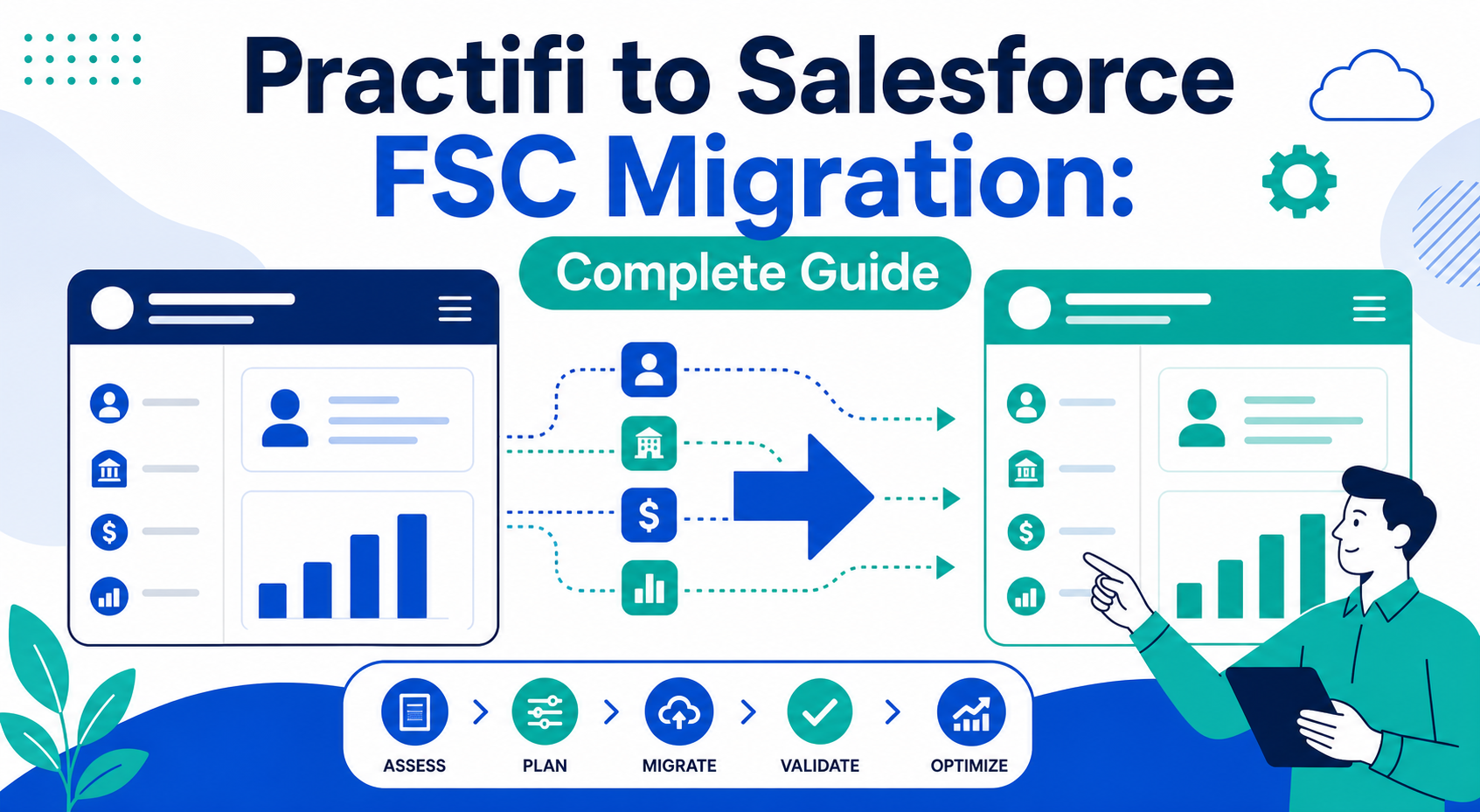
A Practifi-to-FSC migration runs in six phases:
- Discovery and fit-gap analysis (2-4 weeks). Inventory your Practifi configuration: every Process Type, Active Form, custom field, report, and integration, and which features your team actually uses. This inventory drives everything downstream.
- FSC org design (3-6 weeks). Design the target data model using the mapping table above. Decide household structures, record types, and where Practifi concepts without native equivalents (Services, Deliverables) will live. Finalize licensing with Salesforce.
- Data extraction and cleansing (parallel, 4-8 weeks). Extract via Data Loader or ETL. Because the source is Salesforce, you can query precisely, but expect cleansing work: duplicate households, stale relationships, inconsistent categories.
- Build and process re-implementation (6-12 weeks). Configure FSC, rebuild Process Types as Action Plan templates and Flows, re-establish custodian integrations, and rebuild reports and dashboards.
- Test migration and UAT (3-6 weeks). Run full trial migrations into a sandbox, validate record counts and relationship integrity, and have advisors test real workflows against migrated data.
- Cutover and adoption (2-4 weeks). Final delta migration, cutover weekend, hypercare, and structured training. Adoption support matters more than the technical cutover: your team's muscle memory is Practifi-shaped.
How Long Does a Practifi-to-FSC Migration Take?
Realistic ranges, assuming a dedicated project team:
- Small firms (under ~15 users, straightforward processes): 3-4 months
- Mid-size RIAs (15-50 users, moderate process library, a few integrations): 4-6 months
- Large or complex firms (50+ users, extensive Process Types, multiple custodian feeds): 6-9+ months
The variables that move timelines most: the number of Practifi Process Types to rebuild, integrations to re-establish, source data quality, and decision-making speed.
How Vantage Point Helps
Vantage Point is a boutique Salesforce and HubSpot consulting firm with deep Financial Services Cloud experience across wealth management. For Practifi-to-FSC migrations, our Salesforce implementation and advisory team leads discovery, data-model design, and process re-implementation, while our system integration and data migration practice handles extraction, transformation, and custodian re-integration. After go-live, our managed services team keeps the platform optimized.
Senior consultants only. No junior handoffs; the experts you meet are the experts who deliver.
Frequently Asked Questions
Related reading: Sales Cloud to Financial Services Cloud Migration: What You Need to Know covers the adoption and change-management side of an FSC move in more depth.
Is Practifi built on Salesforce?
Yes. Practifi is a managed package built on the Salesforce Lightning Platform and distributed via the Salesforce AppExchange. Your Practifi instance is a Salesforce org, which is why Practifi-to-FSC is a same-platform migration rather than a platform switch.
What happens to my Practifi Processes and workflows?
They must be re-implemented. Practifi Process Types, Process Tasks, Task Outcomes, and Active Forms are package-specific constructs. In FSC, they are rebuilt as Action Plan templates, Flows, and Dynamic Forms: an opportunity to streamline rather than replicate one-for-one.
Do Practifi households map to FSC households?
Yes, conceptually. Practifi models households as Entity (Account) records with related Individuals; FSC models them as Account Groups with group membership. The mapping is well-trodden, but relationship roles need careful translation.
Will my custodian integrations still work after migrating?
Not automatically. Practifi's Schwab, Pershing, Envestnet, and Black Diamond integrations are delivered through the managed package. On native FSC, each feed is re-established via AppExchange connectors, custodian-native integrations, or middleware such as MuleSoft.
How long does a Practifi-to-FSC migration take?
Most firms complete the migration in three to nine months, depending on firm size, process complexity, and the number of integrations to re-establish.
Conclusion
Migrating from Practifi to Salesforce Financial Services Cloud is a strategic consolidation, not an escape. You keep the platform, the admin skills, and the ecosystem, while gaining direct access to FSC's native data model, Agentforce, and Salesforce's industry roadmap. The firms that succeed treat it as a real implementation: rigorous object mapping, honest process re-implementation, early licensing decisions, and serious adoption investment.
Ready to evaluate your Practifi-to-FSC migration? Talk to Vantage Point's senior consultants about a migration assessment. We'll inventory your Practifi configuration, map it to FSC, and give you a realistic plan and timeline.
About Vantage Point
Vantage Point is a boutique CRM consulting firm helping businesses transform with Salesforce, HubSpot, and AI. Our senior-only, employee-owned team delivers Salesforce Financial Services Cloud implementations, integrations, data migrations, and managed services. Learn more at vantagepoint.io.