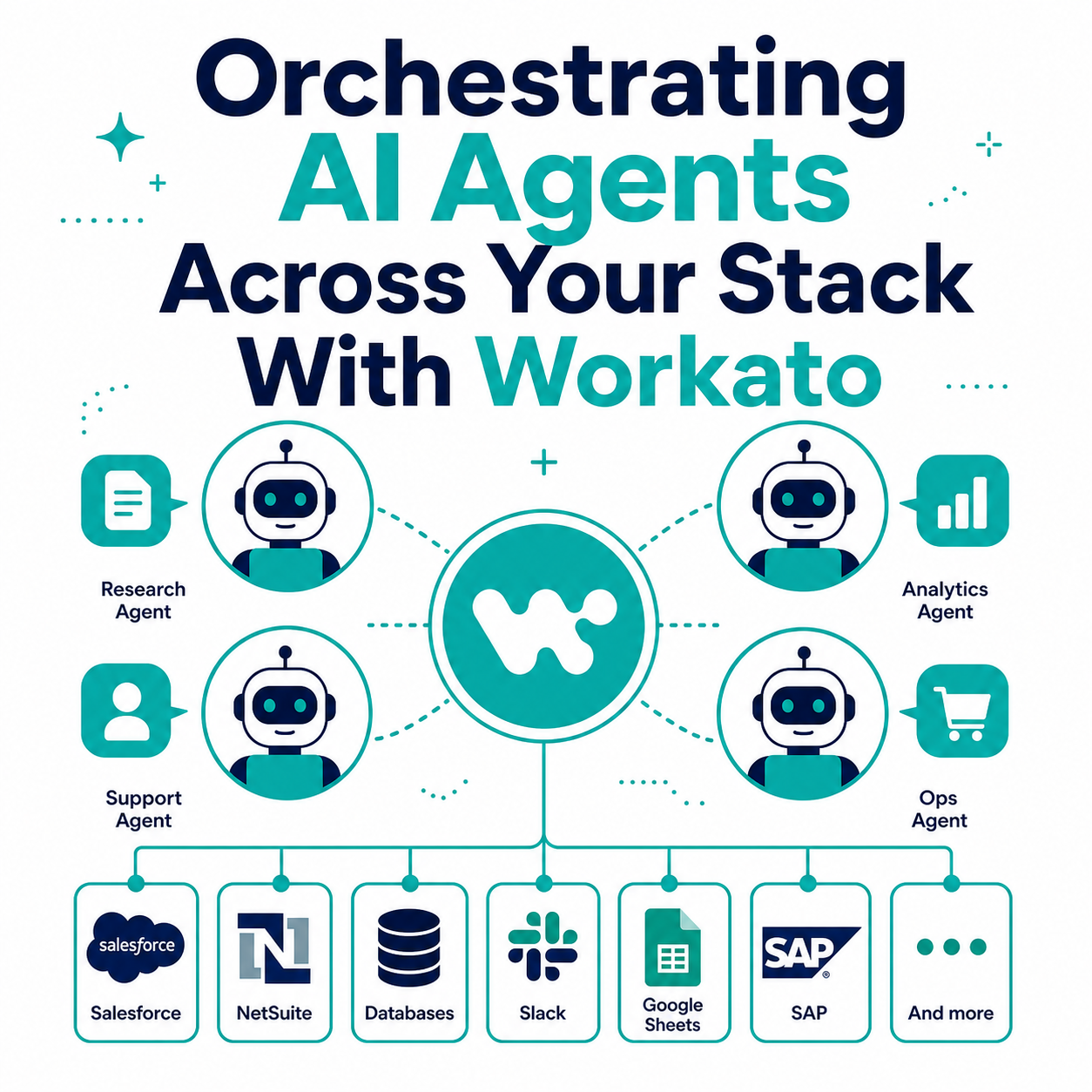
AI agents fail to scale for one common reason: nobody connected them to the rest of the business. A sales agent that can't check inventory, a support agent that can't see billing history, or a finance agent that can't trigger an approval workflow is just an expensive chatbot. Workato's agentic orchestration layer solves this by giving AI agents governed, real-time access to the systems, data, and processes they need to actually finish a task.
This matters right now because most organizations are past the AI agent pilot stage and running into the same wall: agents that work in a demo but can't be trusted in production because nobody built the orchestration layer underneath them.
Quick Answer
What it is: AI agent orchestration is the layer that connects AI agents to your business applications, data, and workflows so they can take real actions — not just generate text. Workato provides this orchestration through its iPaaS (integration platform as a service), Workato Genie for building governed AI agents, and Enterprise MCP for standardized agent-to-system connectivity.
Who it matters for: IT and operations leaders, RevOps and CX teams, and any business piloting Salesforce Agentforce, HubSpot Breeze, Claude, or custom AI agents that need to interact with CRM, ERP, HR, or ITSM systems.
What decision it supports: Whether to build agent connectivity project-by-project (which creates technical debt) or adopt a centralized orchestration platform before AI agent sprawl becomes unmanageable.
Why Vantage Point is relevant: Vantage Point implements Workato alongside Salesforce and HubSpot to connect AI agents to CRM data and workflows with proper governance, so agent pilots can actually scale into production.
TL;DR
- What it is: AI agent orchestration connects AI agents to your applications, data, and processes so they can sense events and take governed actions across systems.
- Why it matters: Most AI agent projects stall in production because connectivity and governance were never built — not because the AI model was weak.
- Best for: Businesses running multiple AI agents (Salesforce Agentforce, HubSpot Breeze, custom LLM agents) that need to act across CRM, ERP, HR, and support systems.
- Decision point: Evaluate whether your current integration approach can support agent-to-agent handoffs and agent-to-system actions with audit logging and access controls — or whether you need a dedicated orchestration platform.
- How Vantage Point helps: Vantage Point designs and implements Workato-based integration and automation architecture, connecting AI agents to Salesforce, HubSpot, and your existing tech stack. See our system integration and data migration services.
What Is AI Agent Orchestration?
AI agent orchestration is the set of connections, rules, and controls that let an AI agent sense an event, retrieve the context it needs from business systems, decide on a course of action, and execute that action — with the right approvals and audit trail. Without orchestration, an agent can only talk about a task. With orchestration, it can complete one.
Workato describes this as three distinct orchestration challenges every organization needs to solve:
- Agent-to-environment: how an agent receives events and reads or writes data through APIs, event streams, and file exchanges.
- Agent-to-agent: how multiple specialized agents discover each other's capabilities and hand off work (for example, a support agent escalating a billing question to a finance agent).
- Intra-environment: how individual system actions are composed into a reusable "skill" an agent can call, instead of one-off point integrations.
Why Agent Orchestration Matters in 2026
Every major CRM and productivity vendor now ships an AI agent: Salesforce has Agentforce, HubSpot has Breeze, and most companies are also experimenting with custom agents built on Claude or other models. That's created agent sprawl — multiple agents, each with its own connectors, credentials, and logic, and no shared governance layer.
Industry research on enterprise agentic AI has found that connectivity to applications and access to business data are the two things organizations most consistently say are critical to agent success — yet only a small fraction have actually implemented an orchestration strategy to support it. The rest are improvising integrations project by project, which accumulates technical debt and creates real security exposure: ungoverned agents with broad system access and no audit trail.
For CRM and operations teams, this shows up as a practical, immediate problem. An agent that's supposed to fulfill a customer order but can't check inventory, verify payment status, or read a CRM satisfaction score can't complete the task without a human doing the integration work manually — defeating the point of automation.
How Workato Orchestration Works
Workato approaches agent orchestration as an extension of its existing integration and automation platform rather than a separate product, which is one of its practical advantages: businesses that already use Workato for system integration don't have to stand up a new architecture just for AI agents.
- Connect systems once, reuse everywhere. Workato's connector library links CRM, ERP, HR, ITSM, and data warehouse systems into a shared integration layer that both traditional automations and AI agents can call.
- Define agent skills as governed actions. Instead of giving an agent open-ended access, teams define specific "skills" — discrete, permissioned actions (such as "check order status" or "update opportunity stage") the agent is allowed to invoke.
- Apply role-based access and audit logging. Every action an agent takes is authenticated, authorized, and logged, so security and compliance teams retain visibility into what agents actually did.
- Use Enterprise MCP for standardized connectivity. Workato supports the Model Context Protocol (MCP), the emerging standard for connecting AI agents to external tools and data, so agents built on different models can access the same governed integrations consistently.
- Coordinate multi-agent handoffs. When one agent needs to pass a task to another (billing to finance, sales to support), Workato's orchestration layer manages the handoff and shared context instead of leaving it to ad hoc scripting.
Build vs. Centralize: Two Approaches to Agent Connectivity
| Approach | How it works | Risk | Best for |
|---|---|---|---|
| Project-by-project integration | Each AI agent project builds its own point-to-point connections to the systems it needs | Technical debt accumulates fast; duplicate connectors, inconsistent security, no shared audit trail | Single-agent pilots with a narrow, well-defined scope |
| Centralized orchestration platform (e.g., Workato) | One integration and governance layer serves all current and future agents | Requires upfront platform investment and an owner for the strategy | Organizations running or planning multiple agents across CRM, ERP, HR, or support systems |
| No orchestration (agent works in isolation) | Agent is limited to conversational output; a human manually acts on its recommendations | Agent can't scale past a demo; low ROI, high manual overhead | Not recommended beyond early proof-of-concept |
Choose centralized orchestration if you're running (or planning) more than one AI agent, need agents to act on live CRM or ERP data, or have compliance requirements around system access and audit trails.
Choose lightweight, project-specific integration only if you have a single, narrow-scope agent pilot with no plans to scale it or add additional agents soon — but revisit this as soon as a second agent is on the roadmap.
If your team is evaluating how this applies to Salesforce, HubSpot, or your broader integration strategy, Vantage Point can help assess the right next step and build a practical implementation plan.
What Businesses Should Do Next
- Inventory your current and planned AI agents. List every agent already deployed (Agentforce, Breeze, custom builds) and what systems each one needs to reach.
- Assign an orchestration owner. Successful organizations put one person or team in charge of the integration and governance strategy for all agents — often whoever already owns automation, integration, or API strategy.
- Audit access and logging today. Before adding more agents, confirm existing integrations have role-based access controls and audit logging in place.
- Start with one high-value, well-scoped workflow. Prove the orchestration pattern on a single process (like order fulfillment or lead routing) before expanding to more agents and systems.
- Standardize on protocols where possible. MCP adoption is still early and not fully standardized across vendors, but building toward it now reduces future rework and vendor lock-in.
How Vantage Point Helps
Vantage Point implements Workato as the connective layer between AI agents — including Salesforce Agentforce and HubSpot Breeze — and the rest of your business systems. Our team designs governed integration architectures so agents can safely read and write CRM data, trigger approved workflows, and hand off tasks between agents without creating security or compliance gaps.
We support this work through our system integration and data migration services for connecting Workato to Salesforce, HubSpot, and other business systems, and our AI-driven personalization and analytics services for designing the CRM data and workflow foundation AI agents depend on. For teams standardizing processes across a growing agent footprint, our workflow automation and process optimization services help define the governed "skills" agents are allowed to execute, and our Salesforce implementation and advisory services and HubSpot services ensure the CRM side of the equation is ready for agentic workflows.
If your team is evaluating how this applies to Salesforce, HubSpot, integrations, or CRM governance, Vantage Point can help assess the right next step and build a practical implementation plan.
FAQ
What is AI agent orchestration, in simple terms? AI agent orchestration is the connectivity and governance layer that lets an AI agent access business data, trigger real actions in your systems, and hand off work to other agents — instead of only generating conversational responses.
Why do AI agents fail to scale without orchestration? Agents that work well in a demo often can't reach the other systems they need (inventory, billing, CRM, HR) in production. Without a shared integration and governance layer, teams end up building one-off connections for every agent, which creates technical debt and security gaps.
What is Workato Genie? Workato Genie is Workato's tool for building AI agents on top of its existing integration platform, allowing teams to define governed agent "skills" — specific, permissioned actions an agent can take — using the connectors and workflows already built in Workato.
What is Enterprise MCP and why does it matter for AI agents? The Model Context Protocol (MCP) is an emerging open standard for connecting AI agents to external tools and data sources. Workato's Enterprise MCP support lets agents built on different models use the same governed, audited connections rather than requiring custom integration work per agent.
How is Workato different from Salesforce Agentforce or HubSpot Breeze? Agentforce and Breeze are the AI agents themselves, built into Salesforce and HubSpot. Workato is the integration and orchestration layer that connects those agents (and others) to the rest of your business systems, data, and processes outside the CRM.
Do we need a centralized orchestration platform if we only have one AI agent today? If you plan to add more agents or expand the current agent's scope, starting with a centralized approach avoids rework later. A single, narrowly scoped pilot can sometimes get by with lightweight integration, but this should be revisited as soon as a second agent is planned.
What governance controls should an AI agent orchestration platform provide? At minimum: role-based access controls, audit logging of every action taken, defined approval steps for sensitive actions, and clear limits on which systems and data an agent can reach.
How does Vantage Point help with Workato and AI agent orchestration? Vantage Point designs and implements the Workato integration architecture that connects AI agents to Salesforce, HubSpot, and other business systems, with the governance and audit controls needed to move agent pilots into production safely.