
Key Takeaways (TL;DR)
- What is it? Open APIs are standardized interfaces that allow your CRM to exchange data seamlessly with external systems — ERP, marketing platforms, e-commerce tools, financial software, and more
- Key Benefit: Eliminate data silos, create a unified 360° customer view, and automate cross-system workflows
- Cost: $10K–$150K+ depending on integration complexity, number of systems, and customization requirements
- Timeline: 2–8 weeks for standard API integrations; 3–6 months for complex, multi-system implementations
- Best For: Growing businesses with multiple software platforms that need real-time data synchronization across departments
- ROI: Organizations with mature API integration strategies see up to 35% reduction in operational costs and 300% improvement in lead conversion rates
Introduction
Every modern business runs on software — CRMs for customer relationships, ERPs for operations, marketing platforms for campaigns, and dozens of specialized tools for everything in between. The challenge? These systems rarely talk to each other out of the box.
When your CRM lives in isolation, sales teams make decisions with incomplete information, marketing campaigns miss key behavioral data, and customer service reps scramble between tabs to find a customer's full history. According to MuleSoft's 2024 Connectivity Benchmark Report, the average enterprise uses over 1,000 applications, yet only 29% of them are integrated. That's a massive data gap — and it's costing businesses real revenue.
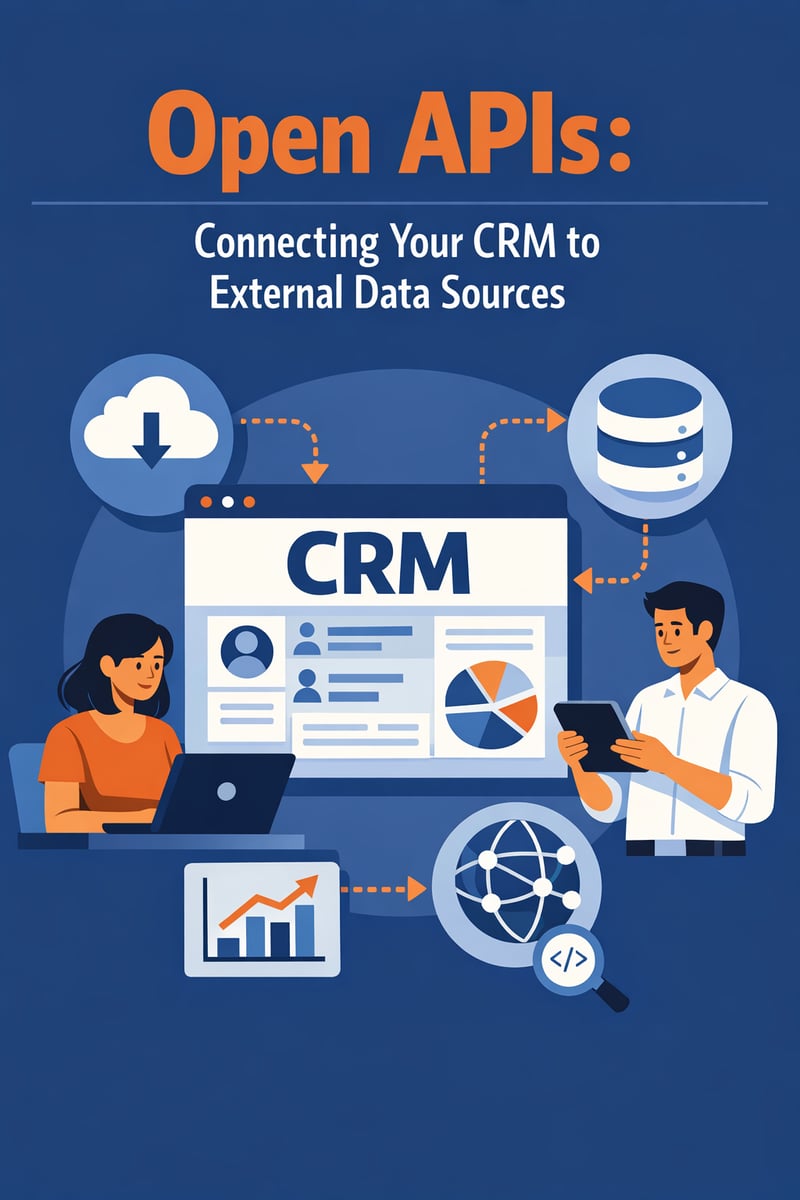
Open APIs solve this problem by providing standardized, well-documented interfaces that connect your CRM to virtually any external data source. Whether you're syncing order data from your e-commerce platform, pulling financial records from your ERP, enriching contact profiles with social media insights, or feeding AI models with unified customer data, open APIs make it possible.
In this guide, we'll walk you through everything you need to know about connecting your CRM to external data sources using open APIs — from understanding API fundamentals and choosing the right integration approach to implementing best practices that ensure security, scalability, and long-term ROI.
What Are Open APIs and Why Do They Matter for CRM?
How Open APIs Work
An Application Programming Interface (API) is a set of rules and protocols that allows different software applications to communicate with each other. An open API (also called a public API) is one that's publicly documented and available for external developers and systems to use, typically via REST or GraphQL protocols.
In the context of CRM, open APIs enable:
- Data retrieval — Pull customer records, deal pipelines, or activity logs from your CRM into other systems
- Data creation and updates — Push information from external sources (e-commerce orders, support tickets, marketing engagement) directly into CRM records
- Workflow automation — Trigger actions in one system based on events in another (e.g., a new order in your e-commerce platform automatically creates a CRM activity)
- Real-time synchronization — Keep data consistent across all platforms without manual intervention
Why CRM API Integration Is Critical in 2026
The data integration market has reached $17.58 billion in 2025 and is projected to grow to $33.24 billion by 2030, reflecting the explosive demand for connected systems. For CRM specifically, the stakes are even higher:
- Customer expectations are rising. Buyers expect personalized experiences at every touchpoint — and that requires a unified view of their interactions across all channels.
- AI demands clean, connected data. AI-powered CRM features like predictive lead scoring, automated recommendations, and intelligent routing only work when they have access to comprehensive data from multiple sources.
- Remote and hybrid work is permanent. Distributed teams need seamless access to synchronized data regardless of which system they're working in.
- Regulatory compliance is intensifying. Centralized, well-managed data flows make it easier to maintain compliance with GDPR, CCPA, and industry-specific regulations.
The bottom line: Businesses that fail to integrate their CRM with external data sources are operating with an incomplete picture of their customers — and leaving revenue on the table.
Common External Data Sources to Connect With Your CRM
Enterprise Resource Planning (ERP) Systems
Connecting your CRM to your ERP creates a bridge between customer-facing operations and back-office processes. Sales teams gain visibility into inventory levels, order status, and billing information without switching systems. Finance teams can see customer interaction history alongside payment records.
Key data flows:
- Order history and fulfillment status → CRM
- Customer credit and payment data → CRM
- CRM opportunity data → ERP for forecasting
Marketing Automation Platforms
When your marketing platform and CRM share data in real time, marketing campaigns become more targeted and sales teams receive warmer, better-qualified leads.
Key data flows:
- Email engagement and campaign performance → CRM lead records
- CRM deal stage changes → Marketing trigger workflows
- Website behavior and content downloads → CRM activity timeline
E-Commerce Platforms
For businesses selling online, integrating your e-commerce platform with your CRM transforms transactional data into relationship intelligence.
Key data flows:
- Purchase history and cart abandonment → CRM
- Customer lifetime value calculations → CRM
- CRM segmentation data → E-commerce personalization
Financial and Accounting Systems
Connecting accounting software to your CRM gives revenue teams visibility into the financial health of customer relationships.
Key data flows:
- Invoice and payment status → CRM
- Revenue recognition data → CRM dashboards
- CRM renewal dates → Accounting for revenue forecasting
Social Media and Communication Platforms
Social data enriches customer profiles with behavioral insights, sentiment analysis, and engagement patterns.
Key data flows:
- Social interactions and mentions → CRM contact records
- Customer sentiment scores → CRM for proactive outreach
- CRM contact data → Social advertising audiences
Third-Party Data Enrichment Services
External data providers like Clearbit, ZoomInfo, and Dun & Bradstreet can automatically enrich CRM records with firmographic, technographic, and demographic data.
Key data flows:
- Company size, revenue, industry → CRM account records
- Technology stack information → CRM for targeted selling
- Contact role and seniority data → CRM lead scoring
How to Choose the Right API Integration Approach
Native/Built-In Integrations
Most major CRM platforms offer pre-built connectors for popular applications. Salesforce's AppExchange and HubSpot's App Marketplace provide thousands of ready-made integrations.
| Pros | Cons |
|---|---|
| Quick to deploy | Limited customization |
| Vendor-supported | May not cover all use cases |
| Lower upfront cost | Can be rigid with complex data flows |
Best for: Standard integrations between widely-used platforms with straightforward data mapping needs.
Middleware / Integration Platform as a Service (iPaaS)
Platforms like MuleSoft, Workato, and Boomi act as a "hub" between your CRM and other systems, providing pre-built connectors, data transformation tools, and workflow automation.
| Pros | Cons |
|---|---|
| Connects multiple systems through one platform | Licensing costs can be significant |
| Visual workflow builders for non-developers | Requires iPaaS expertise |
| Robust error handling and monitoring | Adds another platform to manage |
Best for: Mid-to-large organizations connecting multiple systems that need flexibility, scalability, and enterprise-grade reliability.
Custom API Development
For unique business requirements, custom API integrations provide complete control over data flows, transformation logic, and error handling.
| Pros | Cons |
|---|---|
| Fully tailored to your business logic | Higher development cost |
| Maximum performance optimization | Requires ongoing maintenance |
| No vendor dependency for core logic | Longer implementation timeline |
Best for: Organizations with proprietary systems, complex transformation requirements, or high-volume data needs that off-the-shelf solutions can't handle.
Webhooks and Event-Driven Architecture
Rather than polling for changes, webhooks push data in real time when specific events occur (e.g., "new deal closed" or "contact updated").
| Pros | Cons |
|---|---|
| Real-time data synchronization | Not all systems support webhooks |
| Reduces unnecessary API calls | Requires endpoint management |
| Lower latency than polling | Need retry logic for failed deliveries |
Best for: Real-time use cases where immediate data synchronization is critical — such as order processing, lead routing, or alert systems.
Best Practices for CRM API Integration
1. Start With a Clear Data Strategy
Before writing a single line of integration code, document:
- What data needs to flow between systems
- Which direction the data flows (one-way, bi-directional, or event-triggered)
- How often data needs to sync (real-time, near-real-time, or batch)
- Who owns the data in each system (which system is the "source of truth" for each data type)
- What transformations are needed (field mapping, format conversion, deduplication)
2. Implement Robust Authentication and Security
API security is non-negotiable. Follow these guidelines:
- Use OAuth 2.0 for token-based authentication instead of static API keys
- Implement rate limiting to prevent abuse and stay within provider limits
- Encrypt all data in transit using TLS 1.2 or higher
- Apply the principle of least privilege — grant only the minimum permissions each integration needs
- Rotate credentials regularly and use short-lived access tokens
- Log all API activity for audit trails and compliance
3. Design for Resilience and Error Handling
Integrations will fail — the question is how gracefully they recover. Build in:
- Retry logic with exponential backoff — Don't hammer a failing endpoint. Wait progressively longer between retries.
- Circuit breaker patterns — If an external service is down, stop sending requests temporarily to prevent cascading failures.
- Dead letter queues — Capture failed messages for manual review and reprocessing.
- Comprehensive error logging — Log enough detail to diagnose issues quickly without exposing sensitive data.
- Alerting and monitoring — Set up automated alerts for error rate spikes, latency increases, or sync failures.
4. Plan for Scalability From Day One
Your integration architecture should handle growth without requiring a complete rebuild:
- Use message queues (like RabbitMQ or Apache Kafka) for high-volume data flows
- Implement pagination for large data set retrievals
- Cache frequently accessed data to reduce API call volume
- Design modular integrations that can be updated independently
- Monitor API usage against rate limits and plan for capacity increases
5. Maintain Version Control and Documentation
APIs change. Your integrations must be prepared:
- Pin to specific API versions rather than using "latest"
- Subscribe to provider changelogs and deprecation notices
- Test against new versions in a staging environment before updating production
- Document every integration — data flows, field mappings, transformation rules, error handling behavior, and escalation procedures
- Use contract testing to catch breaking changes early in your CI/CD pipeline
6. Establish Data Governance
Clean data in means clean data out:
- Define data quality standards for each field being synchronized
- Implement validation rules at the integration layer to reject malformed data
- Set up deduplication logic to prevent creating duplicate records
- Audit synchronized data regularly to catch drift or degradation
- Assign data stewards who are responsible for data quality across integrated systems
CRM API Integration Architecture: A Step-by-Step Framework
Step 1: Discovery and Requirements Gathering
Start by mapping your current technology landscape and identifying integration needs:
- Inventory all systems that hold customer-related data
- Interview stakeholders in sales, marketing, service, and operations to understand pain points
- Prioritize integrations based on business impact and technical feasibility
- Document current manual processes that integration could automate
Step 2: Design the Integration Architecture
Choose your approach (native, iPaaS, custom, or hybrid) and design the data flows:
- Create data flow diagrams showing source, destination, direction, and frequency
- Define field mappings between systems
- Specify transformation rules for data format differences
- Plan error handling and fallback procedures
- Design for idempotency — ensure the same operation can be safely repeated without unintended side effects
Step 3: Build and Configure
Implement the integration in a development/sandbox environment:
- Set up authentication between systems
- Build data transformation logic
- Configure sync schedules or webhook listeners
- Implement error handling and logging
- Create monitoring dashboards
Step 4: Test Thoroughly
Before going live, validate every aspect:
- Unit tests for individual transformation functions
- Integration tests for end-to-end data flows
- Load tests to verify performance under expected volumes
- Failure tests to confirm error handling works correctly
- User acceptance testing with business stakeholders
Step 5: Deploy and Monitor
Roll out carefully and maintain vigilance:
- Deploy to production with a rollback plan
- Run parallel systems initially to compare results
- Monitor error rates, latency, and data accuracy continuously
- Gather user feedback and iterate
- Schedule regular reviews to optimize and extend integrations
Real-World Use Cases: API Integration in Action
Use Case 1: Unified Sales and Operations Pipeline
Challenge: A growing B2B company's sales team closed deals in the CRM but had no visibility into inventory or fulfillment timelines, leading to overcommitted delivery dates and frustrated customers.
Solution: API integration between the CRM and ERP system synced inventory data in real time. Sales reps could see available stock, estimated delivery dates, and pricing tiers directly within their CRM workspace.
Result: 40% reduction in order fulfillment errors, 25% improvement in customer satisfaction scores, and sales cycle shortened by 15%.
Use Case 2: Marketing-to-Sales Lead Handoff Automation
Challenge: Marketing generated leads through webinars, content downloads, and ad campaigns across multiple platforms, but leads were manually exported and imported into the CRM weekly — causing delays and data loss.
Solution: Open API connections between the marketing automation platform and CRM created instant, bi-directional sync. New leads flowed into the CRM in real time with full engagement history, while CRM deal outcomes fed back into marketing for campaign optimization.
Result: Lead response time dropped from 48 hours to under 5 minutes, conversion rates improved by 30%, and marketing could directly attribute revenue to specific campaigns.
Use Case 3: Customer 360 With External Data Enrichment
Challenge: An organization's CRM contained basic contact information but lacked the firmographic and behavioral data needed for effective account-based strategies.
Solution: API connections to third-party enrichment services automatically populated CRM records with company size, revenue, technology stack, recent funding events, and social engagement data.
Result: Sales teams increased qualified pipeline by 35% through better targeting, and personalization efforts drove a 22% improvement in email response rates.
Security and Compliance Considerations
Data Privacy Regulations
When connecting external data sources to your CRM, you must ensure compliance with applicable regulations:
- GDPR (EU): Ensure data transfers have a legal basis, implement data minimization, and provide mechanisms for data subject rights (access, deletion, portability).
- CCPA/CPRA (California): Track data sources, honor opt-out requests across all integrated systems, and maintain records of data sharing.
- Industry-specific regulations: Some sectors have additional requirements for data handling, storage, and transmission.
API Security Checklist
| Security Measure | Priority | Implementation |
|---|---|---|
| OAuth 2.0 / OAuth 2.1 authentication | Critical | Use PKCE for public clients; short-lived tokens |
| TLS 1.2+ encryption | Critical | Enforce HTTPS for all API communications |
| Rate limiting | High | Implement per-client and global rate limits |
| Input validation | High | Validate all incoming data against schemas |
| API key rotation | High | Automate rotation on 90-day cycles |
| Audit logging | High | Log all API calls with timestamps and actors |
| IP allowlisting | Medium | Restrict access to known IP ranges where possible |
| WAF protection | Medium | Deploy Web Application Firewall for public endpoints |
The Role of AI in Modern CRM API Integration
AI-Powered Data Mapping and Transformation
Traditional API integration requires manual field mapping — a tedious, error-prone process. AI is changing this. Gartner predicts that by 2026, over 50% of new mid-to-large-scale integrations will use AI-driven mapping to automate data synchronization.
AI tools can:
- Auto-detect field relationships between source and destination systems
- Suggest transformation rules based on data patterns
- Identify data quality issues before they propagate across systems
- Optimize sync schedules based on usage patterns and data change frequency
Agentic Integration: The Next Frontier
The emerging concept of "agentic integration" takes API connectivity even further. AI agents can autonomously navigate API documentation, execute multi-step workflows, and adapt to API changes without human intervention. This represents a fundamental shift from static integrations to intelligent, self-maintaining connections.
For businesses, this means:
- Reduced maintenance overhead — AI agents detect and adapt to API changes automatically
- Faster time-to-integration — Agents can configure new connections in hours instead of weeks
- Smarter error recovery — Agents diagnose and resolve common integration failures without developer involvement
Frequently Asked Questions
What is an open API in the context of CRM integration?
An open API is a publicly documented interface that allows external applications to interact with a CRM system. It defines standardized methods for reading, creating, updating, and deleting data — enabling businesses to connect their CRM to virtually any external software, database, or service. Major CRM platforms like Salesforce and HubSpot provide comprehensive open APIs that support thousands of integration possibilities.
How much does it cost to integrate a CRM with external data sources?
Costs vary widely depending on complexity. Simple native integrations using pre-built connectors may cost $0–$5,000. Middleware/iPaaS implementations typically range from $10,000–$75,000 per year including licensing. Custom API development projects can range from $25,000–$150,000+ depending on the number of systems, data volume, and customization requirements. The ROI typically justifies the investment — organizations report 300–500% returns within 18 months through automation and improved data quality.
What is the difference between REST APIs and GraphQL for CRM integration?
REST APIs use standard HTTP methods (GET, POST, PUT, DELETE) with separate endpoints for different resources, making them straightforward and widely supported. GraphQL provides a single endpoint where clients specify exactly which data fields they need, reducing over-fetching and minimizing API calls. REST is ideal for standard CRUD operations and has broader compatibility with existing tools. GraphQL excels when you need flexible, nested queries — such as pulling a contact's details, recent activities, and associated deals in a single request.
How do I ensure data security when connecting CRM to external sources?
Implement OAuth 2.0 for authentication with short-lived access tokens, encrypt all data in transit with TLS 1.2+, apply the principle of least privilege for API permissions, enable audit logging for all API calls, rotate credentials regularly, validate all incoming data against schemas, and monitor for anomalous access patterns. Additionally, ensure your integration architecture complies with relevant data privacy regulations like GDPR and CCPA.
Can I integrate legacy systems that don't have modern APIs?
Yes. Middleware platforms and iPaaS solutions like MuleSoft can bridge the gap between legacy systems and modern CRMs. Common approaches include: creating a custom API wrapper around the legacy system, using file-based integration (SFTP/CSV) as an intermediary, connecting via database-level integration with proper security controls, or implementing an event-driven architecture that translates legacy system events into modern API calls.
How long does a typical CRM API integration project take?
Timeline depends on complexity: simple pre-built integrations can be configured in 1–2 weeks; standard iPaaS implementations typically take 2–8 weeks; complex multi-system custom integrations may require 3–6 months. Key factors that affect timeline include the number of systems, data volume, transformation complexity, security requirements, and the availability of well-documented APIs on all sides.
What are webhooks and when should I use them instead of polling?
Webhooks are HTTP callbacks that automatically send data to a specified URL when an event occurs in the source system — like a new lead being created or a deal changing stage. Use webhooks instead of polling when you need real-time data synchronization, want to minimize API call volume, and the source system supports webhook configuration. Polling (periodically checking for changes) is better when webhooks aren't available, when you need batch processing, or when near-real-time synchronization is acceptable.
Conclusion
Open APIs have transformed CRM integration from a luxury into a necessity. In a world where customer data lives across dozens of platforms, the ability to connect your CRM to external data sources isn't just a technical nice-to-have — it's a competitive advantage that directly impacts revenue, efficiency, and customer satisfaction.
The organizations that thrive in 2026 and beyond will be the ones that treat their CRM as the hub of an interconnected ecosystem, not an isolated database. By implementing the strategies, best practices, and frameworks outlined in this guide, you can build integrations that are secure, scalable, and resilient — turning fragmented data into a unified engine for growth.
Ready to connect your CRM to the systems that matter most? Vantage Point specializes in CRM integration using Salesforce, HubSpot, MuleSoft, and Workato. Whether you need a simple two-system connection or a complex enterprise integration architecture, our team designs and implements API strategies that deliver measurable ROI. Contact us today to discuss your integration needs.
About Vantage Point
Vantage Point is a technology consulting firm specializing in CRM implementation, integration, and optimization. As certified partners of Salesforce, HubSpot, Anthropic (Claude AI), and Aircall, we help businesses of all sizes build connected, intelligent systems that drive growth. Our services span Sales Cloud, Service Cloud, Experience Cloud, MuleSoft integration, Data Cloud, and AI-powered automation. Learn more at vantagepoint.io.