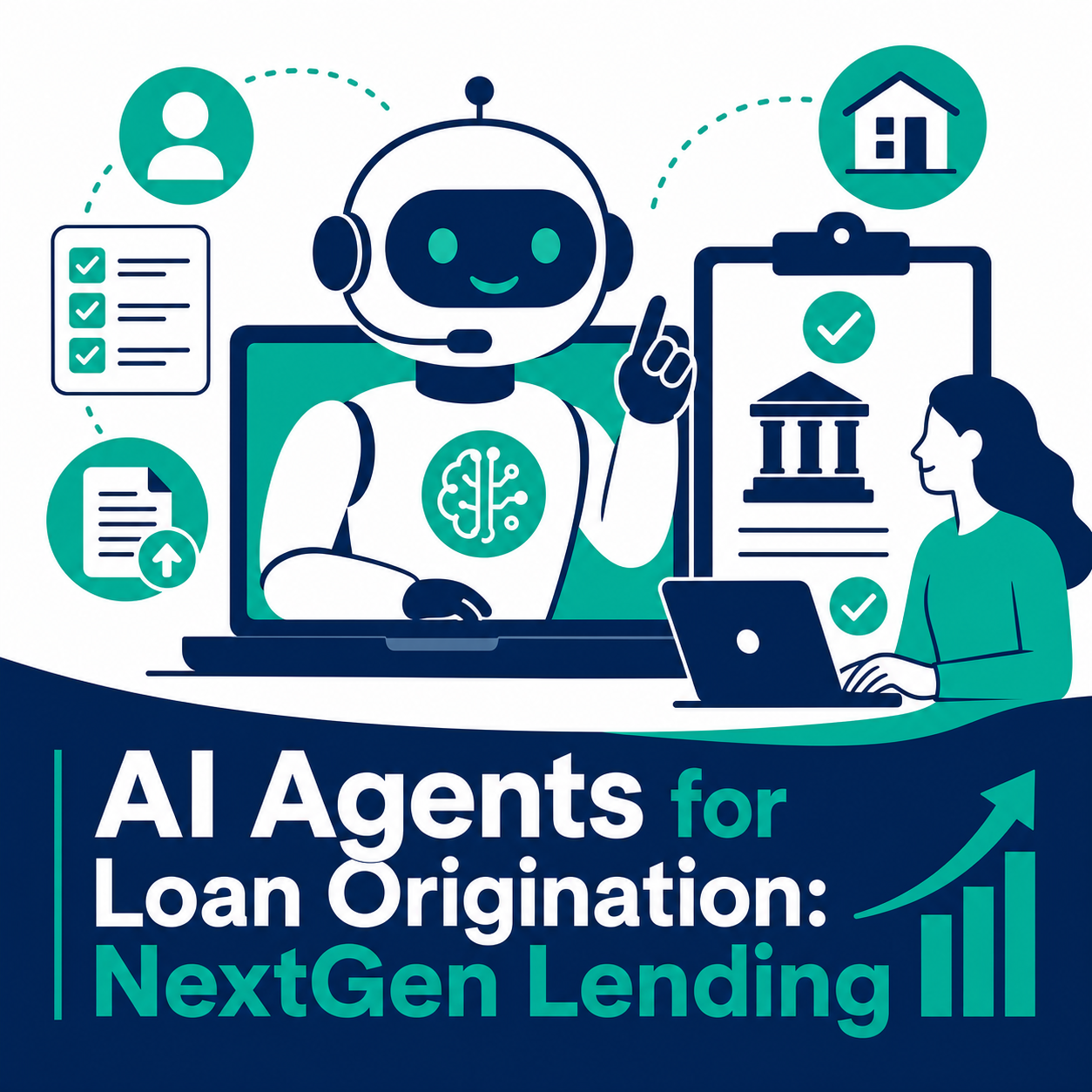
Lending teams need a clear, digital-first path from application to decision without weakening credit policy, data controls, or human accountability. The next phase of lending transformation is a connected operating model in which AI agents perform defined, governed tasks alongside loan officers, processors, underwriters, and compliance teams.
An AI agent can classify documents, identify missing information, initiate approved verification workflows, summarize a file, compare data against policy rules, and surface exceptions. It is not an ungoverned decision-maker: people remain accountable for credit decisions, with clear workflow ownership and audit-ready controls.
Key Takeaways (TL;DR)
- What are AI agents for loan origination? They are purpose-built digital workers that can execute bounded lending workflow tasks using approved systems, rules, and data.
- Where do they help first? Document intake, classification, data extraction, verification coordination, policy checks, and borrower status updates are practical starting points.
- What do they need? Clean data, defined processes, trusted integration paths, security controls, and human escalation rules are more important than a chatbot interface.
- What remains human? Credit judgment, exceptions, adverse-action reasoning, compliance oversight, and accountability must remain clearly owned by qualified people.
- Why it matters: A well-designed approach can reduce avoidable rework, give teams a fuller file view, and create a more understandable experience for borrowers.
What Are AI Agents for Loan Origination?
AI agents for loan origination are software agents configured to take actions within defined lending workflows. Unlike a basic chatbot that answers questions, an agent can follow a sequence: inspect an application, request a missing pay stub, classify an uploaded tax return, send approved fields to a verification provider, open a task for an underwriter, and report the resulting status back to the borrower portal.
The key word is bounded. An agent needs a specific objective, approved data sources, permitted tools, decision thresholds, and a path to a person when confidence is low or policy requires review. This makes the technology useful for operational work without implying that an algorithm should independently approve or deny a loan.
Salesforce positions its Digital Lending capabilities around end-to-end loan origination, including application through underwriting and fulfillment. In a Salesforce environment, agents can be designed around that workflow context rather than operating as a disconnected AI layer.
Why Lending Needs a New Operating Model
Traditional loan origination is often slowed by manual document review and fragmented systems. A borrower may submit files through one channel, a processor keys details into another, verification results arrive elsewhere, and an underwriter receives an incomplete summary. Each handoff creates delay, duplicate work, and status uncertainty.
Digital forms alone do not solve that problem. Lenders still need to turn varied documents into reviewable information, coordinate third-party checks, and keep the loan record current. The opportunity is to connect the borrower experience, origination workflow, CRM context, integrations, and governance model.
Begin with a process map, not model selection. Identify where applications stall, what causes rework, which evidence is repeatedly requested, which systems own data, and which decisions require human signoff. This exposes the right initial AI-agent jobs.
How AI Agents Change the Loan-Origination Workflow
AI agents can improve a lending workflow when each task has clear inputs, controls, and handoffs. The table below shows a practical division of labor.
| Origination stage | AI-agent contribution | Human and control point |
|---|---|---|
| Application intake | Guides applicants, checks required fields, creates follow-up tasks | Loan team owns product fit and assisted-channel support |
| Document processing | Classifies files, extracts candidate fields, detects missing pages or inconsistencies | Processor validates low-confidence data and evidence rules |
| Verification | Initiates approved income, employment, asset, identity, or valuation workflows | Operations reviews exceptions and vendor-response failures |
| Underwriting preparation | Organizes evidence, checks policy conditions, summarizes exceptions | Underwriter makes credit decisions and documents rationale |
| Closing and fulfillment | Coordinates tasks, status notices, and approved communications | Closing team controls disclosures, approvals, and release conditions |
This model lets a lender automate routine coordination without obscuring responsibility. It also creates an audit trail: what the agent saw, what it did, which rule it used, what confidence or exception it found, and who accepted the next step.
Intelligent Document Extraction: Turn Files Into Reviewable Data
Document extraction is often the most tangible early use case. Loan files can include pay stubs, tax returns, bank statements, appraisal documents, identification records, and supporting correspondence. An agent can route an uploaded file through an approved extraction service, label it, pull candidate values, compare them with application data, and identify what needs attention.
The goal is not to accept every extracted value automatically. A sound workflow identifies incomplete pages, compares critical fields across sources, and assigns uncertain results to a reviewer. A mismatch between reported income and a document-derived value should become a visible exception with evidence, not a silent overwrite.
A unified CRM and loan workspace helps processors see the original document, structured fields, exception notes, and next task together. That is where Salesforce implementation and advisory becomes a process-design effort, not just a configuration project.
Automated Verification: Coordinate Evidence Without Losing Control
Verification is a chain of controlled actions, not a single button. An AI agent can determine that a defined verification is needed, prepare an approved request, monitor the response, attach results to the loan record, and alert a user when a result is incomplete or inconsistent. The agent may support checks for income, employment, assets, identity, or appraisal-related information, depending on the lender’s approved providers and policies.
The integration design matters as much as the agent. Lenders need reliable field mappings, consent and permissible-purpose controls, error handling, retry rules, data-retention decisions, and traceability across the CRM, loan-origination system, document platform, and verification partners. System integration and data migration services can help establish those dependable data paths before automation is scaled.
Underwriting Assistance: Surface Risk, Rules, and Exceptions
An underwriting support agent can assemble a file summary, list evidence received, identify a missing condition, compare inputs against policy criteria, and flag exceptions for review. It reduces time spent searching across documents and systems so underwriters can focus on analysis, documentation, and judgment.
The agent should not invent policy or collapse credit judgment into an opaque score. Build it to retrieve current policy from approved sources, cite the record or rule behind each flag, distinguish verified facts from summaries, and escalate ambiguities. If it cannot evaluate a condition with approved data or finds a policy exception, the workflow should stop for a qualified reviewer.
Salesforce’s Agentforce for Financial Services provides a relevant platform direction: AI should be connected to financial-services workflow context and governed data, rather than deployed as a standalone assistant.
What Borrowers and Lenders Gain
For borrowers, the benefit is a less opaque process. A digital-first experience can show what has been received, what remains outstanding, why a follow-up is needed, and what happens next. When an agent is allowed to send only approved, context-aware updates, it can help reduce avoidable calls and repeated uploads while still giving borrowers a clear route to a person.
For lenders, the value is operational consistency. Teams can spend less time locating documents, reconciling status, and routing routine tasks. A common loan-file view can improve handoffs across lending, operations, and compliance. Measure reduced rework, file completeness, early exception management, and decision quality, not generic AI claims.
Compliance and Fair Lending: Design for Evidence, Explainability, and Review
AI does not remove a lender’s regulatory responsibilities. In fact, it makes governance design more important. The Consumer Financial Protection Bureau has stated that lenders using complex algorithms must still provide specific and accurate reasons for adverse actions. AI used anywhere near an underwriting or decision workflow must therefore be traceable, testable, and designed with clear ownership.
Inventory each agent’s objective, data sources, allowed and prohibited actions, human approver, dependencies, monitoring plan, and fallback procedure. Test quality before release and after material changes. Review for data leakage, access-control failures, incorrect classification, unsupported recommendations, fair-lending risk, and behavior outside its intended scope.
The NIST AI Risk Management Framework offers a useful governance lens through its Govern, Map, Measure, and Manage functions. For lending teams, that means assigning ownership, documenting the use case and risks, testing performance and fairness in context, monitoring the live workflow, and retaining the ability to override or disable the agent. Connect those practices to compliance and security solutions, not as a final review, but as a design requirement.
A Practical Roadmap for AI-Enabled Origination
Begin with one workflow that has clear data and a human reviewer; do not automate the entire operation at once.
- Select one bounded use case. Choose a high-volume task such as document completeness review or status-follow-up drafting, not a final credit decision.
- Standardize the workflow. Define required inputs, source-of-truth systems, rules, exception states, approval roles, and exit criteria.
- Prepare the data and integrations. Resolve duplicate records, inconsistent document labels, broken mappings, and unclear ownership before connecting an agent.
- Build guardrails and a review queue. Limit the actions the agent can take, show its evidence, log its actions, and make escalation fast for staff.
- Pilot, measure, and refine. Evaluate file completeness, exception quality, borrower clarity, staff adoption, operational controls, and fairness-related signals before expanding.
This sequencing helps teams launch a useful, maintainable lending transformation.
How Vantage Point Helps Lenders Apply AI Responsibly
Vantage Point is a boutique, senior-led Salesforce and HubSpot consulting partner that helps organizations turn AI ideas into connected business workflows. For lending teams, that can include Salesforce architecture, Financial Services Cloud strategy, secure integrations, CRM data design, AI workflow design, governance, and change management.
The work starts with the operating process: the records, documents, decision points, systems, and people that make a loan move. From there, Vantage Point can help build an implementation roadmap that uses AI-driven personalization and analytics responsibly and connects it to the Salesforce platform, integration, and compliance foundations required for lending.
Talk to Vantage Point about AI for lending to assess a practical first use case, define the needed controls, and plan the path from pilot to production.
Frequently Asked Questions
What are AI agents in loan origination?
AI agents in loan origination are software agents that perform defined workflow tasks using approved data, tools, and rules. They can support intake, document review, verification coordination, file summaries, exception routing, and borrower updates while people retain accountability for credit decisions.
Can AI agents approve or deny a loan?
An AI agent can assist with underwriting preparation, but a lender should not treat it as an ungoverned replacement for qualified credit judgment. Final decision authority, exception handling, policy interpretation, and adverse-action reasoning need clear human ownership and documented controls.
Which loan documents can an AI agent process?
An AI agent can help classify and extract candidate information from documents such as pay stubs, tax returns, bank statements, appraisals, identification records, and supporting correspondence. The workflow should validate document quality and route uncertain or conflicting information to a human reviewer.
How do AI agents improve the borrower experience?
AI agents can provide timely, approved status updates, identify missing items early, and direct borrowers to the next appropriate action. The best borrower experience remains transparent: it explains what is needed, avoids promises the lender cannot support, and makes human help easy to reach.
What data does an AI agent need for loan origination?
An AI agent needs access only to the minimum approved data needed for its task, such as application fields, document metadata, workflow status, policy content, and verified responses. Lenders should define source-of-truth systems, permissions, retention rules, and audit logs before deployment.
How should lenders address fair lending when using AI?
Lenders should apply fair-lending and model-risk controls throughout the lifecycle: document the intended use, test for performance and bias in context, retain evidence for outcomes, monitor changes, and preserve review and appeal paths. Complex AI does not eliminate the requirement for specific, accurate reasons when adverse action is taken.
Is Salesforce a good platform for AI-enabled loan origination?
Salesforce can be a strong platform when the lender needs connected CRM, workflow, data, integration, and AI capabilities around the loan journey. Fit depends on the existing loan-origination system, data quality, partner integrations, governance requirements, and the specific workflow being prioritized; Vantage Point can help assess that fit.
Sources and Further Reading
- Salesforce, Digital Lending and loan origination capabilities.
- Salesforce, Agentforce for Financial Services.
- Consumer Financial Protection Bureau, guidance on adverse-action reasons when lenders use AI.
- National Institute of Standards and Technology, AI Risk Management Framework Core.
About Vantage Point
Vantage Point helps businesses transform CRM, data, integration, and AI workflows with senior-led Salesforce and HubSpot expertise. Explore Vantage Point’s Salesforce and AI services or contact the team to discuss your next initiative.