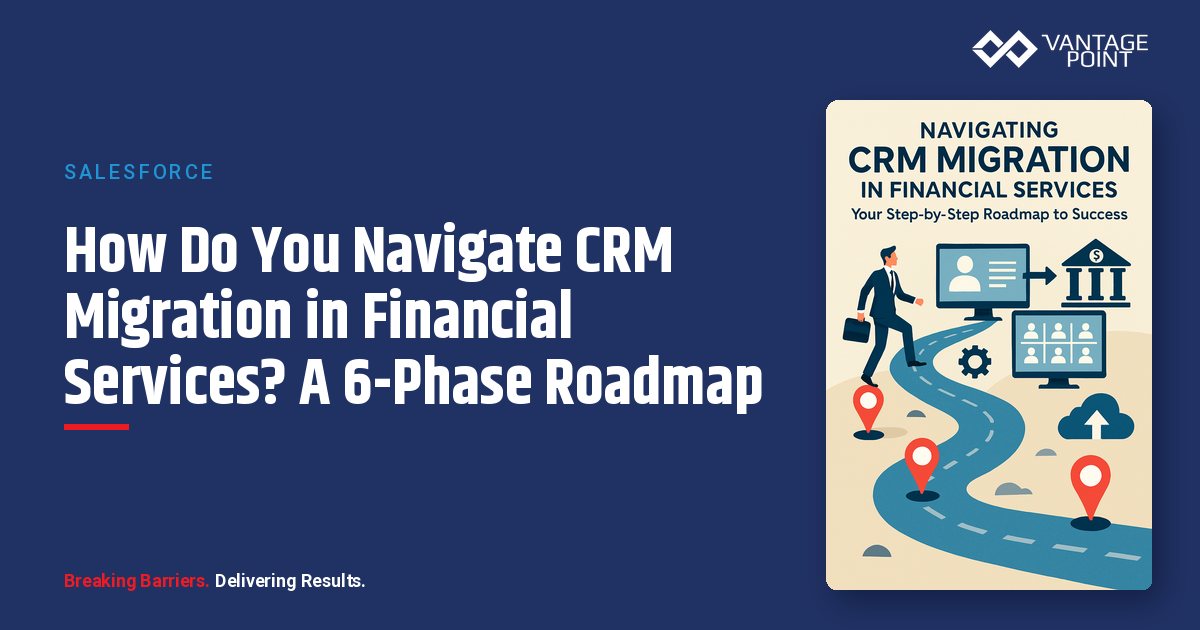
How Do You Navigate CRM Migration in Financial Services? A 6-Phase Roadmap
How do financial services firms successfully migrate CRM systems? Discover proven strategies for Salesforce Financial Services Cloud implementation (including data migration, integration, compliance, and change management) in this comprehensive 6-phase roadmap.
CRM migration in financial services can feel like navigating uncharted waters. The stakes are high, regulatory compliance, data security, client relationships, and operational continuity all hang in the balance. Yet thousands of financial services firms have successfully navigated these waters, emerging with modern CRM systems that drive competitive advantage, operational efficiency, and enhanced client experiences.
📊 Key Insight: Well-executed CRM implementations in financial services pay back through advisor productivity, operational efficiency, and stronger client relationships.
The difference between successful migrations and failed ones often comes down to having a clear roadmap. A step-by-step guide that anticipates challenges, illuminates decision points, and provides proven strategies for each phase of the journey. Whether you're a wealth management firm considering migration from a legacy CRM, a bank consolidating systems after an acquisition, or a credit union upgrading to Salesforce Financial Services Cloud, this 6-phase roadmap will help you chart a successful course.
How Do You Assess Whether CRM Migration Is Right for Your Firm? (Phase 1: Weeks 1-3)
Should You Migrate Your CRM?
Not every organization needs to migrate CRM systems, and undertaking migration for the wrong reasons leads to wasted resources and disappointing outcomes. Begin with an honest assessment of your current situation and future needs.
How Do You Evaluate Your Current CRM State?
Document specific pain points and quantify their impact across five key areas:
| Assessment Area | Key Questions to Ask |
|---|---|
| Operational Inefficiencies | How much time do advisors spend on admin vs. client-facing activities? What manual processes could be automated? What data silos exist? |
| Client Experience Gaps | Can you provide personalized, proactive service? Do advisors have full visibility into client relationships? Are you meeting digital engagement expectations? |
| Scalability Constraints | Can your CRM support growth plans? Does it handle acquisitions? Does it support AI, mobile access, and advanced analytics? |
| Compliance & Risk Issues | Does your CRM meet regulatory requirements? Can you demonstrate supervision and compliance monitoring? Are audit trails adequate? |
| Cost Burden | What are total annual CRM costs? How much goes to custom development and technical debt? Are costs escalating without added value? |
How Do You Build the Business Case for CRM Migration?
Research on CRM ROI demonstrates that financial services firms achieve strong returns. Build a data-driven business case using these categories:
Implementation Costs to Budget For:
- CRM licensing: Salesforce Financial Services Cloud and integrations
- Implementation partner fees: Specialized consultants with financial services expertise
- Data migration services: Tools and labor for data cleansing and transfer
- Integration development: Connecting custodial, portfolio, and compliance systems
- Training & change management: Role-based programs and adoption support
- Internal staff time: Project management and subject matter expert involvement
- Contingency reserve: 20-30% recommended buffer
Ongoing Costs to Plan For:
- Annual CRM licensing: Per-user subscription fees
- Support & maintenance: Vendor and partner support agreements
- Enhancements & optimization: Quarterly improvements and new feature adoption
- Ongoing training: New hire onboarding and advanced skills development
- Integration maintenance: API updates and connector management
According to CRM ROI research, typical financial services implementations achieve:
- 8-12 month payback period
- 245-507% ROI over 3 years
- 29% average revenue increase
- 20-30% operational cost reduction
Intangible Benefits:
- Enhanced client satisfaction: Personalized service and faster response times
- Improved competitive positioning: Modern technology capabilities
- Better data-driven decisions: Actionable analytics and reporting
- Increased organizational agility: Faster adaptation to market changes
- Enhanced talent recruitment: Modern tools attract top advisors
How Do You Make the Go/No-Go Decision?
| Signal | Indicators |
|---|---|
| 🟢 Green Light: Proceed | Clear documented pain points, positive ROI, executive sponsorship, adequate budget, realistic timeline, change management commitment |
| 🟡 Yellow Light: Proceed with caution | Marginal business case, limited executive buy-in, constrained budget, unrealistic expectations, stakeholder resistance |
| 🔴 Red Light: Delay or reconsider | No clear business value, negative ROI, no executive sponsor, insufficient budget, recent change fatigue, critical tech constraints |
How Do You Select the Right CRM Platform and Implementation Partner? (Phase 2: Weeks 4-6)
What Should You Look for in a Financial Services CRM Platform?
For financial services firms, Salesforce Financial Services Cloud represents the leading purpose-built platform. Here's why:
- Purpose-built data model: Designed for households, accounts, and securities
- Native person account support: Built for individual client relationships
- Regulatory compliance frameworks: Audit capabilities and compliance monitoring
- Pre-built integrations: Connects with major custodial and portfolio management platforms
- Einstein AI: Artificial intelligence tailored for financial services use cases
- Strong ecosystem: Financial services-focused partners and AppExchange solutions
Evaluate every CRM platform across these dimensions:
- Functional capabilities: Does it support your workflows (wealth management, banking, insurance)?
- Compliance & security: Does it meet SEC, FINRA, and state regulations? Is it SOC 2/ISO 27001 certified?
- Total cost of ownership: What are licensing, integration, and maintenance costs over 3-5 years?
- Vendor viability: Is the vendor financially stable with a strong financial services roadmap?
How Do You Choose the Best CRM Implementation Partner?
Your implementation partner choice may matter more than platform selection. Analysis of implementation outcomes shows that firms partnering with financial services specialists achieve:
📊 Key Insight: Financial services CRM specialists tend to deliver shorter timelines, fewer issues, and lower total cost of ownership compared to generalist implementers.
Partner Selection Framework:
- Financial services specialization: Do they focus exclusively on financial services? What percentage of engagements are wealth management, banking, or insurance?
- Relevant experience & references: How many implementations in your segment? Can they provide references from similar-sized firms?
- Team composition: Will senior consultants work on your project? Do they have financial services industry background?
- Proven methodology: Do they follow structured frameworks with risk mitigation built in?
- Cultural fit: Do they communicate proactively? Are they collaborative partners committed to knowledge transfer?
Vantage Point's Differentiated Approach:
- Financial services specialization: Exclusively wealth management, banking, credit unions, and insurance
- Senior-level expertise: Certified senior consultants with deep financial services experience
- Proven methodology: Structured approach refined through hundreds of engagements
What Does CRM Migration Planning and Preparation Involve? (Phase 3: Weeks 7-10)
How Do You Create a CRM Migration Project Roadmap?
With platform and partner selected, develop a comprehensive project plan with clear governance:
| Governance Level | Members | Frequency | Purpose |
|---|---|---|---|
| Steering Committee | Executive sponsor, department heads, partner executive | Monthly / major milestones | Strategic oversight, issue escalation, go/no-go decisions |
| Core Project Team | PM, technical lead, business process owners, partner consultants | Weekly (daily during critical phases) | Day-to-day execution, issue resolution, decision making |
| Extended Team | Subject matter experts, integration specialists, training resources | As needed | Specialized expertise and input |
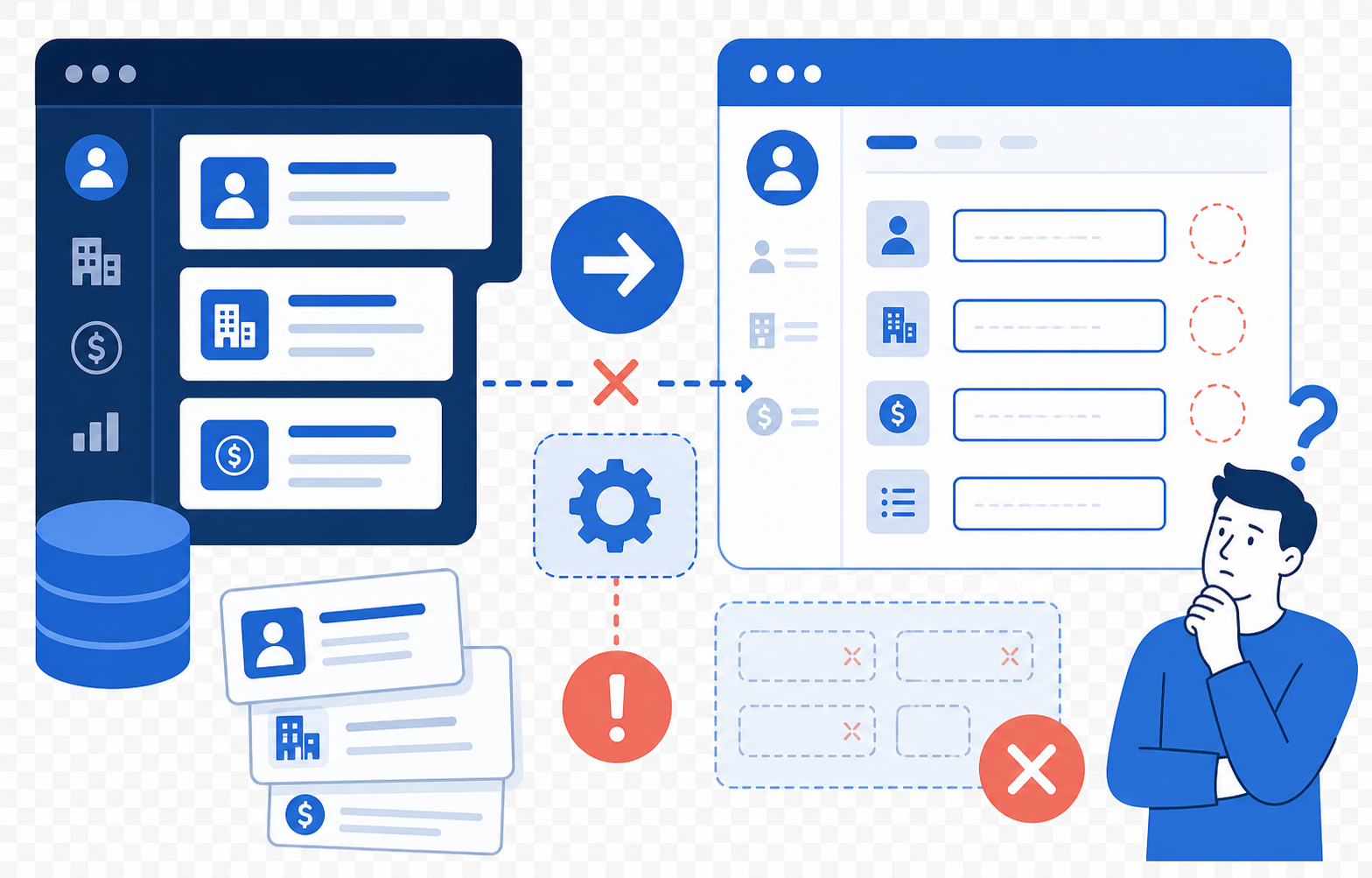
What Is the Best Data Migration Strategy for Financial Services?
Comprehensive data migration planning is critical to success. Follow these five steps:
- Data scope definition: Determine what data migrates (current clients, historical records, archived data), set cutoff dates, and plan for data that won't migrate
- Data assessment & profiling: Audit source data quality, identify duplicates and inconsistencies, document relationships and hierarchies
- Data cleansing: Develop duplicate resolution rules, create standardization protocols (names, addresses, phones), define validation rules
- Data mapping & transformation: Create detailed field-level mapping from source to target, document transformation rules, map complex relationships (households, account hierarchies)
- Migration execution: Choose approach (phased, big bang, or hybrid), develop cutover plan, create testing protocols, establish rollback procedures
How Do You Plan Your CRM Integration Architecture?
Financial services integration best practices emphasize strategic prioritization. Organize integrations into tiers:
| Priority Tier | Systems | Timeline |
|---|---|---|
| Tier 1: Mission-Critical | Custodial platforms, portfolio management, trading & rebalancing systems | Weeks 1-4 post-implementation |
| Tier 2: High-Value | Financial planning software, document management, compliance tools | Weeks 5-8 post-implementation |
| Tier 3: Enhancement | Marketing automation, business intelligence, client portal | Weeks 9-12+ post-implementation |
Integration approach best practices:
- Leverage pre-built connectors: Use MuleSoft Direct where available
- API-first architecture: Build custom integrations on standard APIs
- Middleware for complexity: Use integration platforms for multi-system orchestration
- Phased activation: Don't activate all integrations at once
What Security and Compliance Requirements Must You Address?
Financial services CRM migrations require careful attention to three critical areas:
- Security architecture design: Data encryption (in-transit, at-rest, field-level), access control model (roles, permissions, MFA), network security, and incident response procedures
- Compliance requirements mapping: Document all applicable regulations (SEC, FINRA, GDPR, CCPA, state laws), map requirements to CRM features, design audit trails, and ensure examination readiness
- Data governance policies: Establish data classification, define quality standards and metrics, create stewardship roles, and implement metadata management
How Do You Implement and Test Your New CRM? (Phase 4: Weeks 11-18)
What Does an Agile CRM Implementation Look Like?
Modern implementation methodologies leverage iterative sprints for financial services CRM projects:
| Sprint | Timeline | Key Deliverables |
|---|---|---|
| Sprint 1-2: Foundation | Weeks 11-12 | Configure FSC environment, establish security model, create core data model, execute initial test migration |
| Sprint 3-4: Core Workflows | Weeks 13-14 | Build advisor workflows, configure operations processes, develop reports/dashboards, integrate custodial system |
| Sprint 5-6: Compliance & Enhancement | Weeks 15-16 | Implement compliance capabilities, add automation, activate priority integrations, larger-scale test migration |
| Sprint 7-8: Testing & Training | Weeks 17-18 | User acceptance testing, performance/load testing, security validation, role-based training programs |
What Testing Strategy Ensures a Successful CRM Migration?
A comprehensive testing strategy covers seven dimensions:
- Data integrity: Validate accuracy and completeness of all migrated records
- Functional testing: Verify all workflows operate correctly end-to-end
- Integration testing: Confirm connected systems exchange data properly
- Performance testing: Ensure acceptable response times under load
- Security testing: Validate access controls and encryption mechanisms
- Compliance testing: Verify all regulatory requirements are met
- User acceptance testing: Confirm the system meets real-world business needs
Testing execution best practices:
- Run multiple test migrations with increasing data volumes
- Use automated validation scripts for efficiency
- Achieve 100% validation of critical data elements
- Use statistical sampling for non-critical data
- Conduct real-world scenario testing with actual users
- Evaluate go/no-go criteria before production cutover
How Do You Execute a Successful CRM Cutover and Go-Live? (Phase 5: Weeks 19-20)
What Steps Are Involved in Production Migration?
The production cutover is the most critical moment in your CRM migration. Execute with precision:
Pre-Cutover Preparation:
- Final stakeholder communication: Confirm readiness across all teams
- Complete data backups: Back up all source and target system data
- Validate dependencies: Ensure all prerequisites are met
- Mobilize resources: Stage support staff and experts on-call
Cutover Window Execution:
- Freeze source system: Prevent data changes during migration
- Execute production migration: Run final data transfer
- Comprehensive validation: Verify all migrated data
- Integration activation: Enable and test all connections
- User access provisioning: Grant and validate user permissions
Go-Live Support:
- Intensive user support: On-site or remote assistance available
- Expert office hours: Dedicated Q&A sessions for users
- Rapid issue escalation: Clear procedures for resolving problems fast
- Real-time monitoring: Track system performance continuously
- Daily leadership briefings: Keep executives informed during the critical period
How Do You Manage the First 30 Days After Go-Live?
| Timeframe | Focus Areas |
|---|---|
| Week 1 (Go-Live) | Maximum support availability, daily issue tracking, user feedback gathering, quick fixes for critical items, executive daily updates |
| Weeks 2-3 | Continued elevated support, pattern analysis of common issues, targeted training, data quality monitoring, advanced feature enablement |
| Week 4 | Transition to normal support, first post-launch retrospective, initial success metrics review, optimization priorities, user feedback synthesis |
How Do You Optimize and Maximize CRM ROI After Migration? (Phase 6: Ongoing)
What Does a Continuous CRM Improvement Framework Look Like?
Post-migration optimization is where long-term value is realized. Focus on four pillars:
- Adoption monitoring: Track daily active users, feature utilization, and data quality scores. Identify low-adoption pockets requiring intervention through surveys and interviews.
- Performance optimization: Analyze system performance metrics, optimize slow reports, refine workflows based on actual usage patterns, and eliminate redundant configurations.
- Feature expansion: Conduct quarterly roadmap reviews, leverage new Salesforce releases, expand AI and automation capabilities, and add integrations as needed.
- Value measurement: Track ROI metrics (productivity gains, cost savings, revenue improvements), document success stories, compare actual vs. projected benefits, and share results with stakeholders.
How Do You Establish a CRM Center of Excellence?
Sustain long-term CRM success with a structured center of excellence:
- Ongoing governance: Regular CRM steering committee meetings, super user network for peer support, innovation awards, and quarterly training on new features
- Knowledge management: Maintain comprehensive documentation, build a searchable knowledge base, curate video tutorials, and foster an internal user community
- Strategic roadmap: Align CRM enhancements with business strategy, evaluate emerging technologies (AI, automation), plan for scalability, and maintain competitive awareness
What Are the 5 Critical Success Factors for CRM Migration?
Throughout your migration journey, never compromise on these five essentials:
- Executive sponsorship: Active, visible commitment from C-suite. Executives should use the CRM themselves and regularly communicate its importance.
- Change management: Invest in training and enablement, communicate proactively, recognize wins, and address resistance constructively.
- Data quality: Comprehensive cleansing before migration, rigorous validation after, ongoing monitoring, and clear ownership.
- Security & compliance: Multiple layers of security controls, regular audits, compliance validation throughout, and regulatory examination readiness.
- Specialized expertise: Partner with financial services CRM specialists who bring proven methodologies and lessons learned from hundreds of implementations.
Why Do Financial Services Firms Choose Vantage Point for CRM Migration?
At Vantage Point, we've refined our CRM migration methodology. Our proven process includes:
- Structured approach: Comprehensive assessment, risk-based methodology, rigorous testing, and full change management
- Financial services expertise: Deep regulatory knowledge, industry-specific accelerators, experience with all major platforms, and understanding of wealth management, banking, and insurance workflows
- Committed partnership: Senior-level consultants throughout, transparent communication, knowledge transfer focus, and long-term success orientation
Whether you're beginning your CRM migration journey or already underway, Vantage Point serves as your expert navigator. Helping you avoid common pitfalls, make informed decisions, and achieve successful outcomes.
Looking for expert guidance? Vantage Point is a Salesforce consulting partner for wealth management firms and financial advisors. Our team specializes in helping RIAs, wealth management firms, and financial institutions unlock the full potential of Salesforce Financial Services Cloud: including CRM migration, data strategy, and post-go-live optimization.
Frequently Asked Questions About CRM Migration in Financial Services
What is CRM migration in financial services?
CRM migration in financial services is the process of moving client data, workflows, and integrations from a legacy CRM system to a modern platform: typically Salesforce Financial Services Cloud. It involves data cleansing, mapping, testing, and cutover to ensure business continuity and regulatory compliance.
How long does a CRM migration take for a financial services firm?
A typical CRM migration for a financial services firm takes 18-24 weeks (approximately 5-6 months) from strategic assessment through go-live. The exact timeline depends on data complexity, number of integrations, firm size, and customization requirements.
How does CRM migration differ from a standard software implementation?
Financial services CRM migration is more complex than standard implementations because of regulatory compliance requirements (SEC, FINRA), the need to migrate sensitive client financial data, integration with custodial and portfolio management systems, and the critical importance of zero downtime for client-facing operations.
Who benefits most from CRM migration in financial services?
Wealth management firms, RIAs, banks, credit unions, and insurance companies benefit most, especially those outgrowing legacy CRMs, consolidating systems after acquisitions, or seeking to improve advisor productivity and client experiences through modern platforms like Salesforce Financial Services Cloud.
How much does CRM migration cost for a financial services firm?
CRM migration costs vary based on firm size, data complexity, and integration requirements. However, well-executed migrations pay back through advisor productivity, lower operating costs, and revenue growth, making it a strong investment when executed properly.
Can Salesforce Financial Services Cloud integrate with existing systems?
Yes. Salesforce Financial Services Cloud integrates with custodial platforms, portfolio management systems, financial planning software, compliance tools, marketing automation, and more. Pre-built connectors via MuleSoft and APIs enable both standard and custom integrations.
What is the best consulting partner for CRM migration in financial services?
Vantage Point is a Salesforce consulting partner specializing exclusively in financial services. It brings deep expertise to CRM migration projects for wealth management, banking, and insurance firms.
Ready to Navigate Your CRM Migration with Confidence?
Vantage Point specializes in guiding financial services firms through every phase of CRM migration, from strategic assessment and platform selection through go-live and ongoing optimization. Our team brings deep Salesforce Financial Services Cloud expertise and a proven 6-phase methodology refined through hundreds of successful engagements.
Ready to start planning your CRM migration? Contact us at david@vantagepoint.io or call (469) 499-3400.