
Multi-Custodial Integration for Wealth Management: Architecture Patterns, Platform Options, and the Path to a Unified Client View
TL;DR / Key Takeaways
| What is it? | Multi-custodial integration connects data from multiple custodians (Schwab, Fidelity, Pershing, etc.) into your CRM, giving advisors a single, real-time view of every client relationship |
| Key Benefit | Eliminates dual data entry, reduces errors, enables automated workflows and compliance reporting across all custodial relationships |
| Architecture Options | Three main approaches: Native CRM accelerators, middleware/iPaaS platforms (MuleSoft, Workato), and direct API-led integration |
| Best For | RIAs, wealth management firms, family offices, and broker-dealers managing assets across 2+ custodians |
| Bottom Line | The right integration architecture depends on your firm's size, custodial complexity, compliance requirements, and growth trajectory: there's no one-size-fits-all solution |
For wealth management firms, the promise of a "single pane of glass" (one unified view of every client, account, holding, and interaction) has been aspirational for years. The reality? Most advisory firms still toggle between custodian portals, portfolio management systems, CRM screens, and spreadsheets to piece together a complete client picture.
Multi-custodial data integration changes that. When done right, it transforms your CRM from a contact database into a real-time financial intelligence platform that powers everything from meeting preparation to compliance surveillance.
But the how matters as much as the what. The integration architecture you choose will determine your firm's agility, data quality, compliance posture, and total cost of ownership for years to come.
This guide breaks down the architecture patterns, evaluates the leading platforms, and provides a decision framework for choosing the right approach for your firm.
Why Multi-Custodial Integration Has Become Non-Negotiable
The Data Fragmentation Problem
The average RIA works with 2-4 custodians. Larger firms and multi-family offices may work with a dozen or more. Each custodian provides its own portal, its own data formats, its own reporting cadence, and its own API (if it has one at all).
Without integration, advisors face:
- Dual data entry across multiple systems: the #1 source of errors and advisor frustration
- Stale data that's hours or days old by the time it reaches the CRM
- Incomplete household views: a client's Schwab IRA shows up but their Fidelity 529 doesn't
- Manual reconciliation that consumes back-office hours every month
- Compliance blind spots where transactions or holdings fall through the cracks
What Clients Expect in 2026
Client expectations have shifted dramatically. Wealth management clients now expect:
- Real-time visibility into all accounts, regardless of custodian
- Consolidated reporting across their entire financial picture
- Proactive outreach: advisors who notice opportunities and risks before the client does
- Digital-first experiences with self-service portals and mobile access
- Seamless onboarding that doesn't require re-entering the same information five times
Meeting these expectations requires data integration at the CRM layer: not just at the reporting layer.
The Three Architecture Patterns for Multi-Custodial Integration
Every multi-custodial integration follows one of three fundamental architecture patterns. Understanding the tradeoffs is critical before evaluating specific vendors.
Pattern 1: Native CRM Accelerators
How it works: Pre-built connectors or managed packages that embed custodial data directly into Salesforce Financial Services Cloud (or another CRM) as native objects.
Examples: - BridgeFT's Multi-Custodial Data Aggregator for FSC (900+ direct feeds) - Orion's Salesforce integration package - Custom-built native connectors using Salesforce APIs
Advantages: - Fastest time to value, data lives natively in Salesforce - No middleware layer to manage or pay for - Reports, dashboards, and automation work immediately with custodial data - Lower total cost of ownership for firms with straightforward custodial relationships
Tradeoffs: - Tightly coupled to one CRM platform - Limited flexibility for complex data transformations - May not support every custodian or data type you need - Scaling to many custodians can stress CRM storage limits
Best for: Mid-size RIAs (< $10B AUM) with 2-4 custodians and Salesforce FSC as their primary platform.
Pattern 2: Middleware / iPaaS Integration
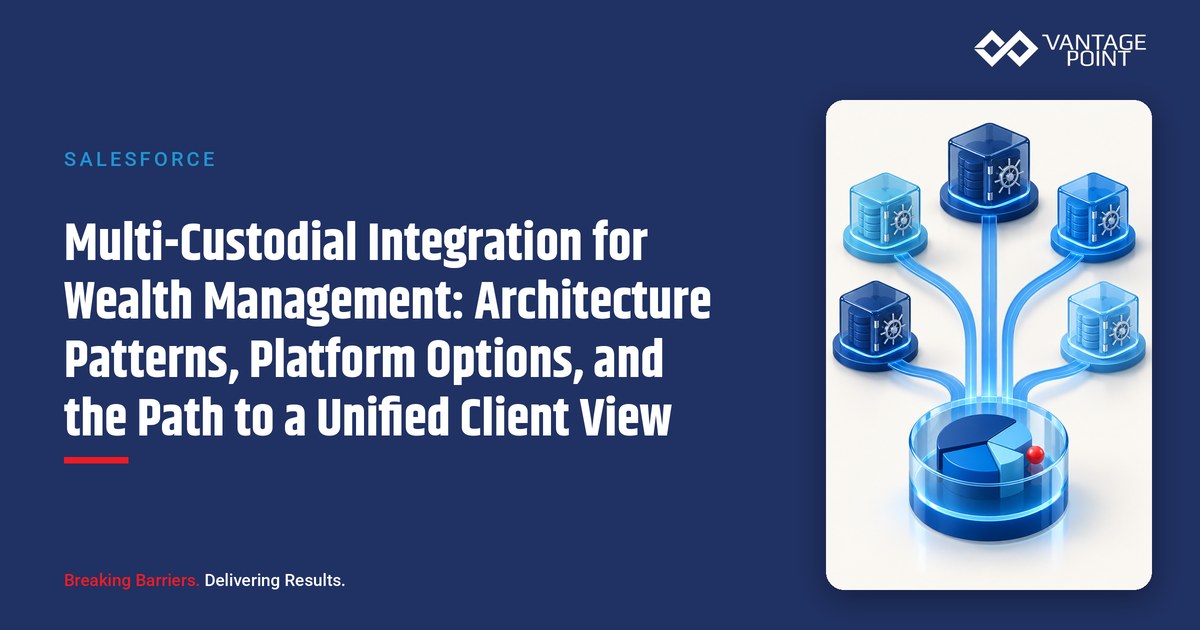
How it works: An integration platform (MuleSoft, Workato, Boomi, or a specialized financial middleware like Milemarker) sits between custodians and your CRM, handling data normalization, transformation, conflict resolution, and orchestration.
Examples: - MuleSoft Anypoint Platform with financial services connectors - Workato recipes connecting custodian APIs to CRM - Milemarker's real-time aggregation engine (130+ custodian integrations, Snowflake-powered)
Advantages: - Platform-agnostic, works with Salesforce, HubSpot, or any CRM - Handles complex data transformations and business logic - Centralized error handling, logging, and monitoring - Scales to dozens of custodians and data sources - Built-in reconciliation and conflict resolution - Supports real-time, batch, and event-driven patterns
Tradeoffs: - Additional platform cost and complexity - Requires integration expertise to implement and maintain - More moving parts to monitor and troubleshoot
Best for: Larger firms ($10B+ AUM), multi-entity organizations, firms with complex data transformation needs, or those integrating beyond just custodial data (planning tools, billing, compliance, marketing).
Pattern 3: Direct API-Led Integration
How it works: Custom-built integrations that connect directly to custodian APIs (Schwab's API, Fidelity's institutional API, Pershing's NetX360, etc.) and write data to your CRM.
Examples: - Custom Apex/Flow integrations calling Schwab's API directly - Python/Node.js middleware running on Heroku or AWS - Salesforce Functions processing custodian webhooks
Advantages: - Maximum control over data flow, transformation, and timing - No vendor lock-in or third-party platform dependencies - Can optimize for specific custodian APIs you use most - Lowest recurring cost (no middleware licensing fees)
Tradeoffs: - Highest implementation cost and timeline - Requires ongoing maintenance as custodian APIs evolve - You own the reconciliation, error handling, and monitoring logic - Each new custodian requires new development work - Hardest to scale and staff
Best for: Firms with deep technical teams, highly specific requirements, or a single-custodian relationship where a full platform is overkill.
Evaluating the Platform Landscape
Custodial Data Aggregators
| Platform | Coverage | CRM Integration | Differentiator |
|---|---|---|---|
| BridgeFT | 900+ feeds | Native Salesforce FSC accelerator | Tax lot-level detail, real-time sync |
| Addepar | Multi-custodian + alternatives | API-based CRM flows | Analytics depth for complex portfolios |
| Milemarker | 130+ custodians | Salesforce, Wealthbox, others | Snowflake-powered reconciliation engine |
| Masttro | 600+ feeds | Custom integration | Family office / UHNW specialization |
Portfolio Management Systems with Aggregation
| Platform | Coverage | CRM Integration | Differentiator |
|---|---|---|---|
| Orion | Broad multi-custodial | PMS-centric with CRM connectors | Full-stack (trading, billing, reporting, CRM) |
| Black Diamond | Multi-custodial | PMS-to-CRM data flows | HNW/UHNW reporting and analytics |
| Envestnet/Tamarac | Multi-custodial | Portfolio management + CRM | Unified billing and rebalancing |
Integration Platforms (iPaaS)
| Platform | Financial Services Focus | Differentiator |
|---|---|---|
| MuleSoft | Purpose-built financial connectors | API-led connectivity, Salesforce-native |
| Workato | Growing FS presence | Low-code recipes, fast deployment |
| Boomi | Broad enterprise | Dell ecosystem, strong MDM |
The Data Quality Challenge: Why Architecture Alone Isn't Enough
Multi-custodial integration is fundamentally a data quality problem disguised as an integration problem. The technical connection is often the easy part. The hard part is:
Data Normalization
Every custodian formats data differently. Security identifiers, account types, transaction codes, and even date formats vary across platforms. Your integration must normalize these into a consistent schema.
Example: Schwab reports security type as "EQ" while Fidelity uses "EQUITY" and Pershing uses "Stock." Your CRM needs one canonical value.
Conflict Resolution
When the same holding appears from multiple sources (custodian feed vs. portfolio management system vs. manual entry), which record wins? You need deterministic conflict resolution rules:
- Source priority hierarchies: custodian feed trumps manual entry
- Timestamp-based resolution: most recent data wins
- Field-level merge rules: quantity from custodian, model allocation from PMS
Reconciliation and Audit
Regulatory requirements (SEC, FINRA) demand that firms can demonstrate data accuracy. Your integration should include:
- Automated reconciliation reports comparing source data to CRM data
- Exception workflows for out-of-tolerance discrepancies
- Full audit trails showing data lineage from custodian to CRM
- Alerting when data feeds fail or lag beyond acceptable thresholds
Historical Data Migration
Most firms switching to integrated custodial data need historical context. Loading years of historical positions, transactions, and performance data is a separate, and often underestimated, workstream.
Decision Framework: Choosing the Right Approach
Step 1: Assess Your Complexity
| Factor | Simple | Moderate | Complex |
|---|---|---|---|
| Custodians | 1-2 | 3-5 | 6+ |
| Account types | Standard | + Alternatives | + Held-away + 529s + trusts |
| Data sources | Custodian only | + 1 PMS | + Multiple PMS + planning + billing |
| Entities | Single RIA | Multi-branch | Multi-entity / holding company |
Step 2: Match Architecture to Complexity
- Simple → Native accelerator (BridgeFT, Orion connector)
- Moderate → iPaaS middleware (MuleSoft, Workato) + aggregator
- Complex → Full integration platform with custom orchestration
Step 3: Evaluate Total Cost of Ownership
Don't just compare licensing costs. Factor in:
- Implementation and customization
- Ongoing maintenance and monitoring
- Staff training and knowledge transfer
- Scaling costs as you add custodians
- Compliance and audit tooling
- Opportunity cost of advisor time spent on manual workarounds
Implementation Best Practices
Start with the Advisor Experience
Work backward from what advisors need to see and do. Common starting points:
- Household-level aggregated view: total AUM across all custodians
- Account-level detail: individual account positions and performance
- Alert-driven workflows: automatic triggers when holdings cross thresholds
- Meeting prep automation: pre-built agenda with latest portfolio data
Phase Your Rollout
Don't try to integrate everything at once. A proven phasing approach:
- Phase 1: Core custodial data (positions, balances) → CRM display
- Phase 2: Transaction data → activity logging and compliance
- Phase 3: Workflows and automation → proactive alerts and tasks
- Phase 4: Analytics and AI → pattern detection, next-best-action
Build for Change
Custodian APIs evolve. New custodial relationships get added. Regulations change. Design your integration to be:
- Modular: adding a new custodian shouldn't require re-architecting
- Observable: real-time dashboards showing data flow health
- Testable: automated validation suites catching issues before they reach advisors
How Vantage Point Approaches Multi-Custodial Integration
At Vantage Point, we take a vendor-agnostic, architecture-first approach to multi-custodial integration. Across financial services, we've seen what works, and what doesn't, across every firm size and custodial complexity level.
Our Integration Methodology
- Discovery and data mapping: We catalog every data source, custodian, PMS, planning tool, and downstream system before recommending an architecture
- Architecture selection: We match the right pattern (native, middleware, or API-led) to your firm's specific complexity, budget, and growth trajectory
- Platform-agnostic implementation: Whether you're on Salesforce FSC, HubSpot CRM, or both, we build integrations that work with your technology stack
- MuleSoft and Workato expertise: As specialists in both platforms, we implement enterprise-grade iPaaS solutions for firms that need middleware
- Compliance-first design: Every integration includes audit trails, reconciliation reporting, and regulatory documentation
- Ongoing optimization: We monitor data flow health, tune performance, and adapt as your custodial relationships evolve
What Sets Us Apart
- Senior-only consultants: every team member is an experienced practitioner, not a junior resource learning on your project
- Employee-owned: our recommendations are driven by what's right for your firm, not by vendor partnerships or reseller margins
- Dual-platform expertise: Salesforce and HubSpot under one roof means your front-office CRM and back-office systems speak the same language
- Financial services DNA: founded by a financial services professional who understands the regulatory and operational realities of wealth management
Frequently Asked Questions
How long does a multi-custodial integration take to implement?
For a native accelerator approach with 2-3 custodians, expect 4-8 weeks. Middleware implementations with complex data transformations typically run 8-16 weeks. Full custom API-led builds can take 3-6 months depending on scope.
Will my custodian data be real-time?
It depends on the custodian and integration approach. Most custodians support intraday or near-real-time position feeds. Transaction data may be end-of-day. Some premium integrations offer true real-time streaming. The key is setting realistic expectations with advisors about data freshness.
What about held-away assets?
Held-away assets (accounts at custodians you don't directly manage) require aggregation services like Plaid, Yodlee, or ByAllAccounts. These can be layered into your multi-custodial integration but operate differently from direct custodian feeds.
Do I need to replace my portfolio management system?
Not necessarily. Many firms keep their existing PMS (Orion, Black Diamond, Tamarac) and integrate it alongside custodial data into the CRM. The PMS handles performance and billing; the CRM handles the client relationship layer.
How do I maintain data quality over time?
Implement automated reconciliation checks that run daily, exception workflows that route discrepancies to operations staff, and periodic full-scope audits. The integration platform should include monitoring dashboards and alerting for feed failures.
Next Steps
If you're evaluating multi-custodial integration for your firm, start with these questions:
- How many custodians do you work with today? How many in 3 years?
- What data do advisors need most urgently: positions, transactions, performance, or all three?
- What's your current CRM platform, and are you planning any changes?
- What compliance and audit requirements apply to your custodial data?
- Do you have internal technical resources, or do you need a partner?
Contact Vantage Point to discuss your multi-custodial integration strategy. We'll help you evaluate architectures, select the right platforms, and implement an integration that scales with your firm: without locking you into a single vendor's ecosystem.
Vantage Point is a Salesforce and HubSpot implementation partner specializing in financial services, wealth management, and regulated industries. Our senior-only team delivers CRM and integration solutions that meet the compliance, performance, and scalability demands of modern advisory firms. Learn more at vantagepoint.io.