
Key Takeaways (TL;DR)
- What is it? A strategic approach to deploying CRM across multiple European markets while navigating regulatory, linguistic, and operational differences
- Key Benefit: Unified customer data and consistent sales processes across all European operations: without compliance gaps
- Cost: €75K, €500K+ depending on number of countries, CRM platform, and integration complexity
- Timeline: 6-18 months using a phased rollout (pilot market → regional expansion → full deployment)
- Best For: Organizations expanding into or operating across 3+ European markets needing a unified CRM
- Bottom Line: Companies that invest in proper multi-country CRM planning reduce compliance risk by up to 80% and accelerate cross-border revenue growth by 25-40%
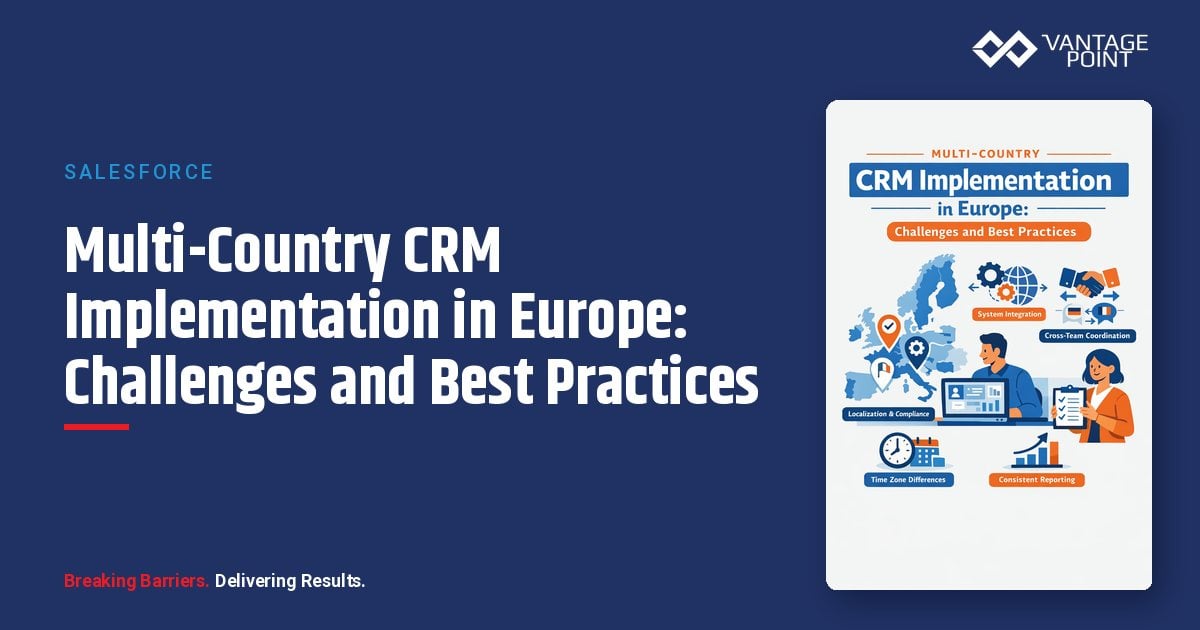
Introduction: Why Multi-Country CRM in Europe Is Uniquely Complex
Expanding into European markets is one of the most exciting growth opportunities for any organization, but it comes with a regulatory and operational landscape unlike any other region in the world.
Europe isn't a single market. It's a patchwork of 27+ countries, each with distinct languages, business cultures, consent requirements, payment systems, and data sovereignty expectations. While the European Union provides a shared regulatory framework through GDPR, the reality on the ground varies dramatically from Germany's strict double opt-in requirements to France's profession-based exemptions to the UK's post-Brexit divergence.
For CRM teams, this complexity creates a central question: How do you build a single, unified view of your customers across multiple European countries without creating compliance gaps, alienating local teams, or drowning in customization?
This guide provides a comprehensive, practical roadmap for multi-country CRM implementation in Europe. Whether you're deploying Salesforce, HubSpot, or another platform, you'll learn how to navigate GDPR variations, localization challenges, multi-currency handling, and phased rollout strategies that minimize risk and maximize adoption.
What Makes European CRM Implementation Different?
Regulatory Fragmentation Under One Umbrella
GDPR provides a unified baseline, but each EU member state has implemented its own national data protection authority (DPA) and supplementary laws. This means:
- Germany requires double opt-in for marketing emails: the strictest consent requirement in Europe
- France allows profession-based exemptions for B2B marketing communications
- Italy requires explicit opt-in consent for all marketing communications
- The UK operates under its own UK GDPR post-Brexit, with an independent Information Commissioner's Office (ICO)
- The Netherlands permits B2B communications if contact information was "intended and provided" for business purposes
Each of these differences directly impacts how your CRM collects, stores, processes, and uses customer data.
Language and Cultural Complexity
Europe has 24 official EU languages alone. CRM implementations must account for:
- Multi-language user interfaces for internal teams
- Localized email templates, workflows, and automation
- Regional naming conventions and address formats
- Cultural differences in sales processes and communication styles
Economic and Currency Variations
Even within the Eurozone, business practices vary. Organizations operating in the UK (GBP), Switzerland (CHF), Sweden (SEK), Denmark (DKK), and Norway (NOK) alongside euro-based countries need robust multi-currency support in their CRM, including real-time exchange rates, currency-specific reporting, and localized pricing.
GDPR and Data Sovereignty: What Every CRM Team Must Know
Understanding the GDPR Baseline
GDPR applies uniformly across the EU/EEA. For CRM implementations, the core requirements include:
- Lawful basis for processing: Every contact record must have a documented legal basis (consent, legitimate interest, contract performance, etc.)
- Data minimization: Only collect what you need; no "just in case" fields
- Right to erasure: Your CRM must support complete data deletion on request
- Data portability: Contacts can request their data in a machine-readable format
- Breach notification: 72-hour reporting requirement to the relevant DPA
- Data Protection Impact Assessments (DPIAs): Required for high-risk processing activities
Country-Specific Variations That Impact CRM
Germany: The Double Opt-In Standard
Germany's Unfair Competition Act (UWG) goes beyond GDPR by requiring double opt-in for email marketing. This means your CRM must:
- Send a confirmation email after initial opt-in
- Only activate the contact's marketing status after they confirm
- Log both the initial opt-in and the confirmation timestamp
France: Profession-Based Exemptions
France's CNIL allows B2B marketing without prior consent if the marketed product or service relates to the recipient's professional role and they were informed at the point of collection. Your CRM must track the professional context of each contact.
UK: Post-Brexit Considerations
Since Brexit, the UK operates under UK GDPR. While similar to EU GDPR, key differences include:
- The UK maintains its own adequacy decisions for data transfers
- Data transfers between the UK and EU require Standard Contractual Clauses (SCCs) or adequacy decisions
- The ICO has signaled potential divergence in AI and innovation-related data use
Italy: Strict Consent Requirements
Italy requires explicit opt-in consent for all marketing communications. The Italian DPA (Garante) has issued some of the largest GDPR fines in Europe, making rigorous consent management non-negotiable.
Data Sovereignty and Hosting Decisions
While GDPR doesn't technically require data to be stored within the EU, practical and regulatory pressures strongly favor EU-hosted CRM instances:
- EU Data Act (2025): Removes data egress fees, making it easier to keep data within European cloud providers
- US CLOUD Act conflict: The US CLOUD Act can compel US-based cloud providers to hand over data stored in Europe, creating a direct conflict with GDPR
- Schrems II implications: The CJEU ruling invalidated Privacy Shield and requires organizations to assess whether US surveillance laws undermine data protection for EU citizens
Recommended approach: Choose CRM hosting in EU data centers (both Salesforce and HubSpot offer EU-hosted instances), implement encryption at rest and in transit, and maintain clear data processing agreements with all vendors.
How to Handle Multi-Language and Localization Challenges
CRM Interface Localization
Most enterprise CRM platforms support multi-language interfaces out of the box:
- Salesforce supports 30+ languages natively with the Translation Workbench
- HubSpot offers the platform interface in 11 languages with multi-language content tools
However, custom objects, fields, picklist values, validation rules, and help text all need manual translation. Budget 15-25% additional time for localization during implementation.
Email and Communication Templates
For each market, you need:
- Translated email templates: Not just word-for-word translation, but culturally adapted messaging
- Localized sender names and addresses: A German prospect expects communication from a German-sounding sender
- Region-specific unsubscribe and preference centers: Each country's language and legal requirements
- Local compliance footers: Company registration numbers, tax IDs, and physical addresses vary by country
Address Formats and Data Validation
European address formats vary dramatically:
- Germany: Street → House Number → Postal Code → City
- UK: House Number → Street → City → County → Postcode
- France: Number → Street → Postal Code → City
- Netherlands: Street → House Number → Postal Code → City
Your CRM must validate and format addresses correctly for each country to maintain data quality and ensure deliverability of physical communications.
Name Conventions
Honorifics, name ordering, and formal address vary across Europe. German business culture often uses "Herr/Frau" with academic titles (Dr., Prof.), while Scandinavian cultures favor first-name informality. Your CRM should accommodate these differences in contact records and communication templates.
Multi-Currency and Financial Considerations
CRM Currency Configuration
A multi-country European CRM must handle:
- Corporate currency: Your organization's base reporting currency
- Local transaction currencies: EUR, GBP, CHF, SEK, DKK, NOK, PLN, CZK, HUF
- Real-time exchange rates: Automated daily or intraday rate updates
- Historical rate locking: Opportunities and deals should lock exchange rates at close date
- Multi-currency reporting: Dashboards showing local and corporate currency views
Tax and Invoicing Variations
Several European countries are implementing or expanding electronic invoicing mandates:
- Italy: Mandatory e-invoicing via SDI (Sistema di Interscambio) since 2019
- France: Phased e-invoicing mandate starting 2026 for large enterprises
- Germany: GoBD compliance for digital record-keeping; e-invoicing expanding
- Spain: Real-time SII (Suministro Inmediato de Información) tax reporting
Your CRM's integration with ERP and invoicing systems must account for these country-specific requirements.
Payment Integration
Local payment preferences vary significantly:
- Netherlands: iDEAL dominates online payments
- Germany: Bank transfers and SEPA direct debits preferred
- Nordics: Mobile payments (Swish in Sweden, Vipps in Norway, MobilePay in Denmark)
- UK: Credit/debit cards and open banking APIs
- Southern Europe: Cash-on-delivery still prevalent in some segments
Your CRM-to-payment integration strategy should support local payment methods for each market.
Varying Sales Processes by Market
Why One-Size-Fits-All Sales Processes Fail in Europe
The assumption that a single sales process works across all European markets is one of the most common, and costly, mistakes in multi-country CRM implementations.
- Germany: Longer sales cycles, heavy emphasis on technical specifications and process documentation. Decision-making often involves multiple stakeholders and formal procurement processes.
- UK: Faster decision-making cycles, value-driven selling, strong emphasis on ROI and business cases.
- France: Relationship-driven sales culture. Personal connections and trust-building take priority.
- Nordics: Egalitarian, consensus-driven. Decisions involve broader teams. Transparency and directness are valued.
- Southern Europe (Spain, Italy): Personal relationships are paramount. Sales cycles may be longer, and face-to-face meetings are preferred.
CRM Configuration Strategy
Rather than forcing a single global process, implement a core-plus-local model:
- Global core: Standard opportunity stages, mandatory fields, and reporting metrics that apply everywhere
- Regional overlays: Country-specific stages, custom fields, and automation rules that adapt to local selling practices
- Local flexibility: Allow regional teams to add non-mandatory fields and create market-specific workflows within guardrails
This approach ensures consistent reporting at the executive level while giving local teams the flexibility they need to sell effectively.
Technology Considerations for Multi-Country CRM
Data Residency: EU vs. US Hosting
| Factor | EU-Hosted CRM | US-Hosted CRM |
|---|---|---|
| GDPR Compliance | Simplified: data stays within EEA | Requires SCCs, DPIAs, and transfer impact assessments |
| CLOUD Act Exposure | Minimized or mitigated | Direct exposure if using US-headquartered provider |
| Latency | Optimized for European users | Higher latency for European end-users |
| Recommendation | ✅ Preferred for multi-country European deployment | ⚠️ Only with robust transfer mechanisms |
Consent Management Platform (CMP) Integration
Your CRM must integrate with a Consent Management Platform to:
- Capture and store granular consent per country and purpose
- Sync consent status in real-time with CRM contact records
- Support country-specific consent workflows (e.g., double opt-in for Germany)
- Provide audit trails for regulatory investigations
- Handle consent withdrawal and automatic suppression
Integration Architecture
Multi-country deployments require robust integration between CRM and:
- ERP systems: For multi-currency financial data and invoicing
- Marketing automation: For localized campaigns and consent management
- Customer support platforms: For multi-language service delivery
- Local payment gateways: For country-specific payment methods
- Business intelligence tools: For consolidated cross-country reporting
MuleSoft and Workato are particularly effective for building these integration layers, providing pre-built connectors and centralized data orchestration across European operations.
Phased Rollout Strategy: Pilot → Regional → Full Deployment
Why Phased Rollout Is Essential
Attempting a simultaneous multi-country CRM launch ("big bang") almost always leads to overwhelming change management demands, undetected compliance gaps, poor user adoption, and data quality issues that compound across markets. A phased approach reduces risk, builds internal expertise, and creates proof points that accelerate adoption in later markets.
Phase 1: Pilot Market (Months 1-4)
Objective: Validate your CRM design, data model, and compliance framework in a single, strategically chosen market.
How to choose your pilot market:
- Moderate complexity (not your most regulated or largest market)
- Cooperative local team with CRM champion
- Representative of your broader European operations
- Strong enough revenue to justify dedicated attention
Success criteria: 80%+ user adoption within 60 days, zero data compliance incidents, validated reporting meets corporate and local needs, documented playbook for subsequent markets.
Phase 2: Regional Expansion (Months 4-10)
Objective: Roll out to 2-4 additional markets, applying pilot learnings.
Market grouping strategy:
- Group 1: Similar regulatory/language markets (e.g., Germany + Austria + Switzerland)
- Group 2: Major markets requiring significant customization (e.g., France, UK)
- Group 3: Smaller markets with lower complexity (e.g., Benelux, Nordics)
Phase 3: Full Deployment (Months 10-18)
Objective: Complete rollout to all remaining European markets with optimized processes.
Implementation Timeline Overview
| Phase | Timeline | Markets | Key Milestones |
|---|---|---|---|
| Phase 1: Pilot | Months 1-4 | 1 market | Core configuration, compliance validation, adoption proof |
| Phase 2: Regional | Months 4-10 | 3-5 markets | Multi-country data flows, cross-market reporting |
| Phase 3: Full | Months 10-18 | All remaining | Full European coverage, governance framework, optimization |
Best Practices for Multi-Country European CRM Success
1. Build a Cross-Functional Governance Team
Include representatives from IT/CRM administration, legal/compliance (with European data protection expertise), sales leadership from each major region, marketing operations, and finance (for multi-currency and tax requirements).
2. Invest in Data Architecture Early
Design your data model to accommodate multi-country needs from day one: country-specific record types and page layouts, multi-language picklist values, flexible address and phone number fields, and consent tracking at the contact level with per-country granularity.
3. Prioritize Change Management
Multi-country CRM adoption fails more often due to people issues than technology issues. Appoint local CRM champions in each market, provide training in local languages, create market-specific quick-start guides, and celebrate early wins to build momentum.
4. Automate Compliance Where Possible
Use CRM automation to enforce compliance rules: auto-apply country-specific consent requirements based on contact's country, trigger double opt-in workflows for German contacts, auto-suppress contacts who haven't confirmed consent within required timeframes, and schedule automated data retention reviews per country.
5. Plan for Ongoing Regulatory Changes
European data protection and digital regulation is evolving rapidly. The EU AI Act (effective 2025-2026) impacts AI-powered CRM features. The ePrivacy Regulation may further harmonize electronic communication rules. Build regulatory monitoring into your CRM governance process.
6. Leverage Integration Middleware
Don't build point-to-point integrations for each country. Use middleware platforms like MuleSoft or Workato to create a centralized integration layer that normalizes data across systems and countries, handles currency conversion and tax calculations, manages multi-language content distribution, and provides a single monitoring dashboard for all integrations.
7. Measure Success Across Markets Consistently
Establish unified KPIs that apply across all markets: user adoption rate (by country), data completeness and quality scores, consent compliance rate, pipeline velocity (adjusted for local sales cycle norms), and customer satisfaction scores.
FAQ: Multi-Country CRM Implementation in Europe
What is the biggest challenge of implementing CRM across multiple European countries?
The biggest challenge is balancing standardization with localization. Organizations need a unified CRM for consistent reporting and customer visibility, but each European market has distinct regulatory requirements, languages, and business cultures that demand local adaptation. The key is implementing a "global core, local flex" model.
How does GDPR compliance differ between European countries for CRM purposes?
While GDPR provides a uniform baseline across the EU/EEA, each member state has its own Data Protection Authority and supplementary laws. For example, Germany requires double opt-in for marketing emails, France allows profession-based B2B exemptions, and Italy mandates explicit consent for all marketing. Your CRM must enforce country-specific consent rules.
Should we host our CRM in the EU or can we use US-based hosting?
EU-hosted CRM is strongly recommended for multi-country European deployments. While GDPR doesn't mandate EU hosting, the combination of Schrems II implications, US CLOUD Act conflicts, and increasing digital sovereignty expectations make EU data centers the safest and simplest choice. Both Salesforce and HubSpot offer EU-hosted instances.
How long does a multi-country CRM implementation typically take?
A phased implementation across 5-10 European markets typically takes 6-18 months. Phase 1 (pilot market) takes 3-4 months, Phase 2 (regional expansion to 3-5 markets) takes 4-6 months, and Phase 3 (full deployment) takes an additional 4-8 months.
What is the recommended approach for handling multiple currencies in European CRM?
Configure a corporate base currency for consolidated reporting, then enable local transaction currencies for each market. Implement automated daily exchange rate updates, lock rates at opportunity close dates, and build multi-currency dashboards that show both local and corporate views. Salesforce Advanced Currency Management and HubSpot's multi-currency features handle most requirements natively.
How do we manage different sales processes across European markets?
Implement a "core-plus-local" model with standardized opportunity stages and mandatory fields across all markets (for consistent reporting), plus country-specific overlays for local sales practices. Give regional teams flexibility to add custom fields and workflows within defined guardrails.
What role does consent management play in multi-country CRM?
Consent management is critical. Your CRM must integrate with a Consent Management Platform (CMP) to capture, store, and enforce country-specific consent requirements. This includes handling Germany's double opt-in, tracking France's profession-based exemptions, managing UK post-Brexit consent separately, and providing audit trails for every DPA jurisdiction.
How should we approach CRM training for teams across different European countries?
Provide training in local languages with market-specific examples and use cases. Appoint CRM champions in each country who receive advanced training and serve as first-line support. Create localized quick-start guides and hold region-specific office hours.
Can a single CRM instance serve all European markets, or do we need separate instances?
A single CRM instance is strongly recommended. It provides a unified customer view, consistent reporting, and simplified administration. Use business units, record types, profiles, and permission sets to partition access and customize the experience per country, rather than deploying separate instances, which create data silos and integration nightmares.
Conclusion: Build Your European CRM for Scale
Multi-country CRM implementation in Europe is complex, but it's also a massive competitive advantage when done right. Organizations that invest in proper planning, phased rollout, and compliance-first architecture gain a unified view of their European customers that drives faster revenue growth, better cross-border collaboration, and reduced regulatory risk.
The key principles to remember:
- Start with compliance: Build GDPR and country-specific consent management into your CRM from day one
- Phase your rollout: Pilot → Regional → Full deployment reduces risk exponentially
- Localize thoughtfully: Translate, adapt, and respect local business cultures
- Invest in integration: Use middleware to connect CRM with ERP, payments, and marketing across markets
- Govern continuously: European regulation evolves: your CRM must evolve with it
Ready to implement CRM across your European operations? Vantage Point's senior consultants have implemented CRM for international organizations across multiple European markets. We understand both the technology and the regulatory landscape, from Salesforce and HubSpot configuration to MuleSoft integration and data sovereignty compliance. Contact us to discuss your multi-country CRM strategy.
About Vantage Point
Vantage Point is a CRM, integration, and automation consultancy that helps organizations deploy Salesforce, HubSpot, MuleSoft, and AI-powered solutions across global markets. With deep expertise in multi-country implementations, regulatory compliance, and cross-platform integration, Vantage Point enables businesses to unify their customer data and accelerate growth: regardless of how many borders they operate across. Learn more at vantagepoint.io.