Key Takeaways (TL;DR)
- What is it? CRM managed services provide ongoing, proactive support including health checks, user training, admin assistance, optimization, and strategic roadmapping that keeps your CRM investment performing long after go-live
- Key Benefit: Eliminates the post-implementation cliff where CRM adoption stalls, data quality degrades, and ROI erodes without expert ongoing support
- Cost: Typically 15-30% of the original implementation cost per year, far less than a full-time CRM administrator ($80K: $150K+ annually)
- Timeline: Onboarding in 30-60 days; measurable ROI improvements within the first quarter
- Best For: Any organization that has completed (or is planning) a CRM implementation and wants to protect and grow that investment
- ROI: Well-supported CRMs pay back through higher user adoption, cleaner data, and continuous optimization
Introduction: Go-Live Is Just the Starting Line
Here's a truth that most CRM vendors won't tell you upfront: the real work begins after your CRM goes live.
Implementation gets all the attention, the requirements gathering, the configuration sprints, the big launch-day celebration. But the months and years after go-live are where your CRM investment either compounds in value or slowly deteriorates. Without ongoing expert support, even the best-designed CRM system will drift out of alignment with your evolving business processes, accumulate data quality issues, and see user adoption rates decline.
CRM systems can deliver a strong return on every dollar spent: but only when they're properly maintained and continuously optimized. Organizations that treat go-live as the finish line instead of the starting line leave the majority of that potential ROI on the table.
This is where CRM managed services come in. In this guide, we'll walk you through exactly what ongoing CRM support should look like, from proactive health checks and user training to strategic roadmapping and continuous optimization. Whether you're running Salesforce, HubSpot, or a multi-platform environment, you'll learn how to evaluate managed services providers and build a support model that delivers lasting peace of mind.
What Are CRM Managed Services?
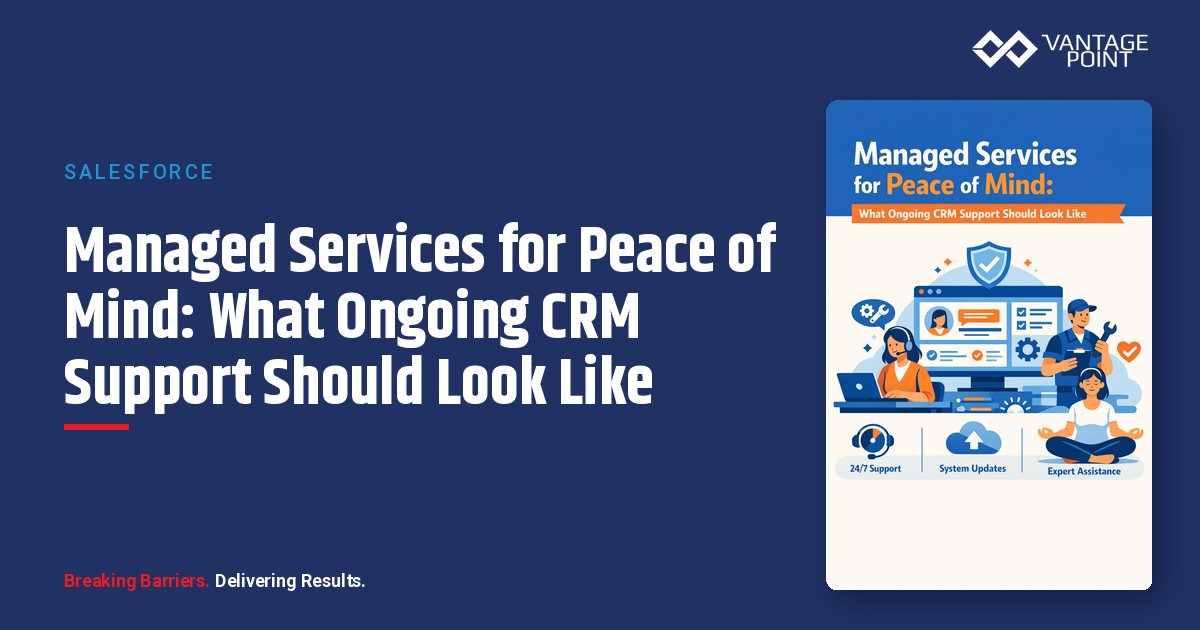
CRM managed services are an ongoing, proactive support model designed to operate, optimize, and evolve your CRM platform without the overhead of building a large in-house administration team. Unlike traditional break-fix support that reacts to problems after they occur, a mature managed services program combines several key disciplines into a continuous engagement:
- Administration and maintenance: Day-to-day system management, user provisioning, permissions management, and configuration updates
- Proactive health checks: Regularly scheduled assessments of system performance, data quality, security posture, and technical debt
- User training and enablement: Ongoing education programs that drive adoption and ensure teams leverage the full capabilities of the platform
- Enhancements and optimization: Iterative improvements to workflows, automations, reports, and integrations based on evolving business needs
- Strategic roadmapping: Quarterly or semi-annual planning sessions that align your CRM roadmap with business goals and upcoming platform releases
- Integration monitoring: Oversight of data flows between your CRM and other business systems (ERP, marketing automation, telephony, etc.)
Managed Services vs. Break-Fix Support
| Aspect | Break-Fix Support | Managed Services |
|---|---|---|
| Approach | Reactive: fix problems after they occur | Proactive: prevent problems before they happen |
| Scope | Issue-by-issue troubleshooting | Comprehensive platform stewardship |
| Staffing | Ad hoc, variable quality | Dedicated team with deep platform expertise |
| Cost Model | Unpredictable hourly billing | Predictable monthly retainer |
| Business Alignment | None: purely technical | Strategic roadmapping tied to business goals |
| Training | Minimal or none | Continuous enablement programs |
| Health Checks | Only when something breaks | Scheduled quarterly or monthly assessments |
| ROI | Minimal: maintenance-focused | Compounding: optimization-focused |
The difference is profound. Break-fix support keeps your CRM running. Managed services make it thrive.
Why Post-Implementation Support Matters More Than You Think
The Post-Implementation Cliff
The "post-implementation cliff" is a well-documented phenomenon in enterprise software. Here's what typically happens:
- Months 1-3 after go-live: Excitement is high, users are actively learning the system, and the implementation team is still available for quick fixes
- Months 4-6: The implementation team moves on to other projects. Questions pile up without expert answers. Workarounds emerge as users find faster (but less effective) ways to complete tasks
- Months 7-12: Data quality begins to degrade. Reports become unreliable. New hires receive minimal CRM training. User adoption plateaus or declines
- Year 2+: The organization is functionally using only a fraction of the CRM's capabilities. Leadership questions the ROI of the original investment. Calls for a "re-implementation" begin
This pattern is preventable. Organizations that invest in managed services from day one avoid the cliff entirely, and those that engage managed services after experiencing a decline can recover and exceed their original adoption targets.
The Case for Ongoing Support
The case for ongoing support is compelling:
- Most companies now use a CRM system, but many are not satisfied with their CRM's performance
- CRM implementations with ongoing optimization support see higher user adoption compared to those without
- Organizations that invest in continuous CRM training report productivity improvements per user
- Proactive health checks can identify and resolve issues that would otherwise cost far more to fix reactively
- The global CRM market keeps growing quickly: meaning your platform is evolving rapidly, and your support strategy needs to evolve with it
The Five Pillars of Effective CRM Managed Services
What should you look for in a managed services engagement? Here are the five pillars that define truly effective ongoing CRM support:
Pillar 1: Proactive Health Checks
Think of CRM health checks like routine maintenance for your car. You wouldn't drive 100,000 miles without an oil change, and you shouldn't run your CRM for months without a systematic review.
What a comprehensive health check covers:
- Data quality assessment: Duplicate records, incomplete fields, stale data, orphaned records
- Security audit: User permissions, role hierarchies, sharing rules, login history, API access
- Performance review: Page load times, automation execution efficiency, storage utilization, governor limits
- Automation audit: Workflow rules, process builders, flows, and triggers: identifying conflicts, redundancies, and opportunities for optimization
- Integration health: Error rates, sync frequency, data mapping accuracy, and API call usage
- Technical debt inventory: Unused custom fields, deprecated features, legacy configurations that should be cleaned up
- Release readiness: Assessment of how upcoming platform releases will impact your configuration
Recommended cadence: Quarterly comprehensive health checks with monthly focused reviews on high-priority areas.
Pillar 2: Continuous User Training and Enablement
User adoption isn't a one-time event: it's a continuous discipline. The most successful CRM organizations treat training as an ongoing investment, not a launch-day checkbox.
What effective ongoing training looks like:
- Role-based learning paths: Tailored training for sales reps, service agents, managers, and executives based on how each role uses the CRM
- New feature onboarding: When your platform releases new capabilities, users need to understand how to leverage them
- New hire orientation: Standardized CRM training for every new team member, ensuring consistency across the organization
- Advanced workshops: Deep dives into reporting, dashboards, automation, and advanced features for power users
- Office hours: Scheduled time where users can ask questions, report issues, and get real-time guidance
- Train-the-trainer programs: Building internal champions who can provide first-line support and encourage adoption within their teams
- Adoption analytics: Tracking login frequency, feature utilization, and engagement metrics to identify where additional training is needed
Pillar 3: Administration and Technical Support
Even the most well-designed CRM requires ongoing administration. Without dedicated admin support, small issues compound into major problems.
Core administration services:
- User management: Adding/removing users, managing licenses, updating permissions and roles
- Configuration updates: Field additions, page layout changes, record type modifications, validation rules
- Report and dashboard creation: Building new reports and dashboards as business needs evolve
- Data management: Import/export, de-duplication, mass updates, archive management
- Bug fixes and troubleshooting: Investigating and resolving issues reported by users
- Sandbox management: Maintaining development and testing environments for safe change deployment
- Documentation: Keeping system documentation current so institutional knowledge isn't lost
Pillar 4: Strategic Optimization and Roadmapping
The best managed services engagements go beyond maintenance: they drive continuous business improvement.
What strategic optimization includes:
- Quarterly business reviews: Structured sessions that assess CRM performance against business KPIs and identify improvement opportunities
- Process optimization: Analyzing workflows and automation to eliminate bottlenecks, reduce manual effort, and improve efficiency
- Feature adoption planning: Evaluating new platform capabilities and developing adoption strategies for features that will deliver business value
- Integration expansion: Identifying opportunities to connect additional business systems to your CRM for greater visibility and automation
- AI and automation opportunities: Evaluating emerging capabilities like AI-powered insights, predictive analytics, and intelligent workflow automation
- Scalability planning: Ensuring your CRM architecture can support organizational growth, new teams, additional data volumes, and expanding use cases
Pillar 5: Integration Monitoring and Management
Modern CRM environments don't exist in isolation. They're connected to email platforms, marketing automation tools, ERP systems, telephony solutions, and dozens of other business applications. These integrations require ongoing attention.
Integration managed services include:
- Real-time monitoring: Dashboards and alerts that track sync status, error rates, and data flow health
- Error resolution: Investigating and resolving integration failures before they impact business processes
- Data mapping maintenance: Updating field mappings as source and target systems evolve
- Performance optimization: Tuning integration frequency, batch sizes, and API call patterns for efficiency
- New integration development: Building connections to additional systems as your technology stack grows
- Vendor coordination: Managing relationships with integration middleware providers and third-party application vendors
How to Evaluate a CRM Managed Services Provider
Not all managed services providers are created equal. Here's a comprehensive checklist for evaluating potential partners:
Expertise and Team Quality
- Senior-level practitioners: Are experienced professionals involved in your day-to-day support, or is the work delegated to junior staff?
- Platform certifications: Does the team hold current certifications across the platforms and clouds you use?
- Multi-platform capability: Can they support Salesforce, HubSpot, and integration platforms like MuleSoft under one engagement?
- Cross-functional skills: Does the team include administrators, developers, architects, and business analysts?
Engagement Model
- Predictable pricing: Is the engagement structured as a monthly retainer with clear deliverables, or unpredictable hourly billing?
- Scalable capacity: Can you flex support hours up or down based on seasonal needs or project spikes?
- Defined SLAs: Are response times, resolution targets, and escalation procedures clearly documented?
- Transparent reporting: Do you receive regular reports on tickets resolved, hours consumed, health check findings, and business impact?
Approach and Methodology
- Proactive vs. reactive: Does the provider actively identify and resolve issues, or do they wait for you to report problems?
- Business alignment: Do they conduct strategic reviews that connect CRM performance to business outcomes?
- Change management: Do they help with user adoption, training, and organizational change: not just technical configuration?
- Documentation discipline: Do they maintain current system documentation, runbooks, and knowledge bases?
Cultural Fit
- Partnership mentality: Do they operate as an extension of your team, or as a transactional vendor?
- Business understanding: Do they take the time to understand your business, your customers, and your competitive landscape?
- Communication style: Are they responsive, proactive communicators who keep you informed without being asked?
- Long-term orientation: Are they invested in your success over years, not just the current contract term?
What a 30-60-90 Day Managed Services Onboarding Looks Like
Transitioning to a managed services model should be structured and systematic. Here's what a well-designed onboarding looks like:
Days 1-30: Discovery and Quick Wins
- Comprehensive CRM health check: Full assessment of data quality, security, performance, automations, and integrations
- Stakeholder interviews: Understanding business goals, pain points, and priorities from key users and leaders
- Backlog creation: Documenting known issues, enhancement requests, and optimization opportunities
- SLA establishment: Defining response times, severity levels, escalation procedures, and communication cadences
- Quick wins: Resolving high-impact, low-effort issues to demonstrate immediate value
- Access and tooling setup: Establishing secure access, monitoring tools, and communication channels
Days 31-60: Rhythm and Stabilization
- Sprint cadence established: Regular two-week cycles for enhancement delivery and issue resolution
- Training program launched: First round of role-based training sessions based on health check findings
- Integration monitoring active: Dashboards and alerts operational for all connected systems
- Documentation underway: System documentation, process flows, and knowledge base articles being created
- First monthly report delivered: Summary of work completed, issues identified, and recommendations
Days 61-90: Strategic Alignment
- KPI baseline established: Measurable benchmarks for adoption, data quality, performance, and business impact
- Quarterly roadmap created: Strategic plan for the next 12 months aligned with business goals and platform release calendars
- Continuous improvement plan: Prioritized list of optimization opportunities with projected business impact
- First quarterly business review: Structured session reviewing progress, findings, and strategic direction
- Steady-state operations: Full managed services engagement running at cadence
Common Mistakes Organizations Make Without Managed Services
Mistake 1: Relying Solely on Internal Resources
Many organizations assign CRM administration to someone who already has a full-time job. An operations manager, an IT generalist, or a sales operations analyst. While these individuals often do their best, they typically lack the deep platform expertise, bandwidth, and strategic perspective that a dedicated managed services team provides.
Mistake 2: Ignoring Platform Updates
Salesforce releases three major updates per year. HubSpot deploys continuous updates. Each release brings new features, deprecations, and potential impacts to your existing configuration. Without a managed services partner tracking these releases and assessing their impact, organizations miss valuable new capabilities and risk breaking existing functionality.
Mistake 3: Treating Training as a One-Time Event
The launch-day training session is forgotten within weeks. New hires receive informal, inconsistent guidance from colleagues. Power users develop workarounds that become institutionalized. Without continuous training, CRM utilization inevitably declines.
Mistake 4: Letting Technical Debt Accumulate
Every quick fix, temporary workaround, and "we'll clean that up later" decision adds technical debt to your CRM. Over time, this debt makes the system slower, harder to maintain, and more expensive to enhance. Regular health checks and proactive cleanup prevent technical debt from becoming unmanageable.
Mistake 5: Failing to Measure CRM Performance
If you're not tracking adoption metrics, data quality scores, automation efficiency, and business impact indicators, you can't know whether your CRM investment is delivering value. Managed services providers build measurement into the engagement, ensuring continuous visibility into CRM performance.
How Vantage Point Approaches Managed CRM Services
At Vantage Point, we believe that CRM implementation is the starting line: not the finish line. Our managed services model is designed to protect your investment and ensure it delivers compounding value over time.
Our VALUE Methodology
Every managed services engagement is guided by our VALUE framework:
- Vision: We begin by understanding your business vision and ensuring your CRM roadmap is aligned with where you're headed, not just where you are today
- Adaptability: Your business evolves, and your CRM must evolve with it. We build flexible support models that scale with your growth and adapt to changing requirements
- Leverage: We help you leverage the full capability of your platform. Identifying underutilized features, automation opportunities, and integration possibilities that amplify your team's impact
- User-Centric: Technology only delivers value when people use it effectively. Our training programs, adoption monitoring, and change management practices keep users engaged and productive
- Excellence: We hold ourselves to the highest standards of quality, communication, and accountability. Every interaction, every deliverable, every recommendation reflects our commitment to excellence
What Makes Vantage Point Different
Senior-only consultants. Unlike firms that staff engagements with junior resources, every Vantage Point team member brings years of deep CRM expertise. You work with experienced practitioners who've seen hundreds of implementations: not entry-level consultants learning on your dime.
Senior team. All work is done by senior consultants, with no hand-off to junior staff. You get direct access to the people managing your CRM.
Multi-platform expertise. Whether you're running Salesforce, HubSpot, or a hybrid environment, we have the expertise to support your entire CRM ecosystem. Our partnerships with Salesforce, HubSpot, Anthropic, Aircall, and Workato mean we can optimize your platform holistically.
Employee-owned mindset. Our team takes personal ownership of your success. We approach every engagement as if we're building solutions for our own business, because our reputation depends on your results.
Services Included in Vantage Point Managed Services
| Service | Description | Cadence |
|---|---|---|
| CRM Health Checks | Comprehensive assessment of data quality, security, performance, and technical debt | Quarterly |
| User Training | Role-based training, new hire onboarding, advanced workshops, and office hours | Ongoing monthly |
| Admin Support | User management, configuration updates, report building, and troubleshooting | On-demand with SLAs |
| Strategic Roadmapping | Quarterly business reviews with forward-looking CRM optimization plans | Quarterly |
| Integration Monitoring | Real-time oversight of data flows between CRM and connected systems | Continuous |
| Enhancement Delivery | New features, workflow improvements, and automation builds via sprint cycles | Bi-weekly sprints |
| Release Management | Impact analysis and preparation for platform updates and new releases | Per release cycle |
| AI and Automation Advisory | Evaluating and implementing AI-powered capabilities | Quarterly review |
Key Metrics to Track With Your Managed Services Provider
Effective managed services should be measurable. Here are the KPIs that matter most:
Adoption Metrics
- Active user rate: Percentage of licensed users logging in regularly
- Feature utilization: Which capabilities are being used vs. available
- Training completion: Percentage of users who've completed assigned training paths
Data Quality Metrics
- Duplicate rate: Percentage of duplicate records in the system
- Completeness score: Percentage of required fields populated across key objects
- Data freshness: Average age of records, frequency of updates
Performance Metrics
- System uptime: Availability during business hours
- Page load times: User experience indicators
- Automation success rate: Percentage of automated processes completing without errors
- Integration error rate: Frequency and severity of sync failures
Business Impact Metrics
- Sales cycle time: Time from lead creation to closed deal
- Customer response time: Speed of response to customer inquiries
- Pipeline visibility: Accuracy and completeness of sales pipeline data
- Report confidence: Stakeholder trust in CRM-generated reports and dashboards
Frequently Asked Questions
What are CRM managed services?
CRM managed services are an ongoing, proactive support model that covers administration, health checks, user training, optimization, integration monitoring, and strategic roadmapping for your CRM platform. Unlike reactive break-fix support, managed services focus on preventing issues, driving adoption, and continuously improving your CRM's business impact.
How much do CRM managed services cost?
Costs typically range from 15-30% of your original implementation investment per year, structured as a predictable monthly retainer. For most mid-size organizations, this translates to $3,000 ($15,000 per month depending on scope, complexity, and service level) significantly less than hiring a full-time CRM administrator ($80K: $150K+ annually plus benefits, training, and coverage gaps).
When should we start managed services after implementation?
Ideally, your managed services engagement should begin immediately after (or even slightly before) go-live. The first 90 days after implementation are the most critical period for user adoption and system stabilization. Starting managed services from day one prevents the "post-implementation cliff" that many organizations experience.
Do we still need an internal CRM administrator with managed services?
Most organizations benefit from having a lean internal CRM owner or champion who serves as the liaison between the business and the managed services team. This person doesn't need deep technical expertise: they need business context and organizational influence. The managed services team provides the technical depth, while the internal champion ensures business alignment.
What's the difference between managed services and staff augmentation?
Staff augmentation adds individuals to your team: you manage the work, set priorities, and direct daily activities. Managed services delivers outcomes with built-in governance, cross-functional expertise, SLAs, and reporting. Managed services providers take ownership of CRM health and performance, while staff augmentation simply adds capacity.
How do CRM health checks work?
A comprehensive CRM health check is a structured assessment covering data quality, security configuration, system performance, automation efficiency, integration health, and technical debt. The output is a detailed report with findings categorized by severity and impact, along with a prioritized remediation plan. Most organizations benefit from quarterly comprehensive health checks with monthly focused reviews.
Can managed services support multi-platform CRM environments?
Yes. Organizations running Salesforce alongside HubSpot, or using integration platforms like MuleSoft and Workato, can find managed services providers that support the entire ecosystem under a single engagement. This unified approach ensures consistent governance, prevents siloed optimization, and provides holistic visibility across your CRM landscape.
Conclusion: Protect Your CRM Investment With the Right Support Model
Your CRM is one of the most important technology investments your organization will make. It touches every customer interaction, influences every sales decision, and shapes the data that drives your business strategy. That investment deserves more than a "set it and forget it" approach.
Managed services transform your CRM from a static tool into a dynamic, continuously improving platform that grows with your business. Proactive health checks catch issues before they become crises. Ongoing training keeps users engaged and productive. Strategic roadmapping ensures your CRM evolves alongside your business goals. And dedicated expert support means you always have someone in your corner when questions arise.
The organizations that get the most from their CRM are the ones that invest in ongoing support. They're the ones with higher adoption rates, better data quality, faster sales cycles, and greater confidence in the technology investments that power their business.
Ready to see what peace of mind looks like for your CRM? Contact Vantage Point today at david@vantagepoint.io or call (469) 499-3400 to discuss how our managed services can protect and grow your CRM investment.
About Vantage Point
Vantage Point is a senior-led, AI-augmented Salesforce and HubSpot consulting firm that helps businesses of all sizes design and implement CRM strategies that drive growth, streamline operations, and enhance client relationships. Founded by David Cockrum (a former financial services COO and longtime Salesforce customer) Vantage Point combines deep operational experience with multi-platform expertise across Salesforce, HubSpot, MuleSoft, Anthropic's Claude AI, and Aircall. Vantage Point delivers measurable results for organizations seeking transformative CRM solutions.
Learn more at vantagepoint.io