Legacy IT Service Management (ITSM) was built for a ticket-and-queue world. An employee files a request, waits for a human to triage it, gets routed to the right group, and eventually receives a fix. That model still runs most internal IT support today, and it is exactly why employees wait too long, IT teams stay buried in repetitive work, and self-service portals go unused.
Agentic AI changes the starting assumption. Instead of logging a ticket and waiting, an employee asks a question where they already work, and an autonomous agent diagnoses and resolves common issues in real time. Salesforce's Agentforce IT Service is one of the most visible examples of this shift.
This guide explains where legacy ITSM breaks down, what agentic IT service actually changes, and how to evaluate whether a move is right for your organization: without the hype.
Quick Answer
Legacy ITSM holds businesses back because it is reactive: it depends on manual ticket logging, manual routing, swivel-chair work across disconnected tools, and self-service portals most employees ignore. This matters for IT leaders, operations teams, and any organization trying to cut support costs and resolution times. Agentic IT service, such as Agentforce IT Service, changes the model by letting AI agents resolve common requests autonomously, deflect routine tickets, retrieve grounded knowledge, and route complex issues to humans with full context. If you are weighing a move, Vantage Point helps organizations run a clear-eyed Agentforce readiness and strategy assessment before committing.
TL;DR
- What it is: Legacy ITSM is the ticket-based model for internal IT support; agentic IT service replaces queues with autonomous AI resolution in the flow of work.
- Why it matters: Manual routing and unused portals create slow resolutions, high costs, and burned-out IT teams.
- What changes: Agentforce IT Service adds autonomous ticket handling, deflection, grounded knowledge retrieval, and integration with existing systems.
- Decision point: Evaluate readiness (data quality, knowledge base health, integration scope, and governance) before you switch or layer in agents.
- How Vantage Point helps: We deliver senior-only Agentforce strategy and implementation so the rollout solves real workflow problems, not just license costs.
What Is Legacy ITSM, and What Is Agentic IT Service?
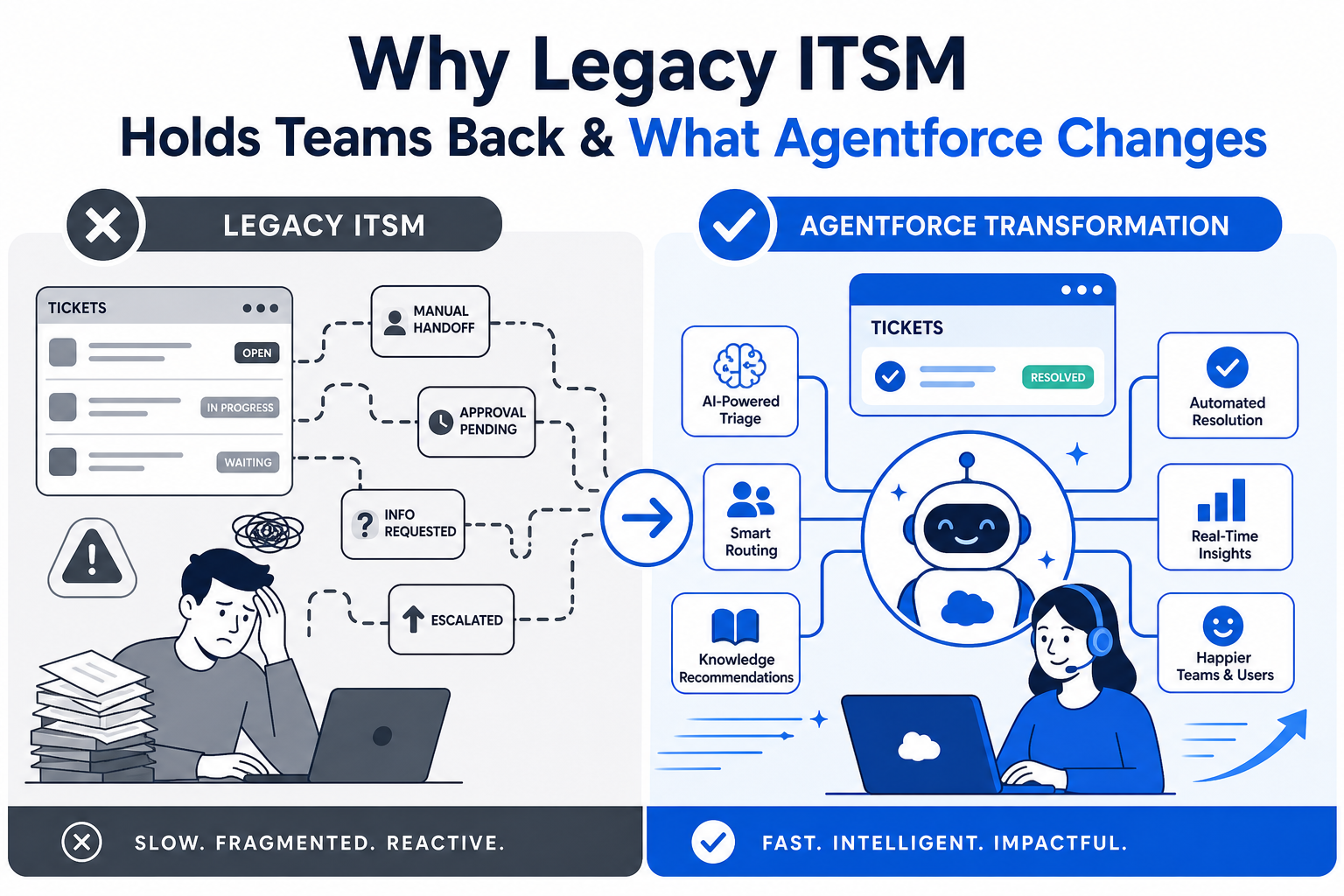
Legacy ITSM is the traditional approach to managing internal IT support: employees submit tickets through a portal or email, requests are triaged and routed by people or static rules, and resolution flows through queues and SLAs. It works, but it is fundamentally reactive.
Agentic IT service is the next model. Autonomous AI agents understand an employee's intent in plain language, ground their reasoning in trusted company knowledge and configuration data, and take action (resetting access, answering policy questions, or creating and escalating incidents) without forcing the employee to file a form first. Agentforce IT Service, which became generally available in October 2025, delivers this directly inside Slack, Microsoft Teams, employee portals, and webchat, built on the Salesforce Service Cloud platform and aligned to ITIL processes.
Why Legacy ITSM Holds Your Business Back
Most legacy ITSM pain is structural, not a tooling configuration problem. The common drains:
- Slow ticket resolution. Every request waits in a queue before a human even looks at it. Routine issues like password resets and access requests sit alongside complex incidents.
- Manual routing. Triage depends on people or brittle rules. Misrouted tickets bounce between groups, adding days to simple problems.
- Swivel-chair work. Agents copy data between the ITSM tool, identity provider, HR system, and asset database because nothing is truly connected.
- Poor self-service. Portals exist, but employees abandon them because search is weak and answers are generic. So they file a ticket anyway.
- Reactive posture. Legacy ITSM waits for an employee to report a problem. Outages and recurring issues are discovered late, after productivity is already lost.
Research cited by Salesforce illustrates the scale: employees lose an average of 352 hours per year to common and complex IT challenges (WalkMe, 2024 State of Digital Adoption). The cost is not just IT headcount: it is every hour an employee waits instead of working.
What Agentforce IT Service Changes
Agentforce IT Service is designed to flip the model from reactive ticketing to proactive, conversational resolution. The capabilities that matter most:
- Autonomous ticket handling. AI agents resolve routine requests end to end (password resets, access provisioning, eligibility questions) 24/7, without human intervention.
- Ticket deflection. By answering and acting in Slack or Teams, agents prevent routine tickets from ever entering the queue.
- Grounded knowledge retrieval. The Atlas Reasoning Engine grounds answers in your trusted knowledge base via Data 360, so responses are specific to your policies rather than generic.
- Integration with existing systems. Agentforce IT Service launched with 100+ pre-built connectors to tools organizations already run, including Google, IBM, Microsoft, Okta, Oracle NetSuite, Workday, and Zoom.
- Augmented IT teams. Assistive agents summarize incidents, suggest root causes, and recommend resolutions inside the IT Service Desk, where humans manage Incident, Problem, and Change.
- Proactive support. Agents can detect a widespread issue (for example, multiple VPN reports), create a major incident automatically, and notify affected employees.
- Trust and governance. The Salesforce Trust Layer, data masking, guardrails, and structured human handoff keep autonomous actions controlled.
Independent analysts expect this shift to accelerate broadly: Gartner predicts that by 2029, agentic AI will autonomously resolve 80% of common customer service issues without human intervention, contributing to a 30% reduction in operational costs.
Legacy ITSM vs Agentforce IT Service
| Dimension | Legacy ITSM | Agentforce IT Service |
|---|---|---|
| Starting point | File a ticket, then wait | Ask in Slack/Teams; agent acts |
| Routing | Manual or static rules | Intent-based, automated |
| Routine requests | Handled by humans in a queue | Resolved autonomously, 24/7 |
| Knowledge | Portal search, often ignored | Grounded retrieval in the flow of work |
| Posture | Reactive (break/fix) | Proactive (detect/prevent) |
| Integrations | Custom-built, fragile | 100+ pre-built connectors |
| IT team role | Manual triage and ticket churn | Strategic work, agent-assisted |
Note: legacy ITSM here refers to traditional ticket-based platforms broadly. A move does not have to be all-or-nothing. Agentforce IT Service can run alongside an existing system of record while employee-facing agents deploy in your systems of engagement.
How to Evaluate a Move to Agentic IT Service
Agentic IT service is only as good as the data and process behind it. Use this checklist before you commit:
- Knowledge base health. Are your IT and HR knowledge articles current, accurate, and structured? Agents ground answers in this content.
- Data quality and access. Can agents reach clean, governed data on employees, entitlements, and assets?
- Integration scope. Which systems must agents touch (identity, HR, endpoint, asset management) and are connectors available?
- Use-case prioritization. Start with high-volume, low-risk requests (password resets, access, status questions) where deflection is immediate.
- Governance and guardrails. Define what agents can act on autonomously versus what requires human approval.
- Coexistence plan. Decide whether you layer agents onto your current ITSM or migrate, and over what timeline.
- Adoption. Plan for change management so employees actually use the conversational channel.
Published Agentforce IT Service editions
| Edition | List price (per user/month) | Focus |
|---|---|---|
| AI Agent for Employees | $15 | Conversational resolution in the flow of work |
| IT Service Desk: Enterprise | $75 | End-to-end incident, problem, change, CMDB |
| IT Service Desk: Unlimited | $150 | Generative + predictive AI, advanced dashboards |
List pricing as published by Salesforce and subject to change; confirm current pricing and packaging directly with Salesforce.
What Businesses Should Do Next
Do not buy agents to fix a process you have not examined. Start by mapping your highest-volume IT requests and how long each takes today. Then assess knowledge quality, data access, and the integrations agents would need. From there, define a small set of autonomous use cases, set governance rules, and pilot before scaling. A grounded pilot proves value faster than a platform-wide switch.
If your team is weighing agentic IT service, Vantage Point can help you assess readiness, design the right workflow automation and process sequence, and build a practical rollout plan that fits your existing stack.
How Vantage Point Helps
Vantage Point is a mid-market specialist with a senior-only, AI-augmented team, employee-owned and guided by our VALUE Methodology. We act as your Agentforce implementation and strategy partner: not a staffing shop. For agentic IT service, that means a clear readiness assessment, knowledge and data preparation, integration design, governance, and adoption planning so the platform delivers measurable resolution gains.
Our work spans Salesforce implementation and advisory, Agentforce IT service strategy, system integration and data migration, and advisory and change management so adoption sticks.
Ready to evaluate the move? Ask Vantage Point for an Agentforce readiness and strategy assessment to see where agentic IT service fits your roadmap.
FAQ
What is Agentforce IT Service? Agentforce IT Service is Salesforce's agent-first, conversational IT support suite built on the Service Cloud platform. It lets autonomous AI agents resolve common IT and HR requests in Slack, Microsoft Teams, and employee portals, while a unified IT Service Desk handles ITIL processes like incident, problem, and change management.
Why is legacy ITSM considered reactive? Legacy ITSM waits for an employee to file a ticket, then relies on manual triage and routing before anyone resolves the issue. This adds delay to even simple requests and discovers recurring problems and outages late, after productivity has already been lost.
Does Agentforce IT Service replace my current ITSM tool? Not necessarily. Agentforce IT Service can run alongside an existing system of record while employee-facing agents deploy in your systems of engagement. Over time, organizations can reduce reliance on the legacy tool and migrate to the agentic service desk at their own pace.
What kinds of tickets can AI agents resolve autonomously? Agents handle high-volume, repeatable requests well, password resets, software and access provisioning, eligibility and policy questions, and status updates. Complex or sensitive issues are escalated to a human with a full summary of the conversation and actions already taken.
How does Agentforce IT Service integrate with our existing systems? It launched with 100+ pre-built connectors and integrations to widely used tools, including Google, IBM, Microsoft, Okta, Oracle NetSuite, Workday, and Zoom. This lets agents act across identity, HR, and asset systems without fragile custom integrations.
What do we need in place before adopting agentic IT service? You need an accurate, current knowledge base, clean and governed data, defined integration scope, prioritized use cases, and clear governance for autonomous actions. Vantage Point runs a readiness assessment to confirm these foundations before implementation.
How is Vantage Point involved? Vantage Point is a senior-only, employee-owned Salesforce partner that delivers Agentforce IT Service strategy and implementation for mid-market organizations. We focus on readiness, integration, governance, and adoption so agentic IT service produces real resolution and cost improvements.