The Model Context Protocol (MCP) makes it easy to connect AI agents to your tools and data. But as MCP connections multiply across teams, "easy to connect" becomes "hard to govern." An MCP gateway gives enterprises a single, controlled point to manage authentication, access, logging, and policy. This guide explains what an MCP gateway is, why it matters, and how to govern MCP at scale.
Quick Answer
An MCP gateway is a centralized control point that manages how AI agents connect to tools and data through the Model Context Protocol: handling authentication, authorization, logging, and policy enforcement. It matters for enterprises scaling AI agents, because ungoverned MCP connections create security, compliance, and sprawl risks. A gateway gives you visibility and control without slowing adoption. Vantage Point helps organizations design governed MCP and integration architectures.
TL;DR
- What it is: An MCP gateway centralizes control over how AI agents access tools and data via MCP.
- Why it matters: Ungoverned MCP connections create security, compliance, and sprawl risks at scale.
- Best for: Enterprises deploying multiple AI agents across teams and systems.
- Decision point: Decide how you will authenticate, authorize, log, and govern MCP before it spreads.
- How Vantage Point helps: We design governed system integration and security and compliance architectures.
What Is an MCP Gateway?
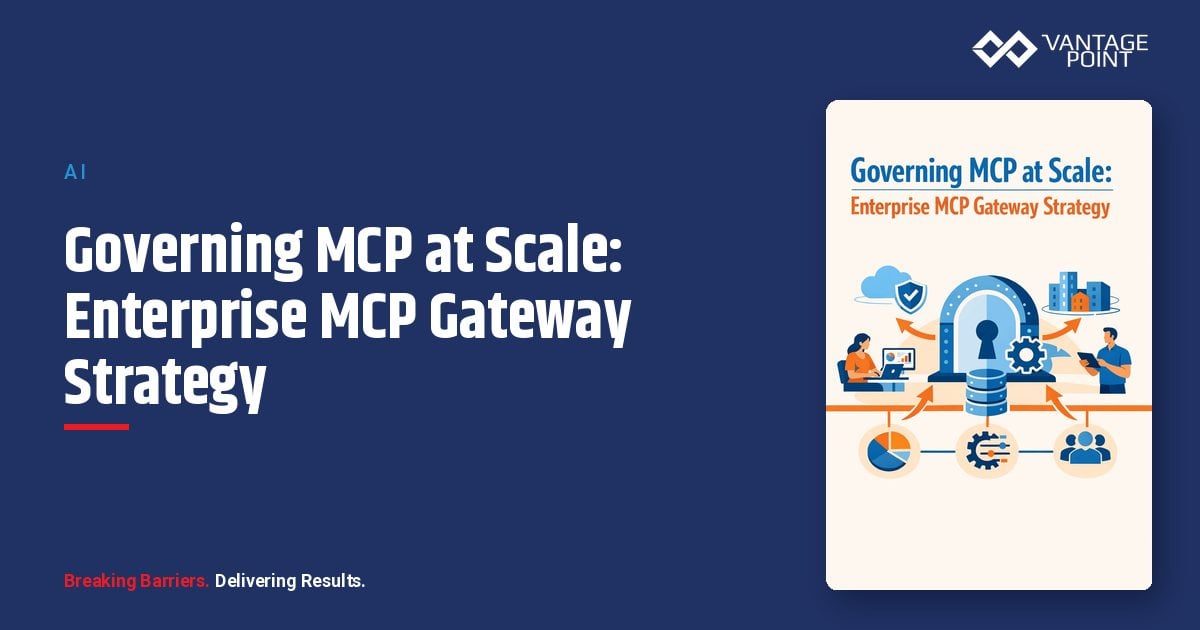
An MCP gateway is a middleware layer that sits between AI agents and the MCP servers exposing your tools and data. Instead of every agent connecting directly to every data source, connections route through the gateway, which enforces consistent rules for authentication, access, rate limits, logging, and policy.
Think of it like an API gateway, but purpose-built for the AI context layer. It standardizes how AI reaches your systems and gives security and platform teams a single place to manage it.
Why MCP Governance Matters in 2026
MCP adoption is accelerating because it solves a real problem: giving AI agents standardized access to tools and data. But rapid adoption without governance creates new risks:
- Connection sprawl. Teams spin up MCP servers independently, with no central inventory.
- Inconsistent security. Each connection may handle credentials and permissions differently.
- Compliance gaps. Without logging and access control, you cannot prove what AI accessed.
- Over-permissioned agents. Agents may reach data they should never touch.
Governance does not mean blocking MCP. It means scaling it safely so AI initiatives are not later unwound by security or compliance concerns.
How an MCP Gateway Governs Access
| Capability | What it does | Why it matters |
|---|---|---|
| Authentication | Verifies which agent or user is connecting | Prevents unauthorized access |
| Authorization | Enforces what each agent may access | Applies least-privilege access |
| Logging and audit | Records every request and action | Supports compliance and troubleshooting |
| Rate limiting | Caps request volume per agent | Protects backend systems |
| Policy enforcement | Applies data-sensitivity and usage rules | Keeps AI within approved boundaries |
| Central inventory | Tracks all MCP servers and tools | Eliminates shadow connections |
How to Govern MCP at Scale
- Inventory MCP usage. Catalog existing and planned MCP servers and tools.
- Define access policies. Decide which agents may reach which data, by sensitivity.
- Route through a gateway. Centralize connections so policy is enforced consistently.
- Standardize authentication. Use a single, strong identity and credential approach.
- Log everything. Capture requests and actions for audit and compliance.
- Review and refine. Monitor usage, prune unused connections, and tighten access over time.
What Businesses Should Do Next
- Inventory where MCP is already in use before connections multiply further.
- Establish access and data-sensitivity policies for AI agents now.
- Plan to route MCP through a gateway rather than allowing direct, ad hoc connections.
- Align MCP governance with your existing security, identity, and compliance standards.
If your team is evaluating how MCP and AI agents apply to Salesforce, HubSpot, integrations, or governance, Vantage Point can help assess the right next step and build a practical implementation plan.
How Vantage Point Helps
Vantage Point is a senior-led Salesforce and HubSpot consulting partner. We help enterprises adopt AI agents and MCP without sacrificing control, designing integration and governance architectures that scale safely. Our work spans system integration and data migration, compliance and security solutions, and AI-driven personalization and analytics. We connect governed data to AI across Salesforce and HubSpot environments.
FAQ
What is the Model Context Protocol (MCP)?
MCP is an open standard that gives AI agents a consistent way to connect to tools and data sources. It simplifies how agents access context across systems. As MCP usage grows, organizations need governance to manage those connections safely.
What is an MCP gateway?
An MCP gateway is a centralized control layer between AI agents and MCP servers that enforces authentication, authorization, logging, and policy. It standardizes how agents reach your systems. This gives security and platform teams a single place to manage AI access.
Why do enterprises need MCP governance?
Enterprises need MCP governance because ungoverned connections create security, compliance, and sprawl risks. Without central control, agents may be over-permissioned and access cannot be audited. Governance lets organizations scale MCP without exposing sensitive data.
How is an MCP gateway different from an API gateway?
An API gateway manages traditional application API traffic, while an MCP gateway is purpose-built for the AI context layer and the MCP standard. They share concepts like authentication, rate limiting, and logging. Many enterprises will run both, sometimes integrated.
Does MCP governance slow down AI adoption?
No, when done well it accelerates safe adoption. Governance prevents the security and compliance problems that often force teams to unwind AI projects later. A gateway lets teams connect quickly within clear, enforced boundaries.
How do we start governing MCP?
Start by inventorying existing MCP usage and defining access and data-sensitivity policies. Then route connections through a gateway, standardize authentication, and log all activity. Vantage Point helps design and implement this governance architecture.
How does MCP governance relate to compliance?
MCP governance supports compliance by controlling and logging what AI agents can access. Audit trails let you demonstrate appropriate data handling, and access policies enforce least privilege. This aligns AI usage with security and regulatory requirements.