

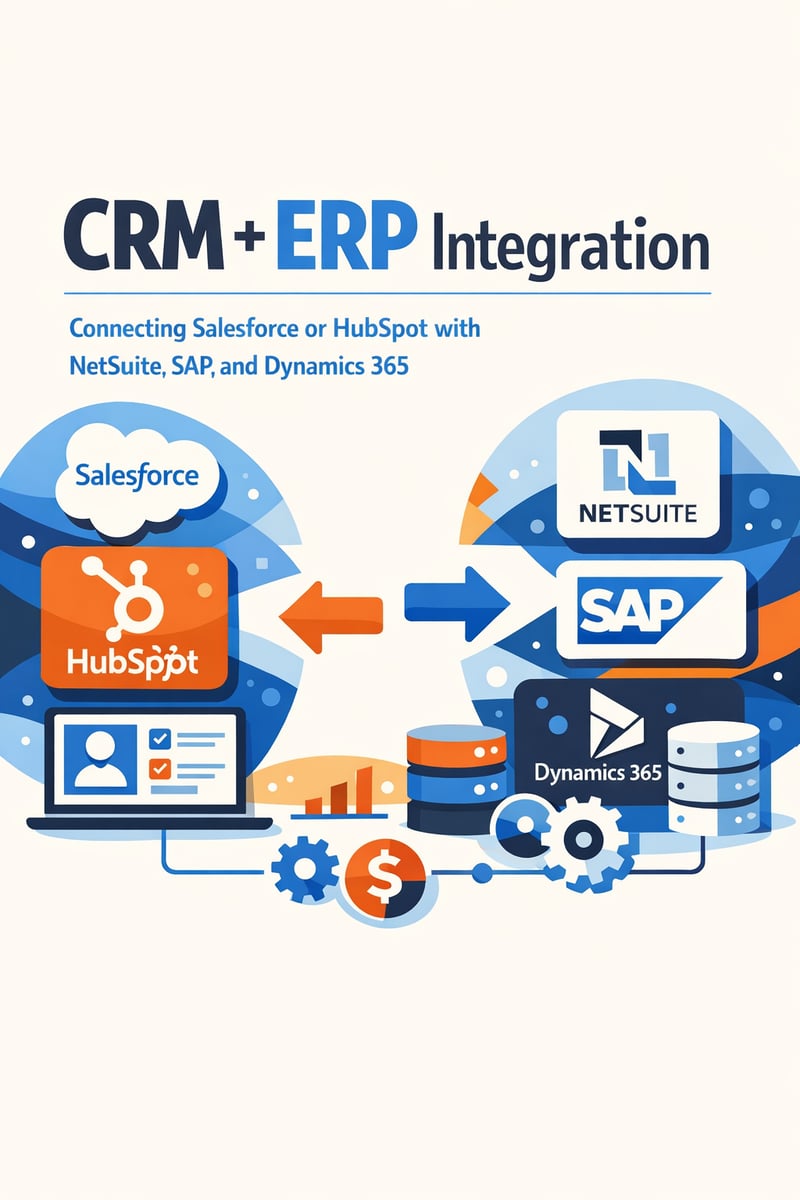
Key Takeaways (TL;DR)
- ✅ What is it? CRM-ERP integration connects your customer-facing systems (Salesforce, HubSpot) with back-office platforms (NetSuite, SAP, Dynamics 365) to create a unified data ecosystem that eliminates silos and manual data entry.
- 🎯 Key Benefit: A true customer 360° view that spans sales, finance, operations, and support — enabling faster order-to-cash cycles, accurate quoting, and real-time inventory visibility.
- 💰 Cost: $50K–$300K+ depending on complexity, number of systems, and middleware choice — with platforms like MuleSoft and Workato reducing long-term TCO by 20–65%.
- ⏱️ Timeline: 4–12 weeks for standard integrations; 3–6 months for complex multi-system environments.
- 👥 Best For: Organizations with 50+ users running separate CRM and ERP systems that need to eliminate double data entry, accelerate revenue cycles, and gain cross-departmental visibility.
- 📈 Bottom Line: Companies that integrate CRM and ERP report 25–35% faster quote-to-cash cycles and up to 40% reduction in manual data entry errors — delivering ROI within 12–18 months.
Why Are So Many Businesses Still Running CRM and ERP in Silos?
If your sales team closes a deal in Salesforce but your finance team has to manually re-enter that order into NetSuite — you have an integration problem. And you're far from alone.
Despite the $59.42 billion ERP software market and the dominant position of CRM platforms like Salesforce and HubSpot, a surprising number of organizations still operate these critical systems in isolation. The result? Duplicate data entry, delayed invoicing, inaccurate inventory counts, and a fragmented view of the customer that costs businesses real revenue.
The data integration market reached $17.58 billion in 2025 and is projected to grow to $33.24 billion by 2030 — a 13.6% CAGR that reflects just how urgently businesses are investing in connecting their systems. Meanwhile, 54% of enterprises now prioritize real-time data synchronization over traditional batch processing, and 70% of ERP deployments are cloud-based — making integration more achievable than ever.
In this comprehensive guide, we'll walk you through everything you need to know about connecting Salesforce or HubSpot with the leading ERP platforms — NetSuite, SAP, and Microsoft Dynamics 365. You'll learn about common integration patterns, middleware options, real-time vs. batch sync strategies, ROI metrics, and the best practices that separate successful integrations from costly failures.
What Is CRM-ERP Integration and Why Does It Matter?
CRM-ERP integration is the process of connecting your customer relationship management platform (where your sales, marketing, and service teams work) with your enterprise resource planning system (where finance, operations, inventory, and fulfillment live). The goal is bidirectional data flow — so information entered in one system automatically appears in the other without manual intervention.
The Business Case for Integration
When CRM and ERP systems operate independently, organizations face a cascade of problems:
- Double data entry: Sales reps enter customer data in CRM; finance teams re-enter it in ERP. Every manual touchpoint introduces error risk.
- Revenue leakage: Quotes created in CRM don't automatically flow to invoicing in ERP, creating delays in the order-to-cash cycle.
- Inventory blind spots: Sales teams can't see real-time inventory or pricing from ERP, leading to over-promising and under-delivering.
- Fragmented reporting: Leadership can't get a unified view of customer lifetime value, profitability by account, or accurate forecasting without manually stitching data from multiple systems.
- Compliance risks: Disconnected systems make audit trails harder to maintain and regulatory reporting more error-prone.
Integrated CRM-ERP environments eliminate these issues by creating a single source of truth. When a sales rep closes an opportunity in Salesforce, the order automatically flows to NetSuite for fulfillment and invoicing. When a payment posts in SAP, the customer record in HubSpot updates in real time. That's the power of integration.
What Are the Most Common CRM-ERP Integration Scenarios?
Understanding the most impactful integration patterns will help you prioritize your implementation roadmap. Here are the three scenarios that deliver the highest ROI:
1. Order-to-Cash (O2C)
Order-to-cash is the end-to-end process from when a customer places an order to when payment is received and recorded. In an integrated environment:
- CRM side: Sales rep closes the deal and creates a sales order in Salesforce or HubSpot.
- Integration layer: The order, customer details, line items, and pricing automatically sync to the ERP.
- ERP side: NetSuite, SAP, or Dynamics 365 handles fulfillment, shipping, and invoicing.
- Back-sync: Payment status, shipping updates, and invoice numbers flow back to CRM so the sales and support teams have full visibility.
Impact: Organizations that automate O2C report 25–35% faster cycle times and significant reductions in billing errors.
2. Quote-to-Cash (Q2C)
Quote-to-cash extends the process further upstream, starting from the initial quote or proposal:
- CRM side: Sales rep creates a quote using Salesforce CPQ or HubSpot's quoting tools with real-time pricing and product data pulled from ERP.
- Integration layer: Approved quotes automatically generate sales orders in ERP.
- ERP side: Finance processes the order, manages billing schedules, and handles revenue recognition.
- Back-sync: Contract status, renewal dates, and payment milestones sync back to CRM.
Impact: Automated Q2C workflows reduce quoting errors by up to 40% and accelerate deal-to-revenue timelines.
3. Customer 360° View
The customer 360 integration pattern creates a unified profile that spans every touchpoint:
- From CRM: Contact information, communication history, support tickets, marketing engagement, deal pipeline.
- From ERP: Purchase history, payment terms, credit status, shipping preferences, returns, lifetime spend.
- Combined: A single view that enables personalized service, proactive account management, and data-driven decision-making.
Impact: Teams with customer 360 visibility report higher customer satisfaction scores, improved upsell/cross-sell rates, and faster issue resolution.
How Do Salesforce and HubSpot Differ in ERP Integration Capabilities?
While both Salesforce and HubSpot can integrate with major ERP platforms, their approaches and native capabilities differ significantly.
Salesforce + ERP Integration
Salesforce offers the most mature enterprise integration ecosystem, especially with its ownership of MuleSoft:
- MuleSoft Anypoint Platform: Pre-built connectors (called Accelerators) for NetSuite, SAP S/4HANA, and Dynamics 365 with API-led connectivity.
- Salesforce Connect: Enables real-time access to external ERP data without replicating it inside Salesforce using OData and custom adapters.
- Data Cloud: Harmonizes CRM and ERP data for unified analytics and AI-driven insights.
- AppExchange ecosystem: Hundreds of third-party integration apps for specific ERP connectors.
- Salesforce CPQ + ERP: Native quote-to-cash workflows that sync directly with ERP billing and fulfillment.
Best for: Large or complex organizations needing robust governance, high-volume real-time transactions, and deep API management capabilities.
HubSpot + ERP Integration
HubSpot takes a more accessible approach, ideal for mid-market organizations:
- Operations Hub: No-code data sync, custom-coded workflows, and data quality tools for ERP connectivity.
- Native NetSuite integration: Direct sync of contacts, companies, deals, and invoices between HubSpot and NetSuite.
- Third-party iPaaS support: Works seamlessly with Workato, Make, and other middleware platforms for SAP and Dynamics 365 connections.
- Custom API: HubSpot's open API allows developers to build custom integrations for any ERP platform.
- Marketplace apps: Growing ecosystem of ERP integration apps on the HubSpot Marketplace.
Best for: Mid-market organizations that want fast time-to-value with lower total cost of ownership and less technical complexity.
What Are the Best Middleware Platforms for CRM-ERP Integration?
Middleware — also called Integration Platform as a Service (iPaaS) — serves as the translation and orchestration layer between your CRM and ERP. Choosing the right middleware platform is one of the most critical decisions in your integration strategy.
MuleSoft Anypoint Platform
As a Salesforce company, MuleSoft is purpose-built for enterprise integration:
- API-led connectivity: Design, build, secure, and manage reusable APIs that connect any system to any system.
- Pre-built accelerators: Production-ready templates for Salesforce-to-NetSuite, Salesforce-to-SAP, and Salesforce-to-Dynamics 365.
- DataWeave: Powerful data transformation language for complex mapping between CRM and ERP schemas.
- Hybrid deployment: Supports cloud, on-premise, and hybrid architectures — critical for organizations running on-premise SAP or legacy ERP systems.
- Governance: Enterprise-grade security, compliance, and API lifecycle management.
Ideal for: Complex, multi-system enterprise environments requiring high governance and API reuse. Typical implementation: 8–12 weeks for standard integrations.
Workato
Workato offers a low-code alternative with enterprise-grade capabilities:
- 1,200+ pre-built connectors: Including Salesforce, HubSpot, NetSuite, SAP, and Dynamics 365 — many with pre-configured recipes.
- Recipe-based automation: Business users can build integrations without deep coding skills, accelerating time-to-value.
- AI-driven workflows: Workato Copilot and Adaptive Workflow Optimization automatically improve recipes over time.
- Event-driven architecture: Real-time triggers and actions that respond instantly to data changes in CRM or ERP.
- Cost efficiency: Organizations report 20–65% total cost of ownership reductions compared to legacy middleware.
Ideal for: Mid-market to enterprise organizations wanting faster implementation (5–10 days for standard integrations) with lower TCO. Strong choice for HubSpot-centric environments.
Comparison at a Glance
| Capability | MuleSoft | Workato |
|---|---|---|
| Primary Focus | API-led enterprise integration | Low-code workflow automation |
| User Audience | Developers and architects | Business users and IT teams |
| Pre-Built Connectors | Extensive enterprise library | 1,200+ with ready-made recipes |
| Deployment | Cloud, on-premise, hybrid | Cloud-native, serverless |
| Implementation Speed | 8–12 weeks typical | 5–10 days for standard flows |
| TCO | Higher (infrastructure + specialists) | 20–65% lower than legacy iPaaS |
| AI Capabilities | Salesforce AI ecosystem integration | Native AI copilot and optimization |
| Best For | Complex, regulated, high-volume | Fast time-to-value, business-led |
Should You Use Real-Time or Batch Synchronization?
One of the most debated decisions in CRM-ERP integration is whether to use real-time or batch synchronization. The answer isn't either/or — it's a strategic combination of both.
Real-Time Sync
Real-time (event-driven) synchronization pushes data between systems immediately when a change occurs:
- When to use: Order creation, inventory updates, pricing changes, customer status changes, payment confirmations.
- Benefits: Eliminates data lag, enables same-session accuracy, supports live customer interactions.
- Considerations: Requires robust API infrastructure, error handling, and may increase middleware licensing costs.
- Technology: Webhooks, streaming APIs, event buses, change data capture (CDC).
Batch Sync
Batch synchronization processes data in scheduled intervals (hourly, daily, or on-demand):
- When to use: End-of-day financial reconciliation, large-volume data migrations, non-time-sensitive reporting updates, historical data backfills.
- Benefits: Lower infrastructure costs, handles large data volumes efficiently, easier error recovery.
- Considerations: Data latency between syncs, potential for stale information in customer-facing scenarios.
- Technology: Scheduled ETL jobs, bulk APIs, file-based data exchange.
The Hybrid Approach (Recommended)
| Data Type | Sync Strategy | Rationale |
|---|---|---|
| New orders and opportunities | Real-time | Time-sensitive, drives fulfillment |
| Inventory levels and pricing | Real-time | Needed for accurate quoting |
| Payment and invoice status | Real-time | Customer experience and cash flow |
| Financial reconciliation | Batch (daily) | Volume-heavy, not time-critical |
| Customer master data updates | Real-time | Ensures consistency across systems |
| Historical reporting data | Batch (weekly) | Large volume, analytical use |
What Does CRM-ERP Integration Look Like for Each ERP Platform?
Salesforce or HubSpot + Oracle NetSuite
NetSuite is one of the most commonly integrated ERPs with both Salesforce and HubSpot:
- Key data flows: Contacts/accounts, sales orders, invoices, inventory levels, payment status.
- Integration approach: MuleSoft's NetSuite Accelerator or Workato's pre-built recipes provide production-ready bidirectional sync.
- Unique consideration: NetSuite's SuiteScript API and RESTlet framework offer flexible integration endpoints. SuiteTalk (SOAP) is being phased out in favor of REST APIs.
- Common pattern: Real-time O2C with batch financial reconciliation.
- Timeline: 4–8 weeks for standard integration; 8–12 weeks for custom workflows.
Salesforce or HubSpot + SAP (S/4HANA and ECC)
SAP integrations tend to be more complex due to SAP's architecture and customization depth:
- Key data flows: Business partners, sales orders, billing documents, material master, pricing conditions, delivery status.
- Integration approach: MuleSoft's SAP connectors support RFC, BAPI, IDoc, and OData protocols. Workato offers SAP OData and RFC connectors with pre-built recipes.
- Unique consideration: Many organizations still run SAP ECC on-premise, requiring hybrid middleware deployment. S/4HANA Cloud simplifies API access significantly.
- Common pattern: Real-time Q2C with bidirectional master data sync.
- Timeline: 8–16 weeks depending on SAP version and customization level.
Salesforce or HubSpot + Microsoft Dynamics 365
Dynamics 365 offers a modern API framework that facilitates relatively straightforward integration:
- Key data flows: Accounts/contacts, opportunities/orders, invoices, product catalog, inventory on-hand.
- Integration approach: Dynamics 365's Dataverse (Common Data Model) provides RESTful APIs that both MuleSoft and Workato support natively.
- Unique consideration: Organizations in the Microsoft ecosystem (Teams, Power Platform, Azure) can leverage Power Automate alongside iPaaS for complementary automation.
- Common pattern: Real-time customer 360 with bidirectional sales and financial data.
- Timeline: 4–10 weeks for standard integration with Dataverse APIs.
How Do You Measure ROI from CRM-ERP Integration?
Quantifying the return on your integration investment requires tracking metrics across several dimensions:
Operational Efficiency Metrics
- Manual data entry reduction: Track hours saved per week from eliminated double-entry. Target: 40–60% reduction.
- Order processing speed: Measure time from deal close to ERP order creation. Target: from days to minutes.
- Error rate reduction: Monitor invoice errors, shipping mistakes, and data discrepancies. Target: 30–50% improvement.
Revenue Impact Metrics
- Quote-to-cash cycle time: Measure the full timeline from initial quote to payment received. Target: 25–35% reduction.
- Revenue recognition speed: Track time from fulfillment to revenue booking. Target: 50% faster monthly close.
- Win rate improvement: With real-time inventory and pricing, sales teams quote more accurately. Target: 5–10% improvement.
Customer Experience Metrics
- First-call resolution rate: Support teams with unified CRM-ERP data resolve issues faster. Target: 15–25% improvement.
- Customer satisfaction (CSAT): Integrated systems enable proactive communication and accurate delivery promises.
- Net Promoter Score (NPS): Organizations with customer 360 views consistently report higher NPS.
Financial Metrics
- Total cost of ownership (TCO): Compare middleware costs + implementation against manual process costs.
- Payback period: Most CRM-ERP integrations achieve full ROI within 12–18 months.
- License optimization: Integrated systems often reveal redundant tools and unused licenses.
What Are the Best Practices for a Successful CRM-ERP Integration?
Based on hundreds of integration projects, here are the practices that consistently separate successful implementations from costly failures:
1. Start with High-Impact Use Cases
Don't try to integrate everything at once. Begin with order-to-cash or quote-to-cash workflows that directly impact revenue. These provide quick wins, build organizational confidence, and create a foundation for expanded integration.
2. Map Your Data Model Before You Build
Create a comprehensive data mapping document that defines:
- Which fields in CRM correspond to which fields in ERP
- Data transformation rules (e.g., CRM currency format vs. ERP currency format)
- Conflict resolution logic (which system is the "master" for each data element)
- Required vs. optional fields in each direction
3. Design for Error Handling from Day One
Integration failures happen. Build robust error handling that includes:
- Dead letter queues for failed transactions
- Automated retry logic with exponential backoff
- Alert notifications for critical sync failures
- Easy-to-access error logs for troubleshooting
4. Implement Proper Data Governance
- Establish clear data ownership — who is responsible for which data elements?
- Define data quality rules and validation at the integration layer
- Create a master data management (MDM) strategy for shared entities like customers and products
- Document your integration architecture for future team members
5. Plan for Scale and Evolution
- Use API-led connectivity or modular recipes that can be extended without rebuilding
- Design integrations that support adding new systems
- Monitor API usage and plan for volume growth
- Schedule regular integration health checks and performance reviews
6. Choose the Right Sync Strategy for Each Data Type
As covered above, not every data element needs real-time sync. Over-engineering real-time where batch would suffice increases costs and complexity without proportional value.
7. Invest in Change Management
Integration projects fail more often due to people and process issues than technology problems:
- Train end users on new workflows enabled by integration
- Document the before/after process changes
- Assign integration champions in each department
- Create feedback loops for continuous improvement
Frequently Asked Questions (FAQ)
How much does CRM-ERP integration cost?
Costs vary widely based on complexity. Simple integrations using pre-built connectors with platforms like Workato may cost $50K–$100K including licensing and implementation. Complex multi-system integrations with MuleSoft or custom development can range from $150K–$300K+. Ongoing middleware licensing typically runs $20K–$100K+ annually depending on the platform and volume.
How long does a CRM-ERP integration project take?
Standard integrations with pre-built connectors take 4–8 weeks. Complex integrations involving custom SAP configurations, multiple ERP instances, or extensive data transformations take 3–6 months. Organizations using low-code platforms like Workato often see 4–10x faster implementation compared to custom-coded solutions.
Can HubSpot integrate with SAP and Dynamics 365?
Yes. While HubSpot's native ERP integrations focus on NetSuite, platforms like Workato and MuleSoft provide robust connectors for SAP and Dynamics 365. HubSpot's Operations Hub and open API also enable custom integration development for any ERP system.
What is API-led connectivity and why does it matter for integration?
API-led connectivity is MuleSoft's architectural approach that organizes integrations into three layers: System APIs (connect to individual systems), Process APIs (orchestrate business logic), and Experience APIs (serve specific use cases). This approach creates reusable building blocks that make it faster and more cost-effective to add new integrations over time.
Should we use real-time or batch sync for our CRM-ERP integration?
Most organizations benefit from a hybrid approach. Use real-time sync for time-sensitive data like orders, inventory, and pricing. Use batch sync for volume-heavy, non-time-sensitive processes like financial reconciliation and historical reporting. The 54% of enterprises prioritizing real-time sync typically focus it on customer-facing and revenue-impacting data flows.
What are the biggest risks in CRM-ERP integration projects?
The top risks include: inadequate data mapping leading to sync errors, lack of error handling causing silent data loss, choosing overly complex middleware for simple use cases, underestimating change management needs, and not planning for data volume growth. By 2026, 80% of organizations will face integration developer shortages, making the choice of low-code vs. pro-code platforms increasingly strategic.
How does Vantage Point approach CRM-ERP integration?
Vantage Point brings deep expertise across both the CRM and integration landscapes. As certified partners for Salesforce, HubSpot, and MuleSoft, and with expertise in Workato, we design integration architectures that prioritize your highest-impact use cases first, select the right middleware for your technical environment and budget, and deliver implementations that scale with your business. Our team has implemented CRM-ERP integrations across organizations of all sizes and industries.
Bridging the CRM-ERP Divide
CRM-ERP integration is no longer a nice-to-have — it's a competitive necessity. As the data integration market surges toward $33 billion by 2030 and businesses demand real-time, AI-enhanced connectivity, the organizations that connect their customer-facing and back-office systems will outperform those that don't.
Whether you're running Salesforce with NetSuite, HubSpot with SAP, or any combination of leading CRM and ERP platforms, the path forward involves:
- Identifying your highest-impact integration scenarios (start with O2C or Q2C)
- Selecting the right middleware (MuleSoft for complex enterprise environments, Workato for fast time-to-value)
- Designing a hybrid sync strategy (real-time for revenue-critical data, batch for everything else)
- Investing in data governance and change management (technology is only half the equation)
The payoff is clear: faster revenue cycles, fewer errors, happier customers, and a unified view of your business that drives smarter decisions.
Ready to connect your CRM and ERP? Contact Vantage Point to discuss your integration strategy. Our team of certified Salesforce, HubSpot, and MuleSoft experts will help you design and implement an integration architecture that delivers measurable ROI.
About Vantage Point
Vantage Point is a technology consulting firm specializing in CRM implementation, integration, and AI-powered automation. As certified partners for Salesforce, HubSpot, and MuleSoft — and with deep expertise in Workato, Anthropic's Claude AI, and Aircall — Vantage Point helps businesses of all sizes connect their systems, automate their processes, and unlock the full value of their technology investments.