Key Takeaways (TL;DR)
- What is it? An analysis of why consulting team composition — specifically seniority level — is the single most important factor in AI and CRM implementation success
- Key Stat: 70% of CRM projects fail, and the root cause is almost always poor implementation, not technology
- Senior Advantage: Senior consultants resolve complex issues in one-third the time of junior consultants, with 60–70% less rework
- Hidden Cost: Blended onshore/offshore teams spend up to 40% of project hours on internal oversight, knowledge transfer, and rework — hours clients pay for but never see
- Best For: Organizations implementing AI-powered CRM solutions (Salesforce, HubSpot) who need it done right the first time
- Bottom Line: A senior-only, employee-owned model like Vantage Point's delivers lower total cost of ownership, faster time to value, and a 95%+ client retention rate across 400+ engagements
Introduction: The Consulting Model You Choose Matters More Than the Technology You Buy
Here's a statistic that should concern every business leader planning a CRM or AI initiative: 70% of CRM projects fail to meet their business objectives. Not because the technology is flawed — Salesforce and HubSpot are both world-class platforms. The failures come from how these platforms are implemented.
And the single biggest variable in implementation quality? The experience level of the people doing the work.
The consulting industry has a dirty secret. When you sign a contract with many firms, the impressive senior architects who led the sales presentation quietly transition off your project. In their place, you get a rotating cast of junior consultants — many of them offshore, many of them still learning the fundamentals of the platform. Your project becomes a training ground. You pay senior rates. You get junior work.
In the AI era, this model doesn't just underperform. It fails catastrophically. AI implementations require the kind of judgment, business process understanding, and architectural decision-making that only comes from a decade or more of hands-on experience. You can't offshore prompt engineering strategy. You can't delegate data architecture decisions to a consultant who's been on the platform for 18 months.
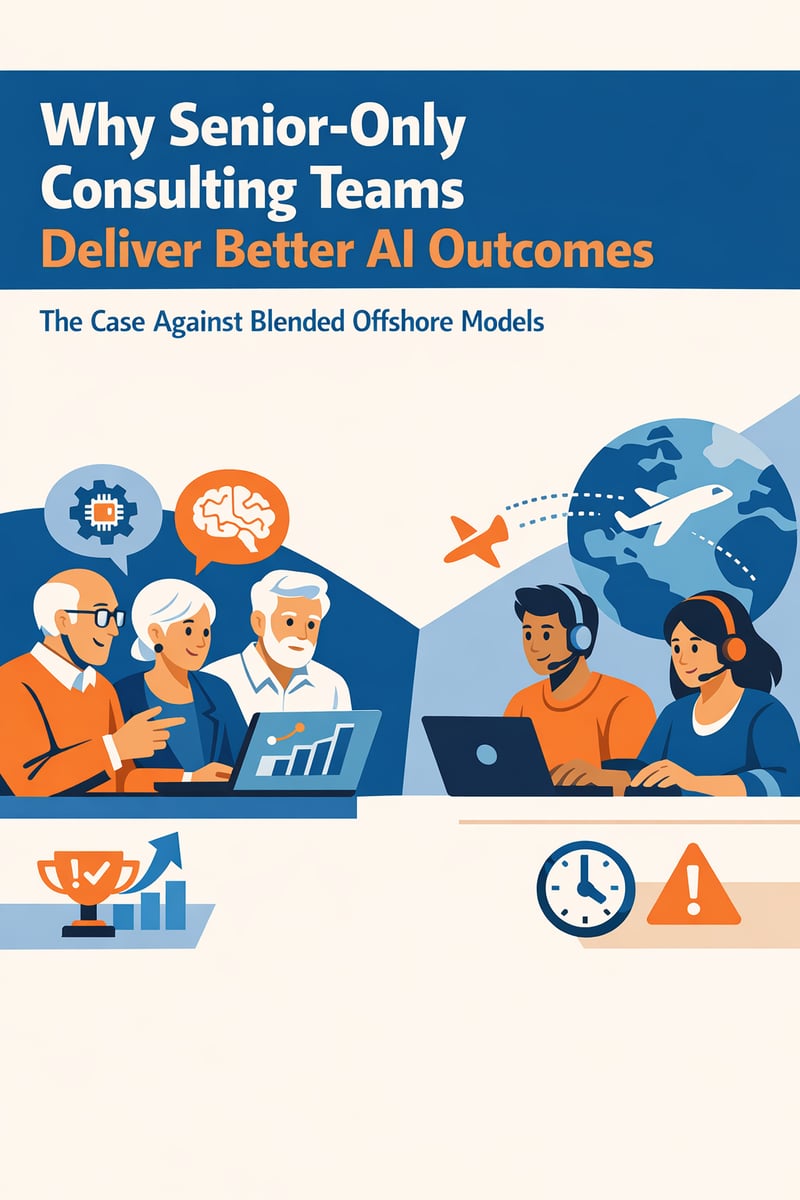
This article makes the data-driven case for why the senior-only consulting model — where every consultant has 10+ years of experience, works directly with clients, and has an ownership stake in outcomes — consistently delivers better results. We'll compare five common consulting models, expose the hidden costs of blended teams, and explain why the AI era has made senior talent more essential than ever.
The Five Consulting Models: An Honest Comparison
Not all consulting engagements are created equal. Before we examine why senior-only teams outperform, let's define the five dominant models in the market today.
1. Senior-Only Model
Every consultant on your project has 10+ years of platform experience, relevant certifications, and deep business domain knowledge. There is no bench of junior staff. No offshore team filling hours behind the scenes. The person you meet in the discovery session is the same person configuring your system, building your integrations, and training your team.
Vantage Point operates exclusively in this model. As an employee-owned firm, every consultant has a literal ownership stake in client outcomes — not just a utilization target to hit.
2. Blended Onshore/Offshore Model
A small team of senior consultants (typically 1–2) manages the client relationship and makes architectural decisions. The majority of the configuration, development, and testing work is performed by junior or mid-level consultants, often in offshore delivery centers. This is the dominant model for mid-size and large consulting firms.
3. Pure Offshore Model
The entire engagement team is located offshore. A project manager coordinates with the client, but all technical work is performed by remote teams in lower-cost regions. Communication happens asynchronously, and the client rarely interacts directly with the people building their solution.
4. Large System Integrators (Big 5 Model)
Global firms bring massive scale and brand recognition. They staff projects through a pyramid structure: a small number of partners and directors set strategy, managers oversee execution, and large teams of analysts and junior consultants do the work. They also follow a well-documented pattern of acquiring smaller, specialized firms approximately every 3–4 years to fill capability gaps.
5. Freelancer/Independent Consultant Model
Individual contractors or small groups of independent consultants are engaged directly. Quality varies enormously — you might get a 20-year veteran or a recently certified professional marketing themselves as an expert.
The Total Cost of Ownership Comparison
The table below compares these five models across the metrics that actually determine project success and long-term value. Hourly rates tell one story. Total cost of ownership tells a very different one.
| Factor | Senior-Only | Blended Onshore/Offshore | Pure Offshore | Big 5 / Large SI | Freelancer |
|---|---|---|---|---|---|
| Hourly Rate Range | $225–$325/hr | $150–$275/hr | $50–$125/hr | $300–$500/hr | $100–$250/hr |
| Rework Rate | 5–10% | 30–40% | 35–50% | 20–30% | 15–40% (varies) |
| Oversight Overhead | ~5% (peer review) | 30–40% of hours | 25–35% of hours | 25–35% of hours | 0–10% |
| Time to Value | 3–6 months | 6–12 months | 8–14 months | 8–18 months | 3–8 months |
| Client Retention | 95%+ | 60–75% | 40–60% | 65–80% | Variable |
| Consultant Turnover | Very Low | High | Very High | High (acquisition cycles) | N/A |
| Direct Client Access | Every consultant | Senior leads only | Project manager only | Partners/Directors only | Yes |
| AI/Automation Expertise | Deep (every consultant) | Senior tier only | Limited | Uneven | Varies |
| Effective Cost (TCO) | $$ | $$$ | $$ – $$$ | $$$$ | $ – $$$$ |
The critical insight: The cheapest hourly rate almost never translates to the lowest total project cost. When you factor in rework, extended timelines, oversight overhead, and opportunity cost of delayed go-live, senior-only teams routinely deliver the lowest total cost of ownership.
The Hidden Costs of Junior Consultants on Your Project
When a consulting firm staffs your project with junior talent, the costs extend far beyond the obvious. Here are the five hidden cost categories that rarely appear on a statement of work — but always appear in your final invoice and timeline.
1. Rework and Revision Cycles
Industry data consistently shows that deliverables produced by consultants with fewer than five years of experience require revision 30–40% of the time. This isn't a reflection of effort or intelligence — it's a reflection of pattern recognition. Senior consultants have seen hundreds of implementations. They know which approaches work, which configurations create downstream problems, and which shortcuts become technical debt.
A junior consultant might build a solution that passes QA testing but creates performance issues at scale. A senior consultant avoids that architecture entirely because they've seen it fail before — three years ago, on a different client, in a different industry.
Cost impact: If 35% of deliverables require rework, and the average rework cycle adds 40% effort to the original task, you're paying approximately 1.14x for every unit of junior work — before accounting for the senior consultant's time to review and redirect.
2. Extended Project Timelines
Junior-heavy teams move slower at every stage. Requirements gathering takes longer because junior consultants don't know which questions to ask. Architecture decisions take longer because they need to research approaches that senior consultants already know. Testing takes longer because more defects need to be identified and fixed.
Cost impact: Projects staffed primarily with junior consultants take 40–80% longer to reach go-live compared to senior-only teams working on equivalent scope. Every additional month of implementation is a month of delayed ROI.
3. Oversight and Knowledge Transfer Overhead
In blended models, senior consultants spend 30–40% of their billable hours managing, reviewing, training, and correcting junior team members. These are hours your organization pays for — at senior rates — that produce zero direct value to your project. The senior consultant becomes a project babysitter rather than a solution architect.
Cost impact: On a $500,000 engagement with 40% oversight overhead, you're effectively paying $200,000 for internal team management that wouldn't exist in a senior-only model.
4. Scope Creep and Change Orders
Junior consultants are more likely to misinterpret requirements, leading to builds that don't match business needs. When the gap is discovered — often during user acceptance testing — the project scope expands. Change orders are issued. Timelines extend. Budgets increase.
Cost impact: Scope creep driven by implementation errors adds 15–25% to total project cost in blended models, according to industry benchmarks.
5. Client Team Frustration and Productivity Loss
Your internal team has to spend more time explaining business processes, reviewing deliverables, and re-explaining requirements when working with junior consultants. This pulls your people away from their actual jobs. The frustration factor is real — and it damages the client-consultant relationship, often leading to team changes or vendor switches mid-project.
Cost impact: Difficult to quantify, but organizations consistently report that their internal team spends 2–3x more hours on project coordination with blended teams compared to senior-only teams.
Why AI Projects Specifically Demand Senior Talent
The shift toward AI-powered CRM implementations — Salesforce's Agentforce and Einstein, HubSpot's AI tools, and custom integrations with platforms like Claude AI — has raised the stakes dramatically. AI projects don't just need configuration skills. They need judgment.
Here's why senior experience is non-negotiable for AI initiatives:
Prompt Engineering and AI Strategy Require Business Context
Effective AI implementation isn't about technical proficiency with APIs. It's about understanding which business processes benefit from AI augmentation, which data sources should feed AI models, and how to design prompts and workflows that produce reliable, accurate results.
A junior consultant can connect an API. A senior consultant knows which API to connect, what data to feed it, how to validate outputs, and when AI automation should hand off to a human. This judgment comes from years of watching business processes succeed and fail.
Data Architecture Decisions Have Compounding Consequences
AI systems are only as good as their underlying data. The architectural decisions made during implementation — how data is structured, normalized, connected, and governed — determine whether your AI tools produce valuable insights or garbage.
A senior data architect makes these decisions correctly the first time because they've seen the consequences of poor data architecture play out across dozens of implementations. A junior consultant follows best-practice documentation that may not account for your specific data complexity.
Change Management Requires Organizational Fluency
AI adoption fails when people don't use it. The most technically perfect AI implementation is worthless if your team doesn't trust the outputs, doesn't understand the workflows, or feels threatened by the technology.
Senior consultants bring change management instincts that can't be taught in a training course. They know how to navigate organizational politics, build executive sponsorship, identify and convert skeptics, and design adoption programs that stick. They've done it dozens of times before.
Stakeholder Navigation Across Complex Organizations
AI projects touch every department. Sales, marketing, service, operations, compliance, IT — everyone has a stake, an opinion, and a concern. Managing these stakeholders, aligning competing priorities, and maintaining project momentum through organizational complexity requires senior-level executive communication skills.
Junior consultants are rarely equipped for this. They can present a technical demo. They can't navigate a boardroom disagreement about data governance policy.
Regulatory and Compliance Judgment
For organizations with significant compliance requirements, AI introduces new risks around data privacy, algorithmic bias, audit trails, and regulatory reporting. Senior consultants understand these implications because they've implemented solutions in compliance-heavy environments. They know which AI applications create regulatory exposure and how to mitigate those risks proactively.
The 4-Year Acquisition Cycle: Why Large Firms Can't Keep Their Best People
Large system integrators and global consultancies follow a predictable pattern that directly impacts client outcomes: the 4-year acquisition cycle.
Here's how it works:
Year 1 — Acquisition: A large consultancy acquires a smaller, specialized firm to fill a capability gap (e.g., AI expertise, a specific platform, or industry vertical knowledge). The acquired team brings deep expertise and existing client relationships.
Year 2 — Integration: The acquired team is absorbed into the parent organization's processes, billing structures, and delivery methodology. Key talent begins to feel the cultural friction. Some leave.
Year 3 — Dilution: The specialized knowledge that made the acquired firm valuable gets diluted across the larger organization. Senior consultants from the acquired team are spread thin. Junior staff from the parent company are brought in to scale the practice. Quality drops.
Year 4 — Attrition: The most talented consultants from the original acquisition — the ones who built the expertise — leave. They start their own firms, join competitors, or move to client-side roles. The large firm is left with the brand but not the talent.
Then the cycle repeats. The large firm acquires another specialized firm to fill the gap created by the talent exodus from the previous acquisition.
For clients, this cycle means:
- Your trusted consultant disappears mid-engagement or between phases
- Institutional knowledge of your environment walks out the door
- You're re-onboarding new consultants every 12–18 months
- Quality is unpredictable — it depends on where in the cycle you catch the firm
Research on mergers and acquisitions shows that 47% of key employees leave within the first year following an acquisition, and 75% leave within three years. When those employees are the senior consultants who know your business, the impact on ongoing projects and support relationships is severe.
The Employee-Ownership Advantage
There's a structural solution to the talent churn problem, and it's one that most consulting firms don't offer: employee ownership.
When consultants have an ownership stake in their firm, the incentive structure changes fundamentally:
- Retention: Employee-owners don't leave for a 15% raise at a competitor. Their ownership stake grows with the firm's success. Studies from the National Center for Employee Ownership (NCEO) show that employee-owned firms have significantly lower turnover than traditionally structured competitors.
- Accountability: When your name is on the business, you don't cut corners. Employee-owners treat every engagement like their reputation depends on it — because it does.
- Long-term thinking: Employee-owned firms optimize for client lifetime value, not quarterly utilization metrics. They invest in relationships, not just billable hours.
- Stability: Harvard Business School research shows that employee-owned companies weather economic downturns better, with fewer layoffs and business closures. For clients, this means your consulting partner will be there next year, and the year after that.
Vantage Point is employee-owned. Every consultant has a direct ownership stake in the firm's success. This isn't a marketing slogan — it's a structural commitment to the kind of long-term client relationships that produce exceptional outcomes. The result: a 4.71/5.0 average engagement rating across 400+ completed engagements and a 95%+ client retention rate.
Vantage Point's Approach: Senior-Only, Employee-Owned, Client-Direct
Vantage Point was built on a fundamentally different premise than most consulting firms: the consultant who sells the engagement is the consultant who delivers the engagement.
Every Consultant Has 10+ Years of Experience
There is no junior bench. No associate consultants learning on your project. Every Vantage Point consultant brings a minimum of a decade of hands-on platform experience — Salesforce, HubSpot, MuleSoft, Data Cloud, and AI solutions. They hold relevant certifications and have delivered implementations across hundreds of clients.
Direct Client Access to Senior Talent
You'll never be told your question needs to be "escalated" to a senior resource. Every conversation, every design decision, every configuration review happens directly with senior-level consultants who have the authority and expertise to make decisions in real time.
Ownership Mentality in Every Engagement
Vantage Point's core values — Ownership Mentality, Collaborative Partnership, Tenacious Execution, and Humble Confidence — aren't aspirational statements on a website. They're how employee-owners naturally operate when their livelihood and reputation are directly tied to client success.
The VALUE Framework
Vantage Point's delivery methodology ensures structured, repeatable excellence:
- V — Validate: Thoroughly understand business requirements, pain points, and objectives before writing a single line of configuration
- A — Architect: Design solutions that account for scale, integration complexity, and future growth
- L — Launch: Execute implementation with senior-level precision, minimal rework, and continuous client communication
- U — Utilize: Drive adoption through training, change management, and ongoing optimization
- E — Evolve: Provide ongoing support and strategic guidance as business needs change and platforms evolve
Key Partnerships That Extend Capabilities
Vantage Point's partnerships with Salesforce, HubSpot, Anthropic (Claude AI), Aircall, and Workato mean clients get senior-level expertise across the full technology stack — not just a single platform. When your CRM needs AI-powered automation, cloud telephony integration, or enterprise-grade data connectivity, the same senior team delivers it all.
Best Practices: Choosing the Right Consulting Partner for AI and CRM Projects
Based on the data and analysis above, here are actionable best practices for organizations evaluating consulting partners:
1. Ask Who Will Actually Do the Work
Before signing any engagement, ask the firm to name every consultant who will work on your project. Ask for their individual experience levels, certifications, and references. If the firm can't commit specific people, that's a red flag.
2. Demand Direct Access to Senior Consultants
If your primary point of contact is a project manager who relays information to the technical team, you're in a blended model whether the firm admits it or not. Insist on direct communication with the consultants building your solution.
3. Evaluate Total Cost of Ownership, Not Hourly Rates
A $150/hour blended team that takes 12 months with 35% rework is more expensive than a $275/hour senior team that delivers in 5 months with 5% rework. Do the math on total project cost, not rate cards.
4. Check Consultant Tenure and Firm Stability
Ask how long the firm's consultants have been with the organization. Ask about the firm's ownership structure. Ask whether they've been acquired recently. High consultant turnover means your project knowledge walks out the door.
5. Verify AI-Specific Experience
For AI implementations, generic CRM experience isn't enough. Ask for specific examples of AI projects the consultants have delivered. Ask about their approach to data architecture, prompt engineering, AI governance, and change management.
6. Look for an Ownership Mindset
The best consulting relationships feel like partnerships, not vendor transactions. Employee-owned firms, where consultants have a personal stake in your success, consistently deliver this dynamic.
7. Request Client References from Similar Projects
Don't accept curated case studies. Ask for direct references from clients with similar scope, complexity, and objectives. Ask those references about rework rates, timeline accuracy, and consultant quality.
Frequently Asked Questions
Why do 70% of CRM projects fail?
The majority of CRM project failures are attributed to poor implementation rather than technology limitations. Common causes include inadequate requirements gathering, insufficient change management, poor data migration, lack of executive sponsorship, and — critically — inexperienced implementation teams. When junior consultants drive implementation, they often miss business nuances that lead to solutions that technically work but don't meet actual business needs.
What is a senior-only consulting model?
A senior-only consulting model is one where every consultant on a client engagement has extensive experience (typically 10+ years), relevant certifications, and deep platform expertise. There are no junior consultants, associate analysts, or offshore teams performing work behind the scenes. The client works directly with the same senior professionals from project kickoff through go-live and beyond.
How much more do senior consultants cost per hour compared to junior consultants?
Senior consultants typically bill at $225–$325 per hour, compared to $75–$150 for junior consultants. However, when factoring in rework rates (30–40% for junior-heavy teams vs. 5–10% for senior teams), oversight overhead (30–40% of blended team hours), and extended timelines (40–80% longer), the total cost of ownership for senior-only teams is typically 20–40% lower than blended models.
What is the "4-year acquisition cycle" in consulting?
The 4-year acquisition cycle refers to a pattern common among large system integrators where they acquire smaller specialized firms to gain expertise, then lose the acquired talent over 2–3 years due to cultural friction and corporate bureaucracy, then acquire again to fill the gap. This cycle creates instability for clients, as their trusted consultants frequently change.
Why are AI projects more dependent on senior talent than traditional CRM implementations?
AI projects require judgment-intensive decisions around data architecture, prompt engineering strategy, business process analysis, change management, and regulatory compliance. These decisions can't be effectively made by following documentation or standard procedures — they require the pattern recognition and business context that comes from years of diverse implementation experience. A misconfigured workflow might be fixable; a poorly architected AI data pipeline creates compounding problems.
What does employee-owned mean for a consulting firm?
An employee-owned consulting firm gives its consultants a direct financial stake in the company's success. This creates structural incentives for quality, retention, and long-term client relationships. Employee-owners are more accountable, less likely to leave for competitors, and more invested in client outcomes. Research from Harvard Business School and the National Center for Employee Ownership shows these firms have lower turnover, higher productivity, and better resilience during economic downturns.
How can I calculate the true cost of a blended consulting team?
To calculate total cost of ownership for a blended team, start with the blended hourly rate multiplied by estimated hours. Then add: rework cost (multiply deliverable hours by 35% rework rate × 1.4 effort multiplier), oversight overhead (multiply senior hours by 40%), timeline extension cost (add 40–80% to estimated project duration × burn rate), and opportunity cost of delayed go-live (monthly revenue impact × additional months). The resulting figure is typically 2–3x the initial quote.
What questions should I ask a consulting firm about their team composition?
Ask: (1) Who specifically will work on my project? (2) What is each consultant's experience level and tenure with your firm? (3) Will any work be performed offshore or by subcontractors? (4) What is your consultant turnover rate? (5) Can I speak directly with the technical consultants? (6) What happens if my assigned consultant leaves during the project? (7) What percentage of project hours go to internal oversight vs. direct client value?
What is Vantage Point's client satisfaction track record?
Vantage Point maintains a 4.71/5.0 average engagement rating across more than 400 completed engagements, with a 95%+ client retention rate. These metrics reflect the senior-only, employee-owned model where every consultant has a personal stake in delivering exceptional outcomes. The firm serves 150+ clients across multiple industries with Salesforce, HubSpot, MuleSoft, Data Cloud, and AI solutions.
How does the senior-only model handle capacity and scaling?
Senior-only firms scale through strategic hiring of experienced professionals and partnership networks — not by adding junior headcount. This means growth is intentionally paced to maintain quality. Vantage Point's partnerships with Salesforce, HubSpot, Anthropic, Aircall, and Workato extend capabilities without diluting team seniority. For clients, this means consistent quality regardless of engagement size.
Conclusion: Experience Isn't Expensive — It's Essential
The data is clear: in CRM and AI implementation, the experience level of your consulting team is the single most predictive factor of project success. Not the platform. Not the methodology framework. Not the brand name on the proposal. The people.
Every year, organizations spend billions on CRM and AI implementations that fail — not because the technology doesn't work, but because the people implementing it don't have the experience to make it work for their specific business. The 70% failure rate isn't a technology problem. It's a talent problem.
The senior-only, employee-owned consulting model solves this problem structurally. When every consultant has a decade of experience and an ownership stake in your success, the incentives align perfectly: your project succeeds, the firm succeeds, the consultant succeeds.
Ready to experience the difference? Vantage Point's senior-level, U.S.-based team delivers Salesforce, HubSpot, MuleSoft, and AI solutions with a 4.71/5.0 satisfaction rating and 95%+ client retention. Contact us to discuss how we can help your organization achieve measurable results — with consultants who have the experience to get it right the first time.
📧 Email: david@vantagepoint.io | 🌐 Website: vantagepoint.io | 📞 Phone: 469-499-3400
About Vantage Point
Vantage Point is a senior-led, employee-owned Salesforce and HubSpot consulting firm specializing in CRM implementation, AI-driven automation, MuleSoft integration, and managed services. With 150+ clients, 400+ completed engagements, a 4.71/5.0 satisfaction rating, and 95%+ client retention, Vantage Point delivers enterprise-grade solutions with the accountability and expertise that only senior-level, employee-owned consultants can provide. As partners with Salesforce, HubSpot, Anthropic, Aircall, and Workato, Vantage Point offers comprehensive technology solutions for organizations across industries.