
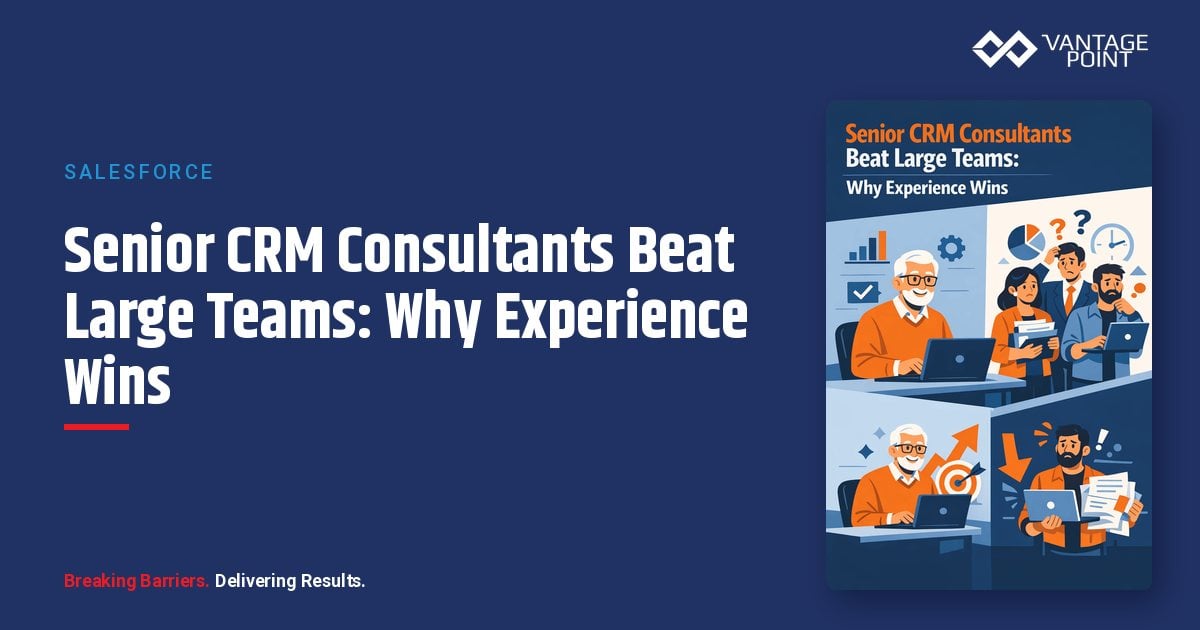
CRM projects succeed when the hardest decisions are made early by people who have already seen the failure patterns. Senior CRM consultants usually create more value than a larger team of junior or offshore resources because they can connect business process, platform architecture, data quality, integration, compliance, and adoption in one practical plan.
That does not mean headcount never matters. Large teams can help when requirements are clear and the work is repeatable. But in Salesforce, HubSpot, and connected CRM programs, the bottleneck is rarely typing configuration faster. The bottleneck is judgment: knowing what to simplify, what to challenge, what to sequence, and what not to build.
Quick Answer
Senior CRM consultants are experienced advisors and builders who lead CRM strategy, implementation, integration, and optimization work with direct accountability. This matters for executives, revenue leaders, operations teams, and IT owners who need CRM projects to support business decisions instead of creating more process debt. This article helps buyers decide when a senior-led consulting model is a better fit than a high-headcount delivery model. Vantage Point is relevant because our Salesforce, HubSpot, integration, data, and managed services work is delivered by senior consultants who connect strategy with execution.
TL;DR
- Senior CRM consultants reduce risk at the decision layer. They help teams avoid unclear scope, weak data models, poor adoption design, and avoidable integrations.
- More headcount does not automatically mean faster CRM delivery. If the work is poorly defined, a larger team often multiplies rework.
- The best fit for senior-led consulting is complex CRM work. Platform selection, Salesforce or HubSpot implementation, integration, data migration, governance, and change management all require experienced judgment.
- Use large delivery teams selectively. They work best after architecture, process decisions, and acceptance criteria are clear.
- Vantage Point helps teams combine senior advisory with hands-on delivery across Salesforce, HubSpot, MuleSoft, Data Cloud, AI personalization, and CRM operations.
Why Do Senior CRM Consultants Matter More Than Headcount?
Senior CRM consultants matter because CRM projects are business operating model projects, not just software configuration projects. The platform can only support the business if the consulting team understands sales, service, marketing, data, automation, reporting, security, and user behavior.
A junior-heavy team can complete assigned tasks. A senior-led team can question whether those tasks should exist in the first place.
That difference matters when an organization is deciding:
- Whether to use Salesforce, HubSpot, or both.
- Which process should be standardized before automation.
- Which data should be migrated, cleaned, archived, or left behind.
- Which integrations should be real-time, batch, middleware-led, or avoided.
- How to keep compliance, security, and user adoption from becoming afterthoughts.
Project management research consistently points to themes such as executive sponsorship, clear goals, communication, and delivered value as drivers of project success. PMI’s Pulse of the Profession research reinforces that project success depends on value and execution discipline, not activity volume alone. CRM programs are no different.
When Does a Large CRM Team Help, and When Does It Hurt?
A large CRM team helps when the work is clearly defined, repeatable, and ready to scale. It hurts when the team is asked to compensate for weak strategy, incomplete requirements, or unresolved ownership decisions.
| CRM project situation | Senior-led model advantage | Large-team model risk |
|---|---|---|
| Platform selection | Clarifies business fit, governance, and long-term operating model | Compares feature lists without resolving decision criteria |
| Salesforce or HubSpot implementation | Designs process, data, and adoption around business outcomes | Builds every request before validating whether it is needed |
| Data migration | Separates migration, cleanup, deduplication, and governance decisions | Moves bad data faster and creates downstream reporting issues |
| Integration work | Defines source of truth, sync logic, error handling, and security | Adds point-to-point complexity without ownership clarity |
| User adoption | Designs workflows around how teams actually work | Treats training as a final project task |
| Post-launch support | Prioritizes improvements based on business value | Keeps a ticket queue moving without solving root causes |
The practical takeaway: use senior consultants to define the work, de-risk the work, and lead the work. Use additional delivery capacity only when the work is specific enough to scale.
What Should Buyers Look For in a Senior CRM Consulting Partner?
A strong CRM consulting partner should bring more than certifications and resource availability. Buyers should look for signs that the partner can make decisions with them, not just take orders from them.
1. Can They Explain Tradeoffs Clearly?
Good consultants do not say yes to every request. They explain the tradeoff between speed, customization, maintainability, user adoption, reporting, and cost of ownership.
For example, a custom Salesforce object may solve a short-term reporting problem but create integration and permissions complexity later. A HubSpot workflow may automate follow-up but fail if lifecycle stages, ownership rules, and list criteria are unclear. Senior consultants identify those issues before they become technical debt.
2. Do They Connect CRM Strategy to Business Process?
CRM success depends on process clarity. Before automation, the team should agree on pipeline stages, service handoffs, marketing qualification, customer data ownership, renewal motions, and reporting definitions.
This is where CRM and marketing automation strategy matters. Salesforce and HubSpot are powerful platforms, but they need a practical operating model behind them.
3. Can They Work Across Salesforce, HubSpot, and Integration Needs?
Many businesses do not live in one system. They may use Salesforce for complex sales or service operations, HubSpot for marketing and sales engagement, and other platforms for finance, support, product, or data operations.
A senior partner should understand Salesforce implementation and advisory, HubSpot consulting and optimization, and system integration and data migration well enough to recommend the right architecture instead of forcing every problem into one platform.
4. Do They Treat Adoption as Design, Not Training?
Adoption starts in requirements and workflow design. If users need ten clicks to complete a common task, training will not fix the problem. If reports do not match how leaders manage the business, dashboards will not create trust.
Senior CRM consultants build adoption into page layouts, required fields, automation, alerts, dashboards, governance, and support models. Training is still useful, but it should reinforce a well-designed workflow rather than compensate for a confusing one.
What Is the Cost of Over-Staffing a CRM Project?
The cost of over-staffing a CRM project is not only budget. The bigger cost is rework, coordination overhead, and diluted accountability.
When too many people are added before the project is ready, teams often see:
- Multiple analysts collecting overlapping requirements.
- Developers waiting for unresolved process decisions.
- Testers validating functionality that may be redesigned later.
- Project managers tracking activity instead of clearing decisions.
- Business users reviewing too many artifacts without a clear decision path.
A senior-led model can be more efficient because it reduces translation layers. The same consultant who understands the business problem can often design the solution, configure the platform, pressure-test the data model, and explain the tradeoff to executives.
How Should Companies Decide Between Senior-Led and High-Headcount CRM Delivery?
Use a senior-led CRM model when the work involves uncertainty, executive decisions, cross-platform architecture, compliance sensitivity, data quality, or adoption risk. Use a larger delivery team when the work is already designed and needs repeatable execution.
| Choose a senior-led CRM consulting model when... | Add larger delivery capacity when... |
|---|---|
| Requirements are unclear or politically sensitive | Requirements are approved and stable |
| Salesforce, HubSpot, integrations, or data migration must be coordinated | Configuration tasks are well documented |
| The team needs architecture, governance, or process leadership | The team needs more build or test throughput |
| User adoption risk is high | Training materials and workflow design are already validated |
| Compliance, security, or data access decisions are important | Security patterns are already defined |
| Executives need a trusted advisor who can challenge assumptions | Project leadership already has decision authority |
This is not an argument against scale. It is an argument for sequencing. Senior judgment should come first. Delivery scale should follow clarity.
What Should Businesses Do Before Starting a CRM Project?
Before starting a CRM project, businesses should define the decisions that cannot be delegated to software. The following checklist helps keep the project practical.
CRM Readiness Checklist
- Define the business outcome. What decision, workflow, or customer experience must improve?
- Name the executive owner. Who can resolve scope, budget, process, and adoption tradeoffs?
- Map the current process. Where do handoffs, exceptions, duplicate work, and reporting gaps appear?
- Clarify source-of-truth rules. Which system owns accounts, contacts, companies, deals, tickets, activities, consent, and revenue data?
- Assess data quality early. What needs to be cleaned before migration or automation?
- Decide what not to automate. Bad process automation creates faster confusion.
- Plan adoption before launch. Who will use the system, what will change, and how will leaders reinforce it?
- Set a post-launch support model. Decide how enhancements, governance, and managed support will work after go-live.
Teams that need help with these decisions often benefit from advisory and change management support before they commit to a full implementation plan.
How Vantage Point Helps
Vantage Point helps organizations plan, implement, integrate, and optimize CRM platforms with senior consultants who stay close to the work. We support Salesforce, HubSpot, MuleSoft integration, Data Cloud, AI personalization, compliance, data migration, and managed services without forcing every client into the same delivery model.
Our approach is practical:
- Clarify the business outcome and platform fit.
- Simplify process before configuration.
- Design the data and integration model before migration.
- Build adoption into the user experience.
- Support continuous improvement after launch.
Vantage Point has supported 175+ clients and 700+ engagements, giving our consultants a broad pattern library across CRM strategy, implementation, integration, governance, and optimization. If your team is evaluating Salesforce, HubSpot, CRM integration, or post-launch optimization, talk with Vantage Point about the right senior-led CRM plan.
FAQ
What is a senior CRM consultant?
A senior CRM consultant is an experienced advisor and implementer who helps design, configure, integrate, and optimize CRM systems around business outcomes. Senior consultants usually combine platform expertise with process, data, adoption, and governance judgment.
Are senior CRM consultants better than larger implementation teams?
Senior CRM consultants are often better for complex or ambiguous CRM work because they reduce decision risk before build work begins. Larger teams can be useful after architecture, requirements, and acceptance criteria are clear.
When should a company use a large CRM delivery team?
A company should use a large CRM delivery team when the work is repeatable, well documented, and ready to scale. Examples include configured backlog execution, testing, data remediation, or migration tasks after senior leaders have defined the solution.
Why do CRM projects fail even with many people assigned?
CRM projects can fail with many people assigned because headcount does not solve unclear scope, poor data, weak executive sponsorship, over-customization, or low user adoption. More people can increase coordination overhead if decisions are not clear.
How does a senior-led CRM model improve Salesforce projects?
A senior-led model improves Salesforce projects by aligning business process, data model, security, automation, reporting, and adoption before heavy configuration begins. This helps teams avoid unnecessary customization and build a maintainable Salesforce environment.
How does a senior-led CRM model improve HubSpot projects?
A senior-led model improves HubSpot projects by connecting lifecycle stages, segmentation, sales process, marketing automation, reporting, and CRM governance. This helps HubSpot teams avoid disconnected workflows and unreliable attribution or pipeline reporting.
How can Vantage Point support an existing CRM project that is struggling?
Vantage Point can assess the project plan, process design, data model, integration approach, adoption barriers, and backlog priorities. From there, our team can help stabilize delivery, simplify scope, and create a practical path to launch or post-launch improvement.