Key Takeaways (TL;DR)
- What is MCP? Model Context Protocol, the "USB-C for AI", is an open standard that lets AI agents connect to any data source or tool through a single, universal interface
- Key Benefit: Organizations running both Salesforce and HubSpot can unify data access across platforms without building custom point-to-point integrations
- Cost: 80-90% reduction in integration development time compared to traditional API approaches; existing MuleSoft investments can be converted to MCP servers with zero code changes
- Timeline: 8-16 weeks for Phase 1 deployment; full cross-platform agent ecosystem in 4-6 months
- Best For: Dual-platform CRM shops (Salesforce + HubSpot) needing unified customer views, cross-platform automation, and AI-powered workflows
- Bottom Line: MCP eliminates the integration tax that multi-CRM organizations have paid for years. AI agents can now read, write, and reason across both platforms through one protocol
Introduction: The Multi-Platform CRM Problem Nobody Solved: Until Now
Here's a reality most CRM consultants won't tell you: the majority of mid-market and enterprise organizations run more than one CRM platform. Marketing lives in HubSpot. Sales closes deals in Salesforce. Service tickets flow through one system while customer success manages renewals in another. The result? Data silos, duplicated records, conflicting reports, and an ever-growing line item for middleware and integration maintenance.
For years, the answer was the same: build custom API integrations, deploy middleware like MuleSoft or Workato, or accept that your two CRM platforms would never truly talk to each other. Every integration was a bespoke project, fragile, expensive, and constantly breaking when either platform shipped an update.
Model Context Protocol (MCP) changes this equation entirely.
Introduced by Anthropic and rapidly adopted by Salesforce, HubSpot, Microsoft, and the broader AI ecosystem, MCP is an open standard that lets AI agents connect to any external system through a universal interface. Think of it as USB-C for AI: one protocol, infinite connections.
In this guide, we'll break down exactly why MCP is a game-changer for multi-platform CRM environments, how the technical architecture works, what Salesforce and HubSpot are doing with MCP today, and how your organization can implement a cross-platform MCP strategy.
What Is Model Context Protocol (MCP)?
The Universal Connector for AI Agents
Model Context Protocol (MCP) is an open-source standard that enables AI models and agents to interact securely with external systems (CRMs, ERPs, databases, APIs, and business tools) without requiring custom integrations for each connection.
Before MCP, every AI agent that needed to access Salesforce data required a purpose-built connector. If that same agent also needed HubSpot data, you built another connector. And another for your ERP. And another for your data warehouse. Each integration was:
- Rigid: hardcoded to specific API endpoints and field structures
- Fragile: broke whenever the platform updated its API
- Expensive: required developer time for every new connection
- Isolated: each connector operated independently with no shared context
MCP replaces this pattern with a single, standardized protocol. An AI agent equipped with an MCP client can discover available tools, understand their capabilities, interpret data schemas in real time, and execute actions: all through one consistent interface.
How MCP Works: The Technical Architecture
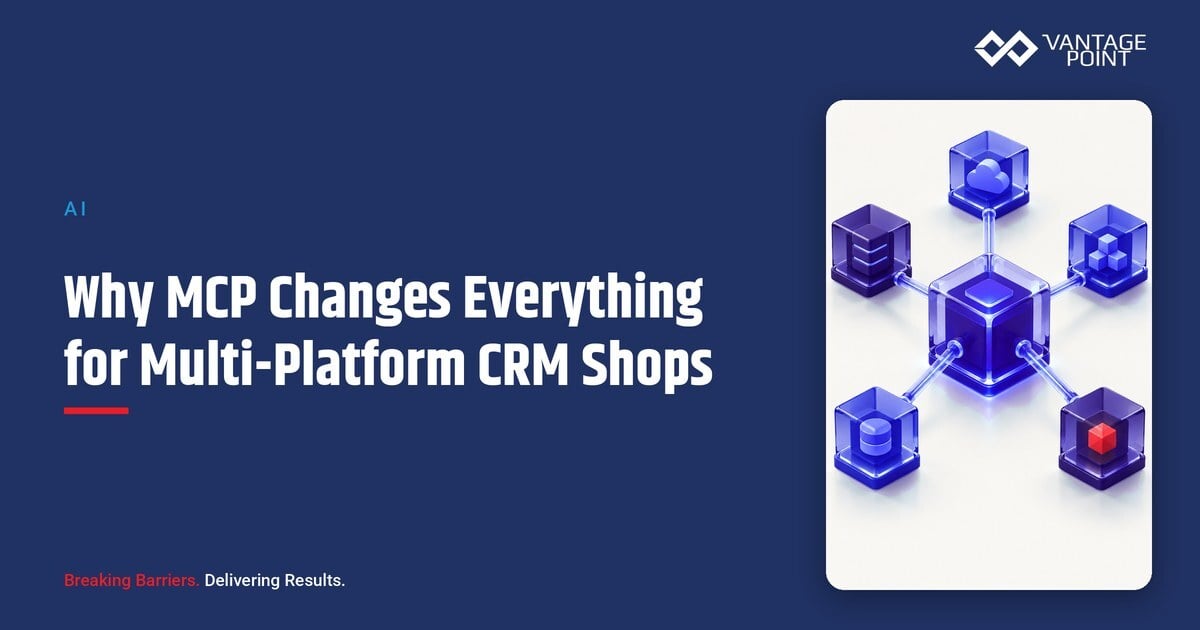
The MCP architecture follows a clean client-server model:
MCP Client (AI Agent) → MCP Server (System Connector) → Data Source/Tool (CRM, ERP, Database)
Here's what happens under the hood:
- Discovery: The AI agent queries available MCP servers to learn what tools and data sources are accessible
- Schema Interpretation: The agent reads the schema and capabilities of each connected system in real time: no hardcoded field mappings required
- Contextual Execution: The agent sends requests through the MCP server, which translates them into the appropriate system calls (SOQL queries for Salesforce, API calls for HubSpot, etc.)
- Response Processing: Results flow back through the MCP server to the agent, which can then reason across data from multiple sources simultaneously
This architecture means a single AI agent can maintain context across your entire technology stack (reading from Salesforce, writing to HubSpot, checking your ERP, and updating your data warehouse) all in one conversation or workflow.
Transport and Communication
MCP supports multiple transport mechanisms:
- Standard I/O (stdio): For local, process-to-process communication
- Server-Sent Events (SSE): For real-time, streaming connections over HTTP
- Streamable HTTP: HubSpot's preferred method for their production MCP server
Why Multi-Platform CRM Shops Are the Biggest Beneficiaries
The Dual-Platform Reality
Organizations running both Salesforce and HubSpot face a unique set of challenges that MCP is purpose-built to solve:
| Challenge | Before MCP | After MCP |
|---|---|---|
| Unified Customer View | Custom sync jobs, duplicate records, conflicting data | AI agents query both CRMs in real time through a single protocol |
| Cross-Platform Lead Routing | Middleware rules, manual handoffs, delayed routing | Agents evaluate lead data across both platforms instantly and route intelligently |
| Reporting | Separate dashboards, manual data merging, monthly reconciliation | Agents pull and synthesize data from both platforms for unified reporting |
| Marketing-to-Sales Handoff | CSV exports, Zapier chains, fragile API integrations | Seamless data flow through MCP: marketing context travels with the lead |
| Data Governance | Two sets of rules, two admin teams, no single source of truth | Unified policies enforced through MCP server configurations |
Six Use Cases That Transform Dual-Platform Operations
1. Unified Customer 360 Across Salesforce and HubSpot
An MCP-connected AI agent can pull a contact's marketing engagement history from HubSpot (email opens, form submissions, content downloads) and combine it with their sales pipeline data from Salesforce (deal stage, last activity, forecast amount): all in a single query. No custom integration. No middleware. No data warehouse required.
Example prompt: "Give me a complete view of Acme Corp. Their marketing engagement this quarter from HubSpot and their current pipeline status in Salesforce."
2. Cross-Platform Intelligent Lead Routing
Instead of static routing rules that only consider data from one platform, MCP-enabled agents can evaluate signals from both systems:
- HubSpot lead score + Salesforce territory assignment
- Marketing qualification status + sales capacity data
- Content engagement patterns + historical win rates by segment
3. Agentforce Agents Reading HubSpot Marketing Data
Salesforce's Agentforce framework now supports MCP server consumption as "Actions." This means an Agentforce agent assisting a sales rep can pull HubSpot marketing data (campaign performance, content engagement, lead scoring) directly into the Salesforce workflow. The rep never leaves Salesforce, but they get the full marketing context.
4. HubSpot Breeze Agents Accessing Salesforce Pipeline
On the HubSpot side, Breeze AI agents can connect to Salesforce through community-built and official MCP servers. A marketing operations manager can ask their Breeze agent: "Which campaigns drove the most pipeline in Salesforce last quarter?": and get an answer that spans both platforms without building a single report.
5. Unified Cross-Platform Reporting
Finance needs a single revenue number. Operations needs a single customer count. Leadership needs a single dashboard. MCP agents can query both platforms, reconcile differences, and generate unified reports that previously required weeks of manual data preparation.
6. Cross-Platform Workflow Automation
MCP enables workflows that span both platforms seamlessly:
- A deal closes in Salesforce → Agent triggers onboarding workflows in HubSpot
- A support ticket escalates in HubSpot → Agent creates a case in Salesforce Service Cloud
- A contract renewal is due in Salesforce → Agent triggers re-engagement campaigns in HubSpot
MCP vs. Traditional Integration Approaches
How does MCP compare to the integration patterns organizations have relied on for years? Let's evaluate across eight critical dimensions:
| Dimension | REST APIs | MuleSoft / iPaaS | Custom Code | MCP |
|---|---|---|---|---|
| Integration Effort | High: endpoint-specific wiring | Medium: visual builders + connectors | Very High: bespoke development | Low: dynamic discovery, no hardcoding |
| Adaptability | Fragile: breaks on API changes | Moderate: requires connector updates | Very Fragile: manual maintenance | High: real-time schema interpretation |
| Scalability | Linear: each new system = new work | Good: reusable connectors | Poor: each integration is unique | Excellent: one protocol for all systems |
| Speed to Value | Weeks to months | Days to weeks | Months | Minutes to hours for MCP-ready systems |
| AI Agent Compatibility | Low: agents can't discover endpoints | Low: designed for system-to-system | None: no agent interface | Native: built for AI agents |
| Cross-Platform Context | None: each call is isolated | Limited: orchestration possible | Manual: requires custom logic | Native: agents maintain context across calls |
| Cost | High development + maintenance | License fees + development | Very high total cost of ownership | Low: open standard, no licensing |
| Security & Governance | Custom per integration | Platform-level controls | Custom per integration | Standardized OAuth 2.0, role-based access, audit trails |
The Key Differentiator: Context
Traditional integrations move data between systems. MCP gives AI agents context across systems. That distinction matters because:
- Data movement is reactive: it happens on a schedule or trigger
- Context is proactive, the agent understands relationships, dependencies, and implications across your entire stack
An MCP-connected agent doesn't just know that a lead exists in both Salesforce and HubSpot. It understands their complete journey, can reason about what should happen next, and can take action in either platform: all in one interaction.
How Salesforce and HubSpot Are Adopting MCP
Salesforce: MCP Through Agentforce and MuleSoft
Salesforce has embraced MCP through its Agentforce AI agent framework. Key developments include:
- Agentforce MCP Client (Pilot): As of Agentforce 3.0 (July 2025), a native MCP client is in pilot, allowing Agentforce agents to consume external MCP servers as "Actions"
- AgentExchange: Salesforce's marketplace for certified MCP servers, ensuring enterprise-grade security and compliance for agent integrations
- Slack MCP Server: Slack is developing its own MCP server, enabling AI agents to interact with Slack conversations and workflows through the protocol
- MCP-Universe Framework: A Salesforce-led framework standardizing MCP implementations with unified APIs, SSE transport, and dynamic discovery
HubSpot: First Major CRM With Production-Grade MCP
HubSpot took a different approach: open and accessible:
- Production MCP Server: Launched June 2025, HubSpot's public MCP server (accessible at
mcp.hubspot.com) was the first production-grade CRM MCP integration - Full CRM Access: Read/write access to contacts, companies, deals, tickets, activities, and marketing content
- OAuth 2.0 with PKCE: Enterprise-grade authentication respecting existing HubSpot user permissions
- Open Interoperability: Works with any MCP client (Claude, ChatGPT, custom agents) not locked to a proprietary assistant
- Natural Language Queries: Users can query live CRM data conversationally: "Summarize my pipeline by region and flag high-risk accounts"
MuleSoft: The MCP Bridge for Existing Integrations
For organizations already invested in MuleSoft (a Salesforce company), MCP Bridge is a game-changer:
- Zero Code Changes: Convert existing MuleSoft APIs into MCP-compatible servers without rewriting anything
- Centralized Governance: All MCP traffic routes through MuleSoft's Flex Gateway for authentication, rate limiting, and threat detection
- 350+ Connectors: MuleSoft's existing connector library becomes MCP-accessible, dramatically expanding what AI agents can reach
- Agent Registry: A centralized registry makes MCP tools discoverable and reusable across the organization
- Attribute-Based Access Control (ABAC): Granular policies control exactly which tools are available to specific agents based on role and context
Implementation Roadmap: From Assessment to Cross-Platform Intelligence
Phase 1: Audit and Assessment (Weeks 1-4)
Objective: Understand your current integration landscape and identify MCP opportunities.
- Inventory all existing integrations between Salesforce and HubSpot
- Map data flows, sync frequencies, and known pain points
- Identify which integrations are candidates for MCP replacement
- Assess MuleSoft investments that can be converted via MCP Bridge
- Document security requirements, compliance needs, and governance policies
- Evaluate team readiness and identify skill gaps
Phase 2: Deploy MCP Servers (Weeks 5-10)
Objective: Stand up MCP server infrastructure for both CRM platforms.
- Configure HubSpot's production MCP server with appropriate OAuth scopes
- Deploy Salesforce MCP capabilities through Agentforce or community-built servers
- If using MuleSoft, deploy MCP Bridge to convert existing APIs to MCP servers
- Implement security controls: OAuth 2.0, role-based access, audit logging
- Set up MCP gateway infrastructure for centralized traffic management
- Conduct shadow testing with non-production data
Phase 3: Build Cross-Platform Agents (Weeks 11-16)
Objective: Deploy AI agents that operate across both CRM platforms.
- Build initial use cases: unified customer view, cross-platform reporting, intelligent lead routing
- Configure agent permissions and guardrails for each platform
- Implement business logic and decision frameworks for cross-platform operations
- Test extensively with real-world scenarios and edge cases
- Deploy canary releases to limited user groups
- Gather feedback and iterate on agent behavior
Phase 4: Optimize and Scale (Ongoing)
Objective: Expand MCP coverage and optimize agent performance.
- Add additional MCP servers for ERP, data warehouse, and other business systems
- Implement advanced use cases: predictive routing, automated reporting, workflow orchestration
- Optimize agent response times and accuracy
- Scale to additional teams and departments
- Implement agent observability and AI SRE practices
- Continuous compliance monitoring and security hardening
Security Considerations for Enterprise MCP Deployments
Authentication and Access Control
MCP is built on enterprise-grade security standards:
- OAuth 2.0 with PKCE: Required for all authentication flows, ensuring secure token exchange
- Role-Based Access: MCP respects existing CRM user permissions: agents can only access data the authenticated user can see
- Attribute-Based Access Control (ABAC): When using MuleSoft MCP Bridge, granular policies control tool availability per agent
- Audit Trails: Every MCP interaction is logged and traceable
Known Security Risks
The MCP ecosystem is still maturing, and organizations should be aware of:
- Tool Poisoning: Malicious MCP servers could manipulate agent behavior. Mitigate by using only certified/trusted MCP servers and implementing gateway-level validation
- Prompt Injection: Adversarial inputs could trick agents into unauthorized actions. Implement input sanitization and output validation at the MCP server level
- Overprivileged Access: Agents with excessive permissions could access sensitive data. Apply least-privilege principles and regularly audit agent permissions
- Configuration Drift: MCP server configurations can diverge over time. Implement infrastructure-as-code and regular configuration audits
A 2026 study of 2,614 MCP server implementations found that 82% were vulnerable to path traversal attacks and 67% exposed APIs open to code injection, underscoring the importance of using managed, enterprise-grade MCP infrastructure rather than ad-hoc implementations.
MCP Adoption Trends: Where the Market Is Heading
The MCP ecosystem is accelerating rapidly:
- 28% of Fortune 500 companies have adopted MCP in some form as of early 2026
- Salesforce, HubSpot, Microsoft, Google, and Anthropic all actively support or implement MCP
- MCP Dev Summit North America 2026 positioned MCP as "enterprise infrastructure": not just a developer protocol
- Enterprise RFPs are increasingly requiring MCP compatibility as a formal evaluation criterion
- Gong, Asana, Intercom, and other major platforms are building native MCP servers
- MCP Bridge GA: MuleSoft's MCP Bridge reached general availability, making it production-ready for enterprises
Best Practices for Multi-Platform MCP Success
- Start With High-Value, Low-Risk Use Cases: Begin with read-only cross-platform queries (unified reporting, customer 360) before moving to write operations (automated lead routing, cross-platform workflow triggers).
- Leverage Existing MuleSoft Infrastructure: If you've invested in MuleSoft, MCP Bridge converts your existing APIs into MCP servers with zero code changes. Don't rebuild: extend.
- Implement Gateway-Level Security From Day One: Route all MCP traffic through a centralized gateway (MuleSoft Flex Gateway or equivalent) for authentication, rate limiting, logging, and threat detection.
- Define Clear Agent Permissions and Guardrails: Each agent should have explicitly defined permissions for each platform. Apply least-privilege access and implement business rules.
- Invest in Observability: Deploy telemetry and tracing for every MCP interaction. You need to know what your agents are doing, what decisions they're making, and why.
- Plan for Protocol Evolution: MCP is evolving rapidly. Design your architecture to accommodate new capabilities, updated security requirements, and expanded platform support without major rework.
- Don't Forget Change Management: AI agents operating across CRM platforms represent a significant shift. Invest in training, communication, and gradual rollouts to ensure adoption.
Frequently Asked Questions (FAQ)
What is MCP in simple terms?
Model Context Protocol (MCP) is an open standard, often called "USB-C for AI", that provides a universal interface for AI agents to connect to any external system, data source, or tool. Instead of building custom integrations for each connection, MCP lets agents discover, understand, and interact with systems through one standardized protocol.
How does MCP differ from traditional REST APIs?
REST APIs require endpoint-specific wiring. You hardcode each connection to a specific URL, with specific field mappings, and specific authentication. MCP provides a dynamic layer of abstraction where agents can discover available tools, interpret schemas in real time, and adapt to system changes automatically. REST APIs move data; MCP provides context.
Can MCP work with both Salesforce and HubSpot simultaneously?
Yes: this is one of MCP's most powerful capabilities. A single AI agent with an MCP client can connect to MCP servers for both Salesforce and HubSpot, querying and writing to both platforms in the same workflow while maintaining context across interactions.
Does MCP replace MuleSoft or other middleware?
MCP doesn't replace middleware: it extends it. MuleSoft's MCP Bridge converts existing APIs into MCP-compatible servers with no code changes, making your existing integration infrastructure AI-agent ready. MCP adds the "AI interface layer" on top of your existing integration architecture.
What is MuleSoft MCP Bridge?
MuleSoft MCP Bridge is a feature that converts any existing MuleSoft API into an MCP-compatible server: instantly making it accessible to AI agents. It runs on MuleSoft's Flex Gateway and adds enterprise governance features like centralized management, authentication, rate limiting, and audit logging.
Is MCP secure enough for enterprise use?
MCP is built on enterprise-grade security standards including OAuth 2.0 with PKCE, role-based access control, and audit logging. However, security depends heavily on implementation. Organizations should use managed MCP infrastructure, route traffic through security gateways, apply least-privilege access, and regularly audit MCP server configurations.
What are the biggest risks of MCP adoption?
Key risks include tool poisoning (malicious MCP servers manipulating agent behavior), overprivileged access, prompt injection attacks, and configuration drift. Mitigation strategies include using only certified MCP servers, implementing gateway-level security, applying least-privilege access, and continuous monitoring.
How long does it take to implement MCP for a dual-CRM environment?
A typical implementation takes 4-6 months across four phases: audit and assessment (4 weeks), MCP server deployment (6 weeks), cross-platform agent development (6 weeks), and optimization (ongoing). Organizations with existing MuleSoft infrastructure can accelerate Phase 2 significantly using MCP Bridge.
Does Agentforce support MCP?
Yes. As of Agentforce 3.0 (July 2025), Salesforce has a native MCP client in pilot that allows Agentforce agents to consume external MCP servers as "Actions." This means Agentforce agents can interact with HubSpot, Slack, and other MCP-enabled systems directly within the Salesforce workflow.
How does HubSpot's MCP server work?
HubSpot's production MCP server (at mcp.hubspot.com) provides read/write access to CRM records, activities, and marketing content through OAuth 2.0 authentication with PKCE. It supports natural language queries, respects existing user permissions, and works with any MCP client: not just HubSpot's own AI tools.
What does Vantage Point recommend for organizations running both Salesforce and HubSpot?
Vantage Point recommends a phased MCP implementation that leverages existing investments, particularly MuleSoft infrastructure, while building toward a unified, cross-platform AI agent ecosystem. As certified experts in both Salesforce and HubSpot, with deep MuleSoft integration expertise, Vantage Point helps organizations architect MCP-connected environments that eliminate data silos and enable true cross-platform intelligence.
Conclusion: The Integration Tax Is Over
For years, multi-platform CRM shops have paid an "integration tax", the cost of keeping Salesforce and HubSpot connected, synchronized, and producing consistent data. Custom integrations, middleware licenses, developer hours, and ongoing maintenance added up to a significant and ongoing expense.
MCP eliminates that tax.
With a single, open protocol, AI agents can now operate across both CRM platforms (reading, writing, reasoning, and automating) without the fragile, expensive point-to-point integrations of the past. The data stays where it is. The agents bring the context. And your teams get the unified intelligence they've been asking for.
The organizations that move early on MCP will build a structural advantage: faster AI agent deployment, lower integration costs, better cross-platform data quality, and workflows that actually span your entire technology stack.
Ready to unify your CRM platforms with MCP? Vantage Point specializes in helping organizations running Salesforce and HubSpot architect MCP-connected environments. From assessment through deployment, our team brings deep expertise in both platforms, MuleSoft integration, and AI implementation. Contact Vantage Point to start building your cross-platform AI strategy.
About Vantage Point
Vantage Point is a CRM consulting firm specializing in Salesforce, HubSpot, and MuleSoft implementations. As a partner to Salesforce, HubSpot, Anthropic (Claude AI), Aircall, and Workato, Vantage Point helps organizations across all industries unify their technology stacks, implement AI-powered automation, and build cross-platform intelligence. With deep expertise in dual-CRM environments and integration architecture, Vantage Point is uniquely positioned to help organizations navigate the MCP revolution and unlock the full potential of their CRM investments. Learn more at vantagepoint.io.