Key Takeaways (TL;DR)
- Key Insight: Technical debt isn't just an IT problem—it's a strategic business risk that compounds over time, consuming up to 80% of IT budgets on maintenance alone.
- Why Now: The legacy modernization market has surged to $24.98 billion in 2025, yet 70% of Fortune 500 companies still run software that's over two decades old.
- Impact: Organizations trapped in the technical debt loop face escalating costs, security vulnerabilities, compliance risks, and an inability to adopt AI-driven innovation.
- Action Required: A phased, strategic approach to modernization—not a rip-and-replace—is the proven path to breaking free from legacy constraints.
- Bottom Line: Every dollar spent maintaining outdated systems is a dollar not invested in growth. The organizations that modernize strategically today will lead their industries tomorrow.
Introduction: The Hidden Tax on Innovation
There's a silent tax eroding the competitive edge of organizations across every industry. It doesn't appear as a line item on a balance sheet, and it rarely makes it into board presentations—but it's draining resources, slowing growth, and creating compounding risk with every passing quarter.
It's called technical debt, and it's become one of the most significant barriers to digital transformation in 2026.
The numbers tell a stark story. The global legacy modernization market reached $24.98 billion in 2025, signaling that enterprises are finally recognizing the urgency. Yet paradoxically, 70% of Fortune 500 companies still rely on software that's more than 20 years old. In the public sector, the picture is even more dramatic: approximately 80% of U.S. government IT budgets are consumed by legacy system maintenance rather than innovation.
This isn't a technology problem. It's a business strategy crisis.
At Vantage Point, we've guided more than 150 clients and completed over 400 engagements helping organizations untangle legacy systems and chart a course toward modern, scalable platforms. In this article, we'll break down why the technical debt loop is so difficult to escape, what the most successful organizations are doing differently, and how to build a modernization roadmap that delivers measurable ROI.
What Is Technical Debt—and Why Does It Compound?
Technical debt is the accumulated cost of shortcuts, outdated architectures, and deferred maintenance in an organization's technology stack. Like financial debt, it accrues interest: the longer you wait to address it, the more expensive and risky it becomes.
How Technical Debt Accumulates
Technical debt doesn't happen overnight. It builds through a predictable cycle:
- Quick fixes become permanent solutions. A temporary workaround deployed during a sprint becomes the foundation for the next three years of development.
- Documentation gaps widen. As the original developers move on, institutional knowledge walks out the door. Teams are left reverse-engineering systems they don't fully understand.
- Integration complexity multiplies. Each new tool or platform added to the stack creates additional dependencies on legacy systems, making them harder—not easier—to replace.
- Maintenance costs crowd out innovation. As more budget goes to keeping the lights on, less is available for strategic initiatives that drive growth.
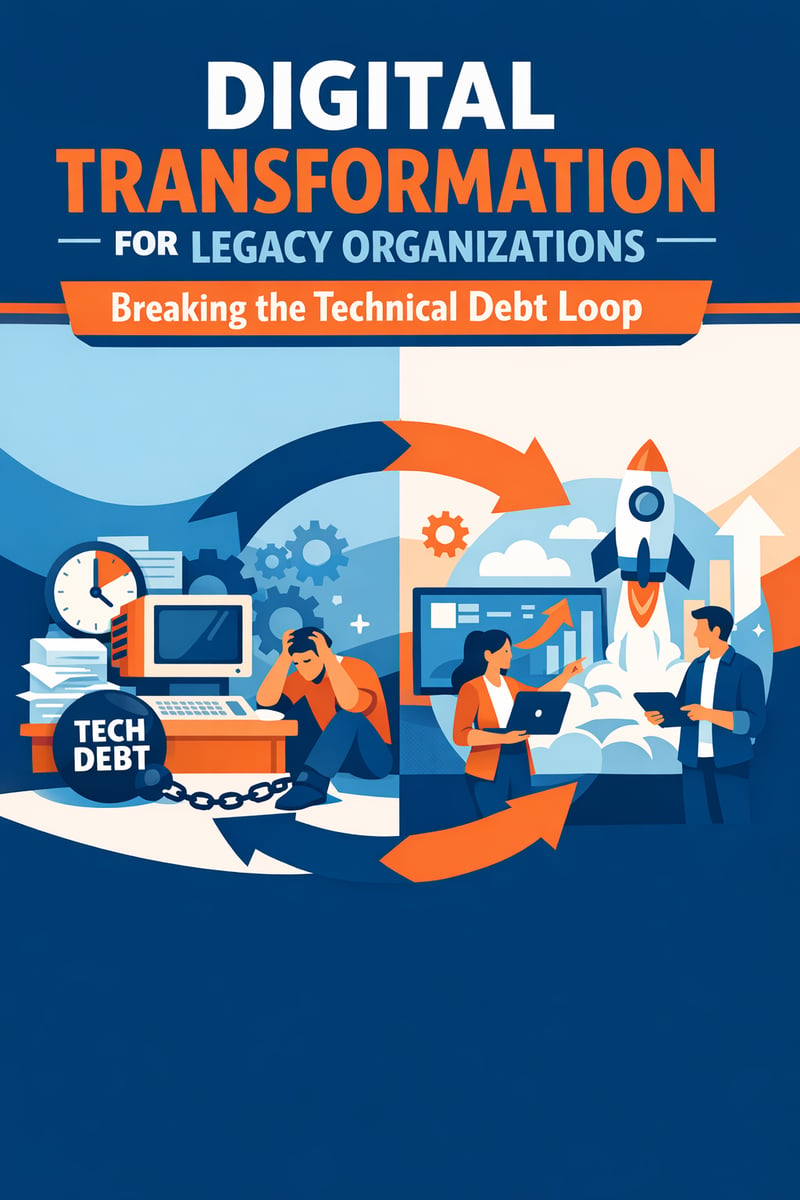
The result is what we call the technical debt loop: a self-reinforcing cycle where the cost of maintaining legacy systems prevents investment in modernization, which in turn makes the legacy systems even more expensive to maintain.
Why Are So Many Organizations Still Stuck?
If the problem is well-understood and the market is booming, why do so many organizations remain trapped? The answer lies in a set of deeply entrenched challenges that go far beyond technology.
1. Undocumented Systems and Lost Institutional Knowledge
One of the most common—and most underestimated—barriers to modernization is the lack of documentation. Many legacy systems were built over decades by teams that have long since departed. Without comprehensive documentation, organizations face the daunting task of reverse-engineering their own infrastructure before they can even begin to plan a migration.
2. Complex Interdependencies
Legacy systems rarely exist in isolation. They're woven into a web of interconnected processes, databases, and workflows. Changing one component can trigger cascading failures across the entire ecosystem. This complexity creates a powerful incentive to leave things as they are—even when "as they are" is increasingly untenable.
3. The Skills Gap
The technologies underpinning many legacy systems—COBOL, mainframe architectures, proprietary middleware—require specialized skills that are becoming increasingly scarce. Organizations find themselves in a difficult position: they can't maintain what they have, but they lack the expertise to safely migrate to something new.
4. Organizational Resistance to Change
Technology modernization is as much a people challenge as it is a technical one. Business units that have built their processes around legacy systems may resist changes that disrupt their workflows, even when those changes promise long-term benefits. Without strong change management, even the best-planned modernization initiative can stall.
5. Risk Aversion in Regulated Environments
For organizations in regulated industries—healthcare, financial services, insurance, government—the stakes of a failed migration are exceptionally high. Compliance requirements add layers of complexity, and the potential for downtime or data exposure during migration creates a powerful argument for maintaining the status quo.
How Do Successful Organizations Break the Technical Debt Loop?
The organizations that successfully break free from the technical debt loop share a common approach: they treat modernization as a strategic business initiative, not just an IT project. Here's what that looks like in practice.
Strategy 1: Adopt a Phased Modernization Approach
The most consistently successful modernization strategy is the Strangler Pattern—a method that gradually replaces legacy components with modern alternatives while keeping existing systems operational. Rather than attempting a high-risk "big bang" migration, this approach:
- Spreads costs across multiple budget cycles
- Minimizes disruption to business operations
- Delivers incremental value at each phase
- Reduces risk by allowing parallel operation and rollback
Think of it like renovating a house while you're still living in it—one room at a time—rather than demolishing the entire structure and rebuilding from scratch.
Strategy 2: Prioritize High-Impact, High-Risk Areas First
Not all technical debt is created equal. Effective modernization starts with a thorough assessment that identifies:
- Systems with the highest maintenance costs (where the ROI of modernization is most immediate)
- Components with the greatest security vulnerabilities (where risk reduction is most critical)
- Integration bottlenecks that prevent adoption of new capabilities like AI and automation
- Compliance gaps that expose the organization to regulatory risk
By tackling these areas first, organizations generate early wins that build momentum and stakeholder buy-in for subsequent phases.
Strategy 3: Leverage APIs and Middleware as a Bridge
You don't always need to replace a legacy system to unlock its value. API layers and modern middleware can serve as a bridge between legacy infrastructure and modern platforms, enabling:
- Real-time data access from legacy databases
- Integration with cloud-native applications
- Gradual migration of business logic without disrupting existing workflows
- Enhanced security through modern authentication and encryption
This approach is particularly powerful for organizations using platforms like Salesforce or HubSpot, where robust API ecosystems allow legacy systems to feed data into modern CRM, marketing, and service platforms without requiring a complete overhaul.
Strategy 4: Use AI to Accelerate Discovery and Migration
One of the most exciting developments in legacy modernization is the application of AI and automation to the process itself. AI-powered tools can now:
- Map undocumented system architectures by analyzing code, data flows, and dependencies
- Generate documentation for legacy systems that were never properly documented
- Automate testing and validation during migration to catch issues before they reach production
- Identify optimization opportunities that human analysts might miss
These capabilities are dramatically reducing the time and cost of the discovery phase—traditionally one of the most expensive and time-consuming parts of any modernization project.
Strategy 5: Invest in Change Management from Day One
The most technically sound modernization plan will fail without organizational buy-in. Successful organizations:
- Communicate the "why" in business terms, not technical jargon
- Involve business stakeholders in planning and prioritization
- Provide training and support well before new systems go live
- Celebrate early wins to build momentum and demonstrate value
- Establish feedback loops that allow teams to raise concerns and influence the process
What Does the ROI of Modernization Actually Look Like?
One of the reasons organizations defer modernization is the difficulty of building a compelling ROI case. The benefits are real, but they often manifest as risk avoidance and capability enablement rather than direct cost savings.
Here's a framework for thinking about modernization ROI:
| ROI Category | Example Metrics |
|---|---|
| Cost Reduction | Reduced maintenance spend, lower licensing costs for end-of-life software, decreased manual workarounds |
| Risk Mitigation | Fewer security incidents, reduced compliance violations, lower downtime costs |
| Speed to Market | Faster deployment of new features, reduced integration timelines, shorter sales cycles |
| Revenue Enablement | Ability to adopt AI/ML capabilities, personalization at scale, improved customer experience |
| Talent Acquisition | Easier recruiting (modern tech stacks attract better talent), reduced contractor dependency |
The market's growth to nearly $25 billion tells us that enterprises are increasingly recognizing these compound benefits. Organizations that modernize strategically report not just cost savings, but fundamental improvements in their ability to compete, innovate, and serve customers.
The Compliance Dimension: Why Security Can't Wait
For organizations in regulated environments, the compliance implications of legacy systems deserve special attention. Outdated platforms often lack:
- Modern encryption standards (TLS 1.3, AES-256)
- Multi-factor authentication capabilities
- Comprehensive audit logging required by frameworks like SOC 2, PCI-DSS, and GDPR
- Automated compliance reporting that regulators increasingly expect
Every day an organization operates on unsupported or under-maintained infrastructure, its exposure to data breaches, regulatory penalties, and reputational damage increases. Modernization isn't just about efficiency—it's about protecting the business.
The good news is that modern cloud platforms and SaaS solutions are built with compliance in mind. Migration to platforms like Salesforce or HubSpot, supported by proper integration architecture (MuleSoft, custom APIs), can dramatically improve an organization's compliance posture while simultaneously reducing the burden on internal IT teams.
Building Your Modernization Roadmap: A Practical Guide
Ready to break the technical debt loop? Here's a practical framework that any organization can adapt:
Phase 1: Assess and Prioritize (Weeks 1–4)
- Inventory all legacy systems, including undocumented components
- Map dependencies and data flows
- Score each system on maintenance cost, risk, and strategic importance
- Identify quick wins and long-term priorities
Phase 2: Architect the Future State (Weeks 5–8)
- Define the target architecture (cloud-native, hybrid, or SaaS-first)
- Design API and integration layers
- Plan data migration and validation strategies
- Establish compliance and security requirements
Phase 3: Execute Incrementally (Months 3–12+)
- Begin with highest-priority systems using the Strangler Pattern
- Deploy API bridges to connect legacy and modern systems
- Migrate data in controlled, validated batches
- Run parallel systems until modern replacements are fully validated
Phase 4: Optimize and Scale (Ongoing)
- Monitor performance and cost metrics
- Retire legacy components as modern replacements prove stable
- Expand modernization to secondary systems
- Continuously evaluate emerging technologies (AI, automation) for further optimization
Frequently Asked Questions (FAQ)
What is technical debt in the context of digital transformation?
Technical debt refers to the accumulated cost of maintaining outdated, poorly documented, or hastily built technology systems. It includes the ongoing expenses of patching, workarounds, and missed opportunities for innovation that result from relying on legacy infrastructure.
How much does technical debt cost organizations?
While costs vary significantly by organization size and industry, research shows that up to 80% of IT budgets can be consumed by legacy system maintenance. The global legacy modernization market reached $24.98 billion in 2025, reflecting the scale of the challenge across industries.
What is the Strangler Pattern for legacy modernization?
The Strangler Pattern is a phased approach to modernization where legacy system components are gradually replaced by modern alternatives while the existing system continues to operate. This minimizes disruption, spreads costs, and allows organizations to deliver incremental value throughout the process.
How long does a typical legacy modernization initiative take?
Timelines depend on the scope and complexity of the legacy environment. Small-scale modernization efforts may take 3–6 months, while enterprise-wide transformations typically span 12–36 months. A phased approach helps manage timelines by delivering value at each stage.
Can AI help with legacy system modernization?
Yes. AI tools can now map undocumented system architectures, generate documentation, automate testing during migration, and identify optimization opportunities. These capabilities are significantly reducing the time and cost of modernization, particularly during the discovery and assessment phases.
What compliance risks do legacy systems create?
Legacy systems often lack modern security features like current encryption standards, multi-factor authentication, and comprehensive audit logging. This creates vulnerabilities that can lead to data breaches, regulatory penalties, and compliance violations under frameworks like SOC 2, PCI-DSS, GDPR, and HIPAA.
How do I build a business case for legacy modernization?
Focus on four categories of ROI: cost reduction (maintenance savings), risk mitigation (security and compliance), speed to market (faster innovation), and revenue enablement (AI adoption, improved customer experience). Quantify the cost of inaction alongside the benefits of modernization.
Ready to Break Free From the Technical Debt Loop?
The technical debt loop is real, but it's not inescapable. With the right strategy, the right technology, and the right partner, your organization can transform legacy constraints into competitive advantages.
At Vantage Point, we specialize in helping organizations navigate complex digital transformations across Salesforce, HubSpot, MuleSoft, and Data Cloud. With 150+ clients, 400+ engagements, and deep expertise in compliance-first modernization, we understand what it takes to turn legacy infrastructure into a platform for growth.
Schedule a consultation with Vantage Point →
Whether you're just beginning to assess your technical debt or you're ready to execute a modernization roadmap, we're here to help you move forward with confidence.
Published by Vantage Point | vantagepoint.io