Key Takeaways (TL;DR)
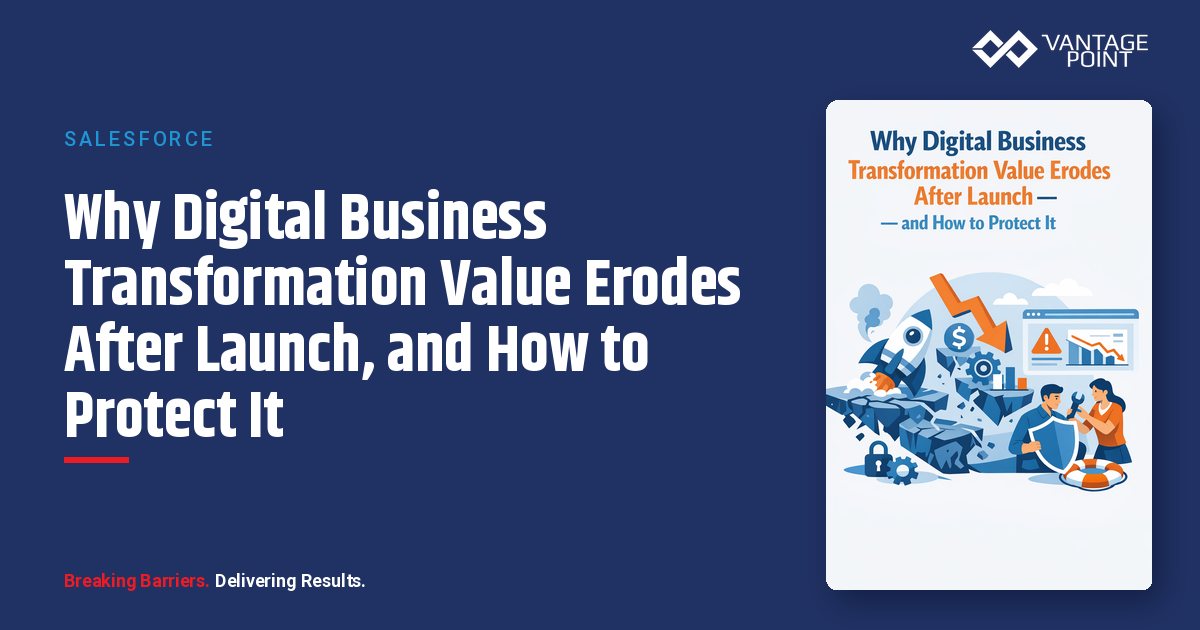
- What is post-launch transformation value erosion? It is the gradual loss of expected ROI after a CRM, automation, data, or digital platform goes live because adoption, governance, data quality, integrations, reporting, and improvement cadence are not actively managed.
- Key Benefit: Protecting value after launch turns a one-time implementation into an operating capability that keeps improving revenue operations, service experiences, and customer engagement.
- Investment: Most organizations need a focused 90-day stabilization plan followed by right-sized CRM managed services, not a large permanent program office.
- Timeline: The first 30 days should stabilize issues and adoption; days 31-60 should tune data, reporting, and integrations; days 61-90 should prioritize automation, AI readiness, and a continuous-improvement backlog.
- Best For: Business and technology leaders responsible for Salesforce, HubSpot, MuleSoft, Data Cloud, AI personalization, CRM adoption, and post go-live support.
- Bottom Line: Go-live is not the finish line. CRM transformation ROI is protected when teams treat launch as the start of value realization, not the end of the project.
Meta Description: Protect digital transformation value after go-live with CRM adoption, managed services, data governance, integration monitoring, and continuous improvement.
Digital business transformation programs often look successful on launch day. The new CRM is live. Integrations are connected. Dashboards are published. Users have been trained. Executives can finally see the platform they funded.
Then the slow leak begins.
A field that seemed harmless becomes mandatory for reporting but is inconsistently populated. A sales team reverts to spreadsheets because the new workflow adds too many clicks. A service automation rule breaks when a downstream system changes. Leaders stop trusting dashboards because definitions drift. AI personalization ideas stall because the customer data foundation is not clean, connected, or governed.
This is where digital business transformation value erodes: not because the original strategy was wrong, but because the operating model after go-live was underdesigned.
For CRM-centered transformation, the risk is especially high. Salesforce, HubSpot, MuleSoft, Data Cloud, AI personalization tools, and customer-facing experiences are not static assets. They are living business systems. They need ownership, measurement, adoption support, data stewardship, integration observability, user experience refinement, and a continuous-improvement rhythm.
Vantage Point helps organizations protect and expand transformation value after launch as an agile, senior-only, employee-owned CRM transformation and managed services partner. Our view is simple: the highest-value transformation work often starts after go-live, when real users, real data, and real business feedback reveal where the platform should go next.
What Is Post-Launch Transformation Value Erosion?
Post-launch transformation value erosion is the decline between the business outcomes a transformation was expected to create and the outcomes it actually produces after the system is live.
In a CRM transformation, value erosion can show up as:
- Lower-than-expected user adoption
- Manual workarounds that return after launch
- Duplicate, incomplete, or unreliable customer data
- Reports that do not match executive questions
- Integrations that technically run but fail silently or require constant manual reconciliation
- Automation that is too rigid for real-world workflows
- AI initiatives that cannot scale because data and process foundations are not ready
- Enhancement backlogs that grow faster than the team can prioritize them
- A support model focused on tickets instead of business outcomes
The important point: erosion is usually gradual. It rarely appears as one dramatic failure. More often, it is a series of small compromises that slowly reduce confidence in the platform.
A CRM program may still be “working” from a technical standpoint while losing business value every month.
Why Do CRM and Digital Transformation Programs Lose Momentum After Go-Live?
Go-live creates a psychological and operational handoff. The implementation team celebrates completion. The business expects benefits to materialize. Internal IT or a support vendor inherits the system. Project governance winds down. The budget shifts from transformation to maintenance.
That handoff is where momentum is most vulnerable.
1. The project team leaves before operational knowledge is embedded
Implementation teams make hundreds of decisions that never fully appear in documentation. They understand why fields were created, which reports depend on which definitions, where integration edge cases live, which automations were deferred, and which process compromises were made to hit the launch date.
If that context disappears, future support teams can resolve tickets but may struggle to protect the original business intent.
2. Success metrics are not translated into operating metrics
Transformation business cases often include goals like higher productivity, better customer visibility, faster response times, improved pipeline accuracy, or more personalized engagement. After launch, those goals need operating metrics: adoption rates, data completeness, automation usage, case resolution cycle time, lead-to-opportunity conversion, integration error rates, dashboard usage, and backlog throughput.
Without measurement, value realization becomes anecdotal.
3. Support is treated as break-fix instead of value protection
Traditional support asks, “Is the system available?” and “Can we close the ticket?”
Post-launch value protection asks better questions:
- Are users completing the intended process?
- Are leaders getting reliable insights?
- Are integrations moving the right data at the right time?
- Are automation rules improving outcomes or creating friction?
- Are enhancement requests tied to measurable value?
- Is the platform becoming more AI-ready every month?
Break-fix support is necessary. It is not sufficient.
4. The business keeps changing while the platform stands still
Sales motions evolve. Service models mature. Marketing campaigns change. Products, territories, pricing, approval rules, data sources, and compliance needs shift. If the platform does not adapt, users create workarounds.
Digital transformation value depends on continuous alignment between the platform and the business operating model.
5. AI raises the cost of weak foundations
AI personalization, copilots, agents, predictive recommendations, and automated next-best actions all depend on trusted data, clear workflows, and well-governed integrations. If the CRM foundation is inconsistent, AI will amplify the inconsistency.
AI readiness is not a separate initiative. It is an outcome of disciplined CRM operations.
The Six Places Digital Transformation Value Leaks After Launch
The most common post-launch value leaks fall into six areas: knowledge transfer, adoption, data quality, integrations, reporting, and AI readiness.
| Value Leak | What It Looks Like | Why It Matters | How to Protect Value |
|---|---|---|---|
| Knowledge transfer | Only a small group understands design decisions, dependencies, and tradeoffs | Support becomes slower and enhancements become riskier | Retain implementation context, document decisions, and include senior architects in early managed services |
| Adoption | Users complete training but do not change daily behavior | CRM transformation ROI depends on consistent usage | Measure process adoption, simplify UX, reinforce role-based enablement, and remove friction |
| Data quality | Required fields are missing, duplicates grow, definitions drift | Reporting, automation, and AI all depend on trusted data | Establish ownership, validation rules, stewardship routines, and data-quality dashboards |
| Integrations | Data syncs fail quietly, mappings break, or error queues are ignored | Customer experience depends on connected systems | Use integration observability, alerting, reconciliation, and MuleSoft/API governance |
| Reporting | Dashboards exist but executives do not trust them | Decisions slow down and teams revert to manual reporting | Define metric ownership, reconcile source logic, and align reporting to business outcomes |
| AI readiness | Teams want AI personalization but lack clean, connected, permissioned data | AI initiatives stall or produce low-trust outputs | Prepare data, permissions, process definitions, and governance before scaling AI |
1. Knowledge transfer: the hidden asset that disappears too quickly
A strong CRM implementation contains a large amount of tacit knowledge. Some of it lives in architecture diagrams and user stories. Much of it lives in the heads of senior consultants, solution architects, admins, and business stakeholders who made decisions together.
When that knowledge is not preserved, the organization loses speed. A simple enhancement takes longer because nobody knows why the original workflow was configured that way. A dashboard change creates downstream impact because dependencies were not documented. A support ticket becomes an investigation.
Protecting value means keeping strategic knowledge close to the platform during stabilization. That does not require keeping the full project team forever. It does require a thoughtful transition from implementation to managed services, with senior resources who understand the business case and architecture.
2. Adoption: usage is not the same as behavior change
A user logging into Salesforce or HubSpot does not prove adoption. Real digital transformation adoption means users are completing the intended workflow in the system because it helps them do their job better.
If users believe the CRM slows them down, they will create shadow processes. If managers still ask for spreadsheet updates, CRM becomes a compliance exercise. If dashboards are not used in weekly meetings, data entry becomes disconnected from decision-making.
Adoption improves when teams:
- Reduce unnecessary clicks and fields
- Align page layouts to role-specific jobs to be done
- Reinforce manager-led usage in pipeline, service, and customer meetings
- Track completion of critical process steps, not just logins
- Use short feedback loops to identify friction
- Improve UI/UX based on real user behavior
Vantage Point often finds that small user experience enhancements create outsized gains. A cleaner layout, better validation, fewer redundant steps, or a guided path can turn reluctant usage into everyday habit.
3. Data quality: the compounding factor in CRM value realization
CRM value compounds when customer, account, contact, activity, opportunity, case, product, subscription, and engagement data become more accurate over time. It erodes when teams stop trusting the data.
Data quality issues are not just administrative problems. They affect forecasting, segmentation, personalization, service routing, account planning, customer health scoring, and executive reporting.
A practical data-quality operating model should include:
- Clear owners for critical data domains
- Required-field logic tied to business moments, not blanket mandates
- Duplicate prevention and merge routines
- Standard definitions for lifecycle stages, pipeline stages, customer status, and engagement metrics
- Data-quality dashboards with trends, not one-time cleanup reports
- Governance for new fields, objects, properties, and integrations
For Salesforce Data Cloud, HubSpot CRM, and AI personalization use cases, data quality is also a readiness issue. AI depends on connected, contextual, permission-aware data. If the underlying data model is weak, AI outcomes will be weak.
4. Integrations: connected systems need active observability
MuleSoft, native Salesforce and HubSpot integrations, APIs, middleware, data warehouses, communication platforms, billing systems, and customer portals all extend CRM value. They also create post-launch risk.
An integration can appear healthy because the job ran, while still moving incomplete data, creating duplicates, missing edge cases, or failing in a queue nobody monitors.
Integration observability should answer:
- Did the integration run?
- Did the expected volume move?
- Were records rejected, delayed, duplicated, or transformed incorrectly?
- Are errors categorized by business impact?
- Is there an owner for retry, reconciliation, and root-cause prevention?
- Are upstream and downstream changes reviewed before release?
For organizations using MuleSoft, the goal is not just technical connectivity. The goal is governed, observable, reusable integration that supports business agility.
5. Reporting: dashboards only create value when people trust and use them
Many transformations launch with a set of dashboards. Value erodes when those dashboards are not embedded into operating rhythms.
Common symptoms include:
- Executives questioning whether CRM numbers match finance or operations
- Teams exporting data into spreadsheets for “real” analysis
- Multiple versions of the same metric
- Dashboards that show activity but not outcomes
- Reports that do not reflect current business priorities
Reporting value protection requires ownership. Every executive metric should have a definition, a source, a refresh cadence, a decision use case, and a person accountable for accuracy.
A good question to ask after launch: “Which recurring meetings should be run from CRM dashboards, and what decisions should those dashboards support?” If the answer is unclear, reporting is not yet operationalized.
6. AI readiness: transformation value now depends on trusted foundations
AI personalization and automation can expand the value of CRM transformation, but only when the foundation is ready.
That foundation includes:
- Clean account, contact, lead, opportunity, case, and engagement data
- Clear permission models
- Documented process flows
- Integrated customer interaction history
- Quality metadata and field definitions
- Human review points for sensitive actions
- Governance for prompts, agents, recommendations, and automated updates
Whether an organization is exploring Salesforce AI capabilities, HubSpot AI, Claude-powered workflows, Data Cloud, or custom personalization models, the same principle applies: AI readiness is built through better CRM operations.
The teams that protect transformation value today are the teams that can scale AI safely tomorrow.
What Should Teams Do in the First 90 Days After Launch?
The first 90 days after launch determine whether a transformation becomes a durable operating capability or a completed project that slowly loses relevance.
Days 1-30: Stabilize, listen, and measure
The first month should focus on user confidence and operational stability.
Recommended actions:
- Establish a daily triage process for launch issues.
- Categorize issues by business impact, not just technical severity.
- Track adoption of critical workflows by role.
- Review data completeness for the highest-value records and fields.
- Monitor integration errors, latency, and reconciliation exceptions.
- Hold office hours for frontline users and managers.
- Capture enhancement requests in a structured backlog.
- Confirm that executive dashboards match agreed definitions.
The goal is not to fix every enhancement request immediately. The goal is to separate defects, training gaps, UX friction, data problems, and future optimization ideas.
Days 31-60: Tune the operating model
The second month should shift from stabilization to optimization.
Recommended actions:
- Identify the top adoption blockers by team and role.
- Simplify page layouts, forms, properties, validation rules, and guided flows where possible.
- Create data-quality scorecards for key objects and properties.
- Review integration exceptions and eliminate recurring root causes.
- Align reporting to actual management routines.
- Define release governance for future CRM changes.
- Prioritize backlog items based on value, risk, and effort.
- Confirm ownership across business, IT, data, and platform administration.
This is where senior-only execution matters. The work requires both architecture judgment and practical CRM operating experience.
Days 61-90: Expand value and prepare for continuous improvement
The third month should create the rhythm for ongoing value realization.
Recommended actions:
- Define quarterly CRM value objectives.
- Build a continuous-improvement roadmap.
- Identify automation opportunities from real user behavior.
- Review AI personalization readiness across data, permissions, and process maturity.
- Establish release notes and enablement for every meaningful change.
- Create an integration observability and ownership model.
- Document decision history and architecture context.
- Decide whether the organization needs CRM managed services, internal ownership, or a hybrid model.
By day 90, the platform should have a clear owner, measurable adoption, a prioritized backlog, reliable reporting, known data-quality metrics, and a cadence for improvement.
Managed Services vs. Traditional Support: What Is the Difference?
Traditional support keeps the lights on. CRM managed services protect and expand business value.
Both are useful, but they solve different problems.
| Dimension | Traditional Support | CRM Managed Services |
|---|---|---|
| Primary focus | Tickets, incidents, availability | Value realization, adoption, optimization, and platform health |
| Success metric | Response time and resolution time | Business outcomes, adoption, data quality, backlog throughput, and ROI |
| Resource model | Often reactive and tiered | Proactive access to senior CRM, data, integration, and UX expertise |
| Change approach | Fix what is broken | Continuously improve what matters |
| Business alignment | Limited to submitted requests | Ongoing roadmap, governance, and stakeholder alignment |
| AI readiness | Usually outside scope | Built into data, process, and platform maturity planning |
CRM managed services should not be a generic help desk. The right model blends administration, architecture, data governance, integration monitoring, UX enhancement, enablement, and strategic roadmap support.
For Salesforce managed services, that may include Sales Cloud, Service Cloud, Experience Cloud, Data Cloud, release management, Flow optimization, reporting, permissions, and adoption analytics.
For HubSpot managed services, that may include CRM architecture, lifecycle stage governance, workflow optimization, marketing and sales operations alignment, reporting, integrations, data hygiene, and user enablement.
For MuleSoft and integration environments, it includes monitoring, error handling, API lifecycle governance, documentation, and continuous improvement.
For AI personalization, it includes data readiness, use-case prioritization, guardrails, and human-centered workflows.
How Vantage Point Helps Protect and Expand Transformation Value
Vantage Point is an agile, senior-only, employee-owned CRM transformation and managed services partner. That combination matters after launch.
Because our work is senior-only, clients get direct access to experienced people who can diagnose business process, CRM architecture, data, integration, reporting, and adoption issues without unnecessary layers. Because we are employee-owned, our team is invested in long-term client outcomes rather than short-term project handoffs. Because we are agile, we can move quickly from insight to improvement.
Vantage Point helps organizations protect digital business transformation value across seven post-launch workstreams.
1. CRM transformation health checks
We assess whether Salesforce, HubSpot, integrations, data, reporting, and user workflows are producing the outcomes the transformation was meant to create. The result is a prioritized view of value leaks, quick wins, platform risks, and improvement opportunities.
2. Salesforce and HubSpot managed services
We provide ongoing administration, optimization, enhancement delivery, adoption support, reporting support, governance, and roadmap execution for Salesforce and HubSpot environments.
3. Data governance and Data Cloud readiness
We help teams define customer data models, quality rules, ownership, segmentation logic, identity resolution considerations, and readiness for Salesforce Data Cloud and AI-powered personalization.
4. MuleSoft and integration observability
We help organizations improve integration reliability through API governance, error monitoring, reconciliation routines, documentation, and change management across connected systems.
5. AI personalization and automation readiness
We identify practical AI use cases, assess data and process maturity, design guardrails, and help teams introduce AI in ways that are measurable, useful, and safe.
6. UI/UX enhancement for CRM adoption
We improve layouts, guided workflows, forms, user journeys, and experience design so the CRM supports how people actually work.
7. Continuous improvement roadmaps
We help clients convert feedback, backlog items, platform health findings, and business priorities into an actionable roadmap that keeps transformation value expanding after launch.
A 12-Point Transformation Value Protection Checklist
Use this checklist after any CRM or digital business transformation launch.
- Define post-launch value owners. Assign business, platform, data, reporting, and integration owners.
- Translate the business case into operating metrics. Track adoption, data quality, automation usage, reporting trust, integration health, and backlog throughput.
- Retain architectural knowledge. Preserve decisions, dependencies, tradeoffs, integration logic, and enhancement rationale.
- Measure workflow adoption, not just logins. Confirm that users are completing the processes that create value.
- Create a 90-day stabilization plan. Separate defects, UX friction, training needs, data issues, and future enhancements.
- Monitor data quality continuously. Track completeness, duplicates, standard definitions, and field usage trends.
- Operationalize dashboards. Tie reports to recurring meetings, decisions, and accountable metric owners.
- Add integration observability. Monitor volume, errors, latency, retries, rejected records, and reconciliation exceptions.
- Govern platform changes. Review new fields, automations, permissions, integrations, and reports before they create complexity.
- Build AI readiness into CRM operations. Improve data, permissions, process documentation, and human review points before scaling AI.
- Prioritize enhancements by value. Rank backlog items by business impact, risk reduction, adoption improvement, and effort.
- Use managed services strategically. Choose a partner or internal model that improves outcomes, not just ticket resolution.
Best Practices for Protecting CRM Transformation ROI
The strongest post-launch programs share a few practical habits.
Make go-live the beginning of value realization
Celebrate launch, but do not let governance disappear. Keep executive sponsors engaged through value metrics and quarterly roadmap reviews.
Keep the business and platform teams connected
CRM value lives at the intersection of process, data, user behavior, and technology. Business teams should not throw requests over the wall, and technical teams should not make changes without understanding operational impact.
Improve the user experience before blaming users
If adoption is weak, examine the workflow. Too many required fields, confusing layouts, unclear handoffs, and slow processes are often design problems, not user problems.
Treat data quality as an operating discipline
One-time cleanup projects help, but they do not prevent future decay. Data quality needs rules, owners, dashboards, and recurring review.
Monitor integrations like business processes
Integration health should be measured by business outcomes, not only technical job status. If customer, account, order, service, or engagement data fails to move correctly, business value is at risk.
Connect every enhancement to a measurable outcome
A healthy backlog is not just a list of requests. It is a portfolio of value opportunities. Each meaningful enhancement should tie to adoption, productivity, revenue, service quality, reporting accuracy, risk reduction, or AI readiness.
FAQ: Digital Business Transformation Value After Launch
What is digital business transformation value?
Digital business transformation value is the measurable business improvement created by new platforms, processes, data, automation, and customer experiences. In CRM programs, that value often includes better visibility, higher productivity, faster service, improved customer engagement, and more reliable decision-making.
Why does CRM transformation ROI decline after go-live?
CRM transformation ROI declines after go-live when users do not adopt the new process, data quality weakens, integrations are not actively monitored, dashboards lose trust, platform changes are not governed, or support focuses only on tickets instead of business outcomes.
What is post go-live support for CRM?
Post go-live support is the structured period after launch when teams stabilize issues, support users, monitor adoption, tune workflows, improve data quality, validate reporting, and manage integrations. The best post go-live support evolves into continuous CRM managed services.
How long should a CRM stabilization period last?
Most organizations should plan for at least 90 days of structured stabilization after a significant Salesforce, HubSpot, integration, or digital transformation launch. Complex environments may need a longer managed services roadmap.
What is the difference between Salesforce managed services and break-fix support?
Salesforce managed services include proactive administration, platform optimization, release management, adoption support, reporting, data quality, governance, and roadmap execution. Break-fix support primarily resolves incidents and defects after they are reported.
What is the difference between HubSpot managed services and traditional support?
HubSpot managed services focus on improving CRM architecture, lifecycle governance, workflows, reporting, integrations, marketing and sales operations alignment, and adoption. Traditional support is usually narrower and more reactive.
How does AI readiness relate to CRM managed services?
AI readiness depends on clean data, connected systems, permission models, process clarity, and governance. CRM managed services help improve those foundations over time so AI personalization, copilots, and automation can create trusted business value.
Conclusion: Protect the Value You Already Funded
Digital business transformation value does not disappear all at once. It erodes through small gaps in ownership, adoption, data quality, integration monitoring, reporting trust, and continuous improvement.
The good news is that value can be protected. With the right 90-day plan, governance model, managed services structure, and CRM operating rhythm, organizations can turn launch into the start of measurable value realization.
If your organization recently launched Salesforce, HubSpot, MuleSoft integrations, Data Cloud, AI personalization, or a broader CRM transformation, Vantage Point can help you identify where value is leaking and where the next wave of ROI is hiding.
CTA: Contact Vantage Point for a complimentary CRM transformation health check or managed services assessment. We will help you evaluate adoption, data quality, integration health, reporting trust, AI readiness, and the practical steps needed to protect and expand your transformation investment.
About Vantage Point
Vantage Point is an agile, senior-only, employee-owned CRM transformation and managed services partner helping organizations improve customer experience, operational efficiency, and revenue performance. We work across Salesforce, HubSpot, MuleSoft, Data Cloud, AI personalization, CRM managed services, and UI/UX enhancement to help businesses turn digital platforms into durable operating capabilities.