
Key Takeaways (TL;DR)
- Key Insight: Up to 30% of B2B CRM records become outdated every year, silently eroding pipeline accuracy, sales productivity, and customer trust.
- Why Now: AI agents like Salesforce Agentforce and HubSpot Breeze Intelligence depend on clean data to function. Dirty data doesn't just slow AI down, it makes AI actively harmful.
- Impact: Organizations with poor data quality waste an estimated 27% of revenue on data-related inefficiencies, while 74% of AI-enabled sales teams now prioritize data hygiene as their #1 initiative.
- Action Required: Implement a structured 5-step remediation framework (Audit, Standardize, Deduplicate, Enrich, and Govern) to transform your CRM from a liability into a competitive advantage.
- Bottom Line: Data quality isn't an IT housekeeping task anymore. It's the single biggest determinant of whether your AI investments will deliver ROI or become expensive failures.
Your CRM is lying to you.
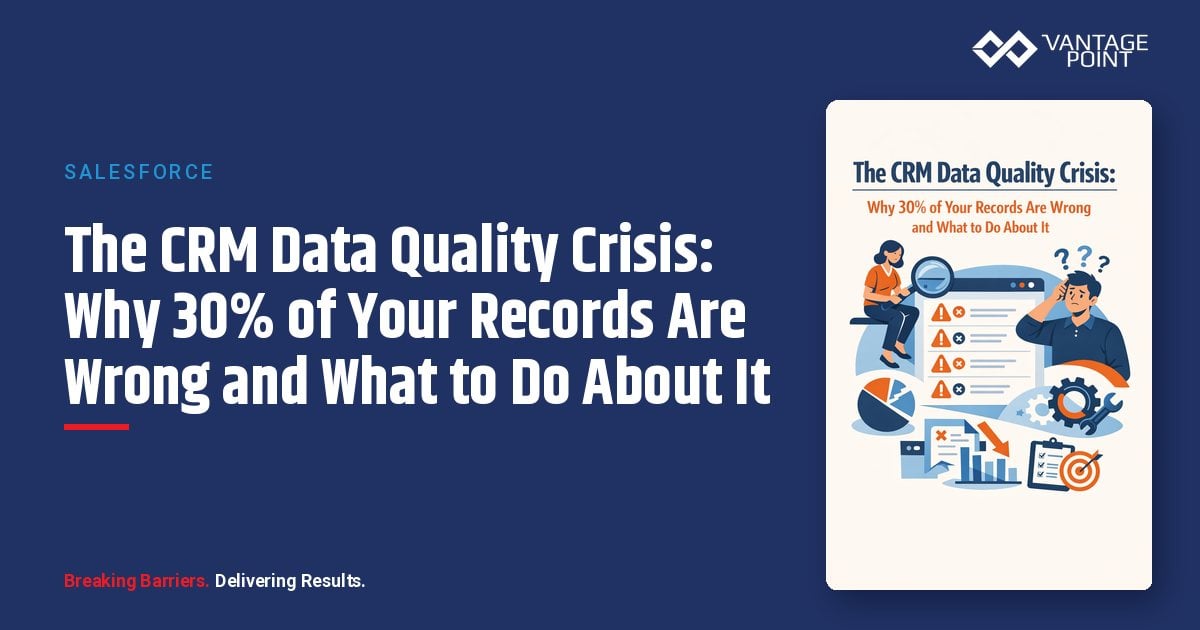
Not maliciously, of course. But right now, roughly one in three records in your database is outdated, incomplete, or flat-out wrong. That contact who "works" at a company they left eighteen months ago. The account with a revenue figure from 2021. The 47 duplicate records for the same prospect, each telling a slightly different story.
For years, organizations treated CRM data quality as a nuisance: an occasional spring-cleaning project that nobody wanted to own. But in 2026, with every major platform racing to deploy AI agents that autonomously engage customers, qualify leads, and orchestrate complex workflows, that neglected data problem has become an existential threat to your technology investments.
The uncomfortable truth? Your AI is only as intelligent as the data it reads. And if 30% of that data is wrong, your AI isn't augmenting your team: it's confidently automating bad decisions at scale.
How Bad Is the CRM Data Quality Problem, Really?
The numbers paint a sobering picture that most organizations prefer not to confront.
The Decay Rate Is Relentless
B2B contact data decays at an average rate of 22.5% to 30% per year, according to research from multiple industry sources. That translates to roughly 2-3% of your database going stale every single month. In high-turnover industries like technology and SaaS, decay rates can spike to 35-70% annually.
The drivers are everywhere and constant:
- Job changes: 15-20% of professionals change roles annually, instantly invalidating titles, email addresses, phone numbers, and reporting structures.
- Company changes: Mergers, acquisitions, rebrandings, and closures continuously reshape the B2B landscape.
- Contact information drift: People change phone numbers, move offices, adopt new email domains, and update LinkedIn profiles: none of which automatically syncs to your CRM.
- Organic entropy: Even without external events, data degrades as business contexts shift, products evolve, and organizational structures are reorganized.
A 50,000-record CRM database losing 22% of its data quality annually means roughly 11,000 records are unreliable by year's end. By the end of month six, you've already lost confidence in over 5,000 contacts, and that's assuming you started with perfect data, which you almost certainly didn't.
The Financial Impact Is Staggering
The cost of bad data extends far beyond simple inefficiency:
- IBM estimated that poor data quality costs the U.S. economy over $3.1 trillion annually: a figure that has only grown as organizations become more data-dependent.
- Gartner research consistently shows that organizations believe poor data quality is responsible for an average of $12.9 million in annual losses.
- Sales productivity suffers directly: Representatives spend an estimated 27% of their time on data-related tasks, verifying information, updating records, and hunting for accurate contact details instead of selling.
- Pipeline inflation: When duplicate records, outdated accounts, and stale opportunities populate your CRM, forecasting becomes unreliable. Salesforce's own research shows that effective CRM hygiene improves forecast accuracy by up to 42%: which means organizations with dirty data are making strategic decisions based on fundamentally flawed projections.
- Marketing waste: Every campaign sent to an invalid email, every nurture sequence targeting someone who left the company, and every personalization based on outdated firmographics represents wasted budget and eroded brand perception.
The AI Amplification Problem
Here's where the crisis becomes urgent: AI doesn't fix bad data. It amplifies it.
Salesforce Agentforce, HubSpot Breeze Intelligence, and every other AI-powered CRM feature fundamentally depend on the quality of underlying data to function correctly. When you deploy an AI agent on a database where 30% of records are unreliable, you're not getting intelligent automation: you're getting confident misinformation at machine speed.
Consider what happens when AI agents encounter dirty data:
- Lead scoring models trained on records with incorrect industry codes, outdated revenue figures, and duplicate entries produce scores that actively mislead sales teams.
- Autonomous outreach agents send personalized emails referencing the wrong company name, an outdated job title, or a product the prospect's organization doesn't use: destroying credibility in seconds.
- Predictive analytics generate forecasts based on historical data riddled with duplicates and inaccuracies, producing projections that bear little resemblance to reality.
- Customer segmentation powered by stale firmographic data creates audiences that don't actually share common characteristics, undermining every campaign built on those segments.
This is why 74% of sales teams currently using AI are prioritizing data hygiene as their foundational initiative, according to Salesforce's State of Sales report. They've learned, often painfully, that AI readiness starts with data readiness.
What Causes CRM Data to Degrade?
Understanding root causes is essential before prescribing solutions. CRM data quality problems typically stem from five interconnected sources.
1. No Entry Standards
Without enforced validation rules, standardized picklists, and clear data entry protocols, every user becomes a freelance data architect. One rep enters "Healthcare" while another types "Health Care" and a third selects "Medical." One records phone numbers as (555) 123-4567, another as 555-123-4567, and a third as 5551234567. Multiply these micro-inconsistencies across thousands of records and dozens of users, and your database becomes an ungovernable mess.
2. Integration Sprawl Without Governance
The average sales organization uses eight or more tools that feed data into or pull data from the CRM. Marketing automation platforms, enrichment services, web forms, event platforms, support systems, billing tools. Each integration is a potential vector for duplicate creation, field overwrites, and format conflicts. Without clear integration governance, your CRM becomes a dumping ground for conflicting information from a dozen sources.
3. No Ownership or Accountability
Data quality is everyone's problem and therefore nobody's responsibility. Without designated data stewards, clear ownership of key objects and fields, and accountability mechanisms tied to data quality metrics, decay is inevitable. When nobody's job depends on data accuracy, accuracy becomes optional.
4. One-Time Cleanups Instead of Continuous Governance
Many organizations approach data quality as a periodic project, a massive cleanup effort every year or two, often triggered by a CRM migration or a particularly embarrassing data-driven failure. But a one-time enrichment project in January means 9% of your data is already stale by June and you're back to full decay rates by December. Data quality requires continuous, automated governance: not annual heroics.
5. Lack of Measurement
You can't manage what you don't measure. Most organizations have no visibility into their data quality metrics, no dashboards tracking completeness rates, no alerts for duplicate creation velocity, no regular audits of field accuracy. Without measurement, decay is invisible until it causes a visible failure.
The 5-Step CRM Data Remediation Framework
At Vantage Point, data quality is not a separate workstream: it's embedded into every CRM engagement we deliver. We've developed a proven five-step framework that transforms CRM data from a liability into a strategic asset.
Step 1: Audit: Diagnose Before You Prescribe
Objective: Establish a complete, honest picture of your current data health.
You can't remediate what you haven't measured. A comprehensive data audit should assess every critical object and field against five dimensions:
- Completeness: What percentage of required fields are populated? Which objects have the most gaps?
- Accuracy: How many records contain verifiably incorrect information? Sample-test key fields like email addresses, phone numbers, and company names.
- Consistency: Are the same data elements recorded the same way across records? Check for format variations, abbreviation inconsistencies, and conflicting values across integrated systems.
- Timeliness: When were records last verified or updated? Flag any record that hasn't been touched in 12+ months as potentially stale.
- Uniqueness: How many duplicate records exist? What's the duplicate creation rate over the past quarter?
Practical approach: Run completeness reports across all critical objects. Use email verification services to test deliverability on a representative sample. Cross-reference a random sample of 500 records against LinkedIn and company websites. The results will tell you exactly where to focus.
Platform tools: - Salesforce: Native Data Quality Analysis dashboards, duplicate management reports, and field audit trail capabilities provide baseline measurement. - HubSpot: Operations Hub's data quality tools include property completeness reporting, formatting issue detection, and duplicate management dashboards.
Step 2: Standardize: Create a Single Source of Truth
Objective: Establish and enforce consistent data entry standards across every channel and user.
Standardization eliminates the chaos of inconsistent formatting that makes deduplication, segmentation, and AI analysis unreliable.
Key actions:
- Define picklist values for all categorization fields: industry, company size, lead source, deal stage. Eliminate free-text fields wherever possible.
- Implement validation rules that enforce formatting standards at the point of entry, phone number formats, state/country codes, required fields by record type.
- Create record type templates that guide users through consistent data entry workflows.
- Standardize naming conventions for accounts, including rules for handling parent/subsidiary relationships, abbreviations, and legal entity names.
- Document everything in a data dictionary that serves as the authoritative reference for what every field means, what values are acceptable, and who owns it.
Platform tools: - Salesforce: Validation rules, dependent picklists, flow-based data entry guidance, and duplicate matching rules enforce standards at the point of entry. - HubSpot: Operations Hub's programmable automation enables custom data quality workflows, automatically formatting phone numbers, standardizing company names, and correcting common entry errors in real time.
Step 3: Deduplicate: Merge the Mess
Objective: Identify and resolve duplicate records while preserving the most complete and accurate data from each.
Deduplication is where most organizations start, but doing it without first establishing standards (Step 2) means you'll recreate duplicates within months.
Key actions:
- Define matching rules that identify duplicates with appropriate confidence thresholds. Exact matches on email are obvious; fuzzy matches on company name require more nuance.
- Establish merge strategies that determine which record survives and which field values take priority when duplicates are merged. Typically, the most recently verified data wins.
- Handle related records carefully. Merging two account records requires decisions about associated contacts, opportunities, activities, and custom objects.
- Process in batches with human review for low-confidence matches. Automated merging of exact duplicates is safe; merging "similar" records requires judgment.
Platform tools: - Salesforce: Native Duplicate Management includes matching rules, duplicate rules, and merge functionality. For large-scale deduplication, third-party tools on the AppExchange provide more sophisticated matching algorithms and bulk merge capabilities. - HubSpot: Built-in duplicate management identifies likely duplicates using AI-powered matching, with one-click merge capabilities and bulk deduplication workflows.
Step 4: Enrich: Fill the Gaps
Objective: Supplement your CRM data with verified, current information from authoritative external sources.
After auditing, standardizing, and deduplicating, you'll have a cleaner but likely incomplete database. Enrichment fills the gaps.
Key actions:
- Select enrichment providers based on your target market. Services like ZoomInfo, Clearbit, Apollo, and Dun & Bradstreet offer varying strengths across firmographic, technographic, and contact data.
- Define enrichment rules that specify which fields to update, which to protect, and how to handle conflicts between CRM data and enrichment data.
- Implement continuous enrichment rather than one-time batch updates. Connect enrichment services via API to automatically update records on a scheduled basis.
- Validate enriched data through sampling and verification before pushing updates to the full database.
Platform tools: - Salesforce: Data Cloud provides native data unification and identity resolution capabilities, connecting disparate data sources into unified customer profiles. Third-party enrichment apps integrate directly via the AppExchange. - HubSpot: Breeze Intelligence provides native enrichment capabilities that automatically fill in missing company and contact information, keeping records current without manual intervention.
Step 5: Govern: Make Quality Permanent
Objective: Establish ongoing processes, ownership, and automation that prevent data quality from degrading after remediation.
This is the step most organizations skip, and why they find themselves back at square one within a year.
Key actions:
- Assign data stewards for each major CRM object. These individuals are accountable for monitoring quality metrics, resolving issues, and evolving standards as business needs change.
- Implement automated quality monitoring with dashboards that track completeness, accuracy, and duplicate creation rates in real time. Set alerts when metrics fall below defined thresholds.
- Create data quality SLAs that define acceptable quality levels for each object and field, with clear escalation paths when SLAs are breached.
- Integrate quality checks into workflows. Every automation that creates or updates records should include validation steps. Every integration should enforce data standards.
- Conduct quarterly reviews that assess data quality trends, identify emerging issues, and adjust governance policies as needed.
- Train continuously. Every new hire, every new tool implementation, and every process change is an opportunity for data quality to degrade. Ongoing training ensures that quality remains a shared organizational value.
Platform tools: - Salesforce: Flow-based automation can enforce governance rules, duplicate prevention runs in real time, and custom dashboards provide ongoing visibility into data health. - HubSpot: Operations Hub's data quality automation runs continuously in the background, automatically fixing formatting issues, flagging anomalies, and enforcing data standards without manual intervention.
Why Data Quality Is the Foundation of AI Success
The organizations that will extract the most value from Salesforce Agentforce, HubSpot Breeze, Einstein AI, and every other AI-powered platform capability are not the ones with the most sophisticated AI strategies. They're the ones with the cleanest data.
Data Quality Directly Determines AI Agent Performance
AI agents are essentially pattern recognition systems that take actions based on what they "see" in your data. When they see accurate, complete, and consistent data:
- Lead scoring correctly identifies your highest-potential opportunities.
- Predictive forecasting produces projections that leadership can actually trust.
- Autonomous outreach delivers genuinely personalized, relevant communications.
- Customer health scoring accurately identifies at-risk accounts before it's too late.
When they see dirty data, every one of those outcomes inverts, and unlike human users who might intuitively question suspect data, AI agents will execute on bad information with unwavering confidence.
The ROI Multiplier Effect
Clean data doesn't just make AI work: it makes everything work better. Organizations that invest in data quality typically see:
- Forecast accuracy improvements of 30-42%, enabling better resource allocation and more reliable revenue planning.
- Sales productivity gains of 15-25% as representatives spend less time verifying data and more time engaging qualified prospects.
- Marketing efficiency improvements of 20-35% through better segmentation, reduced waste from invalid contacts, and more effective personalization.
- Customer retention improvements driven by more accurate health scores, timely intervention, and personalized engagement.
These gains compound: clean data improves AI performance, which improves sales and marketing effectiveness, which generates more accurate data, which further improves AI performance. It's a virtuous cycle, but it starts with getting the data right.
Building a Data Quality Culture
Technology alone won't solve the data quality crisis. The organizations that sustain high-quality CRM data share a common trait: they've built a culture where data quality is everyone's responsibility and where the systems make doing the right thing easier than doing the wrong thing.
Executive Sponsorship Is Non-Negotiable
Data quality initiatives that lack executive sponsorship fail. Period. When leadership treats data quality as a technical concern rather than a strategic imperative, it gets deprioritized in favor of more visible projects. The most successful organizations have a C-level champion who understands that data quality underpins every revenue, marketing, and customer success metric the organization tracks.
Make Quality Visible
Create dashboards that surface data quality metrics alongside traditional KPIs. When teams can see their data quality scores alongside pipeline metrics and conversion rates, the connection between data hygiene and business outcomes becomes tangible.
Reward the Right Behaviors
If your compensation structures reward volume over accuracy (if reps are measured on records created rather than records maintained) your incentives are actively undermining data quality. Align incentive structures with quality outcomes.
Frequently Asked Questions
What percentage of CRM data goes stale each year?
Research consistently shows that B2B CRM data decays at a rate of 22.5% to 30% annually. This means roughly 2-3% of your database becomes unreliable every month due to job changes, company changes, and natural information drift. In high-turnover industries like technology, decay rates can reach 35-70%.
How does poor CRM data quality affect AI tools like Salesforce Agentforce?
AI tools are entirely dependent on the quality of underlying data. When AI agents like Salesforce Agentforce or HubSpot Breeze Intelligence operate on dirty data, they amplify errors rather than correct them, producing inaccurate lead scores, sending poorly personalized outreach, and generating unreliable forecasts. This is why 74% of AI-enabled sales teams now prioritize data hygiene as their foundational initiative.
What is the cost of bad CRM data to businesses?
The costs are substantial and multifaceted. IBM has estimated that poor data quality costs the U.S. economy over $3.1 trillion annually. At the organizational level, Gartner research shows average annual losses of $12.9 million from data quality issues. Sales teams typically waste 27% of their time on data-related tasks instead of selling, and marketing campaigns suffer from inflated costs and reduced effectiveness.
How often should we clean our CRM data?
One-time cleanups are insufficient because data decays continuously. Best practice is to implement automated, always-on data quality monitoring and remediation through native platform tools like Salesforce duplicate management, HubSpot Operations Hub data quality automation, and third-party enrichment services. Supplement automated governance with quarterly manual audits and annual comprehensive reviews.
What tools does Salesforce offer for CRM data quality?
Salesforce provides several native capabilities: Duplicate Management (matching rules and merge functionality), Data Cloud (data unification and identity resolution across sources), validation rules and flow-based automation for enforcing standards, and field audit trails for tracking changes. Third-party AppExchange tools extend these capabilities for large-scale deduplication, enrichment, and monitoring.
What tools does HubSpot offer for CRM data quality?
HubSpot's Operations Hub includes programmable automation for custom data quality workflows, built-in duplicate management with AI-powered matching, data sync for keeping connected systems aligned, and automated formatting and standardization tools. Breeze Intelligence adds native data enrichment capabilities that automatically fill gaps in company and contact records.
How do we measure ROI on data quality initiatives?
Measure ROI across four dimensions: (1) sales productivity gains from reduced time spent on data tasks, (2) pipeline accuracy improvements from better forecasting, (3) marketing efficiency from reduced waste and better targeting, and (4) AI performance improvements from higher-quality training and operational data. Organizations that implement comprehensive data quality programs typically see 15-25% improvements across these dimensions within the first year.
Take Control of Your CRM Data Quality
The CRM data quality crisis isn't a future problem: it's happening right now in your database. Every day that passes without a systematic approach to data governance means more stale records, more duplicates, more missed opportunities, and more AI outputs you can't trust.
At Vantage Point, data quality isn't an afterthought: it's embedded into every engagement we deliver. Our senior consultants address data quality as a foundational element of every Salesforce and HubSpot implementation, migration, and optimization project. Our VALUE methodology (Vision, Adaptability, Leverage, User-Centric, Excellence) ensures that data quality initiatives are aligned with your strategic objectives and designed for long-term sustainability.
Whether you're preparing for AI adoption, planning a CRM migration, or simply tired of making decisions based on data you can't trust, we can help.
Contact Vantage Point to schedule a complimentary CRM data health assessment and learn how our 5-step remediation framework can transform your data from a liability into your most powerful competitive advantage.