Key Takeaways (TL;DR)
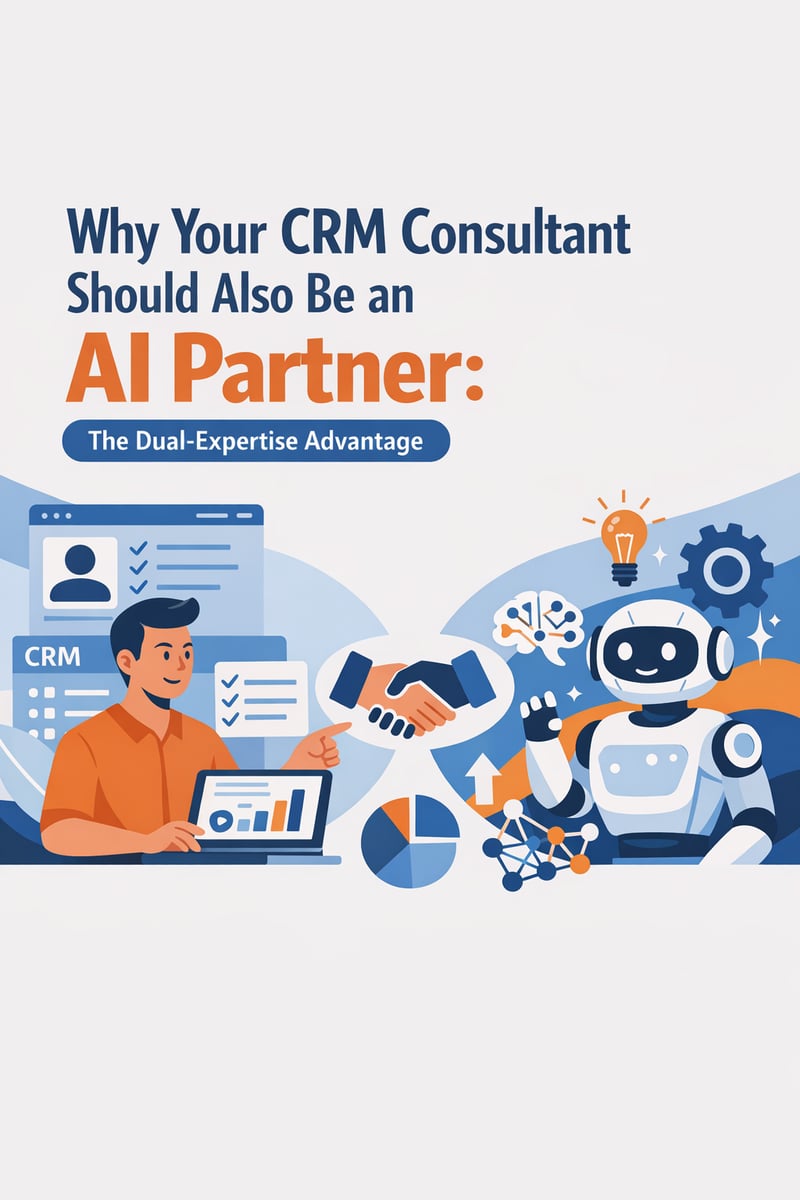
- What is it? The emerging model of hiring a single consulting partner with deep expertise in both CRM implementation and AI — rather than managing separate vendors for each
- Key Benefit: Eliminates the costly "translation layer" between CRM and AI teams, accelerating deployment by 40–60% and reducing integration risk
- Cost Savings: Organizations report 20–35% lower total project costs when using a unified CRM + AI partner vs. separate vendors
- Best For: Businesses investing in CRM modernization who also want to leverage AI for automation, personalization, and predictive analytics
- Bottom Line: With 81% of organizations expected to adopt AI-powered CRM by 2026, the firms that unify CRM and AI expertise under one roof will deliver faster time-to-value, fewer integration failures, and significantly higher ROI
Introduction
Something unusual is happening in the consulting world. For decades, technology consulting has been a game of specialization: you hired one firm for your CRM implementation and another for your data science or AI initiatives. The CRM consultants understood your sales pipelines. The AI specialists understood your machine learning models. And somewhere in between, you — the client — served as the translator, the project manager, and the risk absorber.
That model is breaking.
As AI becomes inseparable from modern CRM platforms — with Salesforce embedding Agentforce and Einstein AI natively, HubSpot rolling out AI-powered content and conversation tools, and large language models like Anthropic's Claude transforming how teams interact with customer data — the gap between "CRM work" and "AI work" has effectively collapsed. Yet most consulting firms haven't caught up.
The result? Businesses are paying a steep premium — in dollars, time, and risk — to coordinate between vendors who don't speak the same language. In this article, we'll explore why the dual-expertise consulting model (one partner for both CRM and AI) isn't just a convenience — it's a strategic imperative. And we'll show you what to look for when evaluating whether your consulting partner is ready for this new reality.
The Market Shift: Why CRM and AI Are No Longer Separate Conversations
How Big Is the AI-CRM Convergence?
The numbers tell a compelling story:
- 88% of organizations now use AI in at least one business function, up from 78% in 2024
- The AI CRM market has reached $11.04 billion, with 81% of organizations expected to adopt AI-powered CRM systems by 2026
- Companies using AI-integrated CRM achieve an average $8.71 ROI per dollar invested, compared to far lower returns from siloed implementations
- 75% of companies report sales forecasting accuracy gains with AI, reaching 88% forecast accuracy versus just 64% with traditional CRM methods alone
These aren't future projections — this is the landscape today. AI is no longer a bolt-on experiment. It is the operating system of modern CRM.
What Changed?
Three forces are driving this convergence:
- Platform-native AI: Salesforce's Agentforce, HubSpot's Breeze AI, and Data Cloud have made AI a first-class citizen inside CRM platforms — not an external add-on
- Large language models in the workflow: Tools like Claude AI can now read, write, and act on CRM data through integrations like Anthropic's Model Context Protocol (MCP), enabling AI to participate directly in sales, service, and marketing workflows
- Customer expectations: With AI agents predicted to handle 80% of common customer issues by 2029, businesses can't afford to treat AI as a separate initiative from their CRM strategy
The Hidden Costs of the Two-Vendor Model
What Is the "Translation Layer" Problem?
When you hire one firm to implement your CRM and another to build AI capabilities, you create what we call the translation layer problem — a persistent communication gap between teams that speak different technical languages, use different methodologies, and optimize for different outcomes.
Here's how it plays out:
| Challenge | CRM Consultant's View | AI Specialist's View |
|---|---|---|
| Data quality | "Fields need to be filled correctly by users" | "The model needs clean, structured training data" |
| Automation | "Let's build workflow rules and approval processes" | "Let's build predictive triggers and autonomous agents" |
| Success metric | "User adoption rate" | "Model accuracy and inference speed" |
| Timeline | "Go-live in 12 weeks" | "We need 6 months to train and validate" |
Neither perspective is wrong. But when these two worldviews collide inside your organization — without a shared context — the result is:
- Duplicated discovery phases (both firms interview the same stakeholders separately)
- Conflicting data architectures (the CRM schema doesn't support what the AI model needs)
- Integration failures (APIs, middleware, and data pipelines become afterthoughts)
- Scope creep and finger-pointing when deliverables don't connect
What Does the Two-Vendor Model Actually Cost?
Most organizations underestimate the true cost of managing separate CRM and AI consultants. Beyond the direct fees, consider:
- Coordination overhead: Your internal team spends 15–25% of project time acting as the bridge between vendors, translating requirements, resolving conflicts, and managing dependencies
- Extended timelines: Dual-vendor projects typically run 30–50% longer than integrated engagements due to handoff delays, misaligned sprints, and rework
- Integration rework: When the CRM data model doesn't match what the AI implementation requires, refactoring costs can add 20–40% to the original budget
- Reduced adoption: Only 30% of target users fully change work practices when AI is layered onto a CRM by a different team — because the experience feels bolted-on rather than native
- Risk multiplication: Each additional vendor relationship doubles your governance, compliance, and security surface area
The bottom line: Organizations that use a unified CRM + AI consulting partner report 20–35% lower total project costs and 40–60% faster time-to-value compared to the two-vendor model.
What Does Dual-Expertise Actually Look Like?
Should My CRM Consultant Also Do AI?
Yes — and here's the litmus test. A true dual-expertise consulting partner should be able to:
- Design your CRM architecture with AI in mind from day one. This means building data models, field structures, and integration layers that support both human workflows and machine learning from the start — not retrofitting later.
- Implement AI within your CRM platform, not alongside it. Instead of building a separate AI layer that reads from your CRM via API, a dual-expertise partner embeds intelligence directly into the tools your team already uses — predictive lead scoring inside Salesforce, AI-assisted content creation inside HubSpot, autonomous agents that act within your existing service workflows.
- Speak both languages fluently. They can translate between business process requirements and AI model specifications without your team serving as the intermediary.
- Own the integration layer. A dual-expertise partner takes responsibility for the connective tissue — MuleSoft integrations, Data Cloud unification, API orchestration — rather than pointing fingers when data doesn't flow.
- Deliver measurable outcomes across both domains. They measure the combined impact: How did AI-enhanced CRM workflows change your conversion rate? Your customer retention? Your team's productivity?
How Is Claude AI Being Used in CRM Workflows?
One of the most practical examples of CRM-AI convergence is how Anthropic's Claude is being integrated directly into CRM workflows:
- Conversational CRM updates: Sales teams use Claude to create and update CRM records through natural language conversation, eliminating context-switching between AI tools and CRM platforms
- Deal analysis and coaching: Claude can analyze deal histories, call transcripts, and engagement patterns to provide real-time coaching recommendations — all within the CRM context
- Automated data enrichment: Rather than manually researching prospects, Claude can pull, synthesize, and populate CRM fields with relevant intelligence
- Document generation: Proposals, follow-up emails, and case summaries can be generated by Claude using CRM data as context, ensuring every output is grounded in actual customer history
- Model Context Protocol (MCP): Anthropic's MCP framework enables Claude to connect directly with CRM systems, reading and acting on data with proper permissions and audit trails — a capability that requires deep understanding of both AI architecture and CRM data governance
Five Signs Your Consulting Partner Isn't Ready for the AI Era
How Do I Know If My CRM Consultant Can Handle AI?
Watch for these red flags:
1. They treat AI as a "Phase 2" conversation.
If your CRM consultant says "let's get the CRM live first, then we'll talk about AI," they're building you a system that will need to be partially rebuilt when AI requirements emerge — and they always emerge.
2. They partner with a separate AI vendor.
Some CRM consultancies have responded to AI demand by forming partnerships with AI-focused firms. While this sounds collaborative, it recreates the two-vendor model with an extra layer of markup and coordination overhead.
3. They can't explain how your CRM data will feed AI models.
Ask your consultant: "How would we use our CRM data to train a predictive model or power an AI agent?" If the answer is vague or deferred to "the data team," they lack the cross-domain fluency you need.
4. Their AI offerings are limited to out-of-the-box features.
Turning on Einstein in Salesforce or Breeze in HubSpot is table stakes. A dual-expertise partner goes further — customizing AI behaviors, building bespoke agents, integrating third-party models like Claude, and designing data architectures that make AI genuinely useful.
5. They don't have an AI practice with real implementations.
There's a difference between "we're exploring AI" and "we've built AI-powered CRM workflows for clients." Ask for specific examples.
The Strategic Advantages of the Unified Model
Why Choose One Partner for Both CRM and AI?
Faster Time-to-Value
When one team handles both CRM configuration and AI implementation, there are no handoff delays, no conflicting architectures, and no translation gaps. Discovery happens once. Architecture decisions account for both current workflows and future AI capabilities simultaneously.
Lower Total Cost of Ownership
Eliminating the coordination overhead between vendors, reducing integration rework, and avoiding duplicated discovery phases can cut total project costs by 20–35%.
Higher Adoption Rates
AI features that are woven into the CRM experience from the start feel native — not bolted on. Users adopt them because they're part of the tools they already use. This is the difference between 30% adoption and 80%+ adoption.
Reduced Risk
A single partner means a single point of accountability. There's no gray area between "that's a CRM issue" and "that's an AI issue."
Future-Proof Architecture
A dual-expertise partner designs systems that can evolve — adding new AI models, incorporating emerging capabilities like autonomous agents, and scaling AI use cases — without requiring a new vendor evaluation and integration cycle every time the technology shifts.
How to Evaluate a Dual-Expertise Consulting Partner
What Should I Look for in a CRM + AI Consultant?
Use this framework when evaluating potential partners:
| Evaluation Criteria | Questions to Ask |
|---|---|
| CRM depth | Which CRM platforms do you hold certifications in? Can you handle Sales, Service, Marketing, and Experience Cloud? |
| AI breadth | What AI models and frameworks do you work with? Do you go beyond native CRM AI? |
| Integration capability | How do you handle data integration between CRM and AI? Do you use middleware like MuleSoft or Workato? |
| Architecture philosophy | Do you design CRM schemas with AI consumption in mind from day one? |
| LLM experience | Have you implemented large language models (like Claude) within CRM workflows? |
| Data governance | How do you manage permissions, audit trails, and compliance when AI acts on CRM data? |
| Measurement approach | How do you measure the combined ROI of CRM + AI, not just each in isolation? |
| Team structure | Do the same consultants work on both CRM and AI, or are they separate teams? |
| Partner ecosystem | Are you affiliated with both CRM platforms and AI providers? |
Best Practices for Adopting the Dual-Expertise Model
- Start your next CRM project with AI requirements included in the RFP. Don't treat AI as a separate scope — require that proposals address both CRM implementation and AI/automation capabilities in a single engagement.
- Insist on a unified data architecture review. Before any implementation begins, your partner should assess your data landscape for both CRM usability and AI readiness.
- Demand integrated success metrics. Your project KPIs should measure the combined impact of CRM + AI, not just CRM adoption or AI accuracy in isolation.
- Prioritize partners with LLM integration experience. As Claude, GPT, and other large language models become integral to CRM workflows, your partner needs hands-on experience connecting these models to CRM data — securely and compliantly.
- Look for boutique agility with enterprise depth. Boutique firms that have intentionally built dual expertise often deliver faster, more cohesive results than larger consultancies with siloed practice areas.
- Plan for continuous AI evolution. Your partner should offer a roadmap, not just a project plan. AI capabilities are evolving quarterly.
FAQ: CRM Consultants and AI Expertise
Should my CRM consultant also do AI?
Yes. As AI becomes embedded in every major CRM platform — Salesforce's Agentforce, HubSpot's Breeze AI, Anthropic's Claude integrations — separating CRM and AI consulting creates unnecessary cost, risk, and delay. A single partner with dual expertise eliminates the translation layer between teams and delivers 40–60% faster time-to-value.
What is the "translation layer" problem in CRM and AI projects?
The translation layer problem occurs when separate CRM and AI consultants speak different technical languages, use different methodologies, and optimize for different outcomes. Your internal team ends up spending 15–25% of project time bridging the communication gap, leading to extended timelines, integration failures, and reduced adoption.
How much does it cost to use separate CRM and AI vendors?
Beyond the direct fees from two consulting engagements, organizations typically face 30–50% longer timelines, 20–40% additional integration rework costs, and significant internal coordination overhead. A unified partner model reduces total project costs by 20–35% while delivering better outcomes.
Can Claude AI really work inside my CRM?
Yes. Through Anthropic's Model Context Protocol (MCP) and direct integrations, Claude can read CRM data, create and update records, analyze deal histories, generate documents, and provide real-time coaching — all within proper permission and audit trail frameworks.
What's the ROI of AI-powered CRM?
Companies using AI-integrated CRM achieve an average $8.71 ROI per dollar invested. Beyond financial returns, organizations see 88% forecast accuracy (vs. 64% with traditional methods), 22% cost reduction in customer operations, and significantly higher sales goal attainment.
How do I evaluate if my CRM consultant is ready for AI?
Ask them: How would you use our CRM data to power a predictive model or AI agent? If they defer to "Phase 2" or a separate partner, they're not ready. A dual-expertise firm will discuss CRM architecture and AI capabilities in the same conversation.
Is this relevant for small and mid-size businesses, or just enterprises?
This is especially relevant for small and mid-size businesses. SMBs typically lack the internal resources to coordinate multiple vendors, making a unified partner even more valuable. AI-powered CRM tools have become accessible at every budget level.
Conclusion
The era of hiring one firm for CRM and another for AI is ending — and organizations that recognize this shift early will gain a significant competitive advantage. With 81% of businesses expected to run AI-powered CRM by 2026, the question isn't whether to integrate AI into your CRM strategy. It's whether your consulting partner can deliver both from a single, cohesive engagement.
The dual-expertise model isn't just more efficient. It produces better architectures, higher adoption, lower risk, and measurably superior outcomes. When your CRM consultant is also your AI partner, every decision — from data model design to workflow automation to predictive analytics — is made with the full picture in mind.
Vantage Point was among the first CRM consultancies to embrace Claude AI and Anthropic's approach to responsible AI, building on deep Salesforce and HubSpot expertise to deliver unified CRM + AI solutions. Whether you're modernizing your CRM, exploring AI automation, or evaluating how large language models can transform your customer operations, we bring both capabilities to the table — in a single team, a single engagement, and a single point of accountability.
Ready to see what dual-expertise consulting looks like in practice? Contact Vantage Point to start the conversation.
About Vantage Point
Vantage Point is a CRM and AI consultancy specializing in Salesforce, HubSpot, MuleSoft, and AI-powered automation. As an early participant in the Claude Partner Network, Vantage Point brings together deep CRM platform expertise with cutting-edge AI implementation capabilities — helping businesses of all sizes unify their customer operations under a single technology strategy. Learn more at vantagepoint.io.