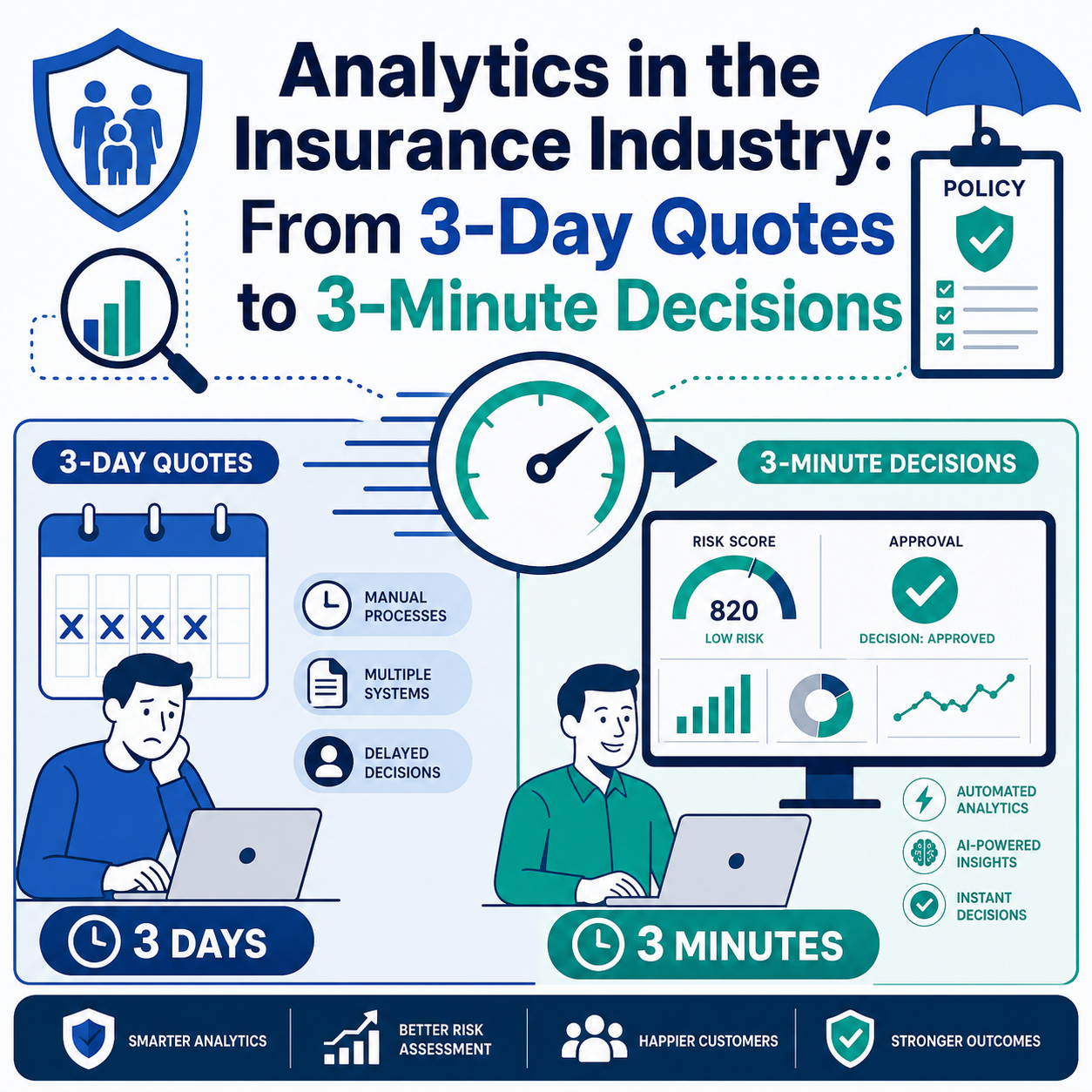
Quick answer: Analytics in the insurance industry pays off fastest in four areas: underwriting speed, claims triage, distribution performance, and customer retention. The gains can be dramatic — Hiscox has publicly reported cutting a key lead underwriting step from about three days to three minutes using AI. But those results depend on a data foundation most carriers and agencies haven't built yet: unified policy, claims, and engagement data, usually anchored by the CRM, governed well enough to satisfy regulators.
Insurance has always been a data business. What has changed is the gap between firms that can act on their data in minutes and firms that still assemble it manually over days. This guide walks through where analytics genuinely moves the needle, why the data foundation is the hard part, and how Salesforce and HubSpot fit into the picture.
Why does underwriting speed get all the attention?
Because it is where analytics translates most directly into won business. In specialty and commercial lines, the first credible quote frequently wins, and quote turnaround is a function of how fast an underwriter can gather, structure, and evaluate submission data.
Hiscox has publicly reported that by introducing AI into specific elements of its London Market lead underwriting process, it could reduce the time for lead open-market quotes from around three days to about three minutes. The underwriter still makes the decision — the analytics layer does the assembly, enrichment, and first-pass evaluation that used to consume the three days.
The lesson for mid-market carriers and agencies is not "buy the same tools as a London Market insurer." It is that most of the elapsed time in quoting is data handling, not judgment — and data handling is exactly what analytics and automation are good at.
Where else does analytics move the needle for insurers and agencies?
Underwriting is one of four high-leverage areas. Here is how they compare:
| Area | Questions analytics answers | Example metrics |
|---|---|---|
| Underwriting | Which submissions deserve attention first? What is our quote turnaround? | Time to quote, quote-to-bind ratio, submission triage accuracy |
| Claims triage | Which claims are straightforward and which need an adjuster now? | Cycle time, straight-through rate, leakage indicators |
| Distribution & agency performance | Which producers, products, and channels actually drive profitable growth? | Producer hit ratio, book growth by segment, pipeline by carrier appointment |
| Retention | Which policyholders are at risk before renewal, and why? | Renewal rate by segment, engagement recency, service-case patterns |
Claims triage deserves a special note: routing simple claims to fast-track handling while flagging complex or suspicious ones early improves both loss-adjustment expense and customer satisfaction at the same time — a rare win-win. For a broader look at where AI is heading in claims and underwriting, see our insurtech trends outlook for 2026.
Why is the data foundation the real problem?
Most insurance organizations don't have an analytics problem — they have a data-assembly problem. Policy data lives in a policy administration or agency management system, claims data in a claims platform, engagement data in email inboxes and phone systems, and marketing data in yet another tool. Any report that spans two of those systems requires exports and spreadsheets, which means it is stale the day it is built.
The CRM is the natural anchor for the engagement side of that picture, because it is the only system designed to capture the full relationship:
- Who we talked to and when — calls, emails, meetings, and service cases tied to the household or account.
- Pipeline reality — submissions, quotes, renewals, and cross-sell opportunities with stage history.
- Producer activity — the leading indicators of next quarter's book, not just last quarter's commissions.
Agencies that run their book from an agency management system still need this engagement layer; the two systems answer different questions and work best integrated. We cover that division of labor in our guide to insurance agency management software.
What does the AI layer add on top of analytics?
Traditional analytics tells you what happened; the AI layer changes what happens next. In practice, the highest-value additions are:
- Extraction and enrichment. Turning unstructured submissions, loss runs, and ACORD forms into structured data an analyst can use — the core of the Hiscox-style speed gain.
- Scoring and triage. Prioritizing submissions, claims, and renewal risks so people work the right items first.
- Next-best-action. Suggesting the outreach, coverage review, or cross-sell most likely to matter for a specific client.
- Summarization. Briefing an underwriter or account manager on a relationship in seconds instead of a file review.
None of these work well on fragmented data. The sequencing matters: foundation first, then analytics, then AI. Firms that reverse the order end up with impressive demos and unreliable outputs.
How do governance expectations shape analytics in insurance?
Insurance is a regulated industry, and regulators increasingly expect insurers to govern analytical and AI-driven decisions, not just manual ones. Without giving legal advice, the practical expectations most firms should plan for include:
- Explainability. If a model influences an underwriting or pricing outcome, someone should be able to explain why in plain language.
- Human oversight. Analytics should inform decisions; a named person should own them, especially adverse ones.
- Data lineage. Knowing where a data point came from and who has touched it — which argues for fewer, better-integrated systems.
- Access controls. Policyholder data visible only to the roles that need it, with an audit trail.
Good governance is not a tax on analytics — it is what makes the outputs trustworthy enough for executives to act on.
Where do Salesforce and HubSpot fit?
Both platforms play real roles, and many insurance organizations use both.
Salesforce is the deeper option for carriers and larger agencies. Financial Services Cloud provides an insurance-aware data model — households, policies, and claims relationships — while Data 360 (Salesforce's data platform, formerly Data Cloud) unifies records from policy admin and other core systems into profiles that analytics and AI can act on. Reports and dashboards then sit on live data rather than exports.
HubSpot shines on the marketing and distribution-growth side: campaign attribution, lifecycle reporting, and engagement analytics that show which channels actually produce quotable submissions. For agencies focused on growth, HubSpot's marketing analytics often deliver the fastest time-to-insight.
The right answer depends on your lines of business, your core systems, and where your growth is coming from — which is a scoping conversation, not a platform religion.
Frequently asked questions
How long does it take to see value from insurance analytics?
Weeks, not years — if you scope narrowly. A single high-value dashboard, such as quote turnaround by producer or renewal risk by segment, can usually be live within a first project phase. The multi-year efforts are the ones that try to unify everything before shipping anything.
Do small and mid-size agencies really need analytics, or is this a carrier topic?
Agencies arguably have more to gain per dollar spent. Producer hit ratios, book concentration by carrier, and renewal-risk flags are all agency-level analytics that directly protect revenue, and they run on data the agency already owns in its AMS and CRM.
Should we build the data foundation before buying AI tools?
Yes, with one nuance: you don't need a perfect foundation, just a governed one for the specific use case. Pick one workflow — say, submission triage — get its data clean and connected, deploy, and expand. Perfection-first programs stall; use-case-first programs compound.
What's the biggest mistake insurers make with analytics projects?
Treating them as IT projects instead of decision projects. If no one names the decision a dashboard is supposed to change — which submissions to work first, which renewals to call — the dashboard becomes wallpaper. Start from the decision and work backward to the data.
Can we do this without replacing our policy administration system?
Usually, yes. Modern integration approaches let the CRM and analytics layer sit alongside existing core systems, syncing the fields that matter. Core replacement is a much larger decision and rarely a prerequisite for the analytics wins described here.
How Vantage Point helps
Vantage Point helps insurers and agencies build the data foundation and analytics layer described here — connecting policy, claims, and engagement data into dashboards and AI-assisted workflows that executives actually use. Our team works across Salesforce Financial Services Cloud and HubSpot, with deep financial-services experience and senior consultants only — no junior handoffs; the experts you meet are the experts who deliver. If you're weighing where analytics would move the needle first in your book, explore our AI-driven personalization and analytics services or reach out for a working session.