
Key Takeaways (TL;DR)
- Key Insight: The CRM landscape in 2026 is defined by AI-native capabilities — Salesforce Agentforce, HubSpot Breeze, and custom AI stacks are reshaping how businesses manage customer relationships.
- Why Now: A 6% Salesforce price increase (August 2025), HubSpot's rapid enterprise push, and maturing composable architectures make 2026 a pivotal decision year.
- Cost Impact: Year-one TCO for 50 users ranges from $60K–$100K (HubSpot) to $150K–$250K (Salesforce) to $200K–$500K+ (custom-built), with AI add-ons adding 15–40% to base costs.
- Action Required: Evaluate your CRM decision through three lenses: AI readiness, total cost of ownership, and time-to-value — not just feature checklists.
- Bottom Line: There is no universal "best CRM." The right platform depends on your organization's size, technical maturity, compliance requirements, and growth trajectory. A vendor-agnostic advisor like Vantage Point can help you make the right call.
The CRM market is projected to reach $126.17 billion in 2026 — up from $112.91 billion in 2025 — and it's accelerating toward an estimated $321 billion by 2034. With 91% of companies with 11+ employees now running a CRM system and 83% already leveraging AI within their CRM workflows, the platform you choose in 2026 isn't just a software purchase. It's an AI strategy decision.
But here's the challenge: the CRM landscape has fundamentally changed. Salesforce has pivoted from a traditional CRM into an agentic AI platform with Agentforce. HubSpot has evolved from a marketing automation tool into a full go-to-market suite powered by Breeze AI. And a growing number of organizations are asking whether they should build their own composable CRM stack using API-first tools and custom AI.
This guide provides a data-driven, vendor-agnostic framework for making the right CRM decision in 2026 — whether you're evaluating your first platform, considering a migration, or rethinking your entire tech stack.
How Does the CRM Market Look in 2026?
The CRM market remains dominated by a handful of major players, but the competitive dynamics are shifting:
| Vendor | Market Share (2025–2026) | Key Differentiator |
|---|---|---|
| Salesforce | ~21–23% | Enterprise depth, Agentforce AI, AppExchange ecosystem |
| Microsoft Dynamics | ~5–12% | Microsoft 365 integration, Copilot AI |
| HubSpot | ~8–10% | Ease of use, native marketing automation, Breeze AI |
| Oracle | ~4.4% | ERP integration, industry-specific clouds |
| SAP | ~3.5% | Supply chain integration, S/4HANA alignment |
Salesforce has held the #1 position for 12 consecutive years with over 150,000 customers worldwide, including 90% of Fortune 500 companies. HubSpot, however, has rapidly scaled to 279,000+ customers across 135+ countries, with annual revenue exceeding $2.6 billion (a 21% year-over-year increase in 2024). The gap in mindshare is narrowing — recent AI-visibility studies show HubSpot appearing in 62% of all CRM-related queries, compared to Salesforce at 56%.
The third option — building your own — is gaining traction as composable architecture, headless CRM, and API-first development mature. Even Salesforce recognized this trend by introducing Headless 360, its own API-first architecture for decoupled front-end experiences.
What Does Salesforce Offer in 2026?
Editions and Pricing
Salesforce announced a 6% average price increase effective August 1, 2025 for Enterprise and Unlimited Editions across Sales Cloud, Service Cloud, and Field Service. Starter and Pro Editions remain unchanged.
| Edition | Price (per user/month) | Best For |
|---|---|---|
| Starter | $25 | Small teams getting started |
| Pro | $80 | Growing businesses |
| Enterprise | $165 → ~$175 (post-Aug 2025) | Mid-market to enterprise |
| Unlimited | $330 → ~$350 (post-Aug 2025) | Large enterprises needing full support |
| Agentforce Add-on | +$125/user/month | AI agents for Enterprise/Unlimited users |
| Agentforce 1 Edition | $550/user/month | All-inclusive AI + Cloud bundles |
Note: Prices are USD, billed annually. Marketing Cloud, Data Cloud, and other products are licensed separately.
Agentforce: Salesforce's AI Bet
Launched in late 2024 and expanded throughout 2025–2026, Agentforce represents Salesforce's pivot from assistive AI (Einstein copilots) to autonomous AI agents that can plan, reason, and take action without human intervention.
Key Agentforce capabilities: - Autonomous agents for sales, service, marketing, and commerce workflows - Pre-built agent templates by role and industry (e.g., banking service assistant, patient services for life sciences) - Flex Credits consumption model: $500 per 100,000 credits (~$0.10 per agent action) - Unmetered employee agent usage for licensed Agentforce users - Deep integration with Data Cloud for unified customer data and real-time decisioning - AI-powered analytics via Tableau Next
Agentforce is powerful but complex. Organizations need certified Salesforce Administrators and Developers to configure, deploy, and maintain AI agents effectively. For enterprises with the technical resources, it's the most capable AI-CRM platform available. For mid-market businesses without dedicated Salesforce staff, the learning curve and implementation costs are significant.
Who Should Choose Salesforce?
- Enterprise organizations (500+ employees) with complex, multi-stage sales cycles
- Companies needing deep process customization (Apex, Lightning components, custom objects)
- Regulated industries requiring granular permission models and audit trails
- Organizations already invested in the Salesforce ecosystem (AppExchange apps, existing customizations)
- Teams ready to deploy autonomous AI agents at enterprise scale
What Does HubSpot Offer in 2026?
Editions and Pricing
HubSpot's pricing model is organized by Hubs (Marketing, Sales, Service, Content, Operations), with a free CRM tier that includes unlimited users — a key differentiator.
| Tier | Price (per user/month or flat) | Best For |
|---|---|---|
| Free CRM | $0 (unlimited users) | Startups, small teams evaluating CRM |
| Starter Customer Platform | $15–$20/user/month | Small businesses needing core CRM + marketing |
| Professional | ~$90/user/month ($800–$1,300/month base) | Growing businesses, marketing-led organizations |
| Enterprise | ~$150/user/month ($2,000–$5,000/month base) | Mid-market companies needing advanced automation |
Note: Professional and Enterprise tiers include mandatory onboarding fees. Marketing Hub pricing also depends on contact volume.
Breeze AI: HubSpot's Integrated Approach
HubSpot's Breeze AI (launched mid-2024, significantly expanded through 2025–2026) takes a different approach than Agentforce: rather than building an autonomous agent platform, Breeze embeds AI directly into the workflows that marketing, sales, and service teams already use.
Breeze AI capabilities include: - Breeze Copilot: AI assistant for drafting emails, summarizing records, generating reports, and answering CRM questions in natural language - Breeze Agents: Purpose-built AI agents for content creation, prospecting, customer support, and social media — accessible without technical configuration - Breeze Intelligence: Data enrichment, buyer intent signals, and form shortening powered by a database of 200M+ business profiles - AI-powered Workspaces: Dedicated views for Sales, Service, and Customer Success teams with AI-driven prioritization and next-best-action recommendations - Predictive lead scoring and AI-optimized email send times
Breeze's advantage is accessibility: non-technical users can leverage AI immediately through the same drag-and-drop interface they already know. Its limitation is depth — Breeze doesn't offer the autonomous, multi-step agent orchestration that Agentforce provides for complex enterprise workflows.
Who Should Choose HubSpot?
- SMB to mid-market organizations (1–500 employees) prioritizing speed and simplicity
- Marketing-led businesses that need native email, content, social, and automation on one platform
- Companies with limited IT/technical resources who need a CRM operational in weeks
- Organizations wanting marketing-sales alignment with a single shared database
- Teams that value total cost of ownership over maximum configurability
What About Building Your Own CRM Stack?
The "build your own" approach has moved from fringe to feasible in 2026, driven by the maturation of composable architecture, headless CRM platforms, and API-first development.
What Does a Custom Stack Look Like?
Instead of a single monolithic CRM, a composable stack assembles best-of-breed tools:
| Function | Example Tools |
|---|---|
| Contact/Account Management | Attio, Twenty, Folk, or custom database |
| Marketing Automation | Customer.io, Brevo, ActiveCampaign |
| Sales Engagement | Apollo, Outreach, SalesLoft |
| Data Enrichment | Clearbit/Breeze, ZoomInfo, Clay |
| Analytics | Looker, Metabase, custom dashboards |
| Integration Layer | MuleSoft, Workato, Tray.io, custom APIs |
| AI Layer | OpenAI, Anthropic, custom LLMs |
| Data Warehouse | Snowflake, BigQuery, Databricks |
Advantages of Building Your Own
- Maximum flexibility: Every component optimized for your specific workflow
- No vendor lock-in: Swap individual tools without replacing the entire system
- Custom AI: Train models on your proprietary data without platform restrictions
- Cost control at scale: Avoid per-seat pricing that balloons with headcount
- Data ownership: Complete control over where customer data lives and how it's processed — critical for heavily regulated industries
Risks and Realities
- Year-one TCO: $200K–$500K+ for a mid-market deployment (development, integration, maintenance)
- Ongoing engineering burden: You're building a product, not buying one — expect 1–3 dedicated engineers for maintenance
- Integration complexity: Every tool connection is a potential failure point; expect 6–12 months to reach feature parity with an off-the-shelf CRM
- No unified support: When something breaks, there's no single vendor to call
- AI training overhead: Custom AI models require data pipelines, fine-tuning, and ongoing evaluation that platform AI provides out of the box
- Compliance risk: Assembling a multi-vendor stack in regulated industries (healthcare, financial services) requires careful attention to data residency, encryption, and audit requirements
Who Should Consider Building?
- Tech-forward organizations with strong engineering teams (typically 500+ employees with 5+ developers available)
- Companies with unique business processes that no off-the-shelf CRM can accommodate
- Organizations in highly regulated industries requiring absolute data sovereignty
- Businesses at scale where per-seat pricing becomes prohibitive (1,000+ users)
- Teams already running a data warehouse-centric architecture (modern data stack)
How Do AI Capabilities Compare Across All Three Options?
AI is the defining battleground for CRM in 2026. Here's how the three approaches stack up:
| Capability | Salesforce (Agentforce) | HubSpot (Breeze AI) | Custom-Built |
|---|---|---|---|
| AI-assisted content generation | ✅ Via Prompt Builder | ✅ Breeze Copilot | ✅ Any LLM API |
| Autonomous AI agents | ✅ Enterprise-grade | ⚠️ Pre-built agents only | ✅ Full custom control |
| Predictive lead scoring | ✅ Einstein AI | ✅ Built-in | ✅ Custom ML models |
| Data enrichment | ✅ Data Cloud | ✅ Breeze Intelligence | ✅ Third-party APIs |
| Conversation intelligence | ✅ Einstein Conversation Insights | ✅ Call recording + AI | ✅ Custom NLP pipeline |
| AI-powered analytics | ✅ Tableau Next | ✅ AI reporting assistant | ✅ Custom dashboards |
| Ease of AI deployment | ⚠️ Requires technical setup | ✅ No-code | ❌ Requires engineering |
| AI cost model | Flex Credits or per-user add-on ($125+/user/month) | Included in paid tiers (Intelligence credits extra) | API usage costs (variable) |
| Data training on proprietary data | ✅ Via Data Cloud | ⚠️ Limited | ✅ Full control |
The bottom line on AI: Salesforce offers the deepest enterprise AI capabilities but at the highest cost and complexity. HubSpot delivers the most accessible AI for immediate productivity gains. Custom-built stacks offer maximum AI flexibility but require significant engineering investment to achieve production quality.
What Is the True Total Cost of Ownership?
License fees tell only part of the story. Here's the full picture for a 50-user deployment over three years:
| Cost Category | Salesforce Enterprise | HubSpot Professional | Custom-Built Stack |
|---|---|---|---|
| Year 1 License/Subscription | ~$99,000 ($165/user × 50 × 12) | ~$54,000 ($90/user × 50 × 12) | ~$30,000–$60,000 (tool subscriptions) |
| Implementation | $30,000–$80,000 | $10,000–$30,000 | $100,000–$250,000 |
| Ongoing Admin/Engineering | $80,000–$120,000/yr (dedicated SF admin) | $0–$20,000/yr (part-time, non-technical) | $150,000–$300,000/yr (1–2 engineers) |
| AI Add-ons | $75,000/yr (Agentforce at $125/user) | Included (Intelligence credits ~$5K–$15K/yr) | $12,000–$60,000/yr (API costs) |
| Marketing Automation | +$12,000–$48,000/yr (Marketing Cloud) | Included | +$6,000–$24,000/yr (separate tool) |
| Third-party Integrations | $5,000–$20,000/yr | $2,000–$10,000/yr | Built-in (engineering cost above) |
| 3-Year TCO Estimate | $550,000–$850,000 | $200,000–$350,000 | $500,000–$1,200,000 |
These are representative ranges for a mid-market deployment. Actual costs vary significantly based on customization complexity, data volume, industry-specific requirements, and organizational maturity.
Key TCO insights: - HubSpot's advantage is driven primarily by lower implementation costs and the absence of a required dedicated administrator — not license price alone - Salesforce's premium is justified for organizations that need deep customization, complex territory management, or enterprise AI agents - Custom-built stacks are typically the most expensive option in years 1–2 but can become more cost-effective at scale (500+ users) where per-seat pricing is eliminated
What Decision Framework Should You Use?
Rather than comparing feature lists, evaluate your CRM decision across five strategic dimensions:
1. Organizational Complexity
| Complexity Level | Recommended Path |
|---|---|
| Simple (standardized sales process, <100 users) | HubSpot Starter or Professional |
| Moderate (multiple teams, some customization, 100–500 users) | HubSpot Enterprise or Salesforce Enterprise |
| High (complex hierarchies, custom objects, regulatory requirements, 500+ users) | Salesforce Enterprise/Unlimited or Custom-Built |
2. Technical Maturity
- No dedicated IT/CRM staff: HubSpot (self-service configuration)
- 1–2 CRM administrators: HubSpot Enterprise or Salesforce Enterprise
- Dedicated CRM team + developers: Salesforce or Custom-Built
3. AI Readiness
- Want AI now, minimal setup: HubSpot Breeze
- Want enterprise AI agents with deep data integration: Salesforce Agentforce
- Want custom AI models trained on proprietary data: Custom-Built
4. Time-to-Value
- Need CRM operational in weeks: HubSpot
- Can invest 3–6 months for full deployment: Salesforce
- Can invest 6–12+ months for a custom solution: Custom-Built
5. Compliance and Data Sovereignty
- Standard compliance needs (SOC 2, GDPR basics): HubSpot or Salesforce
- Industry-specific compliance (HIPAA, PCI-DSS, state-level financial regulations): Salesforce (Health Cloud, Financial Services Cloud) or Custom-Built
- Absolute data sovereignty requirements: Custom-Built
What About Migration? Key Considerations for Switching Platforms
If you're already running a CRM and considering a switch, keep these factors in mind:
- Salesforce → HubSpot: Typically 4–12 weeks. Data migration is straightforward for standard objects; custom Apex logic and complex automations require re-architecture. Best suited for organizations that have outgrown Salesforce's complexity (or cost) relative to their actual usage.
- HubSpot → Salesforce: Typically 3–6 months. The reverse migration is more complex due to Salesforce's configuration requirements. Best for organizations scaling beyond HubSpot's customization limits.
- Either platform → Custom-Built: 6–18 months. This is a full rebuild, not a migration. Only pursue this path if neither commercial platform can meet your needs.
- Custom-Built → Commercial CRM: Often the smartest move for organizations whose homegrown system has become a maintenance burden. Focus on data extraction and process documentation before selecting a target platform.
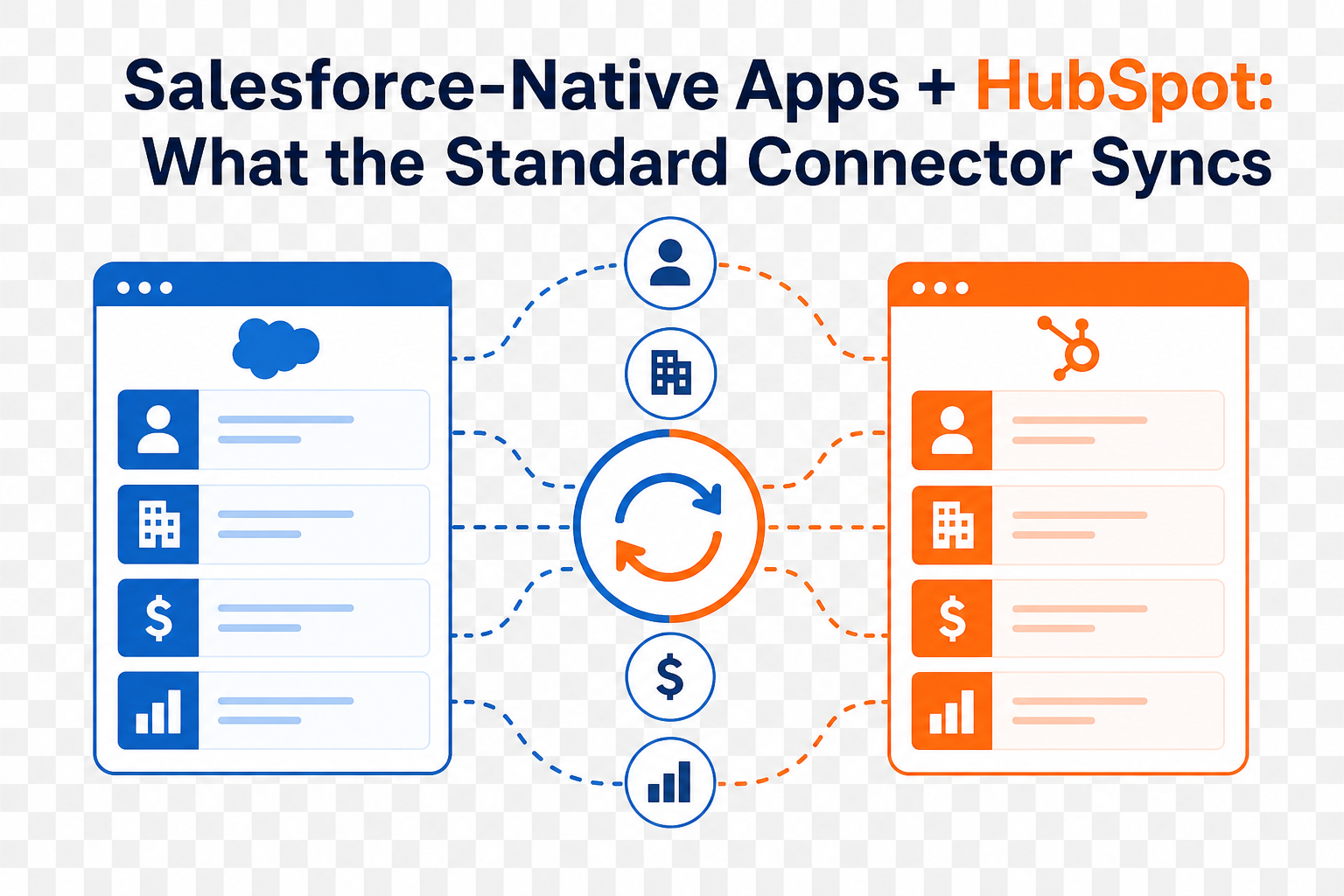
Pro tip: Many organizations successfully run HubSpot and Salesforce together — typically using HubSpot for marketing automation and lead nurturing, with Salesforce handling enterprise sales pipeline management. The native HubSpot-Salesforce integration supports bi-directional sync of contacts, companies, deals, and activities.
Frequently Asked Questions
Is Salesforce or HubSpot better for regulated industries like healthcare and financial services?
Salesforce has purpose-built clouds (Health Cloud, Financial Services Cloud) with industry-specific data models, compliance controls, and regulatory workflows. HubSpot is suitable for organizations in regulated industries that need core CRM and marketing automation but don't require industry-specific object models. For maximum compliance control, a custom-built stack with on-premises or single-tenant hosting provides the most flexibility — though at significant cost. Vantage Point specializes in implementing both Salesforce and HubSpot for regulated industries with compliance-first architecture.
How does Salesforce Agentforce pricing compare to HubSpot Breeze AI?
Agentforce pricing is either per-user ($125/user/month add-on to Enterprise/Unlimited) or consumption-based (Flex Credits at $500 per 100,000 credits, ~$0.10 per agent action). HubSpot Breeze AI capabilities are included in paid tiers at no additional cost, though Breeze Intelligence credits for data enrichment are purchased separately. For a 50-user organization, Agentforce adds approximately $75,000/year to your CRM spend; HubSpot's equivalent AI costs are typically $5,000–$15,000/year for Intelligence credits.
Can HubSpot handle enterprise-scale deployments in 2026?
Yes, for a growing range of enterprise use cases. HubSpot Enterprise has closed significant functionality gaps with its Spring 2025 Spotlight (200+ features) and continued 2026 updates. HubSpot Professional and Enterprise now provide approximately 90% of Salesforce's core CRM functionality. However, organizations requiring deep custom object models, complex approval workflows, Apex-level development, or multi-thousand-user territory hierarchies will still find Salesforce more capable.
What are the risks of building a custom CRM stack?
The primary risks are ongoing engineering maintenance costs (expect 1–3 dedicated engineers), integration fragility (each tool connection is a potential failure point), slower time-to-value (6–12+ months to reach parity with commercial CRMs), and compliance complexity in multi-vendor architectures. Building your own is best suited for organizations with strong engineering teams, unique process requirements, and the budget to sustain a custom product over time.
Should we use both HubSpot and Salesforce together?
A hybrid architecture — typically HubSpot for marketing and Salesforce for sales — is a proven pattern for enterprises that need best-in-class marketing automation alongside deep sales process customization. The native integration handles bi-directional data sync. Consider this approach if your marketing team is constrained by Salesforce's limited native marketing tools but your sales team can't migrate from an established Salesforce environment.
How long does CRM implementation typically take?
HubSpot: 2–4 weeks for a mid-market deployment with a competent implementation partner. Salesforce: 3–6 months for standard deployments; 6–12 months for enterprise with custom development. Custom-built: 6–18 months to reach functional parity with a commercial CRM. These timelines directly impact your ROI calculation — the faster you're live, the sooner you generate return on your investment.
What CRM ROI can we realistically expect?
Industry benchmarks show CRM investments return $3–$5 for every $1 spent when properly implemented. Organizations report a 300% increase in conversion rates, 29% boost in sales, and 17% improvement in lead conversions. However, 20–70% of CRM projects fail to meet their goals — typically due to poor user adoption and cross-functional misalignment rather than technology limitations. Implementation quality and change management are at least as important as platform selection.
The Vantage Point Perspective: Why Vendor-Agnostic Guidance Matters
At Vantage Point, we're one of the few consultancies with deep expertise across both Salesforce and HubSpot — plus the integration, data, and AI capabilities to connect them. Across healthcare, financial services, insurance, and other regulated industries, we've seen firsthand that the best CRM decision depends entirely on your organization's unique profile.
Here's what we recommend:
- Don't start with the vendor — start with your requirements. Map your sales process, marketing workflows, compliance needs, and technical resources before evaluating platforms.
- Calculate true TCO, not just license cost. Include implementation, ongoing administration, training, and AI add-on costs in your 3-year projection.
- Prioritize AI readiness. In 2026, a CRM without embedded AI capabilities is already behind. Evaluate which platform's AI model aligns with your team's technical maturity.
- Plan for integration from day one. Whether you choose Salesforce, HubSpot, a hybrid, or a custom stack, your CRM must connect seamlessly with your existing tech ecosystem.
- Invest in adoption, not just implementation. The most expensive CRM is the one your team doesn't use.
Ready to make the right CRM decision for your organization? Contact Vantage Point for a vendor-agnostic CRM assessment that evaluates your specific needs against all three paths — Salesforce, HubSpot, and custom-built solutions.
This guide is part of Vantage Point's thought leadership series on CRM strategy, AI-powered customer engagement, and digital transformation. For more insights, visit vantagepoint.io/blog.