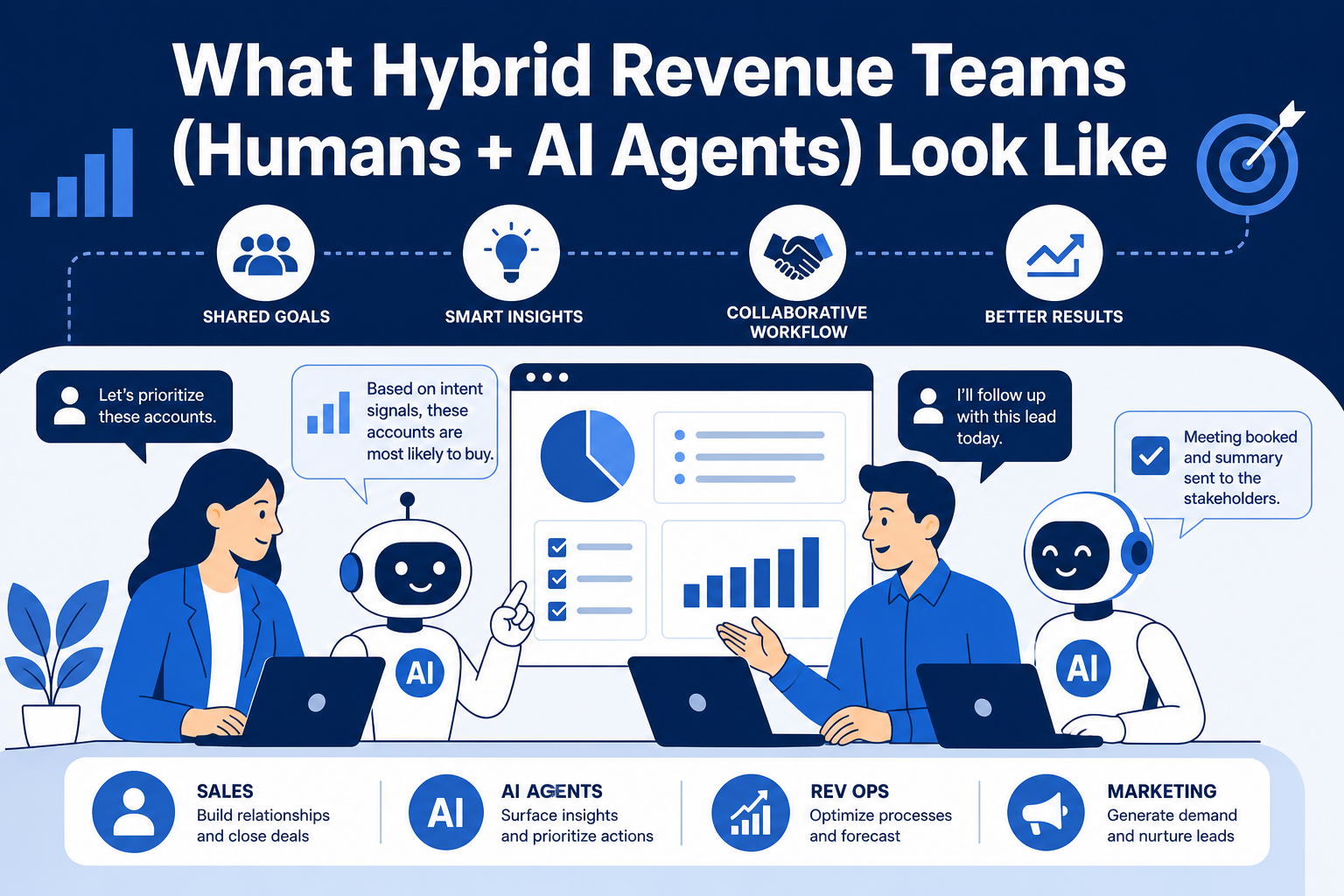
Revenue teams in 2026 are no longer just reps, managers, and RevOps staff working a CRM. Most growing organizations are now running a hybrid model where AI agents handle defined tasks alongside human sellers, marketers, and support staff. Understanding what this actually looks like in practice — not the hype version — is the first step to building it well.
This isn't about replacing your sales or service team with bots. It's about redesigning workflows so AI agents own narrow, well-defined tasks while humans keep ownership of judgment calls, relationships, and exceptions. Done right, this frees people to spend more time on the parts of the job that actually require a person.
Vantage Point works with businesses implementing Salesforce, HubSpot, and connected AI tools like Agentforce and Claude. This guide covers what a real hybrid revenue team looks like today, how the division of labor works, and what to evaluate before you build one.
Quick Answer: A hybrid revenue team combines human sellers, marketers, and service staff with task-specific AI agents embedded in the CRM and surrounding systems. It matters for any organization running Salesforce or HubSpot that wants to reduce administrative drag on reps without losing accountability or customer trust. The core decision this article supports is where to draw the line between agent-owned tasks and human-owned tasks, and what governance to put around that line. Vantage Point is relevant because building this well requires CRM data quality, workflow design, and platform expertise — not just turning on an AI feature.
TL;DR
- What it is: A hybrid revenue team pairs human sellers, marketers, and service reps with AI agents that handle specific, well-bounded tasks inside the CRM and connected tools.
- Why it matters: Reps spend less time on data entry, research, and routine follow-up, and more time on deals, relationships, and complex service issues.
- Best for: Sales, marketing, and service organizations on Salesforce or HubSpot looking to scale output without proportionally scaling headcount.
- Decision point: Which tasks should be agent-owned, which stay human-owned, and what oversight is required in between.
- How Vantage Point helps: We design the workflow, data, and governance model behind hybrid teams as part of our workflow automation and process optimization and AI-driven personalization and analytics services.
What Is a Hybrid Revenue Team?
A hybrid revenue team is a sales, marketing, or service organization where AI agents perform specific, scoped tasks — such as lead research, meeting prep, data entry, follow-up drafting, or first-line case triage — while humans retain ownership of decisions that involve judgment, negotiation, risk, or relationship management.
This differs from simple automation (rule-based workflows that trigger on fixed conditions) and from full AI autonomy (an agent that owns an entire process end to end without review). A hybrid model sits in between: agents act within defined boundaries, and a human is accountable for outcomes.
Why Hybrid Teams Matter in 2026
Three forces are pushing revenue organizations toward this model:
- Administrative overhead has grown faster than headcount. CRM data entry, call notes, follow-up emails, and account research consume a large share of a rep's day. Agents can absorb much of this without requiring a new hire.
- AI agent tooling has matured inside major CRMs. Salesforce Agentforce and HubSpot's Breeze agents are now built into the platforms most teams already use, rather than requiring a separate stack.
- Buyers expect faster response times. Service and sales teams that use agents for first-response drafting, triage, or scheduling can respond faster without sacrificing the human review that keeps quality and trust intact.
The organizations getting the most value are not the ones that deployed the most agents. They're the ones that were disciplined about scoping what each agent does and keeping a clear owner accountable for the result.
How Hybrid Revenue Teams Actually Work
In practice, a hybrid revenue team divides work along a few consistent lines:
Tasks typically owned by AI agents
- Account and contact research before a call or meeting
- Drafting (not sending) follow-up emails and proposals
- Summarizing calls and updating CRM fields automatically
- Qualifying and routing inbound leads based on defined criteria
- First-line case triage and suggested responses for support tickets
- Flagging data quality issues (duplicate records, missing fields, stale opportunities)
Tasks that stay human-owned
- Final decisions on pricing, discounting, and contract terms
- Complex or escalated service issues involving judgment or exceptions
- Relationship-building conversations and negotiations
- Reviewing and approving agent-drafted communications before they go out (in most implementations)
- Strategic account planning and territory decisions
The handoff layer
The most important — and most often skipped — part of the design is the handoff: how work moves from agent to human and back. This requires:
- Clear triggers for when an agent escalates to a person
- Visibility into what the agent did and why, not just the output
- A defined owner for every outcome, even when an agent contributed to it
- Clean, unified CRM data, since agents make decisions based on whatever data they can see
Decision Table: Agent-Owned vs. Human-Owned Work
| Task Type | Agent-Owned | Human-Owned | Why |
|---|---|---|---|
| Lead research and enrichment | Yes | — | Repetitive, low-risk, high-volume |
| Meeting prep summaries | Yes | — | Time-consuming but low-judgment |
| CRM data entry and cleanup flags | Yes | Review | Reduces admin drag; humans confirm changes |
| Drafting follow-up emails | Yes | Review before send | Saves time; tone and accuracy still need a human check |
| Pricing and discount approval | — | Yes | Financial and relationship risk |
| Contract negotiation | — | Yes | Requires judgment and trust-building |
| First-line support triage | Yes | Escalation path | Speeds response; complex cases still need a person |
| Complex or escalated service cases | — | Yes | Requires context, empathy, and accountability |
| Forecast roll-up and anomaly flags | Yes | Final call | Agents surface patterns; managers make the call |
What Businesses Should Do Next
- Audit where time actually goes. Before adding agents, identify which tasks consume the most rep or service-agent time and carry the lowest judgment requirement — these are your best starting points.
- Start with one workflow, not the whole team. Pick a single process (like meeting prep or lead routing) and get the agent-human handoff right before expanding.
- Fix data quality first. Agents make decisions based on CRM data. Duplicate records, missing fields, and inconsistent stages will produce inconsistent agent behavior.
- Define an owner for every outcome. Even when an agent contributes to a result, a person should be accountable for it — this keeps trust and quality control intact.
- Build a review step for anything customer-facing. Most organizations are still keeping a human review step before agent-drafted content reaches a customer, and that's a reasonable default until trust is established.
How Vantage Point Helps
Building a hybrid revenue team is a workflow and data problem before it's an AI problem. Vantage Point helps organizations design the agent-human handoff, clean up the CRM data agents rely on, and implement the platform features (Salesforce Agentforce, HubSpot Breeze, and connected tools) that make this work in practice.
Our workflow automation and process optimization service maps out which tasks belong to agents versus people and builds the operational guardrails around that split. Our AI-driven personalization and analytics service focuses on how AI agents use CRM and customer data responsibly. If your CRM data isn't clean enough to support reliable agent behavior, our system integration and data migration service addresses that foundation first. And for teams still deciding between or combining Salesforce and HubSpot, our HubSpot-Salesforce integration work ensures agents on either platform have consistent, unified data to act on.
If your team is evaluating how AI agents fit into your sales, marketing, or service operations, Vantage Point can help assess the right starting workflow and build a practical implementation plan.
FAQ
What is a hybrid revenue team?
A hybrid revenue team combines human sellers, marketers, and service staff with AI agents that handle specific, well-defined tasks such as research, data entry, and first-line triage, while people retain ownership of judgment calls, relationships, and exceptions.
Are AI agents replacing sales and service reps?
Not in most current implementations. AI agents are primarily absorbing administrative and repetitive tasks — like research, note-taking, and drafting — so reps can spend more time on deals, relationships, and complex issues.
What tasks should stay human-owned in a hybrid team?
Pricing decisions, contract negotiation, complex or escalated service cases, and final approval of customer-facing communications should generally stay human-owned because they involve judgment, risk, or trust that automation can't fully replace yet.
Do I need clean CRM data before deploying AI agents?
Yes. AI agents make decisions and take actions based on the CRM data available to them. Duplicate records, missing fields, and inconsistent pipeline stages will produce unreliable or inconsistent agent behavior, so data quality work should come first.
Which platforms support hybrid revenue team workflows?
Salesforce supports this through Agentforce, and HubSpot supports it through its Breeze AI agents. Both are built into the CRM platforms most teams already use, which lowers the barrier to starting compared to standalone AI tools.
How do I decide which tasks to automate first?
Start with tasks that are high-volume, time-consuming, and low in judgment requirements — like meeting prep, lead research, or data entry flags. Avoid starting with tasks that involve pricing, negotiation, or complex customer relationships.
Should agent-drafted emails go straight to customers?
Most organizations keep a human review step before agent-drafted, customer-facing content is sent, at least until the team has built enough confidence in the agent's output quality and tone.
How does Vantage Point help organizations build hybrid revenue teams?
Vantage Point designs the workflow and data foundation behind hybrid teams — mapping which tasks belong to agents versus people, cleaning up CRM data, and implementing Salesforce or HubSpot AI agent features so the handoff between agents and humans actually works in practice.