
Key Takeaways (TL;DR)
- What is it? AI-powered CRM engagement combines artificial intelligence with customer relationship management to deliver hyper-personalized, proactive client experiences at scale
- Key Benefit: AI-enhanced CRM helps firms grow revenue and lift client satisfaction by making every interaction more relevant
- Investment: $50K: $200K+ for implementation depending on firm size and CRM platform
- Timeline: 3-6 months for initial deployment; measurable engagement improvements within 90 days
- Best For: Financial services firms (wealth management, banking, insurance, fintech) looking to deepen client relationships and reduce churn
- Bottom Line: Firms that fail to integrate AI into their CRM strategy risk losing clients to competitors who deliver the personalized, always-on experience today's clients expect
Introduction: Why Client Engagement Is the New Competitive Battleground
The rules of client engagement in financial services have changed dramatically. Today's clients (whether high-net-worth investors, small business banking customers, or insurance policyholders) expect the same frictionless, personalized experience they get from Netflix and Amazon. Yet most financial services firms still rely on quarterly check-in calls, generic newsletters, and siloed data to manage their most valuable relationships.
The gap between client expectations and firm capabilities is growing, and it's costing real money. Client retention has an outsized effect on profitability, and returning clients tend to spend more than new ones. Meanwhile, business executives increasingly identify personalization as mission-critical to competitive advantage.
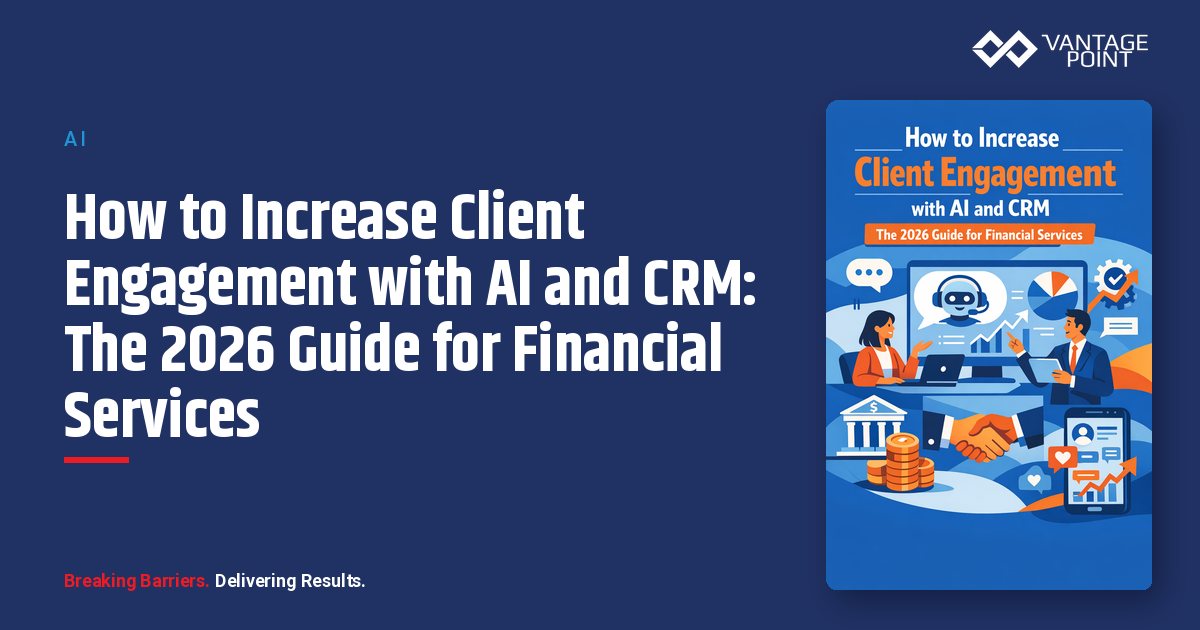
The solution isn't more outreach. It's smarter outreach, powered by artificial intelligence and modern CRM platforms. In this comprehensive guide, you'll learn exactly how to leverage AI and CRM together to transform client engagement across your financial services firm, with practical strategies you can implement in 2026.
What Is AI-Powered CRM Engagement?
AI-powered CRM engagement refers to the use of artificial intelligence capabilities (such as machine learning, natural language processing, and predictive analytics) within a CRM platform to automate, personalize, and optimize every client interaction. Unlike traditional CRM systems that function as digital filing cabinets for contact records, AI-enhanced CRM acts as an intelligent engagement engine that proactively recommends actions, predicts client needs, and delivers the right message at the right time through the right channel.
How AI Transforms CRM from Reactive to Proactive
| Capability | Traditional CRM | AI-Powered CRM |
|---|---|---|
| Client Understanding | Basic demographics & account data | Behavioral micro-segments with predictive intent |
| Engagement Timing | Scheduled quarterly reviews | Event-triggered, real-time outreach |
| Content Relevance | Generic templates for all clients | Individually personalized messaging |
| Decision Making | Manual advisor judgment | AI-recommended next-best actions |
| Risk Detection | Reactive (after client complains) | Predictive (before client disengages) |
| Learning | Static rules and processes | Self-improving with every interaction |
For financial services firms, this shift is transformative. Instead of an advisor manually reviewing 200 client accounts to decide who needs attention, AI identifies the five clients showing early disengagement signals, and recommends exactly what to say and when.
Why Client Engagement Matters More Than Ever in Financial Services
Rising Client Expectations
Modern financial services clients compare their experience with your firm to the best experience they've had with any brand. When a streaming service knows their preferences better than their financial advisor does, something is broken. According to Forbes, early adopters of AI in financial services have seen customer satisfaction scores jump by up to 30%.
The Cost of Disengagement
Client churn in financial services is expensive, not just in lost revenue, but in the years of relationship-building that walk out the door. Consider these realities:
- Acquisition vs. retention costs: Acquiring a new client costs far more than retaining an existing one
- Revenue impact: Returning clients tend to spend more than new ones
- Compounding effect: Small gains in retention can have an outsized effect on profits
Regulatory Complexity Creates Engagement Opportunities
Ironically, the regulatory environment that makes financial services more complex also creates engagement opportunities. Clients need help navigating changing regulations, tax implications, and compliance requirements. Firms that use AI to proactively surface relevant insights (like upcoming regulatory changes that affect a client's portfolio) build trust and deepen relationships organically.
7 Proven Strategies to Increase Client Engagement with AI and CRM
1. Build a Unified 360-Degree Client View
The Problem: Most firms have client data scattered across multiple systems, portfolio management, email, phone logs, meeting notes, compliance records, and marketing platforms. Advisors waste hours piecing together a complete picture before every interaction.
The AI Solution: Modern CRM platforms with AI capabilities automatically consolidate data from every touchpoint into a single, dynamic client profile. Machine learning continuously enriches these profiles by detecting patterns in behavior, communication preferences, and life events.
How to Implement:
- Integrate your CRM with portfolio management, email, phone systems, and marketing tools
- Use Salesforce Data Cloud, HubSpot's Customer Platform, or MuleSoft to unify data streams
- Enable AI-powered profile enrichment to automatically tag client interests and preferences
- Create custom dashboards that give advisors instant client context before every interaction
Impact: Firms with unified client views can respond faster and keep clients more satisfied.
2. Deploy Predictive Engagement Scoring
The Problem: Not all client interactions carry the same weight. Most firms treat a website login the same as a portfolio withdrawal: missing critical signals that predict disengagement.
The AI Solution: Predictive engagement scoring uses machine learning to analyze hundreds of behavioral signals and assign each client a dynamic engagement health score. The model learns from historical patterns to identify which behaviors predict long-term loyalty versus early churn indicators.
Key Signals AI Monitors:
- Login frequency and session duration trends
- Email open and click-through patterns
- Meeting attendance and cancellation rates
- Document download and portal usage
- Service request frequency and sentiment
- Life events (marriage, retirement, inheritance)
Impact: Firms using predictive engagement scoring can identify at-risk clients earlier than traditional methods detect problems.
3. Automate Personalized Client Journeys
The Problem: Generic nurture campaigns and batch-and-blast emails erode trust with sophisticated financial services clients. A retiree managing estate planning doesn't want the same content as a 30-year-old saving for their first home.
The AI Solution: AI-driven journey orchestration creates individualized engagement paths based on client segments, life stages, goals, and real-time behavior. The system automatically adjusts timing, channel, and content to match each client's preferences.
Example: New Client Onboarding (Wealth Management)
- Day 1: Welcome email with personalized advisor introduction + portal setup guide
- Day 3: AI-detected if portal was accessed → Yes: educational content; No: friendly reminder
- Day 7: Personalized investment insights based on risk profile
- Day 14: Advisor scheduling prompt for first review meeting
- Day 30: Satisfaction check-in with AI-powered sentiment analysis
Impact: Automated personalized journeys lift client engagement compared to generic communications.
4. Enable AI-Powered Next-Best-Action Recommendations
The Problem: Advisors often default to the same engagement playbook for every client: quarterly calls, annual reviews, and holiday cards. This one-size-fits-all approach misses opportunities to deepen relationships at critical moments.
The AI Solution: Next-best-action (NBA) engines analyze each client's complete history, current portfolio, market conditions, and engagement patterns to recommend the single most impactful action an advisor can take right now.
Types of AI-Recommended Actions:
- "Client A hasn't logged into the portal in 45 days and has a policy renewal in 30 days → Schedule a proactive review call"
- "Client B just had a major market gain in their portfolio → Send congratulatory note with rebalancing insights"
- "Client C opened your tax planning email 4 times but didn't book a meeting → Send direct calendar link with tax deadline reminder"
- "Client D's engagement score dropped 25% this quarter → Assign senior advisor for a relationship health check"
Impact: Next-best-action recommendations help firms improve client retention and cross-sell conversions.
5. Leverage Conversational AI for Always-On Engagement
The Problem: Clients have questions at 10 PM on a Sunday, not just during business hours. Yet most financial services firms offer no engagement pathway outside of office hours.
The AI Solution: Conversational AI, including intelligent chatbots and AI-powered messaging assistants, provides instant, compliant responses to client questions 24/7. Modern financial services chatbots handle complex queries, maintain conversation context, and seamlessly escalate to human advisors when needed.
Use Cases:
- Account balance and transaction inquiries
- Meeting scheduling and rescheduling
- Document submission and status tracking
- FAQ responses about products, fees, and processes
- Proactive alerts about market events or portfolio changes
Impact: Conversational AI can sharply cut response times and lift client engagement.
6. Harness Predictive Analytics for Proactive Outreach
The Problem: Most client outreach in financial services is reactive: triggered by scheduled reviews or client-initiated requests. By the time a firm reacts to a problem, the client may already be exploring alternatives.
The AI Solution: Predictive analytics uses machine learning to forecast future client behavior based on historical patterns. This enables firms to shift from reactive to proactive engagement.
Predictive Analytics Applications:
- Churn prediction: Identify clients likely to leave before they actually do
- Life event prediction: Detect upcoming life events from financial patterns and public data
- Product affinity: Predict which additional products each client is most likely to need
- Market sensitivity: Identify which clients need proactive reassurance during volatility
Impact: Proactive engagement driven by predictive analytics can reduce client churn and increase cross-sell revenue.
7. Create Omnichannel Engagement Orchestration
The Problem: Clients interact with your firm across email, phone, portal, mobile app, social media, and in-person meetings. When these channels operate in silos, clients receive inconsistent messages and feel like no one has a complete picture.
The AI Solution: Omnichannel orchestration uses AI to coordinate every client touchpoint into a coherent experience. The system learns each client's channel preferences and adapts automatically.
Impact: Cross-channel engagement can improve client retention and lifetime value compared to single-channel communication.
Best Practices for AI-Driven Client Engagement in Financial Services
- Start Small, Scale Fast: Pick one high-impact use case, prove its value, then expand. Most successful firms see measurable results within 90 days.
- Prioritize Data Quality: Invest in data cleansing, deduplication, and integration before deploying advanced AI features.
- Maintain the Human Touch: AI should augment advisors, not replace them. Free advisors to focus on high-value relationship-building.
- Ensure Compliance at Every Step: Build compliance checks directly into automated workflows for SEC, FINRA, HIPAA, or other requirements.
- Measure What Matters: Track leading indicators (engagement scores, portal usage) alongside lagging indicators (retention rates, AUM growth).
- Invest in Advisor Training: Focus training on interpreting AI insights and integrating them into natural client conversations.
- Continuously Optimize: Review and recalibrate AI models and engagement journeys at least quarterly.
Implementation Roadmap: Getting Started in 2026
Phase 1: Foundation (Weeks 1-6)
- Audit existing client data quality and integration points
- Evaluate current CRM capabilities against AI readiness
- Identify top 3 engagement use cases by business impact
- Secure executive sponsorship and compliance sign-off
Phase 2: Pilot (Weeks 7-18)
- Deploy first AI use case (e.g., predictive engagement scoring)
- Establish control groups for measuring incremental lift
- Train pilot group of advisors on new AI-powered workflows
- Document results and refine approach
Phase 3: Scale (Weeks 19-52)
- Expand to additional use cases and client segments
- Integrate additional data sources for richer AI models
- Roll out omnichannel orchestration across all touchpoints
- Establish continuous optimization and model retraining processes
Phase 4: Optimize and Innovate (Ongoing)
- Implement advanced capabilities like next-best-action and conversational AI
- Explore generative AI for personalized content creation at scale
- Build real-time engagement dashboards for advisors and leadership
- Continuously test, learn, and refine
How Vantage Point Can Help
At Vantage Point, we specialize in helping financial services firms unlock the full potential of AI-powered CRM engagement. Our team brings deep expertise in:
- Salesforce Financial Services Cloud (FSC) implementation and optimization
- HubSpot CRM deployment for client engagement and marketing automation
- MuleSoft integration to unify data across legacy systems
- Salesforce Data Cloud for real-time client intelligence
- AI personalization strategy and deployment
- Health Cloud for healthcare organizations seeking HIPAA-compliant engagement
Ready to transform your client engagement? Contact Vantage Point to schedule a consultation.
Frequently Asked Questions (FAQ)
How much does it cost to add AI to my existing CRM?
Costs vary based on your CRM platform and scope. Adding AI features to Salesforce or HubSpot typically ranges from $50K, $200K+ for implementation, with ongoing license costs of $25: $75/user/month for AI add-ons. Well-scoped projects pay back through time saved and stronger client retention.
Can AI replace financial advisors for client engagement?
No, and it shouldn't. AI is designed to augment advisors by handling routine tasks, surfacing insights, and automating repetitive communications. The most successful engagement models use AI to free advisors from administrative work so they can focus on the relationship-building and strategic advice that clients value most.
How do I ensure AI-driven engagement complies with financial regulations?
Build compliance into your AI workflows from the start. This includes implementing approval workflows for automated communications, maintaining complete audit trails of all AI-generated interactions, using pre-approved content templates, and conducting regular reviews of AI recommendations against regulatory requirements.
What CRM platform is best for AI-powered client engagement in financial services?
The right platform depends on your firm's size, existing technology stack, and specific needs. Salesforce Financial Services Cloud is the gold standard for enterprise wealth management and banking firms. HubSpot CRM excels for mid-market firms focused on marketing automation and inbound engagement. Both platforms offer robust AI capabilities: the key is choosing the right implementation partner.
How long does it take to see results from AI-enhanced CRM engagement?
Most firms see measurable improvements within 90 days of deploying their first AI use case. Quick wins like automated email personalization and predictive engagement scoring show results fastest. More complex capabilities like full omnichannel orchestration typically take 6-12 months to fully deploy and optimize.
What's the biggest mistake firms make when implementing AI in their CRM?
Attempting too much too fast. Firms that try to transform everything simultaneously struggle with data quality issues, change management challenges, and advisor overwhelm. The most successful approach is to start with one focused use case, prove its value, then expand systematically.
How does AI handle data privacy and security in financial services CRM?
Modern AI-powered CRM platforms are built with enterprise-grade security and compliance features, including data encryption, role-based access controls, audit logging, and data residency options. Ensure your implementation partner configures these features according to your regulatory requirements (SEC, FINRA, SOC 2, HIPAA, etc.) and conduct regular security audits.
About Vantage Point
Vantage Point is a leading CRM and AI implementation partner for regulated industries. Specializing in Salesforce, HubSpot, MuleSoft, and Data Cloud, we help financial services firms, healthcare organizations, and other regulated businesses transform client engagement through intelligent technology. We deliver measurable results that drive growth.