Key Takeaways (TL;DR)
- What is it? A risk assessment is a structured process for identifying, analyzing, and prioritizing threats before they disrupt your operations, technology, or strategic goals
- Key Benefit: Organizations that conduct proactive risk assessments reduce project failures by up to 70% and avoid costly rework
- Frameworks: NIST RMF, ISO 31000, and FAIR each serve different needs, NIST for compliance, ISO for enterprise-wide risk, FAIR for financial quantification
- Timeline: A thorough risk assessment takes 2-6 weeks depending on scope and organizational complexity
- Best For: Any organization implementing new technology, undergoing digital transformation, or seeking to strengthen operational resilience
- Bottom Line: Risk assessment isn't a one-time checkbox. It's an ongoing discipline that separates successful implementations from failed ones
Introduction: Why Risk Assessment Matters More Than Ever
Every organization faces risk. Whether you're migrating to a new CRM, integrating third-party systems, rolling out AI-powered automation, or simply scaling your operations, threats lurk in every phase of the process. The difference between organizations that thrive and those that struggle comes down to one thing: preparation.
A 2023 Forrester report found that nearly one in three CRM implementations fail to meet expectations. Protiviti's 2026 Global Risk Survey revealed that executive leaders rank technology disruption, cybersecurity threats, and operational complexity among their top concerns. And yet, many organizations still treat risk assessment as an afterthought. Something they do reactively after a problem surfaces, rather than proactively before one occurs.
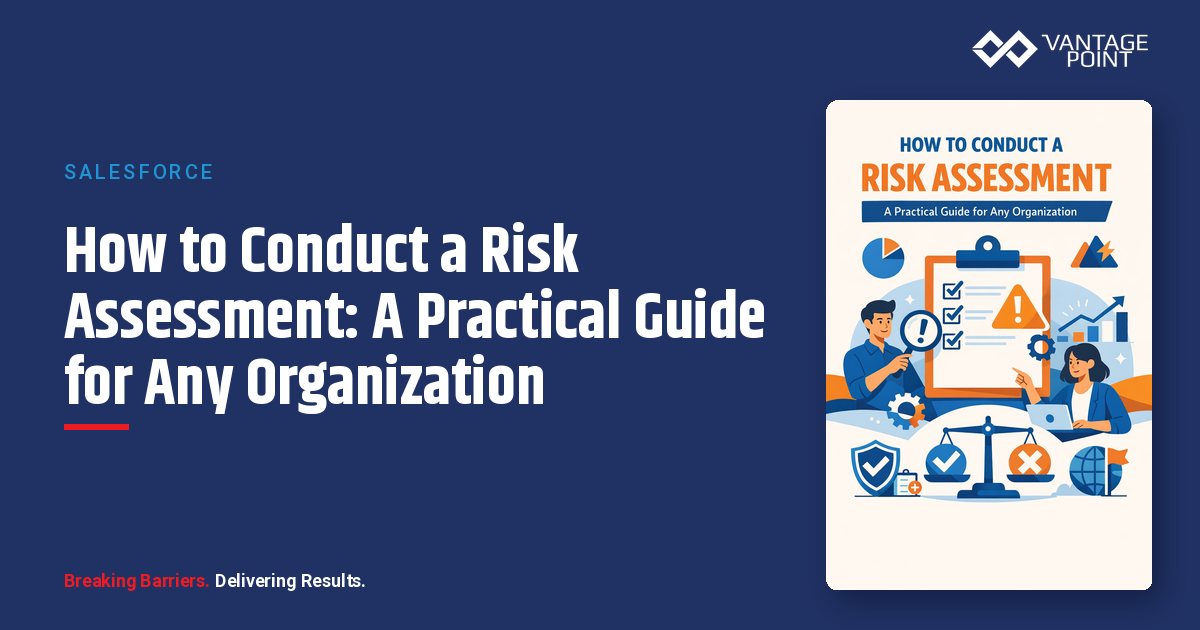
This guide provides a practical, step-by-step framework for conducting risk assessments that actually work. Whether you're evaluating technology risks for a CRM implementation, assessing operational vulnerabilities across departments, or building a company-wide risk management program, you'll find actionable templates, scoring matrices, and strategies you can apply immediately.
What Is a Risk Assessment?
A risk assessment is the systematic process of identifying potential threats, analyzing their likelihood and impact, and prioritizing mitigation strategies to reduce or eliminate harm. It's the foundation of any effective risk management program.
Risk assessments answer three fundamental questions:
- What could go wrong? (Risk Identification)
- How bad could it be, and how likely is it? (Risk Analysis)
- What should we do about it? (Risk Evaluation and Mitigation)
Unlike a one-time audit, effective risk assessment is continuous. It adapts as your organization evolves, new threats emerge, and business priorities shift.
Types of Risk Every Organization Should Assess
| Risk Category | Description | Examples |
|---|---|---|
| Technology Risk | Threats from IT systems, software, data, and digital infrastructure | System outages, data breaches, integration failures, software bugs |
| Operational Risk | Threats to day-to-day business processes and workflows | Process breakdowns, human error, resource shortages, supply chain disruptions |
| Compliance Risk | Threats from regulatory violations or policy non-compliance | GDPR fines, industry audit failures, licensing lapses, data privacy violations |
| Strategic Risk | Threats to long-term business objectives and market position | Competitive disruption, failed transformations, market shifts, poor vendor choices |
| Financial Risk | Threats to revenue, cash flow, and financial stability | Budget overruns, currency exposure, fraud, contract disputes |
| Reputational Risk | Threats to brand trust and stakeholder confidence | Data leaks, service failures, negative publicity, customer churn |
Step 1: Define the Scope and Objectives
Before identifying a single risk, you need to establish what you're assessing and why. A risk assessment without clear boundaries becomes an unfocused exercise that produces volumes of data but little actionable insight.
How to Define Your Scope
- Identify the project, process, or initiative you're assessing (e.g., "CRM migration to Salesforce," "company-wide data governance program," or "new vendor onboarding process")
- Set clear objectives: Are you trying to prevent project delays? Protect sensitive data? Ensure regulatory compliance? Meet a go-live deadline?
- Determine stakeholders: Who owns the risk? Who is impacted? Who needs to approve mitigation plans?
- Establish the timeframe: Is this a one-time assessment for a specific project, or an ongoing program?
Scope Statement Template
Risk Assessment Scope: This assessment covers all risks associated with [project/initiative name], including technology, operational, compliance, and strategic risks. The assessment period is [start date] to [end date]. Primary stakeholders include [list departments/roles]. The objective is to identify, score, and prioritize all risks rated Medium or above and develop mitigation plans for High and Critical risks before [milestone date].
Step 2: Choose the Right Risk Assessment Framework
Not all frameworks are created equal. The right choice depends on your organization's size, industry, regulatory requirements, and the specific type of risk you're assessing.
Framework Comparison: NIST RMF vs. ISO 31000 vs. FAIR
| Feature | NIST RMF | ISO 31000 | FAIR |
|---|---|---|---|
| Best For | IT/cybersecurity risk, compliance-driven orgs | Enterprise-wide risk management | Financial quantification of risk |
| Approach | Prescriptive, step-by-step | Principles-based, flexible | Quantitative, data-driven |
| Risk Rating | Qualitative (High/Med/Low) | Qualitative or quantitative | Purely quantitative (dollar values) |
| Complexity | Moderate to High | Low to Moderate | High |
| Regulatory Alignment | Strong (FISMA, FedRAMP, HIPAA) | Broad (industry-agnostic) | Financial/insurance sectors |
| Output | Risk register with controls | Risk treatment plans | Loss exposure estimates ($) |
| Ideal Org Size | Mid-market to Enterprise | Any size | Mid-market to Enterprise |
When to Use Each Framework
- NIST RMF (SP 800-30): Choose this when you need a structured, compliance-oriented approach, especially for technology implementations, cybersecurity programs, or organizations subject to federal or industry regulations.
- ISO 31000: Choose this when you need a flexible, organization-wide risk management standard that applies across all departments and risk types. It's excellent as a foundational framework.
- FAIR (Factor Analysis of Information Risk): Choose this when leadership needs risk expressed in financial terms, dollars at risk, annualized loss expectancy, and ROI for mitigation investments.
Pro Tip: Many organizations use ISO 31000 as the umbrella framework and layer NIST or FAIR underneath for specific risk domains. This gives you both breadth and depth.
Step 3: Identify Risks
Risk identification is the most collaborative phase of the assessment. The goal is to surface every plausible threat, even ones that seem unlikely, so nothing falls through the cracks.
Risk Identification Methods
1. Brainstorming Workshops
Gather cross-functional teams (IT, operations, finance, compliance, project managers) for structured sessions. Use prompts like:
- "What could prevent us from meeting our go-live date?"
- "What happens if this integration fails?"
- "Where are we most dependent on a single vendor or system?"
2. Historical Analysis
Review past projects, incident reports, and post-mortems. Patterns in previous failures are powerful predictors of future risk.
3. SWOT Analysis
Map Strengths, Weaknesses, Opportunities, and Threats. Weaknesses and Threats feed directly into your risk register.
4. Checklists and Templates
Use industry-standard checklists (NIST, CIS Controls, OWASP) as starting points to ensure comprehensive coverage.
5. Interviews and Surveys
One-on-one conversations with department leads, end users, and technical specialists often reveal risks that group sessions miss.
6. Process Mapping
Walk through each step of a workflow or implementation plan and ask: "What could go wrong here?" at every stage.
Risk Register Template
| Risk ID | Risk Description | Category | Owner | Date Identified |
|---|---|---|---|---|
| R-001 | Data loss during CRM migration due to incomplete field mapping | Technology | Data Team Lead | 2026-05-15 |
| R-002 | Low user adoption due to insufficient training | Operational | Change Mgmt Lead | 2026-05-15 |
| R-003 | Integration failure between CRM and ERP system | Technology | IT Director | 2026-05-15 |
| R-004 | Budget overrun due to scope creep | Financial | Project Manager | 2026-05-15 |
| R-005 | Vendor lock-in limiting future platform flexibility | Strategic | CTO | 2026-05-15 |
Step 4: Analyze and Score Risks: The Likelihood × Impact Matrix
This is where your risk register transforms from a list into a prioritization tool. By scoring each risk on two dimensions, likelihood (how probable it is) and impact (how severe the consequences would be). You create a clear, visual hierarchy of what demands attention first.
The 5×5 Risk Assessment Matrix
| Negligible (1) | Minor (2) | Moderate (3) | Major (4) | Catastrophic (5) | |
|---|---|---|---|---|---|
| Almost Certain (5) | 5: Medium | 10: High | 15: Critical | 20: Critical | 25: Critical |
| Likely (4) | 4: Low | 8: Medium | 12: High | 16: Critical | 20: Critical |
| Possible (3) | 3: Low | 6: Medium | 9: Medium | 12: High | 15: Critical |
| Unlikely (2) | 2: Low | 4: Low | 6: Medium | 8: Medium | 10: High |
| Rare (1) | 1: Low | 2: Low | 3: Low | 4: Low | 5: Medium |
Scoring Definitions
Likelihood Scale:
| Score | Rating | Definition |
|---|---|---|
| 1 | Rare | Less than 5% chance; has never occurred in similar projects |
| 2 | Unlikely | 5-20% chance; has occurred but is not common |
| 3 | Possible | 20-50% chance; occurs occasionally in similar projects |
| 4 | Likely | 50-80% chance; occurs frequently; strong indicators present |
| 5 | Almost Certain | Greater than 80% chance; expected to occur without intervention |
Impact Scale:
| Score | Rating | Definition |
|---|---|---|
| 1 | Negligible | Minimal effect; easily absorbed with existing resources |
| 2 | Minor | Small delays or cost increases (<5% of budget); localized impact |
| 3 | Moderate | Noticeable delays (1-4 weeks), 5-15% budget impact; workarounds needed |
| 4 | Major | Significant delays (1-3 months), 15-30% budget impact; executive intervention required |
| 5 | Catastrophic | Project failure, >30% budget overrun, data loss, regulatory penalties, or reputational damage |
Risk Rating Thresholds
| Risk Score | Rating | Action Required |
|---|---|---|
| 1-4 | Low | Monitor; accept with documentation |
| 5-9 | Medium | Develop mitigation plan; assign owner; review monthly |
| 10-15 | High | Prioritize mitigation; escalate to leadership; review weekly |
| 16-25 | Critical | Immediate action required; executive sponsor engaged; consider project pause if unmitigated |
Scored Risk Register Example
| Risk ID | Risk | Likelihood | Impact | Score | Rating | Mitigation Priority |
|---|---|---|---|---|---|---|
| R-001 | Data loss during CRM migration | 3 (Possible) | 5 (Catastrophic) | 15 | Critical | Immediate |
| R-002 | Low user adoption | 4 (Likely) | 4 (Major) | 16 | Critical | Immediate |
| R-003 | Integration failure (CRM ↔ ERP) | 3 (Possible) | 4 (Major) | 12 | High | This week |
| R-004 | Budget overrun from scope creep | 4 (Likely) | 3 (Moderate) | 12 | High | This week |
| R-005 | Vendor lock-in | 2 (Unlikely) | 4 (Major) | 8 | Medium | This month |
Step 5: Develop Mitigation Strategies
For every risk rated Medium or above, you need a concrete mitigation plan. There are four fundamental strategies for handling risk:
The Four Risk Response Strategies
| Strategy | When to Use | Example |
|---|---|---|
| Avoid | Eliminate the risk entirely by changing the approach | Choose a different migration method to eliminate data loss risk |
| Mitigate | Reduce likelihood or impact through controls and actions | Implement automated data validation checks before migration |
| Transfer | Shift the risk to a third party | Purchase cyber insurance; outsource integration to a specialist partner |
| Accept | Acknowledge the risk when cost of mitigation exceeds potential impact | Accept minor UI inconsistencies that don't affect functionality |
Mitigation Plan Template
| Risk ID | Risk | Strategy | Mitigation Actions | Owner | Deadline | Status |
|---|---|---|---|---|---|---|
| R-001 | Data loss during migration | Mitigate | 1. Run test migration in sandbox 2. Validate field mappings 3. Create rollback plan 4. Schedule migration during low-traffic window | Data Team Lead | Week 3 | In Progress |
| R-002 | Low user adoption | Mitigate | 1. Launch change management program in Week 1 2. Assign department champions 3. Create role-based training 4. Schedule post-launch support hours | Change Mgmt Lead | Ongoing | Not Started |
| R-003 | Integration failure | Mitigate + Transfer | 1. Map all API endpoints during discovery 2. Test in sandbox with live data samples 3. Engage integration partner for complex connections | IT Director | Week 4 | In Progress |
CRM and Technology Implementation Risks: A Deep Dive
Technology implementations, particularly CRM deployments, carry a unique set of risks that deserve special attention. Whether you're rolling out Salesforce, HubSpot, or any other platform, the following risk categories should be part of every technology risk assessment.
1. Data Migration Risks
Data migration is consistently rated as the highest-risk phase of CRM implementations. Common threats include:
- Incomplete data transfer: Records lost or corrupted during extraction and loading
- Field mapping errors: Source and destination fields that don't align, causing data to land in the wrong places
- Data quality degradation: Migrating dirty data (duplicates, outdated records, missing fields) into the new system
- Loss of historical data: Attachments, notes, and activity history that don't transfer cleanly
Mitigation: Audit source data quality before migration. Run test migrations in a sandbox environment. Validate record counts and field accuracy post-migration. Always maintain a rollback plan.
2. Integration Failures
Modern CRM systems don't operate in isolation. They connect to ERPs, marketing automation tools, telephony systems, data warehouses, and more. Integration risks include:
- API incompatibilities between legacy systems and modern platforms
- Data synchronization errors causing duplicate or conflicting records
- Middleware failures that break real-time data flows
- Rate limiting or throttling during peak-volume periods
Mitigation: Map all integration points during discovery. Use middleware platforms like MuleSoft for complex orchestration. Test integrations with production-like data volumes. Monitor API performance continuously after go-live.
3. User Adoption Risks
Research from McKinsey shows that transformation efforts are six times more likely to succeed when employees are involved early. Adoption risks include:
- Resistance to change from teams comfortable with existing tools
- Inadequate training that doesn't address real daily workflows
- Poor user experience from over-customized or poorly configured systems
- Lack of executive sponsorship signaling that the new system isn't a priority
Mitigation: Invest in structured change management from Day 1. Assign department champions. Create role-based training programs. Gather and act on user feedback continuously.
4. Vendor Lock-In Risks
Choosing a platform is a long-term commitment. Lock-in risks include:
- Proprietary data formats that make future migration difficult
- Heavy customization that only works on one platform
- Contractual terms that penalize switching or scaling
- Ecosystem dependency where third-party apps only work with one vendor
Mitigation: Evaluate exit strategies during vendor selection. Favor standard data formats and open APIs. Document all customizations thoroughly. Negotiate flexible contract terms.
5. Security and Compliance Vulnerabilities
CRM systems store sensitive customer data: contact information, purchase history, communication logs, and more. Security risks include:
- Insufficient access controls exposing data to unauthorized users
- Unencrypted data in transit or at rest
- Third-party app vulnerabilities introduced through marketplace integrations
- Compliance gaps with GDPR, CCPA, SOC 2, or industry-specific regulations
Mitigation: Implement role-based access controls from the start. Encrypt all sensitive data. Vet third-party integrations for security certifications. Conduct regular security audits and penetration testing.
Best Practices for Effective Risk Assessments
Drawing from established frameworks and real-world implementation experience, these best practices will strengthen any risk assessment program:
1. Start Early, Not After Problems Appear
Risk assessment should begin during the planning phase: not after go-live. The earlier you identify threats, the cheaper and easier they are to address.
2. Make It Collaborative
Risk identification is not a solo exercise. Cross-functional input from IT, operations, finance, compliance, and end users produces the most comprehensive view.
3. Use Quantitative Scoring
Move beyond vague "high/medium/low" labels. Use a structured scoring matrix (like the 5×5 above) with clearly defined criteria so everyone scores consistently.
4. Assign Ownership
Every risk needs a named owner, not a department, not a committee, a specific person accountable for monitoring and mitigation.
5. Document Everything
Maintain a living risk register that's updated regularly. Document decisions, rationale, and outcomes. This creates institutional knowledge for future projects.
6. Review and Reassess Continuously
Risks evolve. New threats emerge. Priorities shift. Schedule regular risk reviews: weekly during active projects, monthly for ongoing programs.
7. Connect Risk Assessment to Change Management
Risk assessment and change management are two sides of the same coin. Identified risks should inform your change management strategy, and change management activities should feed back into risk monitoring.
8. Build Risk Assessment into Your Implementation Methodology
The most successful technology implementations don't treat risk assessment as a separate activity. They embed it into every phase of the project lifecycle, from discovery through post-launch optimization.
Frequently Asked Questions (FAQ)
What is a risk assessment and why is it important?
A risk assessment is a structured process for identifying, analyzing, and prioritizing threats to your organization, projects, or operations. It's important because it enables proactive decision-making: addressing potential problems before they become costly failures. Organizations that conduct formal risk assessments reduce project failure rates by up to 70%.
How often should risk assessments be performed?
For active projects (like CRM implementations), risk assessments should be reviewed weekly. For ongoing operations, monthly or quarterly reviews are typical. The key is to treat risk assessment as a living process, not a one-time exercise. Major organizational changes, new regulations, or significant incidents should trigger an immediate reassessment.
What is the difference between NIST RMF, ISO 31000, and FAIR?
NIST RMF provides a prescriptive, compliance-focused framework ideal for IT and cybersecurity risk. ISO 31000 offers flexible, principles-based guidance for enterprise-wide risk management across any industry. FAIR is a quantitative model that expresses risk in financial terms (dollars at risk). Many organizations combine them, using ISO 31000 as an umbrella and layering NIST or FAIR for specific domains.
How do you score risks using a likelihood × impact matrix?
Rate each risk on two scales: likelihood (1-5, from Rare to Almost Certain) and impact (1-5, from Negligible to Catastrophic). Multiply the scores to get a risk rating (1-25). Scores of 1-4 are Low, 5-9 are Medium, 10-15 are High, and 16-25 are Critical. Focus mitigation efforts on High and Critical risks first.
What are the most common CRM implementation risks?
The top CRM implementation risks are: (1) data migration failures, (2) low user adoption, (3) integration breakdowns, (4) scope creep and budget overruns, (5) inadequate change management, (6) vendor lock-in, (7) security vulnerabilities, (8) poor executive alignment, (9) overcustomization, and (10) weak post-launch governance.
Who should be involved in a risk assessment?
Risk assessments should be cross-functional. Include project managers, IT leaders, department heads, end users, compliance officers, and executive sponsors. The broader the input, the more comprehensive the assessment. Each identified risk should have a specific, named owner accountable for monitoring and mitigation.
What is a risk register and how do you maintain one?
A risk register is a centralized document that tracks all identified risks along with their scores, owners, mitigation plans, and current status. Maintain it by reviewing and updating regularly (weekly for active projects), adding new risks as they emerge, closing resolved risks, and adjusting scores as conditions change. Use collaborative tools so all stakeholders can access and update the register.
How do you build risk assessment into technology implementations?
Embed risk assessment into every phase: (1) Discovery, identify risks during requirements gathering; (2) Design, assess technical and architectural risks; (3) Build, monitor development and integration risks; (4) Test, validate through UAT and security testing; (5) Deploy, execute migration risk plans; (6) Post-Launch, monitor adoption, performance, and governance risks. This continuous approach catches issues early when they're cheapest to fix.
What is the connection between risk assessment and change management?
Risk assessment identifies what could go wrong; change management ensures people are prepared to navigate those challenges. They reinforce each other, identified adoption risks should drive training and communication plans, while change management activities (like user feedback) should feed back into risk monitoring. Organizations that integrate both disciplines see significantly higher project success rates.
Conclusion: Build Risk Assessment Into Your DNA
Risk assessment isn't a compliance checkbox or a one-time project kickoff exercise. It's a strategic discipline that protects your investments, accelerates your timelines, and gives your teams the confidence to move forward decisively.
The organizations that succeed with technology implementations, digital transformations, and operational improvements are the ones that identify risks before they become problems. They use structured frameworks, quantitative scoring, cross-functional collaboration, and continuous monitoring to stay ahead of threats.
At Vantage Point, risk assessment is built into our implementation methodology. From initial discovery through post-launch optimization, we identify and mitigate risks at every stage, protecting your investment and ensuring your CRM, integration, and automation projects deliver real results. Whether you're implementing Salesforce, HubSpot, MuleSoft, or AI-powered solutions, our team brings the frameworks, experience, and proactive approach that reduces risk and drives success.
Ready to take a proactive approach to risk? Contact Vantage Point to learn how our risk-integrated methodology can protect your next initiative.
About Vantage Point
Vantage Point is a technology consulting firm specializing in CRM implementation, integration, and AI-powered automation. As partners with Salesforce, HubSpot, Anthropic (Claude AI), Aircall, and Workato, we help organizations of all sizes transform their operations with solutions that are built to scale, secure by design, and optimized for adoption. Our methodology integrates risk assessment, change management, and continuous improvement into every engagement. Learn more at vantagepoint.io.