Key Takeaways (TL;DR)
- 📊 What happened? Salesforce FINS partner enablement sessions hit record attendance, 140+ partners at BWAM and 162+ at Insurance, while the first-ever AELA was signed by a major financial services institution
- 📋 What is AELA? A new enterprise licensing model offering unlimited use of Agentforce, Data Cloud, MuleSoft, and Slack for a predictable flat annual fee
- 🏗️ Scale of the First Deal: 21 AI agents planned across a multi-year roadmap spanning banking, wealth management, insurance, service, and operations
- 🔑 Why It Matters: AELA transforms Agentforce from a point solution into an enterprise-wide digital labor strategy
- 🤝 Partner Imperative: "This could only happen with our partners": multi-cloud expertise is essential for AELA-scale deployments
- 🎯 Bottom Line: The agentic enterprise in FINS is no longer theoretical. Record partner momentum and the first AELA deal prove the market is accelerating
Introduction: A Defining Moment for Financial Services AI
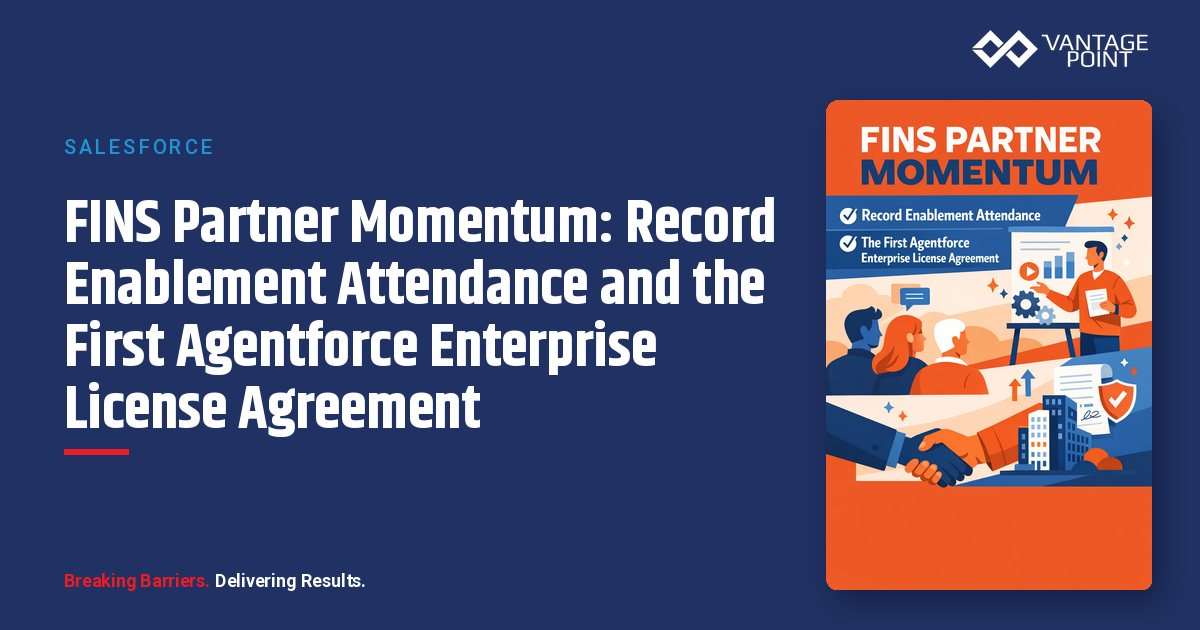
Something extraordinary happened in the Salesforce Financial Services (FINS) partner ecosystem in early 2026. Within a matter of weeks, two milestones converged that signal a fundamental shift in how the industry approaches agentic AI.
First, partner enablement sessions for Banking & Wealth Asset Management (BWAM) and Insurance both shattered attendance records: with 140+ partners attending the BWAM session and 162+ partners attending the Insurance session. These weren't casual webinars. These were deep-dive technical enablement sessions focused on building, deploying, and scaling Agentforce agents in regulated financial services environments.
Second, a major financial services institution became the first organization to sign an Agentforce Enterprise License Agreement (AELA): committing to a vision of 21 AI agents deployed across a multi-year roadmap covering banking, wealth management, insurance, service operations, and back-office functions. As Salesforce leadership noted: "This could only happen with our partners."
These two developments tell the same story: the agentic enterprise in financial services has moved from proof-of-concept curiosity to production-scale commitment. And the partner ecosystem (implementation consultancies, system integrators, and specialized FINS technology firms) is at the center of this transformation.
What Is the Agentforce Enterprise License Agreement (AELA)?
The Evolution of Agentforce Pricing
To understand why AELA is significant, you need to understand the pricing journey Salesforce has traveled with Agentforce since its launch:
- October 2024: $2 per conversation: The initial pricing model was elegant in concept but difficult for enterprise procurement teams to budget. Early adoption was limited.
- May 2025: Flex Credits at $0.10 per action: Salesforce shifted to action-based pricing with 100,000 credits for $500. More granular, but still consumption-based: making cost forecasting challenging for CFOs at large institutions.
- October 2025: AELA: Announced at Dreamforce 2025 alongside Agentforce 360, AELA introduced a flat-fee, unlimited-use enterprise licensing agreement that bundles Agentforce, Data Cloud, MuleSoft, and Slack into a single predictable annual commitment.
How AELA Works
| Component | What's Included |
|---|---|
| Agentforce | Unlimited AI agent conversations and actions across all business functions |
| Data 360 (Data Cloud) | Unified data layer providing context to every agent: structured and unstructured data |
| MuleSoft | Integration platform connecting agents to core banking, insurance, and wealth systems |
| Slack | Conversational interface for human-agent collaboration |
| Governance & Compliance | Einstein Trust Layer, audit trails, and enterprise-grade security controls |
The pricing is structured as a flat annual fee: often calculated per user or as a fixed commitment. Providing the budget predictability that enterprise CFOs and procurement teams require.
Why AELA Matters for Financial Services
For financial services institutions specifically, AELA addresses three critical challenges:
- Budget Predictability in Regulated Environments: Financial institutions operate under strict budgeting and vendor management requirements. AELA's flat-fee structure eliminates consumption-based cost variance.
- Enterprise-Scale AI Deployment: When deploying 21 agents across multiple business lines, consumption-based pricing would create exponential cost growth. AELA decouples usage volume from cost.
- Multi-Cloud Commitment: By bundling Agentforce with Data Cloud, MuleSoft, and Slack, AELA encourages institutions to build their entire digital labor strategy on a unified platform.
Inside the First AELA Deal: A 21-Agent Vision
The Client and the Commitment
A major financial services institution became the first organization globally to sign an Agentforce Enterprise License Agreement. The institution committed to deploying 21 AI agents across a multi-year roadmap: spanning virtually every customer-facing and operational function within the organization.
What a 21-Agent Deployment Looks Like
Banking Operations (5-6 Agents)
- Banking Service Agent: Handles routine customer inquiries: balance checks, transaction history, card management, fee reversals
- Digital Loan Officer Agent: Guides borrowers through loan product discovery for auto, personal, and mortgage lending
- Collections Assistance Agent: Automates early-stage collections outreach with compliant communication workflows
- Fraud Detection & Response Agent: Monitors transaction patterns and initiates investigation workflows
- Account Onboarding Agent: Streamlines new account opening with automated KYC/AML verification
- Branch Operations Agent: Assists branch staff with scheduling, inventory, and service queue optimization
Wealth Management (4-5 Agents)
- Financial Advisor Preparation Agent: Analyzes client portfolios, life events, and interaction history to generate meeting agendas
- Post-Meeting Wrap-Up Agent: Processes meeting notes, creates action items, updates client plans
- Portfolio Review Agent: Generates automated performance summaries and rebalancing recommendations
- Client Relationship Agent: Monitors engagement patterns and surfaces at-risk relationships or cross-sell opportunities
- Compliance Documentation Agent: Ensures all advisor-client interactions meet regulatory documentation requirements
Insurance Operations (4-5 Agents)
- Insurance Service Agent: Assists customers through quoting, policy comparisons, and coverage recommendations
- Claims Intake Agent: Automates first notice of loss (FNOL) gathering and initial claim routing
- Underwriting Support Agent: Pre-processes applications and flags risk factors for underwriter review
- Policy Renewal Agent: Manages renewal workflows, premium adjustments, and retention outreach
- Agent/Broker Support Agent: Provides 24/7 support to distribution partners
Enterprise Service & Operations (4-5 Agents)
- Customer Service Triage Agent: Routes inquiries across business lines to the appropriate department
- IT Service Agent: Handles internal helpdesk requests and system access provisioning
- HR Service Agent: Assists employees with benefits inquiries and policy questions
- Compliance Monitoring Agent: Monitors communications and transactions for regulatory compliance flags
- Operational Analytics Agent: Surfaces real-time dashboards, KPI alerts, and capacity planning insights
The Multi-Year Deployment Roadmap
Phase 1: Proof of Concept (Months 1-3)
Deploy 2-3 agents in controlled environments. Focus on highest-impact, lowest-risk use cases. Validate data connectivity, compliance controls, and user experience. Establish baseline metrics.
Phase 2: Pilot (Months 4-8)
Expand to 5-7 agents across 2-3 business lines. Introduce more complex use cases. Integrate with core banking and insurance systems via MuleSoft. Test human-agent collaboration in Slack.
Phase 3: Controlled Rollout (Months 9-18)
Scale to 12-15 agents with broader user populations. Deploy to customer-facing channels. Implement advanced monitoring dashboards. Refine escalation pathways based on production data.
Phase 4: Full Deployment (Months 18-36)
Complete the 21-agent portfolio across all business lines. Activate multi-agent orchestration. Implement predictive analytics. Establish center of excellence for ongoing agent governance.
Record Partner Enablement: 140+ BWAM, 162+ Insurance
Why These Numbers Matter
Partner enablement sessions are a leading indicator of market demand. When 140+ partners attend a Banking & Wealth Asset Management (BWAM) session and 162+ attend an Insurance session: both setting records. It signals that the consulting and implementation ecosystem is mobilizing for a significant wave of client demand.
These attendance figures represent system integrators preparing their teams, specialized FINS consultancies building competency, technology partners developing integrations, and ISVs creating industry-specific agent templates.
What Partners Are Learning
- FINS-Specific Agent Templates: Configuration, customization, and extension of pre-built agents for financial services
- Demo Capability: Live Agentforce demonstrations in industry-specific contexts during sales cycles
- Multi-Cloud Expertise: Competency across Financial Services Cloud, Data Cloud, MuleSoft, Slack, and the Agentforce platform
- The Data Foundation Story: Leading with data readiness assessments before configuring agents
- Compliance and Governance Architecture: Einstein Trust Layer, audit trail configuration, and industry-specific compliance controls
Why Partners Are Essential for AELA-Scale Deals
When Salesforce leadership said of the first AELA deal, "This could only happen with our partners," they were acknowledging a fundamental truth about enterprise-scale AI deployments in financial services.
The Complexity Factor
A 21-agent deployment across a diversified financial institution requires expertise spanning:
- Industry domain knowledge: Understanding workflows, regulatory requirements, and customer expectations in banking, wealth management, and insurance
- Technical platform expertise: Configuring the Atlas Reasoning Engine, designing Topics and Instructions, building custom Actions
- Data architecture: Designing the Data Cloud foundation that provides every agent with the context it needs
- Integration engineering: Using MuleSoft to connect agents with dozens of internal and external systems
- Change management: Preparing human teams to collaborate with AI agents and redesigning workflows
- Compliance design: Ensuring every agent operates within regulatory boundaries with proper audit trails
The Partner Ecosystem Shift
The record enablement attendance signals several important trends:
- From Advisory to Delivery: Partners are shifting from recommending AI strategies to actually building and deploying agents
- From Single-Cloud to Multi-Cloud: AELA's bundled approach means partners need competency across the full Salesforce stack
- From One-Time Projects to Ongoing Partnerships: Multi-year roadmaps require continuous optimization and governance evolution
- From Generic to Industry-Specific: Partners with pre-built FINS accelerators and compliance frameworks have a significant advantage
What This Means for the Financial Services Market
The Agentic Enterprise Is Real
Consider the trajectory:
- Q4 2024: Agentforce launches with initial financial services use cases
- H1 2025: Early adopters begin pilot deployments; partner enablement begins
- Q4 2025: Agentforce 360 launches at Dreamforce; AELA is introduced
- Q1 2026: Record partner enablement attendance; first AELA deal signed with 21-agent vision
This is a market moving from experimentation to enterprise commitment in roughly 18 months: an exceptionally fast adoption curve for regulated financial services.
Competitive Implications
Financial institutions that move early on AELA-scale deployments will gain:
- Operational efficiency: 21 agents operating 24/7 across banking, wealth, and insurance
- Customer experience: Instant, personalized service across all channels
- Talent optimization: With a large share of the insurance workforce nearing retirement, AI agents help bridge the talent gap
- Cost predictability: AELA's flat-fee structure allows scaling without consumption-based cost uncertainty
The Data Foundation Imperative
Institutions pursuing AELA-scale deployments must invest in Data Cloud configuration, core system integration via MuleSoft, data quality programs, and governance frameworks that define agent data access and regulatory compliance.
Frequently Asked Questions
What is the Agentforce Enterprise License Agreement (AELA)?
AELA is Salesforce's enterprise-wide licensing model that provides unlimited use of Agentforce, Data Cloud, MuleSoft, and Slack for a predictable flat annual fee. Announced at Dreamforce 2025, it replaces per-conversation and per-action pricing models for organizations planning large-scale AI agent deployments.
How does AELA pricing work compared to Flex Credits?
While Flex Credits charge $0.10 per action (20 credits per action from a pool of 100,000 credits for $500), AELA provides unlimited agent conversations and actions for a fixed annual commitment, eliminating usage-based cost variability.
What was the first AELA deal?
A major financial services institution became the first organization to sign an AELA, committing to 21 AI agents deployed across a multi-year roadmap covering banking, wealth management, insurance, service operations, and back-office functions.
What types of agents are included in a 21-agent financial services deployment?
A typical 21-agent FINS deployment spans Banking Service Agents, Digital Loan Officers, Collections Agents, Fraud Detection Agents, Financial Advisor Preparation Agents, Portfolio Review Agents, Insurance Service Agents, Claims Intake Agents, Underwriting Support Agents, Policy Renewal Agents, IT Service Agents, HR Service Agents, Compliance Monitoring Agents, and Customer Service Triage Agents.
How long does it take to deploy 21 agents?
A multi-year roadmap typically follows four phases: Proof of Concept (months 1-3), Pilot (months 4-8), Controlled Rollout (months 9-18), and Full Deployment (months 18-36). Most institutions begin seeing measurable value within the first pilot phase.
What were the record FINS partner enablement attendance numbers?
The Banking & Wealth Asset Management (BWAM) enablement session attracted 140+ partners and the Insurance enablement session attracted 162+ partners: both setting records for FINS partner enablement events.
Why did Salesforce say the first AELA deal "could only happen with partners"?
Enterprise-scale AI deployments in financial services require deep industry domain knowledge, multi-cloud technical expertise, data architecture design, core system integration, compliance framework configuration, and change management: capabilities that implementation partners provide alongside Salesforce's platform technology.
What products are bundled in an AELA agreement?
AELA bundles Agentforce (AI agents and the Atlas Reasoning Engine), Data 360/Data Cloud (unified data layer), MuleSoft (integration platform), Slack (human-agent collaboration interface), and the Einstein Trust Layer (governance and compliance controls).
How does AELA affect Salesforce's partner ecosystem?
AELA is driving partners to expand from single-cloud to multi-cloud expertise, shift from advisory to hands-on delivery, and move from project-based to ongoing partnership models. Record enablement attendance reflects this acceleration.
What data foundation is required for AELA-scale deployments?
Successful AELA deployments require Data Cloud configuration, core system integration via MuleSoft, data quality programs (cleaning, deduplication, enrichment), and governance frameworks that define agent data access and regulatory compliance.
How does Agentforce differ from traditional chatbots in financial services?
Unlike scripted chatbots, Agentforce agents use the Atlas Reasoning Engine to autonomously analyze requests, determine appropriate actions, access multiple data sources, and execute tasks: all while respecting compliance controls and maintaining audit trails.
What compliance and security controls does Agentforce include?
Agentforce operates within the Einstein Trust Layer, which includes zero data retention agreements with model providers, toxicity filtering, access restrictions, audit trail documentation, guardrail configuration, and integration with Financial Services Cloud's compliance framework.
Conclusion: The Partner-Led Agentic Transformation
The convergence of record partner enablement attendance and the first AELA deal marks a defining moment for financial services AI. The message is clear: the agentic enterprise is no longer a concept to evaluate: it's a strategy to execute.
For financial institutions evaluating their own AI roadmap, the key takeaways are:
- AELA provides the economic framework for enterprise-scale AI deployment with budget predictability
- Multi-year, multi-agent roadmaps are the appropriate planning horizon
- Data readiness is the prerequisite that determines agent effectiveness and deployment speed
- Experienced FINS implementation partners are essential for navigating the complexity of regulated-industry AI deployment
The record partner enablement attendance proves the ecosystem is ready. The first AELA deal proves the market is ready. The question for every financial institution is no longer whether to pursue agentic AI, but how quickly they can build the foundation and partner relationships to deploy it at scale.
About Vantage Point
Vantage Point is a specialized Salesforce consultancy with deep expertise in financial services implementations. Vantage Point helps banks, wealth management firms, insurance carriers, and credit unions deploy Salesforce Financial Services Cloud, Agentforce, Data Cloud, and MuleSoft solutions that scale personalized engagement while maintaining regulatory confidence.
Ready to explore your Agentforce and AELA strategy? Contact Vantage Point to discuss your enterprise AI roadmap.
Email: david@vantagepoint.io | Phone: (469) 499-3400 | Website: vantagepoint.io