Key Takeaways (TL;DR)
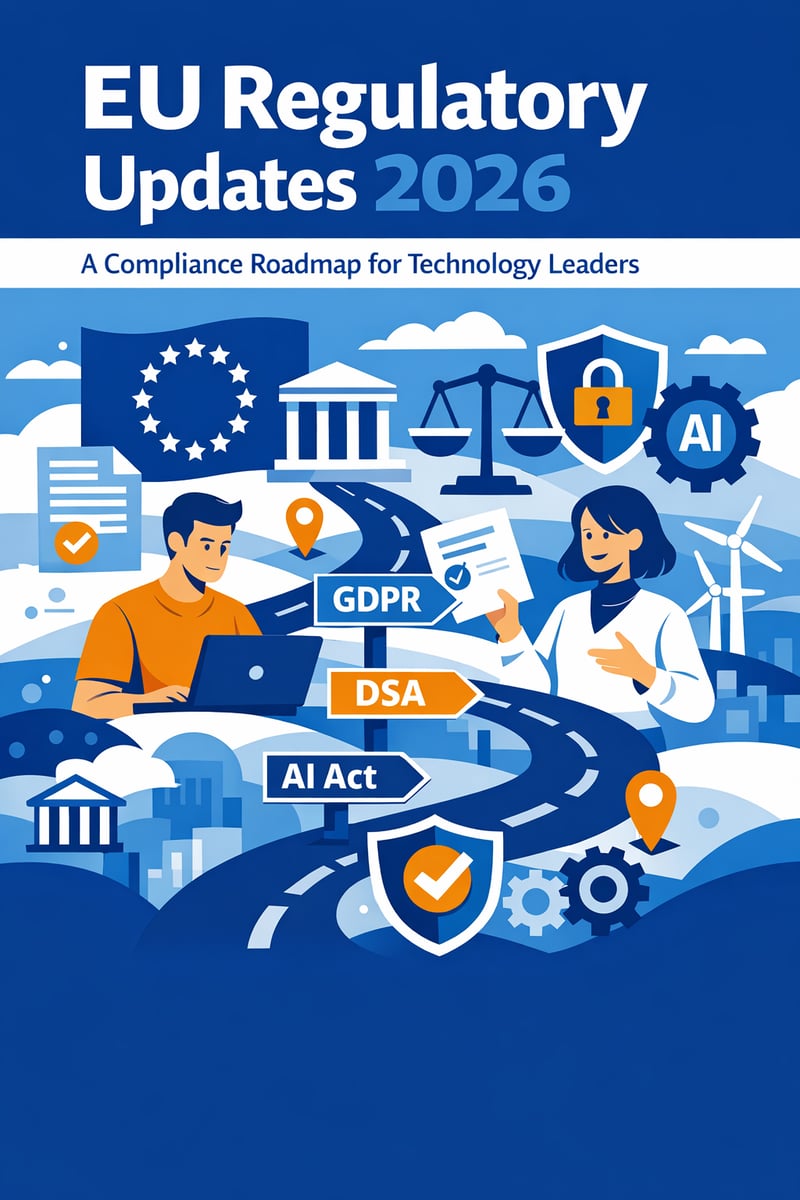
- What is it? A comprehensive guide to the EU's 2026 regulatory wave — covering the AI Act, Data Act, Digital Omnibus Package, DORA, NIS2, Cyber Resilience Act, and more — with a practical compliance roadmap for technology leaders
- Key Challenge: Multiple overlapping enforcement deadlines converging in 2026, with 78% of enterprises reportedly unprepared for EU AI Act obligations alone
- Penalties: Up to €35 million or 7% of global annual turnover for AI Act violations; up to €20 million or 4% for GDPR violations
- Timeline: Critical deadlines throughout 2026 — AI Act (August), Data Act (September), Product Liability Directive (December), e-Evidence (August)
- Best For: Technology leaders, compliance officers, CIOs, and business executives at organizations operating in or serving EU markets
- Bottom Line: Organizations that adopt unified compliance strategies — leveraging CRM-driven data governance, automation, and AI-powered monitoring — can turn regulatory complexity into competitive advantage
Introduction
The year 2026 represents an unprecedented convergence of European Union regulations that will reshape how organizations manage data, deploy technology, and engage with customers across the continent. From the EU AI Act's high-risk system obligations taking effect in August to the Data Act's core data-access requirements arriving in September, technology leaders face a regulatory marathon with multiple checkpoints occurring simultaneously.
What makes this moment uniquely challenging isn't any single regulation — it's the sheer volume of overlapping frameworks reaching enforcement at the same time. The EU AI Act, Digital Omnibus Package, Data Act, DORA, NIS2 Directive, Cyber Resilience Act, and revised Product Liability Directive all demand attention within the same twelve-month window. Organizations that delayed compliance efforts now face compressed timelines across data protection, artificial intelligence governance, cybersecurity resilience, and operational transparency.
This guide breaks down every major EU regulation impacting technology leaders in 2026, provides a practical compliance roadmap with key deadlines, and explains how modern CRM platforms, data governance tools, and automation solutions can help organizations build sustainable compliance infrastructure — turning regulatory complexity into strategic advantage.
What Is Driving the EU's 2026 Regulatory Wave?
Why Are So Many Regulations Converging at Once?
The EU's legislative cycle over the past several years produced a cascade of digital-era frameworks — the AI Act (adopted 2024), Data Act (in force 2024), DORA (applied January 2025), and NIS2 Directive (transposition due 2024-2025) — all reaching critical enforcement milestones in 2026. The European Commission's ambition to create a comprehensive "digital single market" means these regulations are intentionally designed to work together, even though their overlapping timelines create compliance complexity for businesses.
Additionally, the Commission recognized the administrative burden and introduced the Digital Omnibus Package in late 2025 to streamline and simplify aspects of GDPR, the AI Act, and cybersecurity frameworks. This package signals a shift toward regulatory pragmatism — the EU wants compliance, but it also wants its regulations to be workable for businesses of all sizes.
Who Needs to Pay Attention?
These regulations carry extraterritorial reach, meaning businesses located outside Europe face compliance obligations based on their activities, not their physical location. You're affected if your organization:
- Serves customers located in EU member states
- Processes personal data of EU residents
- Deploys AI systems whose outputs affect people in the EU
- Provides technology services to EU-based businesses
- Manufactures or sells connected products in EU markets
- Provides cloud, SaaS, or infrastructure services to EU entities
The Major EU Regulations Impacting Technology Leaders in 2026
1. EU AI Act — The World's First Comprehensive AI Law
The EU AI Act is the flagship regulation of 2026. Formally adopted in 2024, it introduces a risk-based classification framework for artificial intelligence systems, with enforcement being applied in phases through 2027.
Key Dates:
- February 2, 2025: Prohibited AI practices banned (already in effect)
- August 2, 2026: Major obligations for high-risk AI systems take effect
- August 2, 2027: Remaining high-risk obligations for AI embedded in regulated products
The Risk-Based Framework:
| Risk Level | Description | Requirements |
|---|---|---|
| Unacceptable | Social scoring, cognitive manipulation, real-time biometric identification | Banned outright |
| High Risk | AI in employment, credit scoring, education, critical infrastructure | Strict documentation, transparency, human oversight, conformity assessments |
| Limited Risk | Chatbots, AI-generated content, emotion recognition | Transparency obligations — users must be informed |
| Minimal Risk | Spam filters, AI-powered recommendations | Voluntary codes of conduct |
What Technology Leaders Must Do:
- Inventory all AI systems across the organization and classify them by risk tier
- Conduct conformity assessments for any high-risk AI systems
- Implement data governance practices ensuring training data quality and documentation
- Establish human oversight mechanisms for automated decision-making
- Maintain detailed technical documentation and register high-risk systems in the EU database
- Promote AI literacy among all staff involved with AI systems
Penalties: Up to €35 million or 7% of global annual turnover for the most serious violations — significantly exceeding GDPR fines.
CRM Impact: Organizations using AI within their CRM platforms — for lead scoring, customer segmentation, predictive analytics, or automated communications — must assess whether these use cases qualify as high-risk under the Act. Vantage Point helps organizations audit their Salesforce and HubSpot AI features (including Salesforce Einstein, Agentforce, and HubSpot's AI tools) for EU AI Act compliance.
2. EU Data Act — Reshaping Data Access and Portability
The EU Data Act creates new user rights to access and port data generated by connected products and associated services. While in force since January 2024, its core data-access obligations take effect September 12, 2026.
Key Requirements:
- Connected product manufacturers must provide users access to data generated by their devices
- Cloud providers must enable seamless data portability and switching
- Standard APIs and export functions must be built into connected products
- Data holders must share data with third parties upon user request under fair, reasonable, and non-discriminatory (FRAND) terms
- Public-sector bodies can access private data in cases of public emergencies
Who's Affected: Manufacturers of IoT devices, connected products, cloud service providers, SaaS companies, and any business relying on data from connected devices or cloud infrastructure.
CRM Implications: If your CRM integrates with IoT devices, connected products, or collects customer data through digital interfaces, the Data Act may require you to provide data access and portability features. Vantage Point's integration expertise — including MuleSoft-powered data orchestration — ensures your CRM ecosystem supports the required data-sharing capabilities.
3. Digital Omnibus Package — Simplifying the Regulatory Framework
The European Commission's Digital Omnibus Package, proposed in November 2025, aims to streamline compliance across the EU's sprawling digital regulatory landscape. It proposes targeted amendments to GDPR, NIS2, the AI Act, ePrivacy, and the Data Act.
Key Proposed Changes:
- GDPR Amendments: Clearer definition of "personal data," relaxed breach notification requirements for low-risk incidents, new exemptions for small and medium-sized companies (SMCs)
- AI Act Adjustments: Potential delays to certain high-risk AI obligations, clarifications on sector-specific application
- NIS2 Simplification: Streamlined reporting requirements and reduced administrative burden for cybersecurity compliance
- Cross-Framework Alignment: Efforts to eliminate conflicting requirements across overlapping regulations
Current Status: Under legislative discussion in 2026, with final adoption timeline uncertain. However, organizations should monitor these developments closely as they could significantly reduce compliance burden.
4. DORA — Digital Operational Resilience
The Digital Operational Resilience Act (DORA) has been fully applicable since January 17, 2025, establishing uniform requirements for ICT risk management, incident reporting, resilience testing, and third-party risk oversight.
Who's Affected: While primarily targeting financial institutions (banks, insurance companies, investment firms), DORA extends to critical ICT service providers — meaning technology vendors, cloud providers, SaaS platforms, and data analytics companies serving the financial sector face their own compliance obligations.
Key Requirements:
- Comprehensive ICT risk management frameworks
- Major ICT-related incident reporting within strict timelines
- Digital operational resilience testing (including advanced threat-led penetration testing for significant entities)
- Third-party ICT risk management, including contractual requirements for outsourced services
- Information-sharing arrangements on cyber threats
Technology Impact: If your organization provides CRM, data management, integration, or cloud services to clients in financial services, DORA compliance isn't optional — it's a prerequisite for maintaining those business relationships. Vantage Point helps organizations assess their DORA exposure and implement the necessary technical and organizational controls.
5. NIS2 Directive — Expanded Cybersecurity Requirements
The NIS2 Directive broadened the EU's cybersecurity framework to cover more sectors and impose stricter security requirements. Member states were required to transpose NIS2 into national law by October 2024, with enforcement ramping up through 2025-2026.
Expanded Scope: NIS2 covers 18 sectors including energy, transport, health, digital infrastructure, ICT service management, public administration, space, and manufacturing — significantly broader than the original NIS Directive.
Key Requirements:
- Risk-based cybersecurity policies and procedures
- Incident handling and business continuity measures
- Supply chain security assessments
- Encryption, access control, and multi-factor authentication
- Incident reporting to competent authorities within 24 hours (early warning) and 72 hours (full notification)
Penalties: Up to €10 million or 2% of global annual turnover for essential entities.
6. Cyber Resilience Act (CRA) — Security for Digital Products
The Cyber Resilience Act introduces mandatory cybersecurity requirements for products with digital elements. While most obligations apply from December 11, 2027, vulnerability handling and incident reporting obligations take effect from September 11, 2026.
Who's Affected: Manufacturers, importers, and distributors of any product with a digital component — including software, IoT devices, and connected hardware.
Key Early Requirements (September 2026):
- Actively identify and document vulnerabilities in products
- Report actively exploited vulnerabilities to ENISA within 24 hours
- Provide security updates throughout the product's expected lifetime
7. Revised Product Liability Directive (PLD)
The modernized Product Liability Directive explicitly covers digital products including software — a landmark expansion. Member states must transpose it by December 9, 2026.
Key Changes:
- Software and AI systems are now explicitly classified as "products" subject to liability
- The definition of "defective" includes cybersecurity vulnerabilities
- Simplified burden of proof for claimants in complex technology cases
- Liability extends across digital supply chains
Impact: Any organization developing, deploying, or distributing software — including CRM customizations, integrations, and AI-powered applications — faces potential product liability exposure under this directive.
8. e-Evidence Regulation — Cross-Border Data Access
The e-Evidence Regulation applies from August 18, 2026, introducing a framework for law enforcement authorities to request electronic evidence directly from service providers across EU borders.
Key Requirement: Covered providers may need to produce requested data within 8 hours in emergencies, with significant fines for non-compliance.
Who's Affected: Cloud computing services, electronic communications services, online platforms, and any service enabling user-to-user communication.
2026 Compliance Timeline at a Glance
| Date | Regulation | Milestone |
|---|---|---|
| January 2025 (already in effect) | DORA | Full application — ICT risk management, incident reporting |
| February 2025 (already in effect) | EU AI Act | Prohibited AI practices banned |
| June 2026 | Consumer Rights Directive | Mandatory online withdrawal button |
| August 2, 2026 | EU AI Act | High-risk AI system obligations take effect |
| August 18, 2026 | e-Evidence Regulation | Cross-border data production orders applicable |
| September 11, 2026 | Cyber Resilience Act | Vulnerability reporting obligations begin |
| September 12, 2026 | EU Data Act | Core data-access and portability obligations |
| December 9, 2026 | Product Liability Directive | Member state transposition deadline |
| August 2, 2027 | EU AI Act | Remaining high-risk obligations (regulated products) |
| December 11, 2027 | Cyber Resilience Act | Full product cybersecurity requirements |
How CRM and Data Governance Platforms Support EU Compliance
Building a Unified Compliance Architecture
Rather than addressing each regulation in isolation, forward-thinking organizations are building unified compliance architectures that leverage their existing technology investments — particularly CRM platforms, integration middleware, and data governance tools.
Data Governance and Consent Management
Modern CRM platforms like Salesforce and HubSpot provide foundational capabilities for GDPR and Data Act compliance:
- Consent tracking and documentation — Maintain auditable records of consent for every data processing activity
- Data subject rights automation — Streamline access requests, deletion requests, and data portability through workflow automation
- Audit trails — Comprehensive logging of all data access, modifications, and sharing activities
- Role-based access controls — Ensure only authorized personnel access sensitive data
AI Transparency and Oversight
For EU AI Act compliance, CRM-integrated AI tools need clear governance:
- AI system inventories — Document every AI feature in use, from lead scoring to predictive analytics
- Human oversight workflows — Build review and approval processes for AI-driven decisions
- Transparency notifications — Automatically inform users when they're interacting with AI-generated content or decisions
- Bias monitoring dashboards — Track AI model performance for fairness and accuracy
Integration and Data Portability
The Data Act's portability requirements can be addressed through robust integration architectures:
- API-first design — Ensure all systems expose data through standard APIs
- MuleSoft and integration platforms — Orchestrate data flows across systems while maintaining compliance controls
- Export and migration capabilities — Enable customers to extract their data in standard formats
- Data lineage tracking — Document where data originates, how it flows, and where it's stored
Leveraging Automation for Compliance Efficiency
Automation is the key to managing compliance across multiple overlapping frameworks without overwhelming your teams:
- Automated incident reporting — Configure alerts and workflows that meet DORA and NIS2 reporting timelines (24-hour early warning, 72-hour full notification)
- Compliance monitoring dashboards — Real-time visibility into compliance status across all applicable regulations
- Automated vendor assessments — Streamline third-party risk management with templated questionnaires and scoring
- Documentation generation — Automatically produce required technical documentation, conformity assessments, and audit reports
Best Practices for Technology Leaders Navigating EU Compliance in 2026
1. Conduct a Comprehensive Regulatory Mapping Exercise
Before building your compliance roadmap, map every regulation that applies to your organization. Consider your customer base, data processing activities, technology deployments, AI usage, and vendor relationships. Create a matrix that cross-references regulations with business functions to identify overlapping requirements.
2. Prioritize by Deadline and Risk
Not all regulations carry equal urgency or penalty risk. Prioritize the EU AI Act (August 2026) and Data Act (September 2026) deadlines while maintaining ongoing compliance with GDPR and DORA. Use risk-based prioritization to focus resources where non-compliance penalties are highest.
3. Centralize Data Governance
The most efficient path to multi-regulation compliance is centralizing your data governance infrastructure. A unified CRM platform that serves as your system of record — with integrated consent management, access controls, audit logging, and data lineage — can address requirements across GDPR, the AI Act, the Data Act, and DORA simultaneously.
4. Invest in Integration Architecture
The Data Act's portability requirements and DORA's third-party risk management obligations both demand robust integration capabilities. Platforms like MuleSoft enable organizations to build API-driven architectures that support data sharing, portability, and vendor management at scale.
5. Build Cross-Functional Compliance Teams
EU compliance in 2026 isn't a legal-department-only initiative. Build cross-functional teams that include legal, IT, data engineering, product, security, and business leadership. Each regulation touches multiple departments, and siloed approaches create gaps.
6. Implement Continuous Monitoring
Compliance isn't a one-time project — it's an ongoing program. Deploy automated monitoring tools that continuously assess your compliance posture, flag emerging risks, and generate the documentation regulators expect to see during audits.
7. Leverage AI for Compliance (Carefully)
Ironically, AI itself can be a powerful compliance tool — helping organizations classify data, monitor for policy violations, automate documentation, and predict compliance risks. However, any AI used for compliance purposes must itself comply with the AI Act's requirements. Ensure your compliance AI tools are properly documented, transparent, and subject to human oversight.
Frequently Asked Questions (FAQ)
What is the EU AI Act, and when does it take effect?
The EU AI Act is the world's first comprehensive legal framework for artificial intelligence. Adopted in 2024, it introduces a risk-based classification system for AI systems. Prohibited AI practices have been banned since February 2025. Major obligations for high-risk AI systems take effect on August 2, 2026, with remaining obligations for AI embedded in regulated products following by August 2, 2027.
How much can my organization be fined for EU AI Act non-compliance?
Penalties under the EU AI Act are among the most severe in EU regulatory history. Organizations can face fines of up to €35 million or 7% of global annual turnover for the most serious violations (prohibited practices). High-risk system violations can result in fines up to €15 million or 3% of turnover. For comparison, maximum GDPR fines are €20 million or 4% of turnover.
Do these EU regulations apply to companies outside Europe?
Yes. Most EU digital regulations carry extraterritorial reach, meaning they apply to any organization that serves EU customers, processes EU residents' data, or deploys AI systems affecting people in the EU — regardless of where the company is physically located. This mirrors the GDPR's approach to jurisdictional scope.
What is the Digital Omnibus Package, and will it reduce compliance burden?
The Digital Omnibus Package, proposed by the European Commission in November 2025, aims to streamline compliance across multiple EU digital regulations. It proposes targeted amendments to GDPR, NIS2, the AI Act, and other frameworks — including clearer definitions, simplified breach reporting, and exemptions for smaller companies. It's still under legislative discussion in 2026, but signals the EU's intent to make its regulatory framework more workable.
How does the EU Data Act affect CRM systems?
The EU Data Act, with core obligations taking effect September 12, 2026, requires that data generated by connected products be accessible to users and portable between services. If your CRM collects data from connected devices, IoT integrations, or cloud-based services, you may need to provide data access and export capabilities in standard formats. Building API-first architectures and robust data export functionality is essential.
What is DORA, and does it apply to technology companies?
DORA (Digital Operational Resilience Act) establishes ICT risk management and operational resilience requirements primarily for the financial sector. However, it also applies to critical ICT third-party service providers — meaning technology vendors, cloud providers, and SaaS platforms serving financial institutions face direct compliance obligations. If your clients include banks, insurers, or investment firms, DORA likely applies to your organization.
How can a CRM platform help with EU regulatory compliance?
Modern CRM platforms provide essential compliance infrastructure including: consent management and documentation for GDPR; audit trails and role-based access controls for data governance; workflow automation for incident reporting (DORA/NIS2); AI system inventory and oversight tools for AI Act compliance; and API-driven data export capabilities for Data Act portability requirements. A well-configured CRM ecosystem can serve as the compliance backbone across multiple regulations.
Conclusion
The EU's 2026 regulatory wave is not just a compliance challenge — it's an opportunity for technology leaders to build more transparent, resilient, and customer-centric organizations. By approaching these overlapping regulations with a unified strategy — centralizing data governance, investing in integration architecture, automating compliance workflows, and leveraging AI responsibly — businesses can transform regulatory requirements into operational advantages.
The organizations that will thrive aren't those that view EU compliance as a burden, but those that recognize it as a catalyst for building the kind of trustworthy, well-governed technology infrastructure that customers, partners, and regulators increasingly demand.
Vantage Point specializes in helping organizations build compliance-ready CRM and data governance architectures. Whether you need to audit your Salesforce or HubSpot deployments for EU AI Act readiness, implement MuleSoft-powered data portability solutions for the Data Act, or establish automated compliance workflows across multiple EU frameworks, our team is ready to help.
Contact Vantage Point today to schedule a compliance readiness assessment and start building your 2026 EU regulatory roadmap.
About Vantage Point
Vantage Point is a technology consulting firm specializing in CRM implementation, data integration, and AI-powered automation. As partners of Salesforce, HubSpot, Anthropic (Claude AI), Aircall, and Workato, we help organizations across all industries build scalable, compliant, and intelligent technology ecosystems. From Sales Cloud and Service Cloud deployments to MuleSoft integrations and Data Cloud analytics, Vantage Point delivers end-to-end solutions that drive growth while meeting the most demanding regulatory requirements. Learn more at vantagepoint.io.