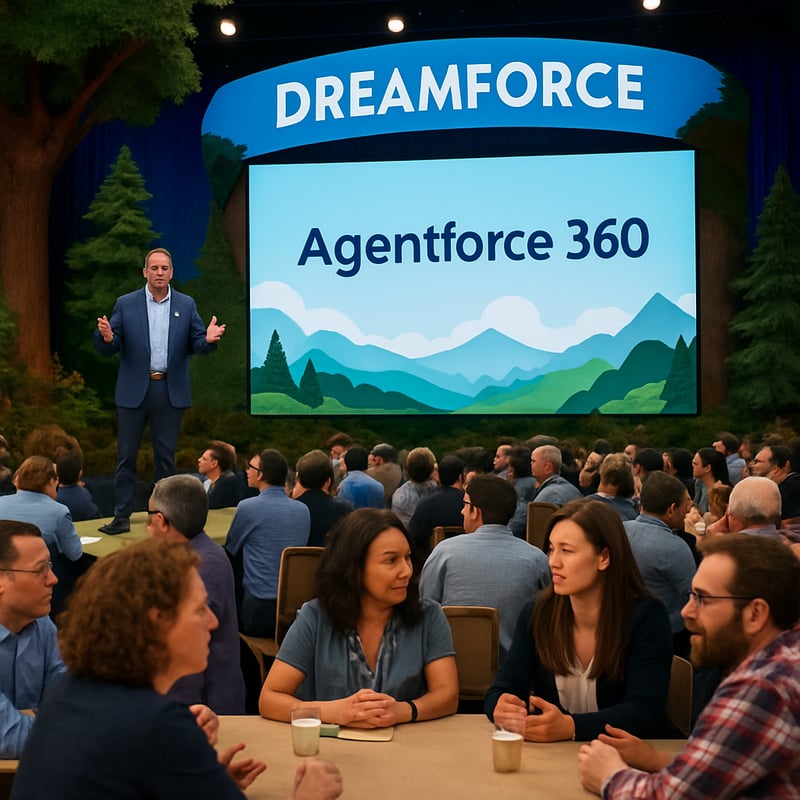
After yesterday's groundbreaking Agentforce 360 announcement, Day 2 of Dreamforce 2025 shifted from vision to execution: from "what's possible" to "what's working." As someone who has guided dozens of financial services firms through Salesforce implementations over the past decade, what I saw today isn't vaporware or distant-future speculation. These are production-ready capabilities solving real problems for real financial institutions right now.
Let me walk you through the most important insights from Day 2 at Dreamforce 2025, with a specific focus on what matters for financial services leaders.
Editor's note (October 2026): Salesforce has reverted the cloud product names announced at Dreamforce 2025. "Agentforce Sales," "Agentforce Service," "Agentforce Financial Services," and the other Agentforce-prefixed clouds are once again Sales Cloud, Service Cloud, Financial Services Cloud, and their earlier names, and the platform is again "Salesforce Platform." "Agentforce" remains the brand for Salesforce's AI agents. This post keeps the product names as announced at the event.
How Do Agentforce Agents Actually Work?
One of the most valuable segments of today's Agentforce keynote explained the internal architecture of an Agentforce agent. Knowledge that's critical for financial services CIOs and compliance officers who need to understand and audit these systems.
Every Agentforce agent operates through a structured four-step cycle:
- Sense: The agent receives input from a user, system event, or scheduled trigger
- Reason: Using the Atlas Reasoning Engine, the agent analyzes the situation, accesses relevant data through Data 360, and determines the appropriate action
- Act: The agent executes the action, whether that's retrieving information, updating records, triggering workflows, or escalating to a human
- Learn: The agent's performance is monitored and refined based on outcomes and feedback
What makes this powerful for financial services is the Hybrid Reasoning capability introduced yesterday. The Atlas Reasoning Engine can be configured to balance flexible LLM-based reasoning with strict rule-based logic.
For a credit union deploying a loan officer agent, this means you can allow the agent to have natural, personalized conversations with members while enforcing hard rules about required documentation, debt-to-income ratio thresholds, and approval authorities. The agent can be creative in how it communicates but deterministic in how it makes decisions.
How Does Agentforce Voice Transform Financial Services?
Today's demonstration of Agentforce Voice was perhaps the most impressive showcase for customer-facing financial services organizations.
Traditional IVR systems are universally despised by customers, and for good reason. They're rigid, frustrating, and designed around technology limitations rather than customer needs. Agentforce Voice flips this paradigm entirely.
The demo showed a banking customer calling about a suspicious charge. Instead of navigating a phone tree, the customer simply explained the problem in natural language. Here's what the voice agent accomplished:
- Authenticated the caller: Using voice biometrics and account verification questions
- Pulled up transaction history: In real-time during the conversation
- Identified the suspicious charge: Along with similar patterns across the account
- Explained findings conversationally: In natural, easy-to-understand language
- Offered to freeze the card: And initiated a dispute for the charge
- Sent confirmation: Including next steps via email
📊 Key Stat: All of this was completed in under 90 seconds with zero wait time.
For regional banks, community financial institutions, and credit unions, this technology is transformative. You can now offer a calling experience that rivals the largest national banks: without building a 24/7 contact center.
📊 Key Stat: Engine, a financial services firm featured in the keynote, reported $2 million in annual savings and a 15% reduction in handle time after deploying Agentforce.
How Is Agentforce Revolutionizing Insurance Claims Processing?
One demonstration that drew audible reactions from the audience showed an insurance claims agent handling a routine auto claim from start to resolution: entirely autonomously.
The scenario: A policyholder submits a claim for minor accident damage through a mobile app, including photos of the damage and a description of what happened.
The Agentforce Claims Agent completed the following steps:
- Received and validated: The claim submission against policy terms
- Analyzed the photos: Using vision AI to assess damage severity
- Checked fraud indicators: Based on historical patterns
- Determined coverage: And calculated the initial estimate
- Approved the claim: Within policy authority limits
- Issued payment authorization: And sent confirmation to the policyholder
- Updated the policy record: And created documentation for audit purposes
📊 Key Stat: Total time from submission to payment approval: under 5 minutes.
For routine, straightforward claims within certain parameters, this kind of automation delivers what customers increasingly expect: instant resolution. Human adjusters can then focus their expertise on complex claims involving injuries, liability disputes, or ambiguous circumstances.
Cumberland Mutual, an insurance company featured today, shared that they're using their initial Agentforce deployment as a foundation to explore use cases in claims and procurement: exactly this kind of workflow automation.
How Does Agentforce Empower Wealth Advisors and Relationship Bankers?
This afternoon's Agentic Sales keynote revealed capabilities that directly address challenges wealth management and private banking clients face constantly: "How do we help our advisors and relationship managers be more productive when they're drowning in administrative work?"
What Can the Financial Advisor Agent Do for Wealth Advisors?
The Financial Advisor Agent demonstration showed a complete day-in-the-life workflow for a wealth advisor:
| Time of Day | Agent Capability | What It Does |
|---|---|---|
| Morning (8:00 AM) | Meeting Preparation | Reviews upcoming client meetings, analyzes portfolio performance, identifies relevant news, notes life events, and generates personalized meeting agendas |
| Throughout the Day | Real-Time Support via Slack | Answers questions like "What's the tax impact if Janet moves $100K from her IRA to a Roth?" or "What's the RMD for Mark's accounts this year?" instantly using actual client data |
| Evening (5:30 PM) | Administrative Wrap-Up | Transcribes voice notes, updates client records, creates tasks, schedules follow-ups, prepares draft emails, and updates financial plans |
This isn't hypothetical. Wealth management firms are deploying versions of this workflow today, and the Winter 2025 release will bring enhanced capabilities specifically designed for financial advisors.
How Does Agentforce Enable Proactive Relationship Banking?
For commercial and private bankers, the Agentforce Sales demonstration showed how AI agents enable proactive relationship management at scale.
The scenario: A business banking relationship manager oversees 150 commercial clients: too many to proactively monitor without help.
The Relationship Banking Agent continuously monitors:
- Business performance indicators: Financial statements and key metrics
- Industry trends: Economic conditions affecting each client's sector
- Banking activity patterns: Product usage and transaction trends
- Competitive threats: Expansion opportunities and market shifts
- Upcoming renewals: Maturities and covenant compliance deadlines
When the agent identifies an opportunity or risk, it alerts the banker with specific, actionable intelligence. For example:
"Green Valley Manufacturing just won a major contract according to public filings. Their working capital needs will likely increase. Consider reaching out about a line of credit increase. Draft email prepared for your review."
The key insight: AI agents don't replace relationship bankers. They amplify their capacity to be the trusted advisor their clients need by handling the monitoring, research, and preparation work that's essential but time-consuming.
How Does Agentforce Deliver 24/7 Financial Services Without 24/7 Staffing?
This afternoon's Agentic Service keynote addressed a challenge every financial services operations leader faces: customers expect always-on service, but staffing 24/7 contact centers is expensive and operationally complex.
What Are the New Economics of AI-Powered Customer Service?
The Agentforce Service Command Center demonstration showed a unified console where human agents and AI agents work together seamlessly. For a typical regional bank's contact center, inquiries break down as follows:
| Inquiry Type | Share of Volume | Agentforce Handling |
|---|---|---|
| Routine Inquiries (balance checks, transaction history, password resets) | Largest share | Handled entirely by AI agents: instantly, accurately, 24/7, across every channel |
| Moderate Complexity (disputed transactions, account changes) | Moderate share | AI handles many autonomously; gathers context before seamless human handoff when needed |
| High Complexity (fraud investigations, escalated complaints) | Smallest share | Routes directly to specialized human agents with AI-generated summaries and suggested resolution paths |
📊 Key Stat: Adecco, featured in today's keynote, reported that 51% of candidate conversations now happen outside traditional working hours: all handled by Agentforce agents.
How Does Agentforce Reduce Fraud Detection from Hours to Seconds?
One of the most powerful demonstrations for banking leaders showed AI agents in fraud management workflows. Here's how Agentforce compares to traditional fraud detection:
| Step | Traditional Process | Agentforce Process |
|---|---|---|
| Detection | Automated flag → alert sits in queue | Real-time monitoring identifies suspicious pattern instantly |
| Investigation | Analyst pulls data from multiple systems | Agent instantly analyzes behavior history, location, device, merchant patterns |
| Decision | Analyst reviews and decides | Agent assesses risk score and decides in seconds |
| Action | Analyst freezes card, contacts customer | Immediately freezes account and initiates outreach via preferred channel |
| Total Time | Hours | Seconds to minutes |
📊 Key Stat: Absa Relationship Banking expects to resolve fraud cases 88% faster with Agentforce support. A difference that can mean stopping fraud before substantial loss occurs.
How Does Agentforce Handle Compliance and Audit Requirements?
A segment that particularly interested the compliance officers in the audience demonstrated how Agentforce maintains audit trails for regulatory purposes. Every agent action is logged with:
- Timestamp and user context: Full traceability of every interaction
- Data accessed and decisions made: Complete record of information used
- Reasoning process: How the agent arrived at its conclusion
- Confidence scores: Quantified certainty levels for each decision
- Human override history: When and why humans intervened
For financial institutions subject to examination by regulators (FDIC, SEC, state insurance departments), this level of documentation isn't just helpful: it's required. Agentforce agents are designed to meet these standards from the ground up.
What Are Financial Services Leaders Saying About Agentforce?
Between keynotes, I've spent time in the Financial Services Zenn Lounge, where banking, wealth management, and insurance professionals are gathering to discuss what they're seeing at Dreamforce.
How Has the AI Conversation Shifted in Financial Services?
The industry mindset has changed dramatically in just one year:
| Last Year (Skeptical) | This Year (Tactical) |
|---|---|
| "Is AI actually ready for regulated industries?" | "Which use cases should we prioritize first?" |
| "Can we trust these systems with sensitive customer data?" | "How do we structure our implementation roadmap?" |
That shift tells you everything you need to know about where the industry is heading.
How Fast Can You Implement Agentforce?
One insurance company CIO shared their journey:
- February 2025: Began exploring Agentforce
- May 2025: Launched pilot for policy inquiry handling
- September 2025: Full production deployment
📊 Key Insight: Their case deflection is already substantial, with customer satisfaction scores actually improving compared to human-only service. Six months from exploration to production.
That's not typical of enterprise software implementations, especially in financial services, but it reflects both the maturity of the platform and the urgency institutions feel to modernize.
What Does Agentforce Mean for Financial Services Talent?
An interesting theme in today's conversations: concerns about AI replacing workers are being replaced by concerns about finding workers who can work with AI.
A community bank CISO put it well: "We're not worried about AI taking jobs. We're worried that our competitors will have employees who are 3x more productive because they know how to work alongside AI agents, and we won't."
This speaks to the importance of change management and training. Topics that honestly don't get enough attention in technology implementations.
What Strategic Sessions Are Coming at Dreamforce Day 3?
Tomorrow's agenda shifts from tactical applications to strategic implications:
- 11:00 AM: Sundar Pichai & Marc Benioff: Insights into the Google Cloud + Salesforce partnership and Gemini model integration with Agentforce
- 10:00 AM: IT Keynote: Governance, security, and compliance frameworks critical for financial services CIOs
- 11:30 AM: MuleSoft Keynote: How the Apromore acquisition enhances process intelligence and multi-agent orchestration
These sessions will help answer the "how do we actually implement this at enterprise scale" questions that senior leaders are asking.
What Is the Recommended Agentforce Implementation Roadmap?
Based on what I've learned over two days of Dreamforce sessions and conversations with financial services practitioners, here's the implementation approach I'm recommending to clients:
Phase 1: Foundation (Months 1-2)
- Data Assessment: Evaluate your data readiness: quality, accessibility, governance
- Use Case Selection: Identify 2-3 high-value, manageable-complexity use cases
- Governance Framework: Establish policies for AI agent behavior, escalation rules, and oversight
- Stakeholder Alignment: Ensure executive sponsorship and cross-functional buy-in
Phase 2: Pilot (Months 3-4)
- Agent Development: Build and configure agents using Agentforce Builder
- Integration: Connect agents to your systems through Data 360 and MuleSoft
- Testing: Rigorous testing in controlled environment with compliance review
- Training: Prepare your team to work alongside agents effectively
Phase 3: Production (Month 5)
- Limited Rollout: Deploy to a subset of customers and users
- Monitoring: Track performance metrics, agent accuracy, customer satisfaction
- Refinement: Tune agent behavior based on real-world feedback
- Documentation: Create audit trails and compliance evidence
Phase 4: Scale (Month 6+)
- Expanded Deployment: Broaden to additional channels, use cases, user groups
- Advanced Capabilities: Layer in Voice, more complex workflows, multi-agent collaboration
- Optimization: Continuously improve based on data and outcomes
- Innovation: Identify next-generation use cases based on success
This 6-month timeline is achievable for organizations with strong data foundations and committed leadership. Institutions starting from scratch on data governance or lacking executive alignment should expect 9-12 months.
How Can Vantage Point Accelerate Your Agentforce Journey?
The capabilities demonstrated today are remarkable, but capability doesn't equal success. Successful Agentforce implementations require:
- Financial Services Expertise: Understanding the regulatory landscape, industry-specific workflows, and unique challenges of banking, wealth management, or insurance
- Salesforce Mastery: Deep knowledge of Financial Services Cloud, Data Cloud integration, and platform architecture
- Implementation Experience: Proven methodologies for complex enterprise deployments
- Change Management: Skills to prepare your teams and organization for new ways of working
This is precisely where Vantage Point's exclusive focus on financial services makes the difference. We understand your world because it's the only world we work in.
What Are Vantage Point's Agentforce 360 Implementation Services?
- Strategic Planning: Use case identification, ROI modeling, roadmap development
- Data Foundation: Assessment and optimization of your data for AI readiness
- Agent Development: Building, configuring, and testing Agentforce agents
- Integration: Connecting agents with your core systems and data sources
- Compliance Support: Ensuring agents meet your regulatory requirements
- Training & Enablement: Preparing your teams to work effectively with AI agents
- Ongoing Optimization: Continuous monitoring and refinement for maximum value
Looking for expert guidance? Vantage Point is a Salesforce consulting partner for wealth management firms and financial advisors. Our team specializes in helping RIAs, wealth management firms, and financial institutions unlock the full potential of Agentforce and AI-powered automation in financial services.
Frequently Asked Questions About Agentforce for Financial Services
What is Salesforce Agentforce?
Salesforce Agentforce is an AI platform that enables financial institutions to deploy autonomous AI agents capable of handling customer interactions, automating workflows, and supporting employees across banking, wealth management, and insurance operations. Agents operate through a Sense-Reason-Act-Learn cycle powered by the Atlas Reasoning Engine.
How does Agentforce differ from traditional chatbots or IVR systems?
Unlike traditional chatbots that follow rigid scripts, Agentforce agents use hybrid reasoning, combining flexible LLM-based natural language understanding with strict rule-based logic. This means they can have natural conversations while enforcing compliance rules and making deterministic decisions. Agentforce Voice replaces frustrating phone trees with conversational AI that resolves issues in seconds.
Who benefits most from Agentforce in financial services?
Agentforce benefits a wide range of financial services organizations including regional banks, credit unions, wealth management firms, RIAs, insurance companies, and community financial institutions. It's particularly valuable for firms that need 24/7 service capabilities without the cost of round-the-clock staffing.
How long does it take to implement Agentforce?
Based on real-world examples shared at Dreamforce 2025, organizations with strong data foundations can go from exploration to full production in approximately 6 months. Firms starting from scratch on data governance or lacking executive alignment should expect 9-12 months. One insurance company CIO shared they went from exploration to production in just six months.
Can Agentforce integrate with existing financial services systems?
Yes. Agentforce connects with existing systems through Data 360 and MuleSoft integrations. It works alongside Financial Services Cloud, Data Cloud, and other Salesforce products, and can access data from core banking platforms, portfolio management systems, and other enterprise applications.
Does Agentforce meet financial services compliance and audit requirements?
Agentforce is designed with compliance in mind. Every agent action is logged with timestamps, data accessed, reasoning processes, confidence scores, and human override history. This creates the audit trails required by regulators such as the FDIC, SEC, and state insurance departments.
What is the best consulting partner for Agentforce implementation in financial services?
Vantage Point is a Salesforce consulting partner exclusively focused on financial services. It combines deep Salesforce expertise with specialized knowledge of banking, wealth management, and insurance operations to accelerate Agentforce deployments.
Ready to Bring Agentforce to Your Financial Services Organization?
The AI capabilities demonstrated at Dreamforce 2025 are production-ready and delivering real results for financial institutions today. Vantage Point specializes in helping banks, wealth management firms, RIAs, and insurance companies implement Agentforce and Salesforce AI solutions that drive measurable outcomes.
Ready to start your Agentforce journey? Contact us at david@vantagepoint.io or call (469) 499-3400.