
Editor's note (October 2026): Salesforce has reverted the cloud product names announced at Dreamforce 2025. "Agentforce Sales," "Agentforce Service," "Agentforce Financial Services," and the other Agentforce-prefixed clouds are once again Sales Cloud, Service Cloud, Financial Services Cloud, and their earlier names, and the platform is again "Salesforce Platform." "Agentforce" remains the brand for Salesforce's AI agents. This post keeps the product names as announced at the event.
What Did Dreamforce 2025 Reveal About AI Agents for Financial Services?
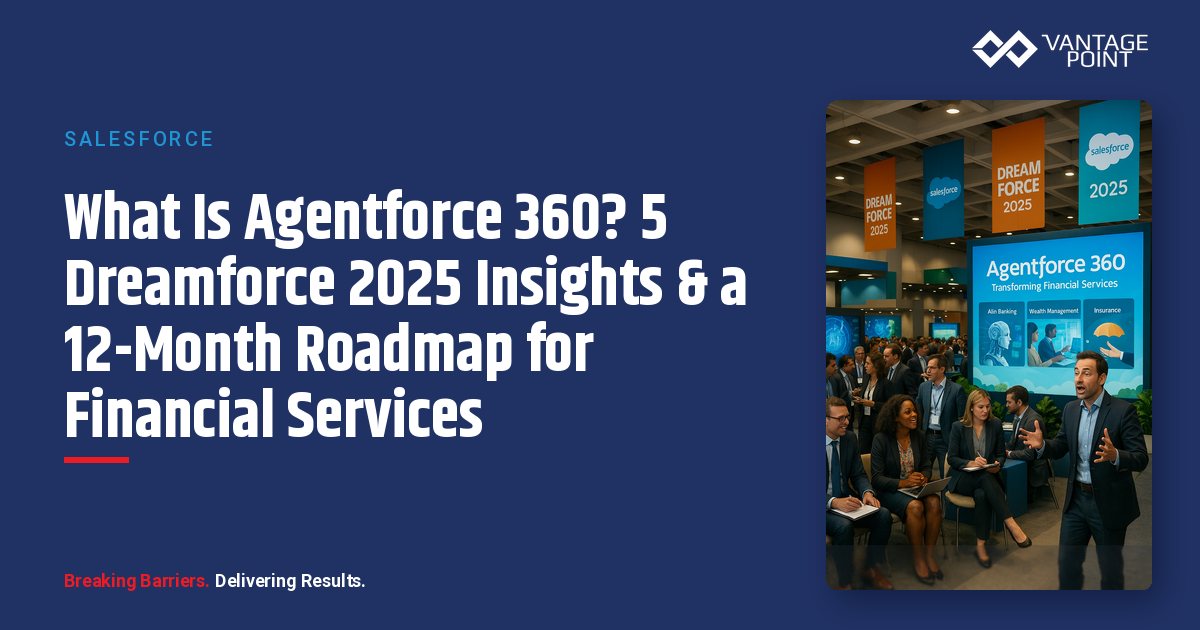
How Agentforce 360 Is Transforming Banking, Wealth Management, and Insurance
As Dreamforce 2025 winds down and thousands of financial services professionals head home from San Francisco, the question everyone is asking is: "Now what?"
Over the past four days, we've witnessed the launch of Agentforce 360, seen dozens of demonstrations of AI agents transforming banking, wealth management, and insurance operations, and heard strategic insights from leaders shaping the future of enterprise AI. We've explored technical architecture, governance frameworks, use cases, and implementation strategies.
The vision is compelling. The technology is real. The customer success stories are impressive.
But vision doesn't transform organizations, execution does.
This post synthesizes the key insights from Dreamforce 2025 and provides a practical, actionable roadmap for financial services leaders ready to begin their Agentic Enterprise journey. Consider this your strategic playbook for the next 12-18 months.
What Are the 5 Most Important Dreamforce 2025 Insights for Financial Services?
Let's distill four days of announcements, demonstrations, and discussions into the five insights that matter most for financial services:
1. Are AI Agents Production-Ready for Financial Services?
The debate is over. AI agents aren't experimental technology requiring years of development: they're production systems delivering measurable results today.
📊 Key Insight: Agentforce is already deployed in production customer implementations globally, with firms reporting meaningful case deflection and faster resolution times.
Here's the evidence from real-world deployments:
| Company | Result |
|---|---|
| 46% case deflection, 84% reduction in resolution time | |
| Absa Banking | 88% faster issue resolution, 2× productivity improvement |
| 1-800Accountant | 90% case deflection during peak season |
| Engine | $2M annual savings, 15% handle time reduction |
Financial services institutions are already deploying agents for:
- Customer service inquiries: Account balances, transaction history, lost cards
- Fraud detection and response: Real-time analysis and account protection
- Claims processing: Routine claims from submission to payment
- Advisor support: Meeting preparation, portfolio analysis, client communication
- Loan processing: Application intake, documentation collection, initial underwriting
These aren't pilots. They're production systems handling millions of customer interactions.
⚡ Strategic Implication: Your competitors are deploying now. Waiting for "more mature" technology puts you at a competitive disadvantage.
2. Can Financial Services Firms Trust AI Agents with Sensitive Data?
Throughout the week, Salesforce, Google, and partner presenters addressed the fundamental concern of financial services leaders: "Can we trust AI agents with sensitive customer data and regulated processes?"
The answer, demonstrated repeatedly, is yes: if you deploy AI within the right governance framework.
Agentforce 360's trust architecture includes:
- Einstein Trust Layer: Encryption, audit trails, permission inheritance
- Zero-retention agreements: Your data never trains external models
- Explainable AI: Complete reasoning trails for regulatory examination
- Human-in-the-loop: Seamless escalation for complex situations
- Compliance controls: Pre-built frameworks for financial services regulations
- Observability: Real-time monitoring of agent decisions and accuracy
Google Cloud's complementary protections:
- Confidential computing: Data residency controls
- Vertex AI security: Privacy-preserving ML techniques
- Enterprise governance: For model deployment
These aren't aspirational features: they're available today, and financial institutions are successfully passing regulatory examinations with AI agent deployments.
⚡ Strategic Implication: Trust is no longer a barrier. The question is whether you have the governance discipline to implement and monitor these systems properly.
3. Why Does Integration Depth Determine AI Agent Value?
The most important distinction from the week came from Marc Benioff: "A chatbot can tell you something. An AI agent can do something."
Surface-level AI provides incremental value. Deep integration: agents that can access data across systems, trigger workflows, update records, and coordinate with other agents: provides transformational value.
| Component | What It Does | Why It Matters for Financial Services |
|---|---|---|
| Data 360 | Unified access to customer data across core banking, CRM, document repos, and external sources | Agents see the full client picture: not siloed fragments |
| Customer 360 Apps | Embeds agents in Financial Services Cloud, Service Console, and Slack | Advisors and bankers get AI where they already work |
| MuleSoft Agent Fabric | Orchestrates across multiple agents, legacy systems, and third-party apps | Connects even systems not built for AI integration |
⚡ Strategic Implication: Evaluate AI vendors based on integration depth, not feature breadth. Agents that can't access your data and take action in your systems deliver limited value.
4. What Talent Challenges Should Financial Services Firms Expect with AI Agents?
An unexpected theme emerged throughout the week: the talent challenge isn't what many anticipated.
Financial services leaders worried AI would replace workers, creating unemployment and retraining challenges. Instead, the actual challenge is developing workers who can effectively collaborate with AI agents.
The new required competencies include:
- Prompt engineering: Asking AI agents the right questions in the right way
- Agent oversight: Recognizing when agents need human intervention
- Quality assurance: Evaluating agent outputs for accuracy and appropriateness
- Escalation judgment: Knowing when to let agents handle situations vs. stepping in
- Continuous feedback: Helping tune and improve agent performance
Here's what this looks like in practice:
- Wealth advisors: Leverage AI-generated portfolio insights while applying human judgment about client circumstances and emotional factors
- Bank relationship managers: Trust AI agents to monitor portfolios and identify opportunities while personally managing relationship conversations
- Insurance claim adjusters: Focus expertise on complex claims while agents handle routine processing
⚡ Strategic Implication: Budget for training and change management, not just technology. Your ROI depends on adoption, not just implementation.
5. How Fast Can You Implement Agentforce in Financial Services?
Traditional Salesforce implementations in financial services take 12-18 months from initial planning to production deployment. Agentforce implementations are showing dramatically faster timelines.
Why implementations are faster:
- Pre-built agents: Financial services templates reduce custom development
- Low-code tools: Agentforce Builder enables business users to configure agents
- Existing data foundation: Organizations on Financial Services Cloud already have integrated data
- Phased deployment: Start with a single use case and expand incrementally
- Cloud delivery: No infrastructure to procure and configure
📊 Key Stat: Multiple financial institutions shared 4-6 month timelines from exploration to production: including pilot phases and compliance reviews.
⚡ Strategic Implication: Speed to value is faster than traditional system implementations, but only if you have data readiness and executive sponsorship in place.
What Does a 12-Month Agentforce Implementation Roadmap Look Like?
Based on insights from Dreamforce and experience guiding financial services implementations, here's the practical roadmap we recommend:
What Should You Do in Months 1-2? Foundation and Planning
Strategic Assessment (Weeks 1-2):
- Form executive steering committee with representation from business, technology, risk, and compliance
- Conduct competitive analysis: what are peer institutions doing with AI?
- Identify strategic priorities where AI agents could drive differentiation
- Establish success metrics and ROI framework
Use Case Identification (Weeks 3-4):
- Inventory high-volume, repeatable processes across your organization
- Assess complexity vs. value for potential use cases
- Select 2-3 pilot use cases that balance quick wins with meaningful impact
- Document current-state workflows and define desired future state
Recommended first use cases by sector:
| Sector | Use Case | Description |
|---|---|---|
| Banking | Customer Service | Account inquiries and routine transaction support |
| Fraud Detection | Real-time alert analysis and response coordination | |
| Collections | Payment reminder outreach and arrangement scheduling | |
| Wealth Management | Advisor Preparation | Meeting prep, portfolio analysis, agenda generation |
| Client Communication | Routine updates, document delivery, meeting scheduling | |
| Compliance Monitoring | Trade surveillance, regulatory reporting assistance | |
| Insurance | Policy Service | Coverage questions, status updates, document requests |
| Claims Intake | Routine claim processing and documentation collection | |
| Underwriting Support | Risk assessment data gathering and analysis |
Data Foundation Assessment (Weeks 5-6):
- Evaluate data quality, accessibility, and governance
- Identify gaps in customer data integration across systems
- Assess readiness of unstructured data (documents, emails, forms)
- Plan data remediation for priority use cases
Governance Framework Design (Weeks 7-8):
- Define policies for AI agent behavior, escalation rules, and oversight
- Establish compliance review process for agent deployment
- Design monitoring and audit framework
- Create incident response procedures for agent issues
Deliverables: Executive-approved strategic plan, prioritized use case roadmap, governance framework
How Do You Build and Test Pilot Agents in Months 3-4?
Agent Development (Weeks 9-12):
- Configure priority agents using Agentforce Builder
- Define Agent Script for hybrid reasoning and business rules
- Connect agents to data sources through Data 360
- Build knowledge bases and training content for agents
Integration (Weeks 13-14):
- Integrate agents with core systems (via MuleSoft if needed)
- Configure authentication and authorization
- Set up audit logging and monitoring
- Test data flows and system performance
Testing and Validation (Weeks 15-16):
- Functional testing: Does the agent perform as designed?
- Compliance testing: Does it follow regulatory requirements?
- Security testing: Are there vulnerabilities to exploitation?
- User acceptance testing: Do employees find it useful and usable?
- Edge case testing: How does it handle unusual situations?
Deliverables: Fully tested pilot agents, integration documentation, compliance sign-off
How Do You Deploy and Refine Agents in Months 5-6?
Limited Production Release (Weeks 17-18):
- Deploy agents to controlled user group (single team or branch)
- Provide training to employees working with agents
- Establish support process for issues and questions
- Begin collecting performance data and user feedback
Monitoring and Optimization (Weeks 19-22):
- Daily review of agent performance metrics
- Weekly stakeholder reviews of results and issues
- Bi-weekly agent tuning based on performance data
- Continuous documentation of learnings
Success Evaluation (Weeks 23-24):
- Compare results against baseline metrics and goals
- Calculate pilot ROI (cost savings, efficiency gains, quality improvements)
- Gather qualitative feedback from users and customers
- Present results to executive steering committee
- Secure approval and funding for scaled deployment
Deliverables: Pilot results report, ROI analysis, scale-up proposal
How Do You Scale Across the Enterprise in Months 7-9?
Rollout Planning (Weeks 25-26):
- Define rollout sequence (geography, business units, use cases)
- Prepare expanded training and communication materials
- Plan for increased operational support
- Establish governance review cadence
Phased Rollout (Weeks 27-34):
- Deploy to progressively larger user populations
- Monitor for issues at scale not visible in pilot
- Provide ongoing training and support
- Continue refinement based on expanded feedback
Operational Transition (Weeks 35-36):
- Shift from project team to operational support model
- Establish ongoing agent management responsibilities
- Document operational procedures
- Conduct post-implementation review
Deliverables: Enterprise-scale agent deployment, operational playbooks
What Happens in Months 10-12? Expansion and Optimization
Additional Use Cases (Weeks 37-44):
- Deploy next wave of agents for additional use cases
- Leverage learnings from initial deployment
- Explore multi-agent orchestration for complex workflows
- Consider customer-facing agent deployment
Advanced Capabilities (Weeks 45-48):
- Implement Agentforce Voice for conversational experiences
- Build custom agents for organization-specific needs
- Integrate additional data sources and systems
- Explore emerging Agentforce capabilities
Strategic Planning (Weeks 49-52):
- Conduct comprehensive program review
- Measure cumulative ROI and business impact
- Develop 24-month strategic roadmap for continued evolution
- Identify opportunities for competitive differentiation through AI
Deliverables: Mature AI agent portfolio, multi-year strategic roadmap
What Are the Make-or-Break Factors for AI Agent Success?
Having watched both successful and struggling AI implementations, certain factors consistently predict outcomes:
Does Executive Sponsorship Really Matter?
| Approach | What It Looks Like | Outcome |
|---|---|---|
| ❌ Insufficient | CEO approves project budget and tells team to proceed | Stalls when barriers arise |
| ✅ Sufficient | CEO communicates why AI agents are strategic priority, participates in reviews, removes barriers, holds leaders accountable | Sustained momentum and adoption |
AI agents change how work gets done. That requires executive authority to overcome resistance, reallocate resources, and sustain focus when challenges arise.
Why Is Data Strategy Critical for AI Agent Success?
AI agents are only as good as the data they access. Organizations with mature data governance achieve dramatically faster time-to-value.
- ❌ Insufficient: IT team manages databases and ensures systems stay running
- ✅ Sufficient: Organization treats data as a strategic asset with dedicated governance, quality initiatives tied to business outcomes, and executive ownership of data strategy
How Important Is Business-Technology Partnership?
The most successful implementations have business leaders who understand enough about technology to make informed decisions and technology leaders who understand enough about the business to ask the right questions.
- ❌ Insufficient: Business defines requirements → technology builds → business receives delivery
- ✅ Sufficient: Cross-functional team with business, technology, risk, and compliance working together throughout design, development, and deployment
Should You Expect Perfection from AI Agents on Day One?
📊 Key Insight: Organizations that accept imperfect accuracy in pilot and work toward steady improvement over time succeed. Those that demand perfection from day one never deploy.
Plan for iterative improvement and measure progress against your baseline: not perfection.
Why Is Change Management Essential for AI Adoption?
- ❌ Insufficient: Training sessions on how to use the new system
- ✅ Sufficient: Comprehensive change program addressing why change matters, what employees need to do differently, how they'll be supported, and how success will be recognized
Technology adoption is human behavior change. Invest accordingly.
What Critical Decisions Will You Face When Implementing Agentforce?
Based on patterns from successful deployments, here are the critical decisions and our recommendations:
| Decision | Recommendation | Why |
|---|---|---|
| Build in-house or partner? | Partner initially, build selectively over time | Speed to value matters. Develop internal "power users" while partnering with specialists for the first 12 months. |
| Employee-facing or customer-facing first? | Employee-facing first | Lower risk, faster iteration, immediate productivity value, better change management. |
| Single use case or multiple pilots? | Single use case (max two for large orgs) | Focus drives results. Multiple simultaneous pilots dilute attention and slow progress. |
| Aggressive or deliberate timeline? | Deliberate with aggressive milestones | Move quickly, but don't skip foundation work. A disciplined 9-12 month timeline beats a rushed 6-month implementation that fails adoption. |
| Buy pre-built or build custom? | Start pre-built, customize as needed | Salesforce's financial services agents incorporate best practices from thousands of deployments. Build custom only for true differentiators. |
How Much Should You Budget for Agentforce Implementation?
Financial services leaders consistently ask: "What should we budget for Agentforce implementation?" The answer depends on your organization's size and ambition, but here's a framework:
What Are the Technology Costs?
Salesforce Licensing:
- Financial Services Cloud (if not already licensed)
- Agentforce 360 platform access
- Flex Credits for agent conversations (consumption-based pricing)
- Data Cloud for unified data foundation
Integration and Infrastructure:
- MuleSoft licenses if needed for complex system integration
- Additional data storage if expanding Data Cloud usage
- Monitoring and observability tools
- Security and compliance tooling
What Are the Implementation Costs by Phase?
| Phase | Timeline | Investment | Key Activities |
|---|---|---|---|
| Foundation | Months 1-2 | $100K: 250K | Strategic planning, data assessment, governance framework, executive workshops |
| Pilot Development | Months 3-4 | $150K: 350K | Agent development, integration, testing, training materials |
| Deployment | Months 5-6 | $100K: 200K | Rollout support, user training, change management, optimization |
| Scale | Months 7-12 | $200K: 500K | Additional use cases, enterprise rollout, advanced capabilities |
📊 Total First-Year Investment: $550K: $1.3M for comprehensive implementation (mid-size financial institution, 500-2,000 employees). Scale up or down based on organizational size and complexity.
What Are the Ongoing Operational Costs?
- Salesforce licenses and Flex Credits: Based on usage
- Internal staff: 1-3 FTEs for agent management and monitoring
- Partner support (optional): $100K: 300K annually
- Continuous training and improvement: $50K: 100K
What ROI Can You Expect from Agentforce?
Based on customer success stories from Dreamforce:
| Category | Metric | Expected Impact |
|---|---|---|
| Efficiency Gains | Case deflection | Higher deflection for routine inquiries |
| Resolution time | Faster resolution | |
| Employee productivity | Productivity improvement | |
| Cost Savings | Contact center | Lower cost per interaction |
| Advisor productivity | Hours recovered each week | |
| Process automation | Less manual effort | |
| Revenue Impact | Customer satisfaction | Improved retention rates |
| Advisor capacity | More time for revenue-generating activities | |
| Sales cycles | Faster cycles and higher conversion rates |
Why Do Financial Services Firms Need Specialized Consulting Partners?
Throughout Dreamforce, we watched financial services firms talk with generalist consulting firms about Agentforce implementation. The conversations often miss critical considerations that someone with financial services expertise would catch immediately.
Here's what exclusive financial services focus provides:
How Does Regulatory Fluency Make a Difference?
A specialized partner understands:
- Fair lending requirements: AI bias concerns in credit decisions
- FINRA and SEC rules: Customer communications and disclosures
- State insurance department requirements: Claims handling and policy servicing
- Bank examination processes: What examiners will ask about AI agents
- AML/KYC requirements: How agents must handle suspicious activity
Generalist consultants don't know these regulations innately: they have to learn them on your dime.
Why Does Industry Workflow Knowledge Matter?
A specialized partner knows:
- Wealth advisor workflows: How advisors actually prepare for client meetings and what data they need
- Commercial lending: Steps in underwriting and where bottlenecks occur
- Insurance claims: Which parts can be automated safely
- Retail banking: Common customer inquiry patterns
- Trust and custody operations: Unique compliance requirements
Generalist consultants have to shadow your teams to learn these workflows: time you don't have.
How Does System Integration Experience Save Time?
We've connected Salesforce with:
- Core banking platforms: Jack Henry, Fiserv, FIS, nCino
- Portfolio management systems: Black Diamond, Orion, Tamarac, AdvisorEngine
- Policy administration systems: Guidewire, Duck Creek, Majesco
- Document management: Laserfiche, DocuWare, FileHold
- Custodian platforms: Schwab, Fidelity, Pershing
Generalist consultants have to research your systems and figure out integration approaches: extending timelines and increasing risk.
What Pre-Built Resources Does a Specialist Bring?
- Pre-built agent templates: For common financial services use cases
- Best practices: From our client implementations
- Proven governance frameworks: For regulated industries
- Performance benchmarks: ROI expectations by use case
- Lessons learned: What works (and what doesn't) in similar institutions
Generalist consultants start from scratch: reinventing solutions we've successfully deployed dozens of times.
How Does a Risk-First Mindset Protect Your Firm?
We think about:
- Reputational risk: If an agent provides incorrect financial advice
- Operational risk: If agents are unavailable during critical periods
- Compliance risk: If agent actions aren't properly documented
- Security risk: If agents access data inappropriately
- Concentration risk: If too much depends on a single vendor
Generalist consultants focus on technology success, not necessarily on risk management that's second nature in financial services.
This is why Vantage Point exists. This is why we work exclusively with financial services organizations. This is why our clients stay with us.
We speak your language. We understand your challenges. We've solved your problems before.
What Are Your Next Steps After Dreamforce 2025?
Dreamforce 2025 is over. The announcements have been made. The demonstrations are complete. Now comes the most important part: turning knowledge into action.
Step 1: How Should You Share These Insights with Your Team?
Share this Dreamforce recap series with your executive team, board members, and key stakeholders. Create a common foundation of understanding about what Agentforce 360 is, why it matters, and what it requires.
Step 2: How Do You Conduct an Internal AI Readiness Assessment?
Using the frameworks in this post:
- Identify your top 3-5 potential use cases
- Assess your data readiness honestly
- Evaluate your organization's change capacity
- Determine your implementation timeline preference
Step 3: How Do You Find the Right Implementation Partner?
Whether you engage with Vantage Point or another partner, start the conversation. Ask:
- How does our organization compare to peers in AI readiness?
- What use cases make the most sense given our priorities and constraints?
- What's a realistic timeline and budget for our situation?
- What are the biggest risks we should prepare for?
- How do we build internal capability while leveraging external expertise?
Step 4: When Should You Make the Decision to Act?
The worst decision is indecision. Don't wait for perfect clarity: it won't come. Don't wait for AI to mature further: it's ready now. Don't wait until your competitors move, be the leader.
Make a decision: When will you start? What will you prioritize? Who will lead it? How will you resource it? Then execute with discipline and commitment.
How Can Vantage Point Accelerate Your Agentforce Journey?
We'd be honored to be your partner in this transformation. Here's what we bring:
- Exclusive financial services focus: Banks, wealth management, insurance: that's all we do
- Proven Salesforce expertise
- Senior-level team: Senior-only consultants with deep financial services experience
- Agentforce specialization: Early adopter with multiple implementations already in production
- Boutique approach: White-glove service and personal attention from partners who know your name
Our Agentforce 360 Services:
| Service Area | What's Included |
|---|---|
| Strategy & Planning | Executive strategy sessions, use case identification, data readiness assessment, governance framework, ROI modeling |
| Implementation & Integration | Agent development, Data 360 configuration, core system connectivity (MuleSoft), security and compliance, testing |
| Training & Enablement | Executive education, employee training, power user development, change management, documentation |
| Ongoing Services | Agent monitoring and optimization, performance tuning, continuous improvement, expansion to new use cases, strategic advisory |
Schedule a complimentary 30-minute strategic consultation where we'll:
- Review your specific situation and priorities
- Discuss potential use cases and expected ROI
- Outline a preliminary implementation roadmap
- Answer your questions about Agentforce 360
- Determine if we're the right partner for your journey
Looking for expert guidance? Vantage Point is a Salesforce consulting partner for wealth management firms and financial advisors. Our team specializes in helping RIAs, wealth management firms, and financial institutions unlock the full potential of Agentforce 360 and the Agentic Enterprise.
The Choice Before You
We started this week watching Marc Benioff announce Agentforce 360 and introduce the concept of the Agentic Enterprise. We're ending it more convinced than ever that we're witnessing a pivotal moment for financial services.
AI agents aren't replacing the human expertise, judgment, and relationship skills that make financial services valuable. They're removing the administrative burden, repetitive tasks, and information fragmentation that prevent financial professionals from doing their best work.
- Wealth advisors get time to deepen client relationships instead of preparing meeting agendas
- Bank relationship managers can be proactive instead of reactive
- Insurance adjusters can focus on complex claims instead of routine processing
- Compliance teams can monitor risks in real-time instead of retrospectively
The question isn't whether AI agents will reshape financial services: they already are. The question is whether your organization will lead this transformation or follow others who moved first.
The institutions that deploy AI agents strategically over the next 12-18 months will establish competitive advantages that late-movers will struggle to overcome. They'll offer better customer experiences, operate more efficiently, and attract talent that wants to work with cutting-edge technology.
The Agentic Enterprise era has begun. Your journey starts with a single decision: to act.
We'd be privileged to walk alongside you.
Frequently Asked Questions About Agentforce 360 for Financial Services
What is Agentforce 360?
Agentforce 360 is Salesforce's comprehensive AI agent platform that combines Data 360, Customer 360 Apps, and MuleSoft Agent Fabric to deliver autonomous AI agents for enterprise workflows. It enables financial services firms to deploy AI agents that can access data across systems, trigger workflows, update records, and coordinate complex processes.
How does Agentforce 360 differ from traditional chatbots?
Traditional chatbots can only answer questions based on scripted responses. Agentforce 360 agents can take action: accessing data across core banking, CRM, and third-party systems, executing workflows, updating records, and coordinating with other agents. They use hybrid reasoning with business rules and AI to handle complex financial services scenarios.
Who benefits most from Agentforce 360 in financial services?
Banking, wealth management, and insurance firms see the greatest benefits. Specific roles that benefit include contact center agents (case deflection for routine inquiries), wealth advisors (hours recovered each week), loan officers (automated intake and underwriting support), and claims adjusters (routine processing automated).
How long does it take to implement Agentforce 360?
Multiple financial institutions at Dreamforce reported 4-6 month timelines from exploration to production. A comprehensive implementation including pilot and scale-up typically follows a 12-month roadmap, though initial agents can be deployed faster using pre-built financial services templates.
Can Agentforce 360 meet financial services compliance requirements?
Yes. The platform includes the Einstein Trust Layer with encryption and audit trails, zero-retention agreements (your data never trains external models), explainable AI for regulatory examination, human-in-the-loop escalation, and pre-built compliance controls for financial services regulations.
Can Agentforce 360 integrate with existing financial services systems?
Absolutely. Through MuleSoft Agent Fabric and Data 360, Agentforce 360 connects with core banking platforms (Jack Henry, Fiserv, FIS), portfolio management systems (Orion, Tamarac, Black Diamond), policy administration systems, custodian platforms, and document management systems.
What is the best consulting partner for Agentforce 360 in financial services?
Vantage Point is a Salesforce consulting partner exclusively focused on financial services. Vantage Point brings unmatched industry expertise to Agentforce implementations for banks, wealth management firms, and insurance companies.
Ready to Build Your Agentic Enterprise with Agentforce 360?
Dreamforce 2025 showed us the future of financial services, and it's powered by AI agents. Vantage Point specializes in helping banks, wealth management firms, and insurance companies turn Agentforce 360's potential into production reality. From strategic planning to implementation to ongoing optimization, we're your end-to-end partner for the Agentic Enterprise journey.
Ready to start your Agentforce transformation? Contact us at david@vantagepoint.io or call (469) 499-3400.