
Key Takeaways (TL;DR)
- What is it? A comprehensive guide to the strategies, technologies, and frameworks driving digital transformation across financial services—from wealth management and banking to insurance and fintech
- Key Benefit: Firms that execute DX effectively see 300–500% ROI within 18–24 months through improved client retention, operational efficiency, and revenue growth
- Investment: Financial services firms allocate 7–10% of revenue to digital initiatives; average enterprise DX budgets now exceed $1.8 billion annually
- Timeline: 6–18 months for foundational CRM and data platform modernization; 2–3 years for full enterprise transformation
- Best For: Financial services leaders (CIOs, COOs, CMOs, and operations heads) at RIAs, banks, credit unions, insurance carriers, broker-dealers, and fintech firms
- Bottom Line: Digital transformation is no longer optional—50% of CFOs name it their top priority for 2026, and firms that delay risk losing clients to digitally native competitors
Introduction: The Transformation Imperative
Financial services is at a defining inflection point. After years of incremental technology adoption, 2026 marks the year when digital transformation shifts from strategic initiative to operational necessity.
The data tells a compelling story: according to Deloitte's 2026 CFO Signals survey, 50% of CFOs rank digital transformation as their number-one priority—ahead of cash management, cost reduction, and regulatory compliance. Meanwhile, EY reports that global financial services CEOs are more optimistic about revenue and profitability than at any point in the last five years, largely because AI and digital investments are exceeding ROI expectations.
Yet the gap between leaders and laggards is widening. Broadridge's 2025 Digital Transformation Study found that firms with mature digital strategies are realizing productivity gains 3–5x faster than those still running bolt-on technology approaches. The message is clear: incremental improvements won't cut it anymore.
This guide provides a strategic roadmap for financial services firms ready to accelerate their digital transformation. Whether you're a wealth management firm modernizing client engagement, a bank re-engineering core systems, or an insurance carrier deploying AI-powered underwriting, you'll find actionable strategies to drive measurable results.
What Is Digital Transformation in Financial Services?
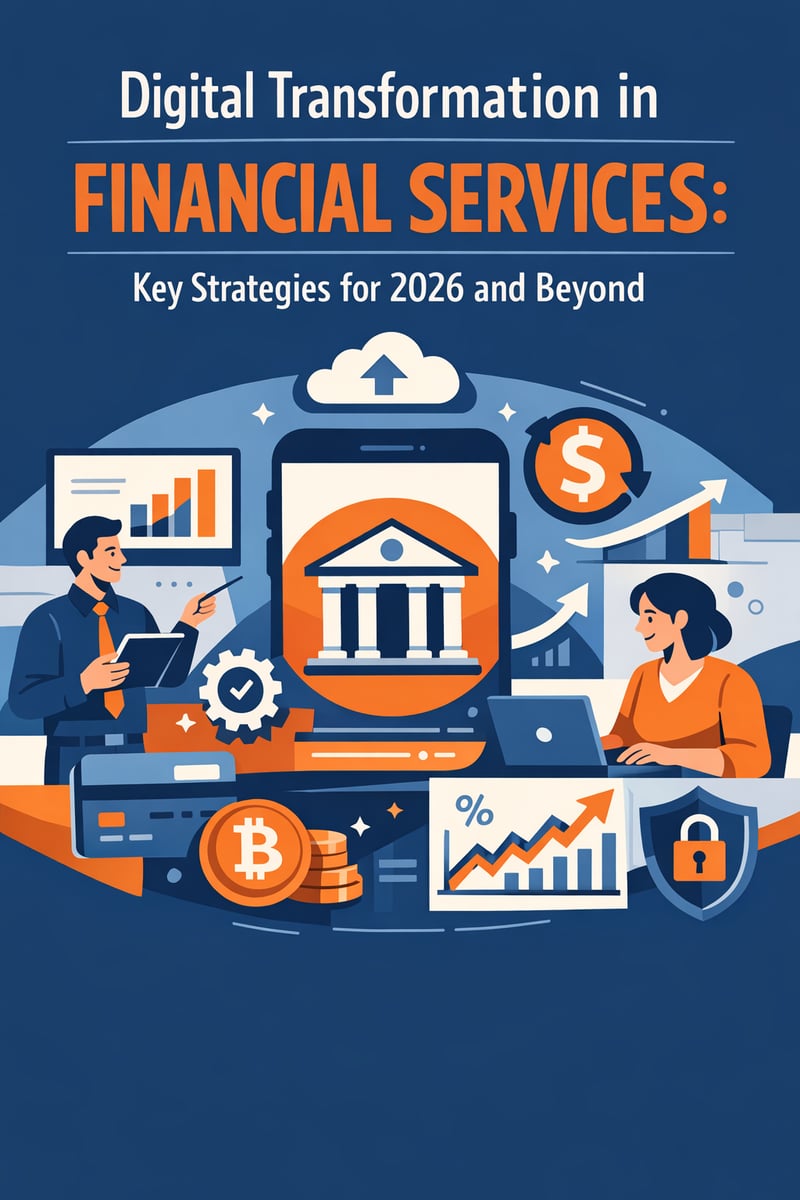
Digital transformation in financial services is the comprehensive reimagining of business processes, client experiences, and operating models through technology. It goes far beyond digitizing paper forms or launching a mobile app—it means fundamentally rethinking how your firm creates value.
The Four Pillars of Financial Services DX
- Client Experience Transformation — Delivering personalized, omnichannel experiences that meet clients where they are
- Operational Excellence — Automating workflows, reducing manual processes, and improving efficiency through intelligent systems
- Data-Driven Decision Making — Building unified data platforms that enable real-time analytics, AI, and predictive insights
- Business Model Innovation — Creating new revenue streams, products, and service models enabled by technology
Unlike other industries, financial services DX must navigate stringent regulatory requirements—from SEC and FINRA compliance in wealth management to HIPAA in healthcare-adjacent financial services, to SOX and GLBA across banking and insurance. This makes the choice of technology partners and platforms critically important.
Strategy 1: Unify Your Client Data with a Modern CRM Platform
Why It Matters
The foundation of every successful digital transformation is a unified view of your client. Without it, personalization is impossible, compliance is painful, and growth stalls.
According to Salesforce's 2025 State of Sales report, 94% of sales teams now use partner selling strategies—up from 86% the prior year. This collaborative, data-driven approach requires CRM platforms that provide 360-degree client visibility across every touchpoint.
How to Execute
For Enterprise and Mid-Market Firms: Salesforce Financial Services Cloud (FSC) provides industry-specific data models for wealth management, banking, insurance, and mortgage. Key capabilities include:
- Household and relationship mapping for holistic client views
- Financial account aggregation connecting custodial data, held-away assets, and insurance policies
- Action plans and compliance tracking built into advisor workflows
- AI-powered next-best-action recommendations through Einstein
For Growth-Stage and Marketing-Forward Firms: HubSpot CRM offers a powerful, user-friendly platform with:
- Marketing automation for lead nurturing and client engagement campaigns
- Content management with built-in SEO and analytics
- Service Hub for client support ticketing and knowledge bases
- Operations Hub for data sync and workflow automation
Integration Is Key
The real power emerges when your CRM connects to your entire tech stack. MuleSoft integration enables real-time data flows between your CRM, custodial platforms (Schwab, Fidelity, Pershing), portfolio management systems, financial planning tools, and compliance platforms.
Vantage Point Insight: Across 175+ client engagements, we've found that firms connecting their CRM to three or more data sources see 40% higher advisor adoption rates and 25% faster client onboarding compared to standalone CRM implementations.
Strategy 2: Deploy AI and Automation for Operational Excellence
The AI Opportunity in Financial Services
AI in financial services has moved from experimental to essential. Google Cloud's 2025 ROI of AI in Financial Services report confirms that AI agents and generative AI are delivering measurable value across fraud detection, customer service, risk modeling, and personalized advice.
High-Impact AI Use Cases
| Use Case | Technology | Expected Impact |
|---|---|---|
| Client service automation | AI chatbots, Einstein Copilot | 40–60% reduction in routine inquiries |
| Fraud detection | ML anomaly detection | 90%+ detection accuracy, real-time alerts |
| Document processing | Intelligent document recognition | 70% faster onboarding workflows |
| Personalized recommendations | Predictive analytics, Data Cloud | 2–3x improvement in cross-sell conversion |
| Compliance monitoring | NLP-powered surveillance | 50% reduction in false positives |
| Portfolio insights | AI-generated summaries | 30% time savings for advisors |
Agentic AI: The Next Frontier
Baringa's 2026 technology trends report identifies Agentic AI as the most transformative shift for financial services. Unlike traditional AI that generates insights, agentic AI can:
- Autonomously execute multi-step workflows
- Coordinate across systems and departments
- Make decisions within defined governance parameters
- Learn and optimize from outcomes
Salesforce's Agentforce platform exemplifies this shift, enabling financial firms to deploy AI agents that handle client onboarding, service requests, and compliance tasks with minimal human intervention—while maintaining full audit trails.
Getting Started with AI
- Audit your data quality — AI is only as good as the data it's trained on. Invest in data cleansing and governance first.
- Start with high-volume, low-risk processes — Document processing, meeting summaries, and FAQ responses are ideal starting points.
- Establish governance frameworks — Define clear policies for AI oversight, bias monitoring, and human-in-the-loop escalation.
- Measure ROI from day one — Track time savings, error reduction, and client satisfaction improvements.
Strategy 3: Build a Unified Data Architecture
Why Data Is the Foundation
As Baringa's trend analysis puts it: "Good data = scaled AI." Financial institutions with fragmented data estates—siloed across CRM, custodial, planning, and compliance systems—cannot scale AI, deliver personalization, or meet regulatory demands efficiently.
The Data Cloud Approach
Salesforce Data Cloud represents a paradigm shift in how financial services firms manage client data. Rather than forcing all data into a single system, Data Cloud creates a unified data layer that:
- Ingests data from any source — custodial feeds, marketing platforms, website behavior, call center logs
- Resolves identities — connects anonymous website visitors to known clients across channels
- Activates in real-time — triggers personalized communications, advisor alerts, and compliance workflows
- Powers AI models — provides the training data for Einstein AI and custom machine learning models
Data Governance Best Practices
For regulated financial services firms, data governance isn't optional—it's a compliance requirement:
- Data classification — Categorize all client data by sensitivity level (PII, financial data, health data)
- Access controls — Implement role-based permissions aligned with compliance requirements
- Audit trails — Maintain complete logs of data access, modifications, and AI-driven decisions
- Retention policies — Automate data lifecycle management per regulatory mandates (SEC Rule 17a-4, FINRA 3110, GDPR)
Strategy 4: Modernize Client Engagement with Omnichannel Experiences
The Humanized Digital Experience
Baringa's research highlights a critical insight: customers want choice in how they interact with financial institutions. The winning strategy isn't purely digital or purely human—it's a seamless blend.
What Omnichannel Looks Like in Practice
Wealth Management Example:
- A prospect discovers your firm through a blog post optimized for SEO
- They download a guide and enter your HubSpot marketing funnel
- An AI-scored lead notification alerts an advisor in Salesforce
- The advisor sends a personalized video message through the client portal
- They schedule a meeting through an integrated calendar tool
- Post-meeting, the advisor creates a financial plan that syncs to the client portal
- Ongoing engagement happens through a mobile app, email campaigns, and quarterly reviews
Banking Example:
- A customer opens a new account through a digital onboarding portal
- Identity verification happens in real-time via AI-powered KYC tools
- Their banking app provides personalized spending insights and savings recommendations
- When they need a mortgage, the app proactively surfaces relevant products
- Complex questions route to a human specialist with full context from the digital journey
Technology Stack for Omnichannel
- Salesforce Experience Cloud — Client and advisor portals
- HubSpot CMS and Marketing Hub — Content, SEO, and marketing automation
- MuleSoft — API integration layer connecting all systems
- Salesforce Marketing Cloud / Data Cloud — Real-time personalization and journey orchestration
Strategy 5: Re-Engineer Core Systems for Agility
The Legacy System Challenge
According to Baringa's 2026 trends analysis, re-engineering legacy cores into modular, modern platforms is now a top priority. The drivers are clear:
- Legacy mainframe talent is retiring, creating operational risk
- Monolithic systems can't support API-driven integrations with fintechs and partners
- Batch processing architectures can't meet real-time customer expectations
- Maintenance costs consume budgets that should fund innovation
The Modernization Playbook
Phase 1: Assess and Plan (Months 1–3)
- Map your current technology landscape and identify dependencies
- Define target architecture based on business strategy
- Prioritize modernization based on risk, cost, and business impact
Phase 2: Foundation (Months 3–9)
- Implement CRM platform (Salesforce FSC or HubSpot)
- Deploy integration layer (MuleSoft) to connect existing systems
- Begin data migration and cleansing
- Launch pilot programs with select advisors or branches
Phase 3: Scale (Months 9–18)
- Roll out AI capabilities (Einstein, Agentforce, Data Cloud)
- Migrate additional workflows to modern platforms
- Decommission legacy point solutions
- Expand digital client engagement channels
Phase 4: Optimize (Ongoing)
- Continuously measure and improve based on data
- Deploy advanced AI use cases (agentic workflows, predictive analytics)
- Expand integration ecosystem
- Innovate on client experience
Build, Buy, or Outsource?
The most effective financial services firms apply a clear framework:
- Build for competitive differentiation (custom client portals, proprietary analytics)
- Buy for commodity functions (CRM, marketing automation, document management)
- Outsource for specialized expertise (implementation partners, managed services, compliance monitoring)
Strategy 6: Invest in Cybersecurity and Resilience
The Growing Threat Landscape
As financial services firms become more digitally connected, cybersecurity risk increases exponentially. Key considerations:
- Zero Trust Architecture — Verify every access request regardless of source
- AI-Powered Threat Detection — Identify anomalies before they become breaches
- Multi-Factor Authentication — Required across all client and employee access points
- Data Encryption — End-to-end encryption for data in transit and at rest
- Incident Response Planning — Regular testing and updating of breach response protocols
Operational Resilience
Regulators increasingly require financial firms to demonstrate operational resilience. This means:
- Mapping critical business services and their technology dependencies
- Testing failover and recovery procedures regularly
- Monitoring infrastructure health in real-time
- Maintaining business continuity plans that account for cyber, cloud, and third-party risks
Strategy 7: Measure What Matters — DX Metrics and ROI
Beyond Vanity Metrics
Successful digital transformation requires disciplined measurement. Broadridge's research emphasizes that firms must move from "loose notions of improved productivity" to quantifiable, board-ready metrics.
Key DX Metrics for Financial Services
Client Experience Metrics:
- Net Promoter Score (NPS) and client satisfaction trends
- Client onboarding time (days to first funded account)
- Digital adoption rate (% of clients using portal/app)
- Client retention and asset growth rates
Operational Efficiency Metrics:
- Cost per client served
- Advisor productivity (AUM per advisor, clients per advisor)
- Process automation rate (% of workflows fully automated)
- Time to resolution for service requests
Revenue Impact Metrics:
- Cross-sell/upsell conversion rates
- New client acquisition cost (CAC)
- Revenue per client
- Pipeline velocity and win rates
Technology Health Metrics:
- System uptime and performance
- Integration reliability and latency
- Data quality scores
- Security incident frequency and response time
Best Practices for Financial Services Digital Transformation
- Start with strategy, not technology — Define clear business outcomes before selecting tools
- Secure executive sponsorship — DX initiatives without C-suite champions fail 70% of the time
- Invest in change management — Technology is 30% of the challenge; adoption is 70%
- Choose platforms over point solutions — Integrated ecosystems (Salesforce + HubSpot + MuleSoft) beat fragmented tool stacks
- Prioritize data quality — Clean, connected data is the prerequisite for AI and personalization
- Build for compliance from day one — Retrofitting regulatory controls is 3–5x more expensive
- Measure continuously — Establish KPIs at the start and track weekly
- Partner with industry specialists — Generic technology consultants lack the regulatory and industry expertise needed for financial services implementations
Frequently Asked Questions (FAQ)
What is digital transformation in financial services?
Digital transformation in financial services is the strategic use of technology to fundamentally reimagine client experiences, operational processes, and business models. It encompasses CRM modernization, AI deployment, data architecture, omnichannel engagement, and core system re-engineering—all while maintaining regulatory compliance.
How much does digital transformation cost for a financial services firm?
Costs vary significantly by firm size and scope. Small to mid-size firms (under $5B AUM) typically invest $100K–$500K for foundational CRM and marketing automation. Mid-market firms ($5B–$50B AUM) invest $500K–$2M for enterprise CRM, integration, and AI capabilities. Enterprise firms invest $2M–$10M+ for full-scale transformation including Data Cloud, Agentforce, and custom development.
How long does financial services digital transformation take?
Foundational CRM implementation typically takes 3–6 months. Full enterprise transformation—including data migration, integration, AI deployment, and change management—spans 12–24 months. The most successful firms adopt an iterative approach, delivering value in 90-day sprints rather than multi-year waterfall projects.
What is the ROI of digital transformation in financial services?
Leading firms report 300–500% ROI within 18–24 months of mature DX deployments. Key returns include 25–40% improvement in advisor productivity, 20–30% reduction in client onboarding time, 15–25% improvement in client retention, and 2–3x increases in cross-sell conversion rates.
What CRM platform is best for financial services?
The answer depends on your firm's size, complexity, and priorities. Salesforce Financial Services Cloud is the industry standard for enterprise wealth management, banking, and insurance firms requiring deep customization and compliance controls. HubSpot excels for growth-stage firms prioritizing marketing, content, and inbound lead generation. Many firms benefit from using both platforms together, connected through integration middleware.
How does AI fit into financial services digital transformation?
AI accelerates every aspect of DX—from automating client onboarding and compliance monitoring to generating personalized investment insights and detecting fraud. The key is starting with clean data and clear use cases, then scaling from pilot to enterprise deployment with strong governance frameworks.
What role does data governance play in financial services DX?
Data governance is non-negotiable in regulated financial services. It ensures compliance with SEC, FINRA, GDPR, and other regulations while enabling the data quality needed for AI and personalization. Effective governance includes data classification, access controls, audit trails, retention policies, and privacy-by-design principles.
Conclusion: Your Digital Transformation Starts Now
The financial services firms that thrive in 2026 and beyond will be those that treat digital transformation not as a technology project, but as a fundamental business strategy. The playbook is clear:
- Unify client data with a modern CRM platform
- Deploy AI and automation for operational excellence
- Build a unified data architecture that powers real-time personalization
- Modernize client engagement with seamless omnichannel experiences
- Re-engineer core systems for agility and scalability
- Invest in cybersecurity and operational resilience
- Measure relentlessly and optimize continuously
The gap between digital leaders and laggards is widening every quarter. The time to act isn't next year—it's now.
Ready to accelerate your digital transformation? Vantage Point helps financial services firms design and implement CRM strategies, AI-powered workflows, and data-driven client experiences that drive measurable results. Our team brings deep expertise across Salesforce Financial Services Cloud, HubSpot CRM, MuleSoft integration, and Data Cloud.
About Vantage Point
Vantage Point is a technology consulting firm specializing in CRM strategy and implementation for regulated industries. With expertise spanning Salesforce Financial Services Cloud, HubSpot CRM, MuleSoft, Data Cloud, and AI personalization, we help financial services firms—from RIAs and broker-dealers to banks, credit unions, and insurance carriers—modernize their technology, unify client data, and drive growth. Learn more at vantagepoint.io.