Key Takeaways (TL;DR)
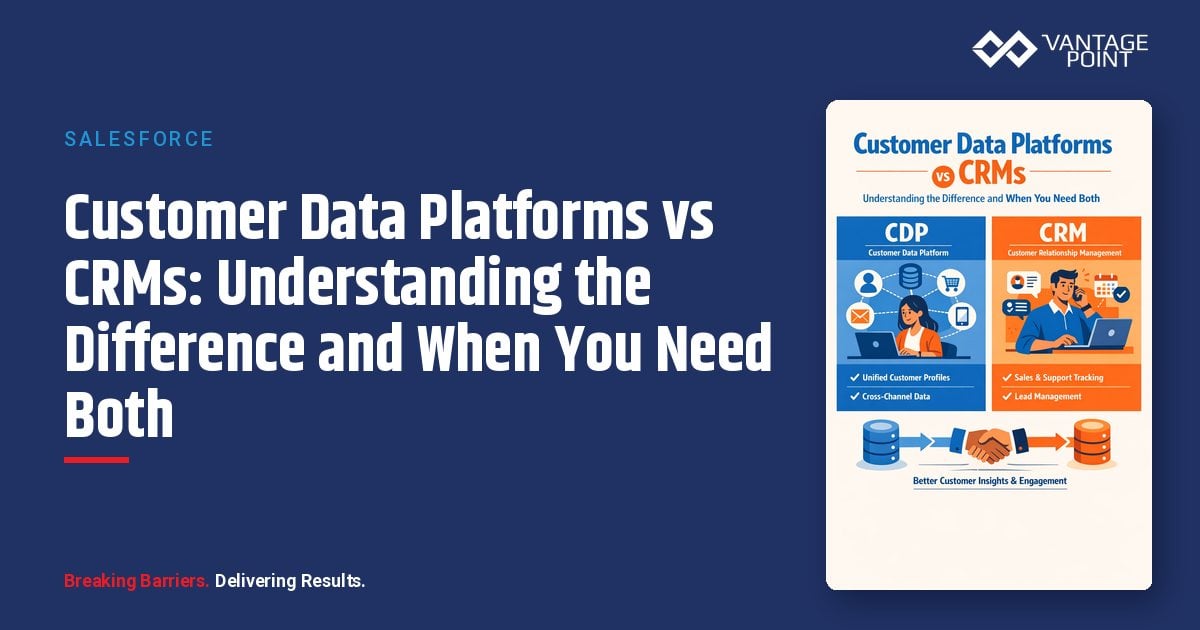
- What is a CDP? A Customer Data Platform unifies customer data from every source (websites, apps, email, social media, and offline interactions) into a single, actionable profile for marketing personalization
- What is a CRM? A Customer Relationship Management system tracks direct customer interactions like emails, calls, and deals to help sales and service teams manage relationships
- Key Difference: CDPs focus on data unification and marketing activation; CRMs focus on relationship management and sales pipeline tracking
- Cost: CDPs range from $12K, $300K+/year depending on data volume; CRMs range from $25: $300/user/month
- Best For: Organizations with data spread across 5+ systems that need unified customer profiles for personalized marketing at scale
- Bottom Line: You likely need both. Together they deliver 360-degree customer visibility, with 88% of CDP adopters achieving ROI within 18 months
Introduction
Every business today generates customer data, from website visits and email opens to sales calls and support tickets. But here's the challenge: that data often lives in silos across dozens of disconnected tools and platforms. The result? Incomplete customer views, generic marketing, and missed revenue opportunities.
Two categories of technology sit at the center of solving this problem: Customer Data Platforms (CDPs) and Customer Relationship Management (CRM) systems. While they sound similar and both deal with customer data, they serve fundamentally different purposes.
Understanding the difference (and knowing when you need one, the other, or both) is critical for any organization looking to improve customer engagement, streamline operations, and drive growth. In this guide, we'll break down exactly what CDPs and CRMs do, how they differ, when each makes sense, and how the two platforms work together to create a complete customer data strategy.
What Is a CRM (Customer Relationship Management)?
A CRM system is software designed to manage and track your company's interactions with current and potential customers. It serves as a centralized hub for:
- Contact and account management: storing customer details, company info, and communication history
- Sales pipeline tracking: managing deals from lead to close
- Service case management: logging and resolving customer support requests
- Activity logging: recording emails, calls, meetings, and notes
- Workflow automation: automating follow-ups, task assignments, and notifications
Who Uses a CRM?
CRMs are built primarily for sales, service, and account management teams. Sales reps use CRMs to track leads and opportunities. Service agents use them to manage cases. Managers use them for pipeline reporting and forecasting.
Popular CRM Platforms
- Salesforce (Sales Cloud, Service Cloud): the market leader for enterprise CRM
- HubSpot CRM: popular with growing businesses for its user-friendly interface and free tier
- Microsoft Dynamics 365: strong for organizations already in the Microsoft ecosystem
What CRMs Do Well
| Strength | Description |
|---|---|
| Relationship tracking | Centralized history of every customer interaction |
| Pipeline management | Visual deal tracking from lead to close |
| Sales forecasting | Revenue predictions based on pipeline data |
| Service management | Case tracking, SLAs, and resolution workflows |
| Team collaboration | Shared customer records across departments |
| Reporting | Dashboards for sales, service, and activity metrics |
What Is a CDP (Customer Data Platform)?
A Customer Data Platform is software that collects, unifies, and organizes customer data from multiple sources into a single, persistent customer profile. The CDP Institute defines it as "packaged software that creates a persistent, unified customer database accessible to other systems."
CDPs aggregate data from:
- Website and app behavior: page views, clicks, session data
- Email and marketing interactions: opens, clicks, conversions
- Purchase and transaction history: orders, revenue, product preferences
- Social media engagement: likes, shares, comments, ad interactions
- Offline interactions: in-store visits, event attendance, call center data
- Third-party data sources: enrichment providers, partner data
Who Uses a CDP?
CDPs are primarily used by marketing teams, data analysts, and customer experience professionals. They enable precise audience segmentation, real-time personalization, and cross-channel campaign orchestration.
Popular CDP Platforms
- Salesforce Data 360 (formerly Data Cloud), named a Leader in the 2026 Gartner Magic Quadrant for CDPs for the third consecutive year
- Segment (Twilio): developer-friendly data routing
- Treasure Data: strong for enterprise data unification
- Tealium: real-time data collection and audience management
What CDPs Do Well
| Strength | Description |
|---|---|
| Data unification | Merges data from all sources into a single customer profile |
| Identity resolution | Matches anonymous and known behaviors to the same person |
| Real-time activation | Triggers personalized experiences as events happen |
| Audience segmentation | Creates precise segments based on behavior, demographics, and intent |
| Cross-channel orchestration | Coordinates messaging across email, web, ads, and more |
| First-party data strategy | Centralizes privacy-compliant data in a cookieless world |
How Do CDPs and CRMs Differ? A Side-by-Side Comparison
Understanding the core differences helps you make the right technology decisions:
| Feature | CRM | CDP |
|---|---|---|
| Primary purpose | Manage customer relationships and sales | Unify customer data for marketing activation |
| Core users | Sales, service, account management | Marketing, data, customer experience |
| Data scope | Known contacts with explicit interactions | Known + anonymous users across all channels |
| Data types | Structured (emails, calls, deals) | Structured + unstructured (behaviors, events, preferences) |
| Data entry | Mostly manual or integration-based | Automated collection from all touchpoints |
| Identity resolution | Limited: tied to contact records | Advanced: links anonymous to known profiles |
| Real-time capability | Limited real-time processing | Designed for real-time data ingestion and activation |
| Personalization | Basic (merge fields, segmentation) | Advanced (behavioral, predictive, cross-channel) |
| Primary output | Pipeline reports, service dashboards | Unified profiles, audience segments, activation signals |
| Compliance focus | Contact consent management | Comprehensive consent + data governance |
The Simple Way to Remember It
A CRM tracks what your team does with customers. A CDP tracks what customers do across your entire ecosystem.
CRMs are process-centric: built around sales stages, service workflows, and team activities. CDPs are data-centric: built around unifying every data point into a complete customer picture.
When Do You Need a CRM?
A CRM is essential when your organization needs to:
- Track sales pipelines: manage leads, opportunities, and deal stages
- Manage customer relationships: maintain organized records of all interactions
- Automate sales workflows: trigger follow-ups, assign tasks, send sequences
- Provide customer support: log cases, track resolution times, manage SLAs
- Forecast revenue: predict sales outcomes based on pipeline data
- Enable team collaboration: give everyone visibility into customer history
Signs You Need a CRM
- Your sales team tracks deals in spreadsheets or email
- Customer information is scattered across tools with no central source of truth
- Follow-ups are falling through the cracks
- You can't report on pipeline health or team performance
- Handoffs between sales and service are disjointed
When Do You Need a CDP?
A CDP becomes essential when your organization needs to:
- Unify data from multiple systems: break down silos across marketing, sales, service, and operations
- Personalize at scale: deliver individualized experiences across email, web, ads, and more
- Resolve customer identity: connect anonymous website visitors to known contacts
- Activate first-party data: replace third-party cookies with privacy-compliant customer data
- Enable real-time marketing: trigger campaigns and experiences based on live behavior
- Support AI and predictive analytics: feed unified data into machine learning models
Signs You Need a CDP
- Customer data lives in 5+ disconnected systems
- Marketing campaigns use basic segmentation (or none at all)
- You can't connect website behavior to known customer profiles
- Personalization is limited to first name in emails
- Your data team spends more time wrangling data than analyzing it
- You're preparing for a cookieless future and need a first-party data strategy
Why You Likely Need Both: The Power of CDP + CRM Integration
Here's the critical insight: CDPs and CRMs are complementary, not competitive. The most effective customer data strategies use both platforms together.
How They Work Together
- CDP feeds enriched data to CRM: Sales reps see not just interaction history, but complete behavioral profiles including website activity, content engagement, and buying signals
- CRM feeds interaction data back to CDP: Sales calls, deal outcomes, and service interactions enrich the CDP's unified profile for better marketing segmentation
- Marketing gets sales context: The CDP uses CRM data (deal stage, account value, service history) to create smarter marketing segments
- Sales gets marketing context: The CRM displays CDP insights (content consumed, ads clicked, intent signals) so reps can have more informed conversations
- Both systems power AI: Unified data from CDP + CRM creates the foundation for predictive lead scoring, churn prediction, and next-best-action recommendations
Real-World Integration Example
Consider how this works in practice:
- A prospect visits your website and downloads a whitepaper (CDP captures this anonymous behavior)
- They fill out a form, identifying themselves (CDP resolves their identity, matching previous anonymous sessions)
- The CDP creates an enriched lead and syncs it to the CRM with full behavioral context
- A sales rep sees the lead in their CRM with insights: "Visited pricing page 3 times, downloaded ROI calculator, engaged with 4 blog posts about implementation"
- The rep reaches out with a personalized pitch based on these insights
- After the deal closes, the CRM updates the CDP, which adjusts future marketing to focus on onboarding and expansion content
This closed-loop system is impossible with either platform alone.
How Salesforce Data 360 and HubSpot Approach the CDP-CRM Convergence
Salesforce Data 360 (Formerly Data Cloud)
Salesforce has led the charge in converging CDP and CRM capabilities. Data 360: named a Leader in the 2026 Gartner Magic Quadrant for CDPs for the third consecutive year, operates as a hyperscale data engine embedded directly within the Salesforce platform.
Key capabilities:
- Zero-copy data access: connect external data without moving it
- Real-time unified profiles: sub-second data processing for instant personalization
- Native Agentforce integration: powers AI agents with unified customer context
- Cross-cloud activation: use unified data in Sales Cloud, Service Cloud, Marketing Cloud, and Commerce Cloud
HubSpot's Integrated Approach
HubSpot takes a different approach by building CRM and marketing data capabilities into a single, unified platform. While HubSpot isn't a traditional CDP, its Smart CRM provides:
- Unified contact records across Marketing Hub, Sales Hub, and Service Hub
- Behavioral tracking built into the CRM
- Custom objects and properties for flexible data modeling
- Built-in analytics and segmentation across the full customer lifecycle
For organizations that need advanced CDP capabilities alongside HubSpot, platforms like Segment or Salesforce Data 360 can integrate to provide the data unification layer.
Best Practices for Implementing a CDP + CRM Strategy
1. Start with Clear Objectives
Define what you want to achieve before selecting technology. Common goals include:
- Improve marketing personalization and conversion rates
- Give sales teams better customer insights
- Build a first-party data strategy
- Enable AI-driven customer experiences
2. Audit Your Current Data Landscape
Map every system that touches customer data:
- How many data sources do you have?
- Where are the biggest silos?
- What data quality issues exist?
- How is data currently shared between teams?
3. Establish Data Governance Early
Before unifying data, establish:
- Data ownership: who is responsible for each data source?
- Quality standards: what constitutes clean, usable data?
- Privacy compliance: how do you manage consent across systems?
- Access controls: who can see and use what data?
4. Choose Platforms That Integrate Natively
The value of CDP + CRM comes from seamless data flow. Prioritize platforms with:
- Native integrations or strong API connectivity
- Pre-built connectors for your tech stack
- Real-time data sync capabilities
- Consistent data models across platforms
5. Implement in Phases
Don't try to do everything at once:
- Phase 1: Implement CRM for sales and service teams
- Phase 2: Add CDP for marketing data unification
- Phase 3: Integrate CDP and CRM for bidirectional data flow
- Phase 4: Layer in AI and predictive capabilities
6. Measure ROI Continuously
Track metrics that demonstrate value:
- Customer acquisition cost (CAC) reduction
- Marketing conversion rate improvement
- Sales cycle length reduction
- Customer lifetime value (CLV) increase
- Time saved on data management
The CDP Market in 2026: What You Need to Know
The CDP landscape is evolving rapidly:
- Market size: The global CDP market is valued at $4.58 billion in 2026, projected to reach $13.14 billion by 2031 (CAGR of 23.47%)
- ROI timelines: 45% of CDP adopters achieve ROI within 3-6 months; 88% achieve ROI within 18 months
- Efficiency gains: Organizations report 25-40% improvement in marketing efficiency after CDP implementation
- Conversion lifts: 30-50% improvement in conversion rates through better personalization
- AI convergence: CDPs are increasingly becoming the data foundation for agentic AI: powering autonomous agents that act on unified customer data
- Cookieless readiness: With third-party cookies continuing to decline, CDPs have become essential for first-party data strategies
Frequently Asked Questions (FAQ)
What is the main difference between a CDP and a CRM?
A CDP collects and unifies customer data from all sources (websites, apps, email, social, offline) into a single profile for marketing personalization. A CRM manages direct customer interactions (sales calls, emails, deals, and support cases) to help teams build relationships. CDPs are data-centric; CRMs are process-centric.
Can a CRM replace a CDP?
No. While CRMs store valuable customer data, they typically only capture structured interaction data from known contacts. CDPs capture both known and anonymous behavioral data from all channels, perform identity resolution, and enable real-time marketing activation: capabilities most CRMs don't offer.
Can a CDP replace a CRM?
No. CDPs excel at data unification and marketing activation but aren't designed for sales pipeline management, deal tracking, or service case management. These operational workflows are core CRM functions that CDPs don't replicate.
How much does a CDP cost compared to a CRM?
CRM pricing typically ranges from $25, $300 per user per month, depending on the platform and tier. CDP pricing is usually based on data volume and ranges from $12,000 to $300,000+ per year. Many organizations invest in both, with total costs depending on scale and complexity.
How long does CDP implementation take?
Basic CDP implementation typically takes 2-4 months. Full integration with a CRM and other systems usually takes 4-8 months. Organizations should plan for a phased rollout, starting with core data sources and expanding over time.
Do small businesses need a CDP?
Not always. Small businesses with limited data sources may find that a CRM with built-in marketing features (like HubSpot or Salesforce) provides sufficient data management. CDPs become valuable when data is spread across 5+ systems and personalization at scale is a priority.
What is Salesforce Data 360?
Salesforce Data 360 (formerly Salesforce Data Cloud, and before that, Salesforce CDP) is Salesforce's hyperscale customer data platform. Named a Leader in the 2026 Gartner Magic Quadrant for CDPs, it unifies customer data across the entire Salesforce ecosystem and external sources, powering real-time personalization and AI-driven experiences.
Conclusion
The question isn't CDP vs CRM. It's understanding how each platform serves a different but complementary purpose in your customer data strategy. CRMs manage relationships and processes. CDPs unify data and power personalization. Together, they create a complete picture of every customer that drives smarter marketing, more informed sales conversations, and better customer experiences.
As the CDP market grows toward $13 billion by 2031 and AI becomes central to customer engagement, organizations that invest in both a strong CRM foundation and a robust CDP layer will have a significant competitive advantage.
Ready to build your unified customer data strategy? Vantage Point helps organizations implement and integrate CRM and CDP solutions (including Salesforce Data 360, HubSpot CRM, and MuleSoft integration) to create seamless, data-driven customer experiences. Contact us today to discuss your data strategy.
About Vantage Point
Vantage Point is a certified Salesforce and HubSpot partner specializing in CRM implementation, data strategy, and AI-driven customer engagement. We help businesses of all sizes unify their customer data, automate workflows, and deliver personalized experiences across every touchpoint. Our team brings deep expertise in Salesforce (Sales Cloud, Service Cloud, Data 360), HubSpot CRM, MuleSoft integration, and AI solutions including Anthropic's Claude AI and Salesforce Agentforce.
Learn more at vantagepoint.io