
TL;DR / Key Takeaways
- What is it? A structured decision framework for selecting a CRM data integration and migration services provider specifically for commercial banks
- Key Benefit: Avoid costly migration failures by evaluating partners on banking domain expertise, regulatory compliance, and core system integration capabilities
- Investment: Bank CRM migrations typically run 6-18 months and $250K, $2M+ depending on data complexity, number of source systems, and regulatory requirements
- Best For: US commercial bank IT leaders, digital transformation executives, and operations teams planning a CRM upgrade from legacy systems
- Bottom Line: The right migration partner understands banking regulations (OCC, FFIEC, GLBA), integrates with core platforms like FIS, Fiserv, and Jack Henry, and delivers a structured methodology that protects data integrity and audit trails throughout the process
Why Is CRM Data Migration So Complex for Banks?
CRM data migration in commercial banking is fundamentally different from migrations in other industries. Banks operate under strict regulatory oversight, maintain decades of customer relationship data across siloed legacy systems, and must ensure zero disruption to critical financial operations during the transition.
The complexity stems from three converging factors: regulatory requirements that demand complete audit trail continuity, legacy system architecture built on platforms like FIS, Fiserv, Jack Henry, Temenos, and Oracle FLEXCUBE, and data volume and sensitivity involving millions of customer records governed by BSA/AML, GLBA, and state-level privacy regulations.
A failed CRM migration doesn't just cost money. It can trigger regulatory examination findings, disrupt customer relationships, and create compliance gaps that take months to remediate.
The Real Cost of Getting It Wrong
| Migration Risk | Business Impact | Regulatory Consequence |
|---|---|---|
| Data loss during extraction | Incomplete customer profiles, broken relationship history | OCC examination findings for inadequate recordkeeping |
| Audit trail gaps | Inability to trace customer interaction history | FFIEC IT examination deficiency |
| BSA/AML data discontinuity | Missed suspicious activity patterns | FinCEN enforcement action, potential fines |
| Customer disruption | Relationship manager productivity drop, client attrition | Reputational risk, board-level scrutiny |
| Parallel running failures | Inconsistent data across old and new systems | Regulatory reporting inaccuracies |
What Are the Key Phases of a Bank CRM Data Migration?
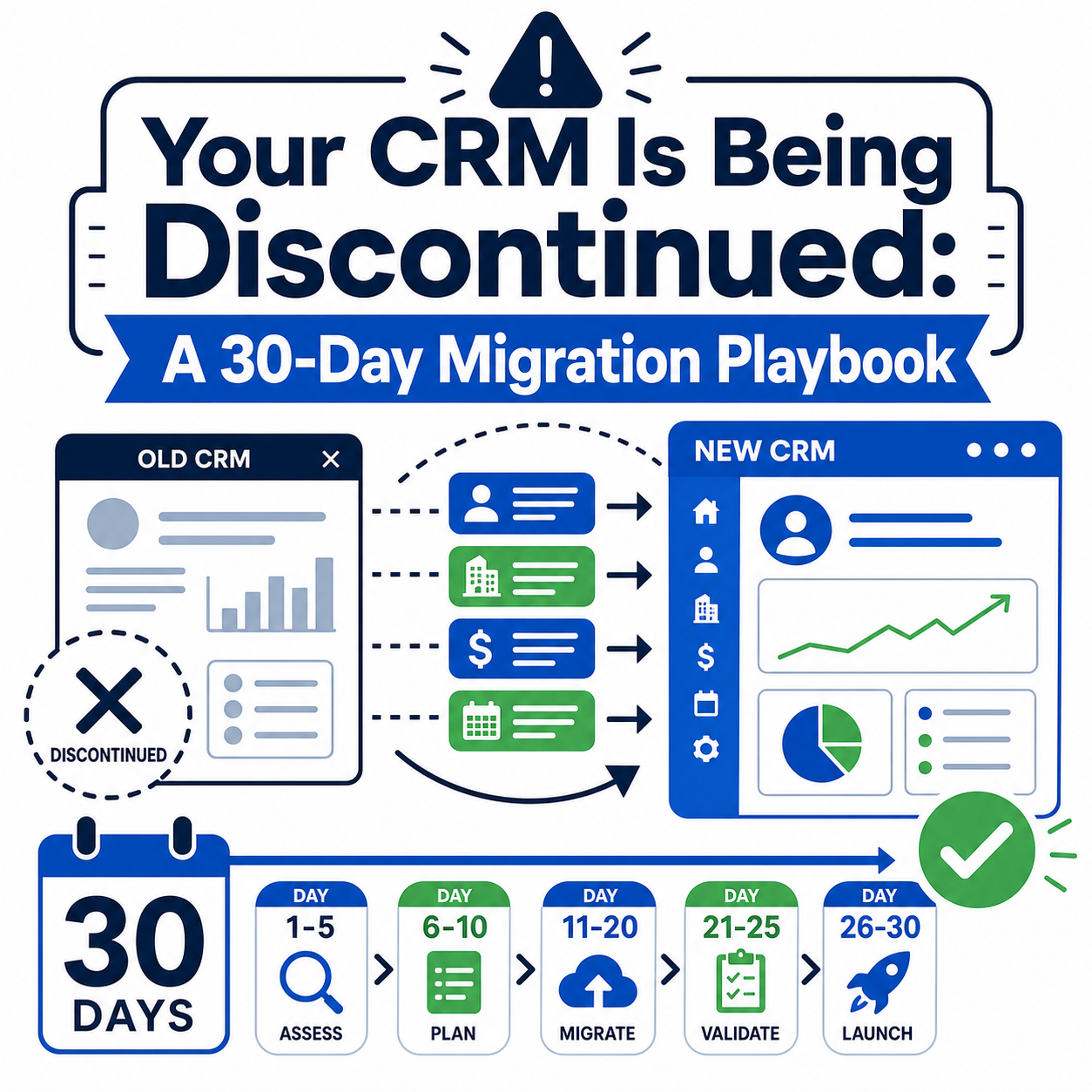
A successful bank CRM data migration follows a structured, phased approach that balances speed with regulatory compliance. Understanding these phases helps you evaluate whether a prospective partner has the methodology to execute safely.
The eight critical phases are:
- Assessment & Discovery: Inventory all source systems (core banking, loan origination, digital banking, document management, AML screening), map data ownership, and identify regulatory constraints
- Data Profiling: Analyze data quality, completeness, duplication rates, and format inconsistencies across legacy platforms
- Data Cleansing: Remediate quality issues, standardize formats, deduplicate records, and enrich incomplete fields before migration
- Data Mapping: Define field-by-field mapping from source systems to the target CRM, including transformation rules and business logic
- ETL Development: Build extraction, transformation, and loading processes with error handling, logging, and rollback capabilities
- Validation & Testing: Execute iterative test migrations, reconcile record counts, verify data integrity, and conduct user acceptance testing
- Go-Live Cutover: Execute the production migration with a defined rollback plan, parallel running period, and real-time monitoring
- Post-Migration Reconciliation: Verify data completeness, validate regulatory reporting continuity, and confirm audit trail integrity
Pro Tip: The best data migration service providers will spend 30-40% of total project time on phases 1-3 (assessment, profiling, and cleansing). Partners who rush to ETL development are setting you up for costly rework.
What Should You Look for in a CRM Data Migration Partner for Banks?
Choosing the right CRM data integration and migration services provider requires evaluating candidates across multiple dimensions specific to banking. Generic CRM consultancies that lack financial services experience will underestimate regulatory complexity and core banking integration challenges.
Here is a comprehensive evaluation framework:
1. Banking Domain Expertise
Your partner must understand commercial banking operations: not just CRM technology. Look for:
- Experience with core banking platforms (FIS, Fiserv, Jack Henry, nCino, Temenos)
- Knowledge of commercial lending workflows, treasury management, and relationship banking models
- Understanding of bank organizational structures (relationship managers, credit analysts, branch operations)
- Familiarity with banking-specific data models (customer hierarchies, account relationships, collateral linkages)
2. Regulatory and Compliance Knowledge
Banking CRM migrations are subject to regulatory scrutiny. Your partner must demonstrate:
- OCC Third-Party Risk Management compliance, understanding of the OCC's guidance on technology service provider oversight
- FFIEC IT Examination Handbook alignment. Ability to structure the migration in accordance with IT examination expectations
- BSA/AML Data Continuity: proven approach to maintaining suspicious activity monitoring throughout the migration
- GLBA Data Privacy: data handling procedures that protect customer financial information during extraction, transfer, and loading
- SOC 2 Type II Certification: your partner should hold current SOC 2 certification covering data handling controls
3. Integration Architecture Capabilities
A CRM migration is rarely a standalone project. The target CRM must integrate with your entire banking technology stack:
| Integration Point | Examples | Why It Matters |
|---|---|---|
| Core Banking | FIS, Fiserv, Jack Henry | Real-time account data, balances, transaction history |
| Loan Origination | nCino, Finastra, custom platforms | Pipeline visibility, credit decisioning, document flow |
| Digital Banking | Online/mobile platforms, APIs | Customer self-service data, digital engagement history |
| Payment Processing | ACH, wire, card platforms | Transaction monitoring, relationship profitability |
| Document Management | Hyland, Laserfiche, SharePoint | Regulatory documents, correspondence, compliance files |
| Compliance/AML | Actimize, Verafin, custom screening | SAR filing continuity, watchlist screening integration |
API-led connectivity using platforms like MuleSoft is increasingly critical for bank integrations. Rather than building brittle point-to-point connections, an API-led approach creates reusable integration layers for core banking, digital channels, and compliance systems: reducing long-term maintenance costs and enabling future flexibility.
4. Data Governance Framework
Your partner should bring a formal data governance framework that includes:
- Data ownership and stewardship assignments
- Data quality metrics and monitoring
- Master data management (MDM) strategy for golden customer records
- Data lineage and transformation documentation
- Retention and archival policies aligned with banking regulations
5. Methodology and Project Management
Look for a structured, repeatable methodology rather than ad hoc project management:
- Defined phases with clear deliverables and exit criteria at each gate
- Risk management framework specific to banking data migrations
- Change management plan for relationship manager and branch staff adoption
- Parallel running strategy with defined success criteria for cutover
- Rollback procedures documented and tested before go-live
How Do Boutique Consultancies Compare to Large System Integrators for Bank CRM Migrations?
The choice between a boutique consultancy and a large system integrator significantly impacts your migration's cost, quality, and timeline. Both models have trade-offs that bank IT leaders should evaluate carefully.
| Factor | Boutique Consultancy | Large System Integrator |
|---|---|---|
| Team Seniority | Senior-only consultants; hands-on experts | Mixed teams; senior architects oversee junior staff |
| Banking Focus | Deep specialization possible | Broad industry coverage, banking is one of many verticals |
| Flexibility | Agile, responsive to scope changes | Structured SOWs, change orders for scope adjustments |
| Cost Structure | Higher per-hour rates, lower total cost (fewer hours) | Lower per-hour rates, higher total cost (more hours, coordination overhead) |
| Data Handling | Senior-only team; no hand-offs | May use offshore teams; GLBA and data residency considerations |
| Relationship | Direct access to senior decision-makers | Account management layers between you and delivery team |
| Scalability | Best for mid-market banks ($1B: $50B assets) | Better for largest institutions ($50B+ assets) with massive data volumes |
For most US commercial banks, a senior-focused boutique consultancy with deep Salesforce and integration expertise delivers better outcomes than a large systems integrator. The reason is simple: bank CRM migrations require judgment and domain knowledge at every step, not just at the architecture level. When junior consultants handle data mapping and ETL development without understanding banking data models, errors cascade through the entire migration.
Vantage Point, for example, staffs engagements exclusively with senior consultants and brings MuleSoft integration expertise critical for API-led bank connectivity. Their employee-owned model means consultant incentives are aligned with project outcomes: not billable hour targets.
What Questions Should You Ask Prospective CRM Migration Partners?
Use these questions during your vendor evaluation process. The quality of a partner's answers will quickly reveal whether they have genuine banking migration experience or are generalizing from other industries.
Technical Capability Questions
- "Walk me through your approach to extracting data from [your core banking platform].": They should name specific APIs, file formats, and known limitations of your platform.
- "How do you maintain BSA/AML monitoring continuity during the migration?": They should describe parallel running, data synchronization, and SAR filing procedures.
- "What is your integration architecture for connecting the new CRM to our core, LOS, and digital banking platforms?": Look for API-led connectivity approaches, not point-to-point integrations.
- "How do you handle data quality issues discovered during profiling?": They should describe a formal remediation process with business stakeholder involvement.
Project Delivery Questions
- "What is your typical timeline for a bank CRM migration with [X] source systems?": Realistic answers for mid-size banks: 6-18 months depending on complexity.
- "Who specifically will be on our project team, and what is their banking experience?": Insist on meeting actual delivery consultants, not just sales teams.
- "Can you provide references from US commercial banks of similar size?": No substitutes accepted. Ask for banks, not generic financial services references.
Risk and Compliance Questions
- "Do you hold current SOC 2 Type II certification?": Non-negotiable for handling bank customer data.
- "How do you ensure audit trail continuity from legacy to new CRM?": They should describe specific data lineage documentation and reconciliation procedures.
- "What is your rollback plan if the production migration fails validation checks?": A well-defined rollback plan is a sign of migration maturity.
How Should You Structure Your CRM Migration Vendor Selection Process?
A structured selection process reduces risk and ensures you evaluate partners consistently. Here is a five-step framework used by leading commercial banks:
Step 1: Define Requirements (2-3 Weeks)
- Document source systems, data volumes, integration requirements, and regulatory constraints
- Identify internal stakeholders (IT, compliance, operations, relationship management)
- Establish evaluation criteria and weighting
Step 2: Issue RFP and Shortlist (3-4 Weeks)
- Send RFP to 4-6 qualified firms with banking experience
- Require detailed methodology descriptions, team bios, and banking references
- Shortlist 2-3 firms based on written responses
Step 3: Technical Deep Dive (2-3 Weeks)
- Conduct half-day workshops with each shortlisted firm
- Present a real data migration scenario from your environment
- Evaluate their approach to data profiling, mapping, and integration architecture
Step 4: Reference Checks (1-2 Weeks)
- Speak directly with CIO/CTO-level contacts at reference banks
- Ask about data quality outcomes, timeline adherence, regulatory examination results post-migration, and team quality
- Verify the specific consultants proposed for your engagement worked on the reference projects
Step 5: Contract Negotiation (2-3 Weeks)
- Structure the engagement with phase-gate milestones
- Include data quality SLAs and acceptance criteria
- Define rollback provisions and warranty period terms
What Role Does Data Cloud Play in Modern Bank CRM Migrations?
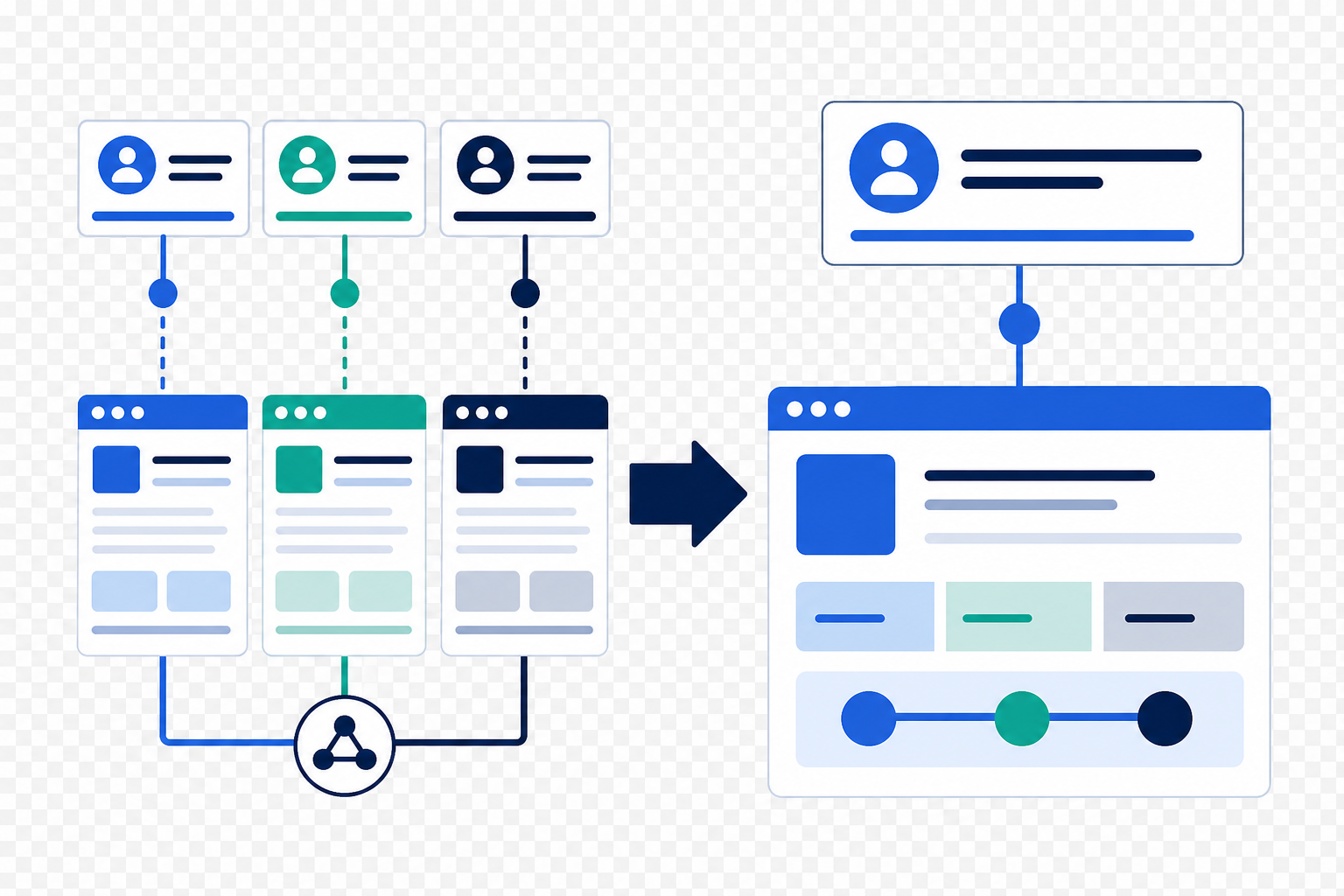
Salesforce Data Cloud is transforming how banks approach CRM data integration by creating unified customer profiles that span every banking system. Rather than simply migrating data from one CRM to another, Data Cloud enables banks to build a real-time, 360-degree view of each customer relationship.
For banks, this means:
- Unified customer identity across core banking, digital channels, loan systems, and CRM
- Real-time data synchronization that eliminates the "stale data" problem in traditional CRM implementations
- AI-ready data foundation for predictive analytics, next-best-action recommendations, and relationship deepening
- Reduced integration complexity by serving as a centralized data hub rather than requiring point-to-point connections
When evaluating CRM data integration and migration services providers, ask whether they have Data Cloud implementation experience. This capability is increasingly important as banks move beyond basic CRM migration toward building intelligent customer platforms.
How Long Does a Bank CRM Migration Typically Take?
The timeline for a commercial banking CRM upgrade depends on several complexity factors. Here are realistic ranges based on industry benchmarks:
| Complexity Level | Source Systems | Data Volume | Typical Timeline |
|---|---|---|---|
| Low | 2-3 systems | < 1M records | 4-6 months |
| Medium | 4-6 systems | 1-10M records | 6-12 months |
| High | 7-10+ systems | 10M+ records | 12-18 months |
| Enterprise | 10+ systems, multiple LOBs | 50M+ records | 18-24+ months |
Factors that extend timelines:
- Poor data quality in legacy systems (add 2-4 months for cleansing)
- Complex regulatory requirements (add 1-3 months for compliance validation)
- Multiple lines of business with different data models
- Custom legacy system integrations without documented APIs
- Organizational change management challenges
Frequently Asked Questions
What is the biggest risk in a bank CRM data migration?
The biggest risk is data quality degradation: migrating dirty, incomplete, or duplicate data from legacy systems into your new CRM. This undermines user adoption, regulatory reporting accuracy, and the ROI of your entire CRM investment. Invest heavily in data profiling and cleansing before any migration begins.
Can we migrate our CRM data in-house without a partner?
While technically possible, in-house bank CRM migrations carry significant risk. The combination of regulatory requirements, core banking integration complexity, and data volume typically exceeds internal team capacity. Banks that attempt in-house migrations often experience significant timeline overruns and higher total costs than those that engage experienced data migration service providers.
How do we ensure GLBA compliance during CRM data migration?
Ensure your migration partner has documented data handling procedures covering encryption in transit and at rest, access controls limiting who can view customer financial data, data residency requirements (US-based processing for US customer data), and formal data destruction procedures for temporary migration environments. Require SOC 2 Type II certification as a baseline.
Should we clean our data before or during the migration?
Before. Data cleansing should occur in a staging environment after extraction from legacy systems but before loading into the target CRM. Attempting to cleanse data within the target system creates unnecessary complexity and risks contaminating your new environment. Budget 20-30% of your migration timeline for data quality remediation.
What is API-led connectivity, and why does it matter for bank CRM integrations?
API-led connectivity is an integration architecture (commonly implemented using MuleSoft) that organizes integrations into three layers: system APIs (connecting to core banking, LOS, etc.), process APIs (orchestrating banking workflows), and experience APIs (serving applications and channels). For banks, this approach creates reusable integration assets that reduce long-term maintenance costs and accelerate future system connections.
How do we handle the parallel running period between old and new CRM?
Plan a parallel running period of 2-4 weeks where both systems are operational. During this period, define clear data synchronization rules, identify which system is the "source of truth" for each data domain, and establish daily reconciliation procedures. Your migration partner should provide automated reconciliation tools and daily exception reports.
What regulatory examinations should we prepare for after a CRM migration?
Post-migration, expect potential scrutiny during OCC or state examiner technology reviews. Maintain complete documentation of the migration methodology, data lineage, validation results, and any data quality exceptions. Ensure your BSA/AML monitoring experienced no gaps, and that all regulatory reporting (call reports, HMDA, CRA) can be generated accurately from the new system.
How do we evaluate whether a migration partner truly has banking experience?
Ask for three specific US commercial bank references of similar asset size. During reference calls, ask about regulatory examination outcomes post-migration, data quality metrics, timeline adherence, and whether the same consultants proposed for your project were on the reference engagement. Generic "financial services" experience (insurance, wealth management) does not substitute for commercial banking expertise.
Ready to Evaluate Your CRM Migration Options?
Selecting the right CRM data integration and migration services partner is one of the most consequential technology decisions a commercial bank makes. The framework in this guide gives you a structured, repeatable approach to evaluating candidates based on what actually matters: banking domain expertise, regulatory knowledge, integration architecture, and proven methodology.
Vantage Point brings MuleSoft and Data Cloud expertise, senior-only consultants, and a structured VALUE Methodology designed for complex, compliance-sensitive projects. If you're planning a legacy system modernization or CRM upgrade, schedule a consultation to discuss your specific migration challenges.
Vantage Point is an employee-owned consultancy specializing in Salesforce, HubSpot, AI, MuleSoft, Data Cloud, and UI/UX: with deep expertise in financial services data integration and migration.