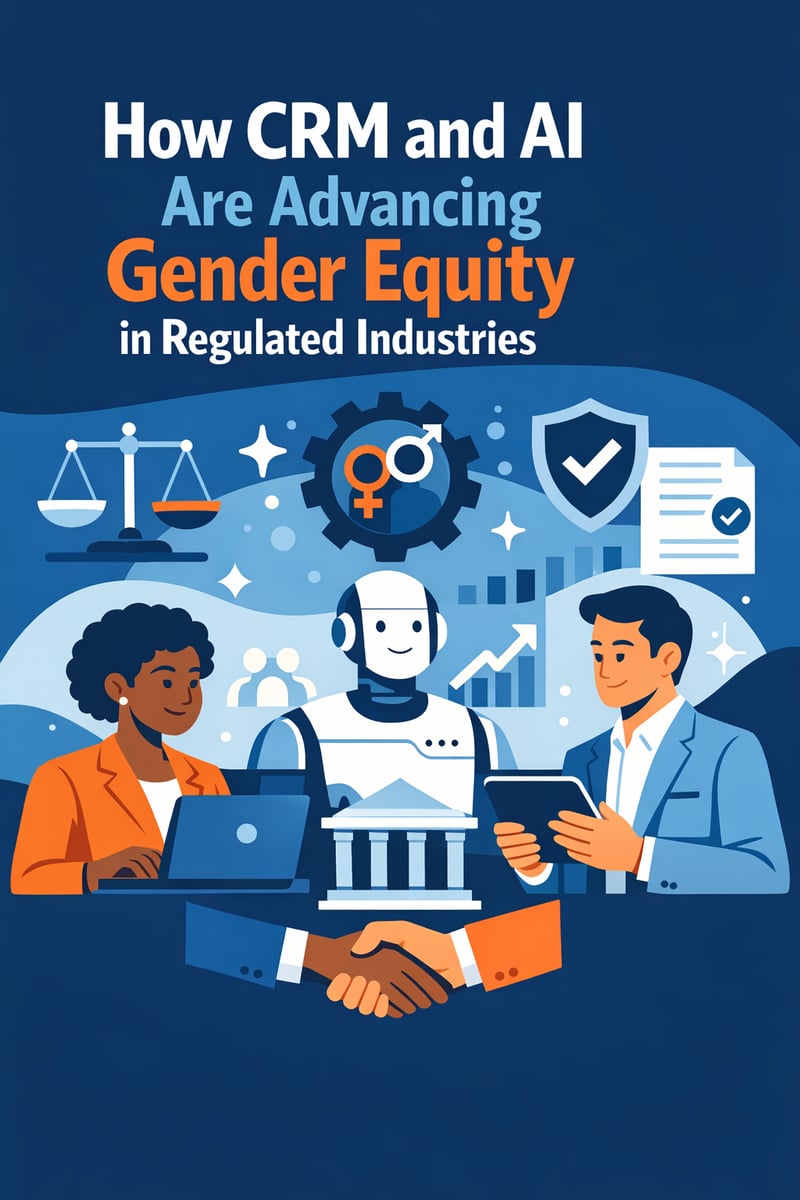
How CRM and AI Are Advancing Gender Equity in Regulated Industries
TL;DR / Key Takeaways
What is it? An exploration of how CRM platforms (Salesforce, HubSpot) and AI tools are being used to measure, monitor, and advance gender equity in financial services, healthcare, and insurance Key Insight AI can either amplify bias or eliminate it — the difference is in how firms configure, train, and monitor their technology Biggest Opportunity 700 million unbanked women globally + $84T wealth transfer = the largest untapped CRM market in financial services Best For CRM administrators, compliance officers, technology leaders in regulated industries Bottom Line The firms using technology to advance equity aren't just doing good — they're outperforming competitors by 25% on profitability
Part 3 of 4 in our International Women's Day 2026 series | #GiveToGain
Technology Is Either Part of the Problem or Part of the Solution
Here's an uncomfortable truth about CRM and AI in financial services: the same tools that can advance gender equity can also reinforce existing biases. The difference isn't the technology itself — it's how organizations configure, deploy, and monitor it.
In 2026, regulated industries are at a critical juncture. AI adoption is accelerating (68% of financial services firms are now using AI tools), while simultaneously, women's representation in financial services leadership remains stuck at historically low levels. The question isn't whether to deploy technology — it's whether to deploy it intentionally.
Where AI Can Amplify Bias — and How to Prevent It
Before we celebrate technology's potential, we need to acknowledge the risks:
The Bias Problem
AI systems learn from historical data — and historical data in financial services reflects decades of gender inequality. Without careful design, AI can:
- Score women lower in credit and lending algorithms trained on historical approval patterns
- Route women to junior advisors through automated assignment rules based on account size (reflecting historical wealth gaps)
- Recommend conservative portfolios based on demographic assumptions rather than individual risk tolerance
- Deprioritize women-owned businesses in marketing automation if lead scoring models weight firmographic data that correlates with gender
- Perpetuate pay gaps if compensation benchmarking tools rely on historical salary data
The Prevention Framework
Responsible CRM and AI deployment requires:
- Bias auditing — Regularly test algorithms against demographic outcomes
- Diverse training data — Ensure AI models are trained on representative datasets
- Human-in-the-loop — Maintain human oversight for high-stakes decisions (lending, investment recommendations, hiring)
- Transparency — Document how AI-driven recommendations are generated and make them explainable
- Ongoing monitoring — Build dashboards that track outcomes by gender across all automated processes
5 Ways CRM Platforms Are Advancing Gender Equity
Despite the risks, CRM and AI platforms provide powerful tools for organizations committed to advancing gender equity. Here's how leading firms are using them:
1. Measuring What Matters: Equity Analytics
You can't improve what you don't measure. CRM platforms enable firms to track gender equity metrics alongside traditional business KPIs:
Salesforce approach: - Tableau CRM dashboards that overlay demographic data with service quality metrics, response times, and outcome disparities - Einstein Analytics to identify patterns in how women clients vs. men clients are served, communicated with, and retained - Custom report types tracking advisor-to-client assignment patterns, product recommendations, and fee schedules by demographic - Data Cloud aggregating equity metrics across multiple systems (CRM, HR, financial planning) for holistic analysis
HubSpot approach: - Custom properties tracking client demographic segments and service satisfaction - Attribution reporting measuring whether marketing campaigns reach diverse audiences equitably - Lead scoring audits reviewing whether automated scoring disadvantages women-owned businesses - Service Hub analytics ensuring support tickets from all client segments receive equitable response times
2. Inclusive Client Journeys
CRM automation enables firms to design onboarding and service journeys that work for all clients — not just the "default" client:
- Personalized communication that adapts language, channel, and cadence to individual preferences rather than demographic assumptions
- Milestone-based journeys for life events that disproportionately affect women (divorce, widowhood, career transitions, caregiving)
- Financial literacy resources embedded in client portals, addressing the confidence gap research has identified between women and men investors
- Multi-language support reaching immigrant women who represent a growing segment of first-time financial services clients
3. Equitable Advisory Distribution
One of the most impactful applications: using CRM to ensure equitable advisory distribution regardless of gender:
| Traditional Approach | Equity-Forward Approach |
|---|---|
| Assign clients based on AUM thresholds | Assign based on complexity, goals, and advisor expertise |
| Route high-net-worth clients to senior advisors | Route all clients to appropriately skilled advisors |
| Base service tiers on current account value | Base service tiers on total relationship value including potential |
| Prioritize outreach by portfolio size | Prioritize outreach by engagement signals and life events |
Salesforce FSC's household model and HubSpot's association system enable firms to view women as complete financial actors — with their own careers, businesses, and inheritance trajectories — rather than secondary contacts on a spouse's account.
4. Compliance-Driven Equity Monitoring
Regulated industries have a unique advantage: compliance infrastructure that can be leveraged for equity monitoring:
- SEC examination readiness — Track and document equitable treatment across all client interactions
- FINRA suitability — Ensure investment recommendations are based on individual profiles, not demographic stereotypes
- HIPAA-compliant healthcare CRM — Monitor equitable patient outreach and care coordination across gender
- Fair lending compliance — Use CRM data to audit lending recommendations for demographic disparities
- EU CSRD reporting — Generate gender pay gap and board diversity disclosures directly from HR and CRM systems
Firms already investing in compliance infrastructure can extend those tools to equity monitoring at minimal incremental cost — turning a regulatory requirement into a competitive advantage.
5. AI-Powered Financial Inclusion
For firms looking at the 700 million unbanked women globally, AI and CRM enable financial inclusion at scale:
- Agentforce and AI assistants that provide multilingual financial guidance through conversational interfaces, reducing barriers for women in underserved markets
- Automated KYC processes that simplify account opening for first-time banking customers
- Mobile-first CRM interfaces that serve clients in regions where women's primary digital access is through smartphones
- Predictive analytics identifying women who would benefit from financial products based on life events rather than existing wealth
- Chatbots and self-service portals providing financial education in culturally appropriate formats
The Financial Services Wealth Transfer Opportunity
The gender equity conversation intersects directly with the largest wealth transfer in history:
- $84 trillion will change hands over the next two decades
- 70-80% of women change financial advisors within a year of a spouse's death
- Women are starting businesses at 2x the rate of men
- By 2030, women are expected to control $30 trillion in US financial assets alone
Firms that invest in gender-equitable CRM strategies now will be positioned to capture this wealth as it moves. Firms that don't will watch it walk out the door.
What the CRM Strategy Looks Like
| Stage | Action | Technology |
|---|---|---|
| Now | Audit current client base for gender equity gaps | Salesforce reports, HubSpot analytics |
| Q2 2026 | Build inclusive onboarding journeys | Marketing automation, personalized portals |
| Q3 2026 | Deploy AI with bias monitoring | Einstein AI, Agentforce with oversight dashboards |
| Q4 2026 | Launch targeted outreach to underserved segments | Data Cloud, HubSpot smart content |
| 2027 | Measure outcomes and iterate | Tableau dashboards, A/B testing |
The Regulatory Tailwind
Regulatory bodies worldwide are accelerating equity requirements:
- EU's Corporate Sustainability Reporting Directive (CSRD) — Mandatory gender pay gap and board diversity disclosures beginning 2025
- SEC examination priorities — Increased scrutiny on fiduciary duty and equitable client treatment
- Germany's Leadership Positions Act — Requiring at least 40% women on boards by 2026
- UK FCA Diversity & Inclusion proposals — New rules for regulated financial services firms
For firms already operating in regulated environments, these requirements create a natural forcing function. CRM platforms that can generate compliance-ready equity reports — automatically — save time, reduce risk, and demonstrate commitment to regulators.
Moving from Measurement to Action
The technology exists. The data supports it. The regulatory environment demands it. Here's how firms can move from awareness to action:
- Start with data — Run an equity audit on your current CRM data (client assignment, communication frequency, product recommendations, service satisfaction by gender)
- Design intentionally — Build client journeys and automation rules that explicitly account for equity
- Monitor continuously — Create dashboards that track equity metrics alongside revenue and retention
- Train your team — Ensure advisors and client-facing staff understand unconscious bias and how technology can help mitigate it
- Choose partners wisely — Work with CRM consultancies that understand both the technology and the equity imperative
This is Part 3 of Vantage Point's International Women's Day 2026 series. Tomorrow — International Women's Day: Building Inclusive Firms: A Complete Technology and Culture Roadmap.
Frequently Asked Questions
Can AI in financial services CRM be biased against women?
Yes. AI systems trained on historical data can perpetuate existing biases — from credit scoring to client assignment to investment recommendations. The key is implementing bias auditing, diverse training data, human oversight for high-stakes decisions, and continuous monitoring through CRM dashboards.
How can Salesforce FSC help advance gender equity in wealth management?
Salesforce FSC's household model allows firms to view women as complete financial actors rather than secondary contacts. Combined with Tableau analytics, Einstein AI with bias monitoring, and Agentforce for personalized service, FSC enables equitable client journeys, fair advisory assignment, and compliance-ready equity reporting.
What's the business case for gender equity in financial services technology?
Companies in the top quartile for gender diversity are 25% more likely to achieve above-average profitability. Additionally, the $84T wealth transfer, women's increasing control of financial assets ($30T by 2030), and regulatory requirements all create strong business incentives for firms that invest in equity-forward CRM strategies.
How does the 700 million unbanked women statistic connect to CRM strategy?
Each unbanked woman who gains financial access represents a potential client relationship. AI-powered CRM tools enable financial inclusion at scale through multilingual interfaces, simplified onboarding, mobile-first design, and predictive analytics — turning a social challenge into the largest untapped market in financial services.
What regulations require gender equity reporting from financial services firms?
Key requirements include the EU's CSRD (mandatory gender pay gap and board diversity disclosures), Germany's Leadership Positions Act (40% women on boards by 2026), UK FCA Diversity & Inclusion proposals, and expanding SEC examination priorities around equitable client treatment. CRM platforms can generate compliance-ready equity reports automatically.
About Vantage Point: We help financial services firms, healthcare organizations, and regulated businesses implement Salesforce and HubSpot CRM solutions that drive growth, ensure compliance, and deliver exceptional client experiences. Learn more at vantagepoint.io