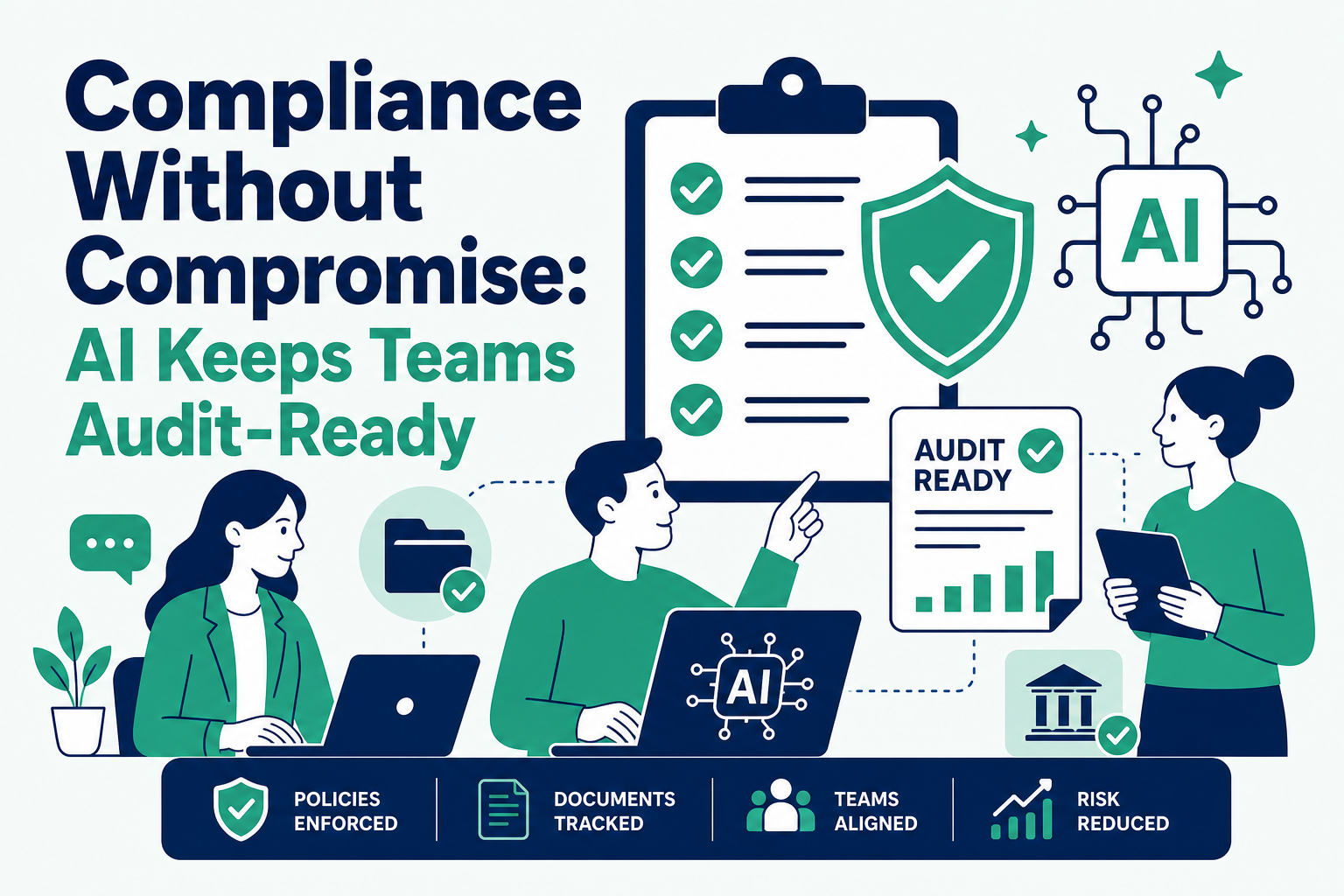
Organizations do not have to choose between tighter compliance and faster operations. A well-designed AI agent can monitor approved controls continuously, document decisions as work happens, and route exceptions before they become an audit surprise.
That does not make compliance hands-off. It creates a stronger operating model: automation performs repeatable checks and evidence collection, while people retain ownership of policy, judgment, exceptions, and accountability.
Quick Answer
AI compliance uses governed AI agents and automation to evaluate business activity against approved policies, retain evidence, and escalate exceptions. It matters to organizations managing growing volumes of CRM, customer, employee, operational, and AI-generated data across connected systems.
The practical decision is where to place controls so the compliance team gains continuous visibility without expanding manual review indefinitely. Vantage Point helps organizations design the CRM data, permissions, workflows, and governance needed to apply that model responsibly across Salesforce, HubSpot, integrations, and related business systems.
Key Takeaways (TL;DR)
- What is AI compliance? Governed agents and rules evaluate activity against approved controls and record the outcome.
- Key benefit: Continuous monitoring surfaces exceptions between scheduled reviews rather than waiting for a sample or audit request.
- What makes it defensible: Material actions should retain the actor, timestamp, source data, policy version, decision, and reviewer disposition.
- Policy enforcement: Agents can validate eligible transactions at defined workflow gates; people approve policy intent, exceptions, and high-risk actions.
- Bottom line: AI compliance needs trusted data, least-privilege access, clear escalation paths, and an evidence model designed before automation goes live.
Why Is the Compliance Paradox Getting Harder?
Organizations face more rules, systems, data, and transactions, while the teams responsible for oversight rarely receive proportionate time or headcount. A single customer interaction can touch a CRM, marketing platform, service desk, communications tool, data warehouse, integration layer, and AI-enabled workflow. Each handoff is a place for a policy to be missed or evidence to be difficult to retrieve.
The usual response—more checklists, larger samples, and late-cycle evidence requests—does not scale cleanly. It creates compliance debt: unreviewed exceptions, undocumented decisions, stale access, and incomplete evidence that must be reconstructed under deadline pressure. AI does not remove an obligation, but it can make detection, documentation, and routing more continuous.
Where Does Traditional Compliance Leave Gaps?
Traditional controls often prove compliance after the activity is complete. Teams inspect a sample, compare it with a procedure, request screenshots or exports, and investigate exceptions later. That approach can suit judgment-heavy work, but it struggles with high volumes of routine activity.
| Traditional pattern | Continuous AI-assisted pattern | Control question |
|---|---|---|
| Periodic transaction samples | Evaluate eligible events at workflow gates | Was the approved rule applied before the action proceeded? |
| Evidence gathered for an audit | Evidence retained as work occurs | Can the full record be retrieved without chasing systems? |
| Manual policy comparison | Policy and relevant context retrieved for the task | Which policy version governed this decision? |
| Exception found after a review cycle | Exception routed when a rule is not met | Who owns the next step and when is it due? |
| Spreadsheet remediation log | Case, task, and approval history tied to the record | Can leaders see open exceptions and closure evidence? |
The advantage is not that an agent “knows” every regulation. It can apply a defined test consistently, flag ambiguity, and preserve the context a human reviewer needs. People can then focus on interpretation, approval, and investigation instead of repetitive collection and comparison.
How Do AI Agents Enable Continuous Compliance Monitoring?
An AI agent is useful for compliance only when it operates inside a bounded workflow with an approved purpose, data sources, and decision rights. Treating a free-form assistant as a broadly authorized control creates avoidable risk.
A practical continuous-monitoring loop has four parts:
- Observe: Receive an eligible event, such as a record change, access request, service case, document submission, integration failure, or workflow handoff.
- Evaluate: Retrieve relevant policy, rule, record data, and permitted context. Deterministic rules handle hard requirements; AI can summarize evidence, classify a case, or identify missing context.
- Act or escalate: Let the workflow proceed within approved guardrails, or open a case, route approval, or stop the next step when a threshold is not met.
- Document: Write the outcome and evidence to a durable record for later review.
The foundation is accurate data, controlled integrations, and role-based permissions. For example, a workflow can check for required disclosures before release, expected approvals before a handoff, or incomplete documentation before a case closes. Salesforce’s Agentforce Trust Layer documentation describes protections such as grounding and data masking when large language models are used. Those capabilities support—but never replace—an organization’s own controls.
What Should a Traceable AI Compliance Workflow Record?
“Every action logged” matters only if a reviewer can reconstruct what happened, why it happened, and who was accountable. For each material decision or exception, capture:
- the triggering request, transaction, record, or workflow event;
- the human user, service account, or agent identity, timestamp, system, and relevant source-data version;
- the policy, control, or knowledge source consulted, including its version and effective date;
- the rule result, decision rationale, ambiguity signal where relevant, and action taken; and
- the approver, escalation owner, remediation task, and closure evidence.
Evidence design must also respect data minimization, retention, privacy, and security obligations. The goal is a reviewable record, not a new uncontrolled data store. Salesforce’s Generative AI Audit Trail is one platform example: it records audit data related to Trust Layer features, including data-masking and toxicity information. Teams should confirm exactly what is collected, retained, and accessible in their configuration.
How Does Real-Time Policy Enforcement Work?
Real-time enforcement evaluates a rule at a meaningful decision point—not merely in a dashboard after the activity is complete. The gate might be before an approval, communication, access grant, data transfer, or agent-proposed action.
A sound design separates three types of work:
- Hard controls: testable conditions such as required fields, approved status, role eligibility, retention date, or missing consent.
- Contextual signals: incomplete narratives, unusual change sequences, or a policy that may be relevant. AI can triage these but should not silently convert them into a final high-risk decision.
- Human judgment: policy interpretation, exception approval, investigation, and accountability.
This prevents a model’s narrative output from being mistaken for a compliance decision. Salesforce’s Security Center overview similarly frames compliance, privacy, and governance as visibility and action across the platform, not a single automated checkbox.
How Does Continuous Monitoring Improve Audit Readiness?
Audit readiness means producing complete, consistent evidence without a last-minute hunt. A defined system of record should connect the control objective, policy version, workflow history, approvals, exceptions, remediation tasks, and underlying record context.
AI can help assemble an evidence package for a named control or period: identify relevant events, group associated approvals, summarize open exceptions, and flag missing artifacts. A control owner should review that package before it is presented as audit evidence, particularly where an agent has summarized narrative information or mapped policy to operational records.
How Can Organizations Manage Regulatory Change Faster?
When a requirement changes, policies may be updated before workflows, data fields, training, and evidence collection catch up. AI can speed analysis and coordination; it should not autonomously interpret a regulation and deploy controls.
Use a governed sequence:
- Maintain approved policies, procedures, and regulatory interpretations.
- Use AI to identify affected controls, data fields, automations, integrations, and knowledge articles for human review.
- Have policy owners approve the interpretation and control changes.
- Update rules, agent instructions, permissions, and training through formal release management.
- Test representative and edge cases, retain the test evidence, then monitor exceptions after release.
A policy change may affect a CRM workflow, document repository, service process, and data flow at once. Clear ownership and a shared evidence model make that work faster without weakening accountability.
Where Can the Pattern Apply Across Industries?
The operating pattern is cross-industry: observe activity, check it against approved rules, create traceable evidence, and escalate exceptions. The policy content and authorized reviewers differ by organization.
| Application area | Example AI-assisted control pattern | Required human oversight |
|---|---|---|
| Financial services | Surface missing approvals or documentation before an internal workflow moves forward | Authorized reviewers interpret requirements and approve exceptions |
| Healthcare | Check that required case documentation or access steps are present before a process closes | Privacy, clinical, and compliance owners set boundaries and review sensitive exceptions |
| Insurance | Identify incomplete records, required disclosures, or inconsistent workflow states | Control owners validate policy mapping and investigate material deviations |
| Manufacturing | Monitor quality, supplier, service, or change-control records for missing evidence | Operations and quality leaders decide corrective action and release criteria |
These are not a recommendation to apply one industry’s rules to another. They show the same discipline: AI handles repeatable evidence work; authorized people own the policy, the exception, and the final decision.
How Does the Human Role Change?
AI moves capable compliance professionals away from full-time evidence collection and toward control design, risk interpretation, exception review, and improvement. They define what an agent may access, which actions need approval, what must be logged, and when the system must stop and escalate.
Success should be measured by control quality, clear exception handling, and ready evidence—not by how much work is removed from people.
What Should Businesses Do Next?
Start with one high-volume, bounded process that already has a clear policy owner and recurring evidence burden. Avoid a broad mandate to “make compliance autonomous.”
- Map the control objective, policy source, process owner, systems, evidence, and exceptions.
- Classify checks as deterministic, AI-assisted, or human-approved.
- Confirm data quality, retention, identity, permissions, and integration boundaries.
- Define the event log, evidence package, escalation thresholds, reviewer service levels, and fail-safe path before deployment.
- Test representative records, including edge cases and prohibited actions; then review results and adjust rules or training.
For teams evaluating data movement or policy-aware automation, Vantage Point’s system integration and data migration services can help clarify data flows and evidence boundaries before a control is automated.
How Vantage Point Helps
Vantage Point is a boutique, senior-led Salesforce and HubSpot consulting partner that helps organizations turn AI governance goals into practical CRM and workflow design. We help assess the process, align data and permissions, define policy-aware automation, and build an implementation sequence that keeps people accountable for high-impact decisions.
Explore compliance and security solutions, AI-driven personalization and analytics, Salesforce implementation and advisory, and HubSpot technology services to see how the right foundation supports governed AI. Talk to Vantage Point about AI-powered compliance when you are ready to assess a focused use case and build a practical plan.
FAQ
What is AI compliance?
AI compliance is the use of governed AI and automation to evaluate business activity against approved policies, document the result, and route exceptions to authorized people. It is useful when the workflow has defined rules, trusted data, and a clear decision owner.
Can AI agents make final compliance decisions?
AI agents should not independently make high-risk compliance decisions unless an organization has expressly designed, validated, authorized, and monitored that use case. In most settings, they apply defined checks, prepare evidence, and escalate ambiguous or material exceptions to accountable reviewers.
What should be included in an AI audit trail?
An AI audit trail should include the triggering event, relevant data context, actor or agent identity, timestamp, policy or rule version, action or recommendation, approvals, and remediation outcome. The exact evidence must match the organization’s privacy, retention, and security obligations.
How does AI improve audit readiness?
AI improves audit readiness by organizing evidence as the work occurs instead of asking teams to reconstruct it during an audit. A control owner should still confirm that the right population was included and approve what is shared with auditors.
Does continuous monitoring replace compliance testing?
Continuous monitoring complements rather than replaces compliance testing. Independent testing, policy review, access review, and human investigation remain necessary because a control can be consistently automated yet still be poorly designed, configured, or applied to the wrong population.
How can Salesforce support AI compliance workflows?
Salesforce can support AI compliance workflows through its CRM data model, workflow and permission capabilities, and Agentforce trust and audit features where configured. Vantage Point can help evaluate how those capabilities fit with an organization’s policy controls, integrations, and evidence requirements.
About Vantage Point
Vantage Point is a boutique CRM consulting firm that helps organizations transform with Salesforce, HubSpot, integration, data, and AI solutions. Its senior-led team helps clients build practical, governed systems that improve operations while keeping people in control of critical decisions.