TL;DR
- What it is: AI compliance uses agents and rules engines to apply approved jurisdiction-specific controls to everyday work.
- Why it matters: One process can trigger different obligations depending on location, data type, party, product, and regulatory authority.
- What AI can automate: Rule retrieval, change detection, risk triage, routing, evidence capture, and draft reporting.
- What still needs people: Legal interpretation, policy approval, high-risk exceptions, and periodic control validation.
- Bottom line: The goal is consistent execution with local context—not a black-box decision maker.
Organizations operating across jurisdictions face a simple problem with difficult consequences: one business process rarely has one set of rules. A data request, customer onboarding step, marketing approval, or cross-border transaction may be subject to different requirements based on where the parties are located, where data is processed, and which regulator has authority.
Traditional compliance operations address that complexity with spreadsheets, regional inboxes, local workarounds, and periodic reviews. Those methods can preserve expertise, but they make it hard to prove that the right rule was applied at the right moment. A governed AI agent can help teams scale repeatable checks, surface ambiguity sooner, and preserve a usable record of every decision.
What Is AI Compliance Across Jurisdictions?
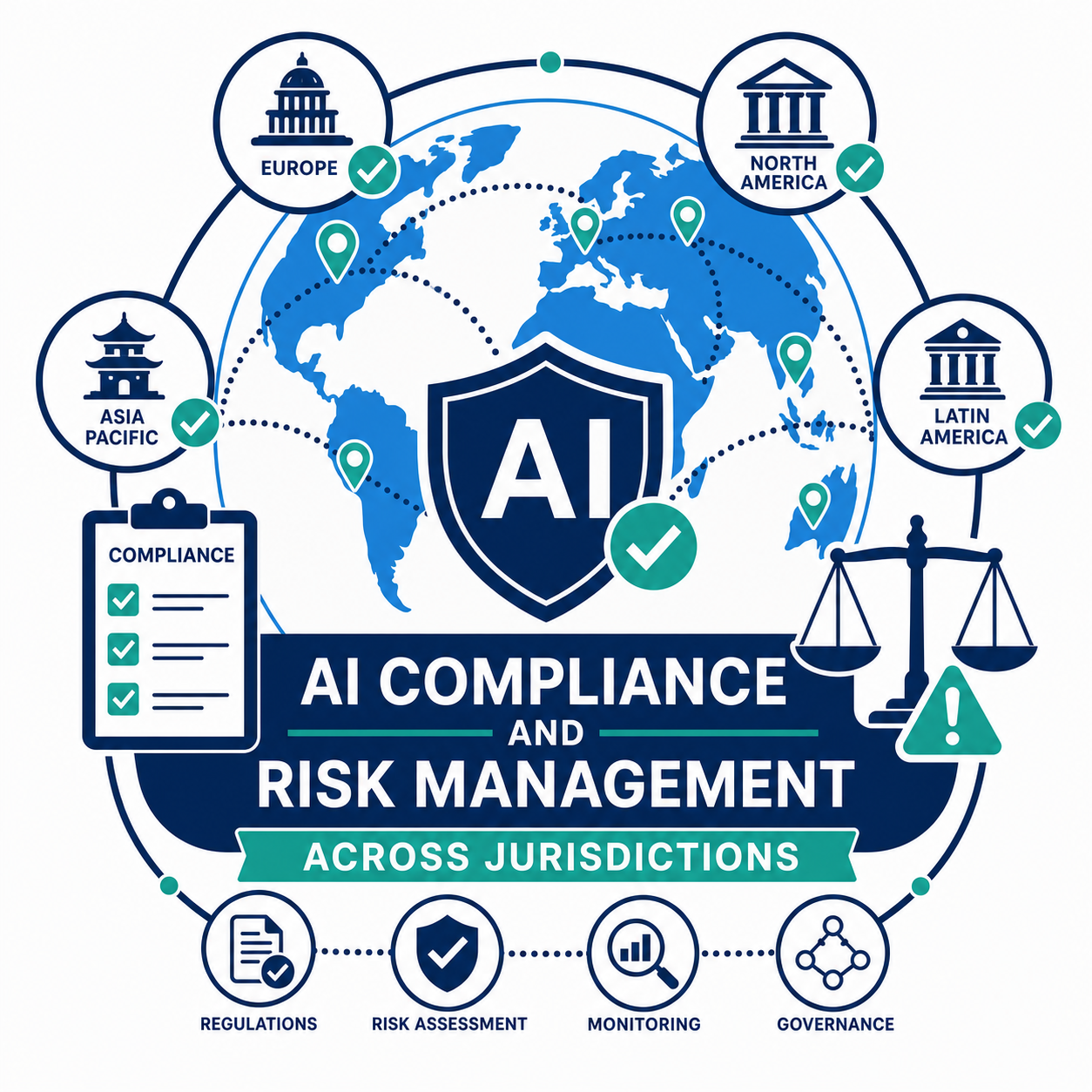
AI compliance across jurisdictions is the use of AI-assisted workflows to identify the applicable policy or regulation for a specific business event, apply approved controls, and escalate exceptions. The agent should not invent legal rules or make unreviewed legal determinations. Instead, it works from a curated rule library, structured business data, approved knowledge, and defined action boundaries.
Think of the agent as a control operator. It can read the jurisdiction and transaction context, retrieve the current policy version, test required conditions, and either complete a permitted workflow or hand the case to a person. The result is useful only when the organization defines the source of truth, ownership, review cadence, and evidence it expects to retain.
This approach can support Salesforce, HubSpot, and integrated systems. The architecture matters more than the user interface: accurate identity and location data, clear permissions, versioned rules, and reliable connections between the CRM, source systems, and case-management process are the foundation.
Why Is Multi-Jurisdiction Compliance So Difficult?
The challenge is more than keeping a list of regulations. Rules may differ by country, state or province, regulator, product, data category, customer status, or transaction direction. They also change on different schedules. A control that is appropriate in one location can be incomplete, overly restrictive, or inapplicable in another.
| Operational reality | What can go wrong without a governed workflow |
|---|---|
| Different rules and regulators | Teams apply a familiar local process to an event governed elsewhere. |
| Constant regulatory change | A new obligation sits in an update feed while operational instructions stay unchanged. |
| Fragmented systems | Location, consent, contract, and transaction data live in separate tools, so a reviewer lacks context. |
| Local expertise in silos | Regional teams resolve similar issues differently and cannot easily compare outcomes. |
| High documentation burden | Evidence is reconstructed after the fact instead of captured as work occurs. |
Manual tracking is still essential for interpretation and accountability. The risk appears when manual tracking is asked to perform every repeatable check at the volume and speed of modern operations. An AI-supported process should reduce that workload while preserving the ability to explain, override, and improve a decision.
How Do AI Agents Maintain Jurisdiction-Specific Rule Sets?
A strong design separates policy from execution. Compliance owners and legal reviewers maintain a versioned rule library with a plain-language requirement, authoritative source, effective date, jurisdiction, scope, owner, testing criteria, and escalation path. Technical teams then map that policy into deterministic checks, workflow constraints, or tightly bounded agent instructions.
When an event occurs, the agent first classifies context rather than jumping to an answer. It can identify the relevant location, entity role, data category, transaction type, and dates. It then retrieves only the rule set that matches those attributes. That scoping matters: an agent should not search a global knowledge base and choose whichever sentence sounds most relevant.
A useful rule record answers these questions:
- When does this rule apply? Define jurisdiction, trigger, exclusions, and effective dates.
- What action is permitted? Specify the required check, allowed outcome, and prohibited actions.
- Who owns uncertainty? Name the role or queue responsible for exceptions.
- What evidence is required? Capture inputs, rule version, output, reviewer, and follow-up action.
This model lets an organization update a local rule without rewriting an entire global workflow. It also makes testing possible: teams can run sample events against a draft rule before it becomes active.
How Does Automated Regulatory Change Monitoring Work?
Regulatory monitoring begins with approved sources, not indiscriminate web searching. A compliance team can designate regulator notices, government publications, policy subscriptions, and internal counsel updates as sources. An AI workflow can collect new items, identify the jurisdiction and topic, compare them to the current rule inventory, and create a review task when a likely change appears.
The key word is likely. A notice may be informational, proposed, delayed, or limited to a narrow scenario. The agent can summarize and route it, but a designated owner should confirm the interpretation, effective date, operational impact, and implementation plan. Once approved, the new rule version can be published with a controlled effective date and linked to the change record.
That process creates a measurable chain: source notice, assessment, decision, updated control, test result, and communication. It is far stronger than asking each regional team to remember what changed.
How Does AI Apply Rules to Cross-Border Transactions?
Cross-border compliance is often a data-quality problem before it is an AI problem. An agent needs reliable fields for parties, locations, entity roles, product or service, data categories, transaction purpose, and timing. If those inputs are missing or contradictory, the right outcome may be a hold or an escalation—not a confident prediction.
| Step | AI-supported action | Required safeguard |
|---|---|---|
| Classify | Read structured location and transaction context. | Validate source fields and flag conflicts. |
| Retrieve | Select the approved rules in force for the applicable jurisdiction. | Use effective dates and version IDs. |
| Evaluate | Run required checks and identify missing evidence. | Keep deterministic controls for hard requirements. |
| Act or route | Permit a bounded action, create a task, or place the item on hold. | Require human approval for defined risk thresholds. |
| Record | Store the decision, reason, evidence, and exception status. | Make records searchable and retained under policy. |
For example, a workflow may route an item differently when a counterparty, destination, or data-processing location changes. The value is not that AI “knows every law.” The value is that it consistently calls the organization’s approved rule set, catches missing context, and makes the escalation visible before the process moves on.
How Can AI Improve Risk Assessment, Monitoring, and Alerts?
AI can help a compliance team prioritize attention. Rather than treating all exceptions alike, a risk model can evaluate factors such as jurisdiction, data sensitivity, process history, missing documentation, unusual patterns, rule recency, and unresolved prior findings. The score should explain its drivers and should never be the only basis for a high-impact decision.
Monitoring works best when alerts have a clear owner and an expected response. A useful alert says what changed, which rule or risk factor triggered it, the affected workflow, evidence available, and the next action. A noisy alert stream trains people to ignore the system; a concise, role-based queue helps them resolve risk quickly and improve the underlying rule.
What Must Be in a Jurisdiction-Specific Audit Trail?
An audit trail must tell a reviewer what happened without asking them to reconstruct the story from separate systems. At minimum, retain the event identifier, relevant jurisdiction attributes, applicable rule and version, input data references, evaluation result, action taken, timestamp, user or agent identity, and any human override or approval.
For AI-assisted work, add the agent’s permitted action scope, knowledge source or policy reference, confidence or uncertainty indicator where meaningful, and the reason for escalation. Do not treat a generated narrative as proof by itself. The underlying records, rule version, and evidence links are what make a decision testable.
Audit design should also address access and retention. The people who need to review a case must be able to retrieve the appropriate evidence, while sensitive data remains subject to permissions, masking, and retention policies.
Where Does Salesforce Fit in a Governed AI Workflow?
Salesforce can serve as the operational layer where customer, case, transaction, approval, and task data come together. In a well-designed implementation, configured workflows and agents can use structured context to route work, enforce approved process steps, and create records that support review. Integration is often necessary so the platform has the source data needed to apply a rule correctly.
Salesforce’s official guidance reinforces the governance point. Its guidance on identifying Agentforce project risks and guardrails calls for teams to document risks and mitigation strategies for compliance and internal-audit purposes. Its Generative AI Audit Trail documentation describes audit data that can be used to investigate relevant AI activity, including information related to masking and toxicity assessment.
Those capabilities do not remove the need for policy design. They make it more practical to operationalize approved rules where work happens, while maintaining an evidence path for compliance owners and internal reviewers.
What Should Global Organizations Do Next?
Start with one repeatable, high-volume workflow where rule triggers and escalation paths are already reasonably clear. Map the jurisdiction attributes and source systems. Identify the policy owner, decision points, exceptions, and evidence requirements. Then test the flow with representative scenarios, including incomplete data and conflicting jurisdiction signals.
Avoid starting with an autonomous “global compliance agent.” Begin with retrieval, routing, documentation, and reviewer support. Expand the agent’s action scope only after the rules, data, permissions, monitoring, and audit trail have proven reliable.
How Vantage Point Helps
Vantage Point is a boutique, senior-led Salesforce and HubSpot consulting partner. We help organizations turn policy requirements into durable operations: governed CRM design, practical AI workflows, integrations, data controls, and support processes that people can use.
Our teams can connect Salesforce implementation and advisory with compliance and security solutions, AI-driven personalization and analytics, and system integration and data migration. We can also help establish the operating model through managed services and ongoing support.
Talk to Vantage Point about AI-powered compliance if your team needs to assess a multi-jurisdiction workflow, clarify the right control boundaries, or build an implementation plan.
Frequently Asked Questions
Can AI agents make legal decisions across jurisdictions?
No. AI agents can apply organization-approved rules, collect context, flag exceptions, and route work, but accountable legal and compliance owners must define the rules and approve high-risk or ambiguous outcomes.
What data does an AI compliance workflow need?
It needs accurate structured data about jurisdiction, parties, entity roles, transaction or case type, timing, consent or permissions where relevant, and the evidence required by the applicable policy. Missing or conflicting fields should trigger review.
How do organizations keep jurisdiction-specific rules current?
Organizations should maintain an owned, versioned rule library and use approved regulatory sources to create review tasks for likely changes. A qualified owner should validate the change before a new rule becomes active.
Can Salesforce support compliance documentation for AI-assisted workflows?
Salesforce can support operational records, approvals, tasks, and audit-oriented data in a governed workflow. The exact design depends on the organization’s policies, data model, integrations, permissions, and retention requirements.
How should a team start using AI for cross-border compliance?
Start with one bounded workflow that has clear rules, reliable inputs, an escalation path, and test scenarios. Use AI first for retrieval, routing, and documentation, then expand only after controls and review practices are working.
What makes an AI compliance audit trail useful?
A useful trail links the event, jurisdiction context, applicable rule version, data references, outcome, evidence, timestamps, and any human override. It should explain how the organization applied its policy, not merely preserve a generated summary.
Does AI compliance work only in Salesforce?
No. The same governance pattern can support Salesforce, HubSpot, and connected systems. What matters is a trusted rule library, accurate operational data, controlled actions, and an evidence trail that spans the systems involved.
About Vantage Point
Vantage Point helps businesses transform CRM, automation, integration, and AI operations with senior-led Salesforce and HubSpot expertise. Visit vantagepoint.io to explore our approach.