
Key Takeaways (TL;DR)
- What is it? Vantage Point's structured change management methodology, the VALUE framework, that transforms CRM implementations from technology rollouts into lasting organizational change
- Key Benefit: Organizations using structured change management are far more likely to meet or exceed CRM project objectives
- The Problem: Many CRM implementations fail to meet expectations, and the #1 reason is poor change management: not the technology itself
- Timeline: Change management should begin 4-8 weeks before go-live and continue 6-12 months post-launch
- Best For: Any organization implementing Salesforce or HubSpot CRM who wants strong, lasting adoption
- Bottom Line: Our advisory approach is built to drive real user adoption in the first 90 days after launch
Introduction: Why Most CRM Implementations Fall Short
Here is a statistic that should concern every executive planning a CRM investment: up to 70% of CRM implementations fail to meet expectations. According to Gartner, this pattern is expected to persist through 2027. Yet the root cause is rarely the software itself.
The #1 reason CRM projects underperform is change management, or rather, the lack of it.
Organizations pour hundreds of thousands of dollars into Salesforce, HubSpot, or other CRM platforms, invest months in configuration and customization, and then wonder why teams are still using spreadsheets six months after launch. The issue is not that the technology does not work. The issue is that nobody prepared the people who have to use it.
At Vantage Point, we have seen this pattern repeat, and we have built a methodology specifically designed to break it. This post walks through our advisory approach to change management, including the frameworks, strategies, and adoption metrics we use to ensure CRM investments deliver real, measurable ROI.
Whether you are implementing Salesforce Sales Cloud, HubSpot CRM, or migrating between platforms, these strategies will help your organization join the 30% that get it right.
What Is CRM Change Management and Why Does It Matter?
CRM change management is the structured process of preparing, equipping, and supporting people through a CRM implementation or transition. It addresses the human side of technology change. The behaviors, workflows, habits, and mindsets that determine whether your team actually uses the system.
The Cost of Ignoring Change Management
Without deliberate change management, CRM implementations face predictable consequences:
| Failure Indicator | Impact |
|---|---|
| Low login rates | Only a fraction of licensed users actively use the CRM within 90 days |
| Shadow systems | Teams revert to spreadsheets, sticky notes, or legacy tools |
| Data quality collapse | Incomplete records, duplicate entries, and outdated information |
| Executive disillusionment | Leadership questions the CRM investment and cuts funding for Phase 2 |
| Revenue leakage | Pipeline visibility disappears and forecast accuracy drops |
Research from Prosci consistently shows that projects with excellent change management are 6x more likely to meet objectives than those with poor change management. For a CRM implementation that might cost $100K. $500K+, that is the difference between transformative ROI and an expensive underperforming system.
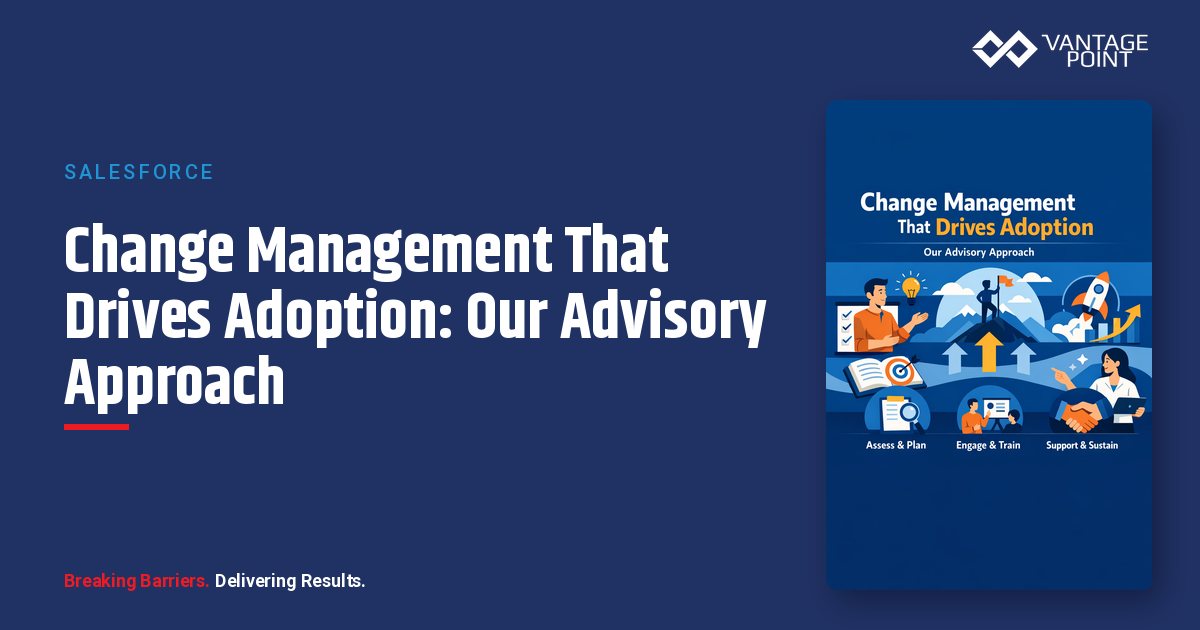
The VALUE Framework: Vantage Point's Change Management Methodology
After hundreds of engagements across industries, we developed the VALUE framework: a structured, repeatable approach to change management that drives adoption across any CRM platform.
V: Vision Alignment
Every successful CRM implementation starts with a clear, shared vision that connects the technology to business outcomes.
What we do:
- Facilitate executive alignment workshops to define what CRM success looks like in measurable terms
- Create a compelling "case for change" that answers the question every employee asks: "What's in it for me?"
- Map CRM capabilities to specific pain points each department currently faces
- Establish a shared definition of success with KPIs that executives, managers, and end users all understand
Why it matters: When employees understand why the change is happening and how it benefits them personally, resistance drops significantly. A vision statement like "we're implementing Salesforce" means nothing. A vision like "we're eliminating the 3 hours per week every sales rep spends on manual data entry so they can focus on selling" creates buy-in.
A: Adaptability Planning
Not every team, role, or individual experiences change the same way. Adaptability planning ensures your change strategy is tailored: not one-size-fits-all.
What we do:
- Conduct role-based impact assessments to understand how each team's daily work changes
- Build persona-based change plans for power users, casual users, managers, and executives
- Create flexibility in timelines and training for teams with different learning curves
- Design phased rollouts that allow early wins before introducing complex features
Why it matters: A sales rep's CRM experience is fundamentally different from a service agent's. An operations manager needs dashboards and reports, not lead management. When you adapt your change approach to how people actually work, adoption accelerates.
L: Leverage (Champions and Stakeholders)
CRM adoption does not happen through top-down mandates alone. It spreads through trusted peers. The change champions who model the behavior you want to see across the organization.
What we do:
- Identify and recruit change champions: respected team members who become CRM advocates
- Build a formal Champion Network with regular training sessions, early access to updates, and a direct feedback loop to the project team
- Conduct stakeholder mapping using a Power/Interest grid to segment sponsors, champions, neutral parties, and potential resistors
- Equip managers with talking points, FAQ documents, and data to support their teams through the transition
The Stakeholder Mapping Process:
| Stakeholder Segment | Engagement Strategy |
|---|---|
| High Power / High Interest (Executive Sponsors) | Active partnership: involve in decisions, regular status updates |
| High Power / Low Interest (Senior Leaders) | Keep satisfied: quarterly briefings, highlight business impact |
| Low Power / High Interest (Champions, Power Users) | Keep informed: weekly updates, beta testing, feedback sessions |
| Low Power / Low Interest (Casual Users) | Monitor: standard communications, on-demand training |
Why it matters: Prosci research shows that employees prefer to hear about change from two sources: senior leaders (for the business case) and their direct managers (for personal impact). Your champion network bridges the gap between executive strategy and frontline execution.
U: User-Centric Design and Training
Training is not a one-day event. It is a sustained program designed around how people actually learn and work.
What we do:
- Develop role-based training paths: sales, service, marketing, operations, and leadership each get customized curricula
- Create a blended learning approach combining live workshops, self-paced e-learning, quick-reference guides, and in-app guidance
- Build a CRM Knowledge Base with searchable articles, video walkthroughs, and scenario-based tutorials
- Schedule reinforcement sessions at 30, 60, and 90 days post-launch to address emerging questions and advanced features
- Establish office hours and a dedicated Slack or Teams channel for real-time CRM support
Training Timeline:
| Phase | Timing | Activities |
|---|---|---|
| Awareness | 6-8 weeks before go-live | Town halls, email campaigns, "what's changing" guides |
| Preparation | 3-4 weeks before go-live | Role-based training sessions, sandbox access, practice exercises |
| Launch Support | Go-live week | Floor walkers, dedicated help desk, daily tips |
| Reinforcement | 30-90 days post-launch | Advanced feature training, adoption reviews, optimization workshops |
| Continuous | Ongoing | Quarterly refreshers, new feature rollouts, new hire onboarding |
Why it matters: People forget much of what they learn quickly when there is no reinforcement. A single training session before go-live is not enough. Sustained, role-specific training is what converts reluctant users into proficient ones.
E: Excellence Through Measurement
You cannot improve what you do not measure. Our approach builds adoption metrics into the implementation plan from Day 1: not as an afterthought.
What we do:
- Define adoption KPIs before go-live and track them weekly for the first 90 days
- Build real-time adoption dashboards visible to project sponsors and department leaders
- Conduct monthly adoption reviews with targeted interventions for lagging teams
- Celebrate wins publicly: teams and individuals who hit adoption milestones get recognized
Adoption KPIs: What We Measure and Why
Measuring CRM adoption requires more than checking login counts. At Vantage Point, we track a comprehensive set of KPIs across four dimensions:
1. Engagement Metrics
| KPI | Target | What It Reveals |
|---|---|---|
| Daily Active Users (DAU) | 80%+ of licensed users | Whether people are logging in consistently |
| Login Frequency | 4+ times per week per user | Habitual vs. sporadic usage patterns |
| Session Duration | 15+ minutes average | Whether users are doing real work or just checking a box |
| Feature Utilization Rate | 60%+ of core features used | Whether teams use the CRM fully or just the basics |
2. Data Quality Metrics
| KPI | Target | What It Reveals |
|---|---|---|
| Record Completeness | 90%+ of required fields populated | Whether users are entering meaningful data |
| Duplicate Rate | Below 3% | Whether data hygiene processes are working |
| Data Freshness | 85%+ of records updated within 30 days | Whether the CRM reflects current reality |
| Contact-to-Account Linkage | 95% | Whether relationships are properly structured |
3. Process Compliance Metrics
| KPI | Target | What It Reveals |
|---|---|---|
| Opportunity Stage Updates | Within 48 hours of stage change | Whether pipeline data is trustworthy |
| Activity Logging | 90%+ of customer interactions logged | Whether the CRM is the system of record |
| Task Completion Rate | 80%+ of assigned tasks completed on time | Whether workflows are being followed |
| Report Utilization | 70%+ of managers using dashboards weekly | Whether data-driven decisions are happening |
4. Business Outcome Metrics
| KPI | Target | What It Reveals |
|---|---|---|
| Forecast Accuracy | Within 10% of actual results | Whether CRM data supports reliable predictions |
| Pipeline Velocity | 15-25% improvement within 6 months | Whether CRM is accelerating deals |
| Customer Response Time | 20%+ reduction | Whether service teams leverage CRM effectively |
| Cross-Sell / Upsell Rate | 10-15% increase within 12 months | Whether 360° customer views drive revenue |
Communication Planning: The Backbone of Successful Change
A strong communication plan ensures the right people receive the right message at the right time through the right channel. Here is the framework we use at Vantage Point:
The 5W Communication Framework
- Who needs to know? (Segment by role, department, and change impact level)
- What do they need to know? (Tailored by audience: executives want ROI, end users want workflow changes)
- When do they need to know it? (Mapped to project milestones and phases)
- Where will they receive it? (Email, Slack, town halls, one-on-ones, intranet)
- Why should they care? (Benefits framed from their perspective)
Communication Cadence
| Audience | Channel | Frequency | Content |
|---|---|---|---|
| Executive Sponsors | Steering committee meetings | Biweekly | Budget, timeline, risk, adoption metrics |
| Department Managers | Manager briefings | Weekly during rollout | Team-specific impact, talking points, FAQ |
| Change Champions | Champion network meetings | Weekly | Early access, feedback, advocacy tools |
| End Users | Email + Slack/Teams | 2x per week pre-launch; weekly post-launch | What's changing, training dates, tips and tricks |
| Entire Organization | Town halls | Monthly | Big-picture progress, success stories, Q&A |
Managing Resistance: Turning Skeptics into Advocates
Resistance is not a problem to eliminate: it is a signal to listen to. Every objection contains information about what people need to feel confident in the change.
Common Sources of CRM Resistance
- Fear of surveillance: "Management will use this to monitor my every move"
- Workflow disruption: "My current process works fine, why change?"
- Technology anxiety: "I'm not tech-savvy enough to learn a new system"
- Past failures: "We tried this before and it didn't work"
- Time pressure: "I don't have time to learn something new while hitting my targets"
Our Resistance Management Approach
Step 1: Anticipate. During the impact assessment, we identify which roles and teams will experience the most significant changes. These groups get proactive, personalized attention.
Step 2: Listen. We create safe channels for feedback, anonymous surveys, one-on-one check-ins with champions, and "ask me anything" sessions. Resistance voiced is resistance you can address.
Step 3: Address root causes. Each type of resistance requires a different response:
| Resistance Type | Response Strategy |
|---|---|
| Fear of surveillance | Demonstrate how the CRM helps reps (auto-logging, templates) rather than monitors them |
| Workflow disruption | Show side-by-side "before and after" workflows proving efficiency gains |
| Technology anxiety | Provide extra hands-on training, buddy systems, and patient support resources |
| Past failure memory | Acknowledge previous experiences honestly and explain what is different this time |
| Time constraints | Quantify time savings, show how a few minutes of CRM input replaces manual reporting |
Step 4: Escalate constructively. For persistent resistance that impacts team adoption, we work with managers to understand whether the issue is skill-based (needs training), will-based (needs motivation), or systemic (needs a process fix).
What Makes Vantage Point's Approach Different
Not all consulting firms approach change management the same way. Here is what sets Vantage Point apart:
Senior-Only Consultants
Every Vantage Point engagement is led by senior consultants with 10+ years of CRM experience. We do not staff projects with junior resources or offshore teams. When you work with us, you get practitioners who have navigated complex organizational change firsthand: not textbook theorists.
Employee-Owned Model
Vantage Point is employee-owned, which means our consultants have a direct stake in your success. There are no misaligned incentives to extend timelines or upsell unnecessary services. Our goal is straightforward: deliver measurable results that earn long-term partnerships.
Platform Agnostic, Strategy First
Whether your organization runs Salesforce Sales Cloud, HubSpot CRM, or is evaluating both, our change management methodology adapts to the platform. The VALUE framework works because it focuses on people and process first: the technology is the enabler, not the driver.
Best Practices for CRM Change Management
Based on our experience across hundreds of implementations, here are the practices that consistently drive the highest adoption:
1. Start Change Management Before the Project Kicks Off
Do not wait until UAT to think about adoption. Ideally, change management planning begins during the scoping phase: 4 to 8 weeks before development starts.
2. Secure Visible Executive Sponsorship
Active, visible executive sponsors increase adoption rates by up to 72%, according to Prosci research. Sponsors should communicate regularly, participate in key milestones, and model the CRM usage they expect from their teams.
3. Build Your Champion Network Early
Identify 1-2 champions per department or team of 15-20 people. Champions should be respected peers (not managers) who are comfortable with technology and genuinely enthusiastic about the CRM.
4. Tailor Everything by Role
Generic training, generic communications, and generic timelines produce generic (low) adoption. Invest the time to customize by role: what sales reps need is different from what service agents need is different from what executives need.
5. Measure Adoption Weekly for the First 90 Days
The first 90 days after go-live are critical. Weekly adoption reviews allow you to identify lagging teams, provide targeted interventions, and celebrate early wins before bad habits solidify.
6. Celebrate and Publicize Quick Wins
When a team hits 90% login rates, when a manager pulls their first pipeline report from the CRM instead of a spreadsheet, when a rep closes a deal using CRM insights: celebrate it. Public recognition reinforces the behaviors you want to see.
7. Plan for the Long Game
Adoption is not a launch-day metric. True CRM adoption is an ongoing organizational discipline. Budget for post-launch support, quarterly training refreshers, and continuous optimization for at least 12 months after go-live.
Frequently Asked Questions
What percentage of CRM implementations fail?
Studies consistently report that 50-70% of CRM implementations fail to meet their intended business objectives. Gartner projects this trend continuing through 2027. The primary driver of failure is not technology: it is inadequate change management and user adoption.
How long does CRM change management take?
A comprehensive CRM change management program typically begins 4-8 weeks before go-live and continues for 6-12 months post-launch. The pre-launch phase focuses on awareness and preparation, while the post-launch phase emphasizes reinforcement and optimization.
What is the most important factor in CRM adoption?
Executive sponsorship is the single most important factor. Research from Prosci shows that active, visible sponsors can increase the likelihood of project success by up to 72%. However, sponsorship must be combined with role-based training, stakeholder engagement, and sustained reinforcement.
How do you measure CRM adoption?
CRM adoption should be measured across four dimensions: engagement metrics (login frequency, feature utilization), data quality (record completeness, duplicate rates), process compliance (activity logging, stage updates), and business outcomes (forecast accuracy, pipeline velocity).
What is the VALUE framework?
VALUE is Vantage Point's proprietary change management methodology: Vision Alignment, Adaptability Planning, Leverage (Champions and Stakeholders), User-Centric Design and Training, and Excellence Through Measurement. It provides a structured, repeatable approach to driving CRM adoption across any platform.
How do you handle resistance to CRM adoption?
Resistance management starts with anticipation, identifying high-impact roles during planning, and continues with active listening, root cause analysis, and tailored responses. Fear of surveillance, workflow disruption, technology anxiety, past failures, and time pressure each require different intervention strategies.
Can change management improve adoption for an existing CRM?
Absolutely. Many organizations engage Vantage Point specifically for "adoption rescue". Re-energizing a CRM that was implemented without proper change management. The approach includes a current-state assessment, gap analysis, champion recruitment, targeted retraining, and a 90-day adoption sprint.
What is the ROI of investing in change management?
Organizations that invest in change management report higher ROI on their CRM implementations than those that do not. The return comes from higher data quality (better decisions), improved process compliance (fewer errors), and accelerated pipeline velocity (faster revenue).
How does Vantage Point's approach differ from other consulting firms?
Three key differentiators: (1) senior-only consultants with 10+ years of experience on every engagement, (2) an employee-owned business model that aligns our incentives with client success, and (3) a proven methodology.
Conclusion: Technology Is Only Half the Equation
Every CRM platform on the market (Salesforce, HubSpot, or otherwise) is capable of transforming how your organization manages customer relationships, accelerates revenue, and delivers exceptional service. But capability alone does not drive results. People do.
The organizations that succeed with CRM are the ones that invest as deliberately in their people as they do in their technology. They align leadership, engage stakeholders, train effectively, measure relentlessly, and treat adoption as an ongoing discipline: not a launch-day checkbox.
At Vantage Point, change management is not an add-on service. It is woven into every implementation we deliver. Our VALUE framework, senior consultant team, and employee-owned commitment to client success have helped organizations achieve the adoption rates that turn CRM investments into competitive advantages.
Ready to make your next CRM implementation succeed? Contact Vantage Point to learn how our advisory approach can drive adoption across your organization.
About Vantage Point
Vantage Point is an employee-owned CRM consultancy specializing in Salesforce, HubSpot, MuleSoft, Data Cloud, and AI-powered solutions. We help organizations of every size turn CRM technology into measurable business results. Our senior-only consulting model ensures every engagement is led by experienced practitioners: never offshore teams or junior resources.
Learn more at vantagepoint.io.