Key Takeaways (TL;DR)
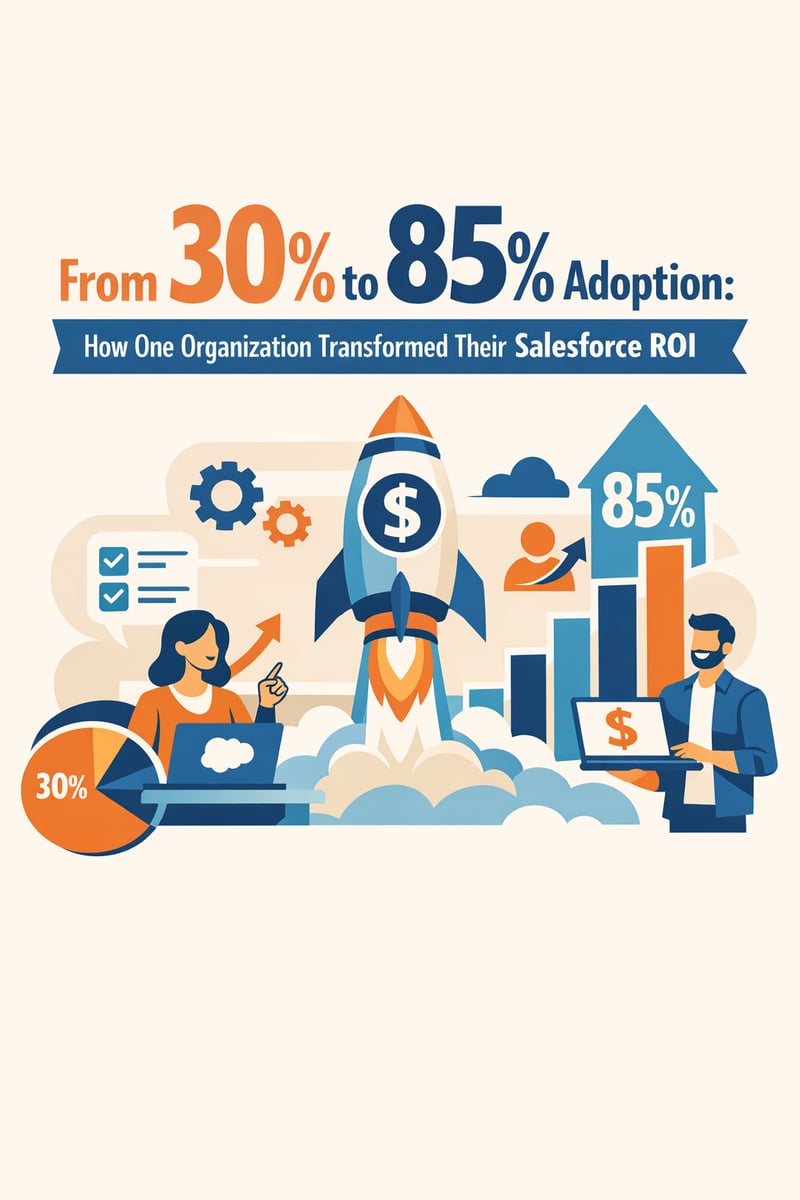
- What is it? An anonymized case study showing how a mid-market organization tripled Salesforce adoption through a structured methodology — going from 30% to 85%+ in under 12 months
- Key Results: 350% improvement in data completeness, 62% reduction in onboarding time, and 85%+ platform adoption
- Timeline: 3 phases over approximately 9–12 months (Discovery → Implementation → Optimization)
- Best For: Organizations with 50–500+ users struggling with low CRM adoption, poor data quality, or underwhelming Salesforce ROI
- Root Causes Addressed: Poor data quality, lack of training, misaligned processes, low user trust, no executive sponsorship
- Bottom Line: CRM adoption is not a technology problem — it's a people, process, and strategy problem. The right methodology turns Salesforce from a cost center into a growth engine.
Introduction: The Silent Killer of CRM Investments
Here's a stat that should concern every business leader: the average CRM adoption rate across industries sits at just 26%, according to recent 2026 research. That means roughly three-quarters of users with CRM access aren't leveraging it effectively — or at all.
For organizations investing six or seven figures annually in Salesforce licenses, customization, and maintenance, low adoption isn't just an inconvenience. It's a direct hit to ROI, forecasting accuracy, data integrity, and operational efficiency.
This is the story of one organization that refused to accept that outcome. Working with Vantage Point, they transformed their Salesforce adoption from a dismal 30% to over 85% — and unlocked measurable business results along the way.
While we've anonymized the details to protect confidentiality, the challenges, solutions, and outcomes in this case study are real. And if your organization is struggling with CRM adoption, this roadmap may be exactly what you need.
The Starting Point: A CRM in Crisis
What the Organization Looked Like
The organization in question was a mid-market company with approximately 200 employees across sales, service, and operations teams. They had been running Salesforce for over three years but were seeing deeply disappointing results:
- Only ~30% of licensed users were actively logging into Salesforce on a weekly basis
- Data completeness hovered around 20% — critical fields like deal stage, close dates, and contact information were frequently blank or outdated
- New hires took 6+ weeks to become proficient with the system
- Leadership had no visibility into pipeline accuracy because the data couldn't be trusted
- Shadow systems proliferated — spreadsheets, personal note-taking apps, and manual trackers became the de facto tools for managing customer relationships
The Root Causes
Through an in-depth discovery process, Vantage Point identified five interconnected root causes driving the adoption crisis:
1. Poor Data Quality & No Governance
Historical data migrations had introduced duplicates, incomplete records, and outdated information. Without data governance policies, the problem compounded over time. Users lost trust — why enter data into a system full of bad information?
2. Lack of Role-Based Training
The organization's initial Salesforce rollout included a single, generic training session for all users. Sales reps, service agents, and managers all received the same walkthrough — leaving each group without the skills they actually needed for their daily workflows.
3. Misaligned Processes
Business processes hadn't been redesigned to work within Salesforce. Instead, Salesforce was layered on top of existing manual workflows, creating double-entry and administrative overhead that users resented.
4. Low User Trust
The combination of bad data and clunky processes meant users didn't trust Salesforce to help them do their jobs. They viewed it as a reporting obligation rather than a productivity tool.
5. No Executive Sponsorship
Leadership talked about Salesforce ROI in board meetings but didn't actively use the platform themselves. Without visible executive buy-in, frontline teams had no incentive to change their behavior.
The Transformation: Vantage Point's VALUE Methodology
Vantage Point's approach to this engagement followed their proprietary VALUE Methodology — a structured framework designed to address CRM challenges holistically rather than through piecemeal fixes.
What Is the VALUE Methodology?
The VALUE Methodology stands for:
- V — Validate: Assess the current state, identify gaps, and establish a clear baseline
- A — Align: Map business processes to Salesforce capabilities and align stakeholders around shared goals
- L — Launch: Implement changes in prioritized phases with built-in feedback loops
- U — Uplift: Train, enable, and support users with role-specific programs
- E — Evolve: Measure outcomes, iterate, and continuously optimize
This framework ensures that technology changes are always paired with people and process changes — because adoption is never just a technical challenge.
Phase 1: Discovery & Validation (Weeks 1–6)
Comprehensive Platform Audit
Vantage Point began with a thorough assessment of the existing Salesforce environment. This included:
- Usage analytics review: Identifying login frequency, feature utilization, and workflow completion rates across all user roles
- Data quality audit: Profiling records for completeness, accuracy, duplicates, and staleness
- Process mapping workshops: Facilitating sessions with each department to document actual workflows versus intended CRM workflows
- Stakeholder interviews: One-on-one conversations with executives, managers, and frontline users to understand pain points, frustrations, and unmet needs
- Shadow system inventory: Cataloging every spreadsheet, external tool, and workaround that users relied on instead of Salesforce
Key Discovery Findings
| Metric | Baseline |
|---|---|
| Weekly Active Users | ~30% |
| Data Completeness | ~20% |
| Average Fields Completed per Record | 4 of 15 required |
| New Hire Salesforce Proficiency | 6+ weeks |
| Pipeline Forecast Accuracy | ~40% |
| Duplicate Record Rate | 22% |
Building the Roadmap
Based on these findings, Vantage Point built a phased roadmap with clear milestones:
- Quick wins (0–30 days): Data cleanup, simplified page layouts, executive dashboard deployment
- Foundation building (30–90 days): Role-based training rollout, process redesign, governance framework
- Sustained optimization (90–180 days): Advanced automation, analytics expansion, continuous enablement
Phase 2: Implementation & Alignment (Weeks 7–24)
Data Cleanup & Governance
The Problem: 22% duplicate records, thousands of stale contacts, and no validation rules to prevent future decay.
The Solution:
- Mass deduplication: Identified and merged over 4,000 duplicate records using automated matching rules with manual review for edge cases
- Data enrichment: Partnered with data validation tools to fill in missing firmographic and contact information
- Validation rules: Implemented required fields with smart defaults and conditional logic to ensure data was captured at the right stages
- Data governance framework: Established data stewardship roles, defined RACI responsibilities, and set up quarterly data health reviews
- Automated hygiene: Configured scheduled jobs to flag stale records and incomplete opportunities for review
Impact: Data completeness jumped from ~20% to over 70% within the first 90 days — and user trust began to rebuild.
Process Redesign & Workflow Simplification
The Problem: Salesforce workflows didn't match how teams actually worked, creating friction and resistance.
The Solution:
- Workflow mapping: Redesigned sales, service, and operations processes to be Salesforce-native rather than bolt-on
- Reduced clicks: Simplified page layouts from 15+ fields visible at once to role-specific views showing only relevant information
- Guided paths: Implemented Salesforce Path and guided flows that walked users through stage-by-stage processes
- Automation of manual tasks: Configured Flow automations to handle repetitive tasks like follow-up reminders, task creation, and record updates
- Eliminated shadow systems: Rebuilt the most-used spreadsheet workflows inside Salesforce using reports, dashboards, and list views
Impact: Users reported a 40% reduction in the time required to complete daily CRM tasks. Spreadsheet usage dropped by 70%.
Role-Based Dashboards
The Problem: Everyone saw the same default dashboard, which was relevant to no one.
The Solution:
- Executive dashboards: Pipeline health, forecast accuracy, win/loss trends, and team performance KPIs
- Sales rep dashboards: My opportunities, next actions, quota attainment, and activity tracking
- Service team dashboards: Open cases, SLA compliance, customer satisfaction, and resolution time
- Manager dashboards: Team activity, coaching opportunities, data quality scores, and adoption metrics
Impact: Dashboard usage increased 300% within the first month of deployment. For the first time, leadership could trust the data they were seeing.
Executive Sponsorship Program
The Problem: Frontline users had no visible proof that leadership valued or used Salesforce.
The Solution:
- Executive dashboard reviews: Weekly leadership meetings began with a Salesforce dashboard review — making the platform the single source of truth for business discussions
- CEO/CRO communications: Regular messages from senior leadership highlighting wins enabled by Salesforce data
- Manager accountability: Manager performance reviews included CRM adoption metrics for their teams
- Recognition program: Monthly recognition for teams and individuals with the highest data quality and platform engagement scores
Impact: When leadership walked the walk, adoption accelerated faster than any training program alone could achieve.
Phase 3: Uplift & Optimization (Weeks 25–40)
Targeted Training Program
The Problem: One-size-fits-all training left every user group underserved.
The Solution:
- Role-specific training tracks: Separate curricula for sales, service, operations, and leadership
- Microlearning modules: 5–10 minute video lessons for specific tasks (e.g., "How to log a call," "How to update an opportunity stage")
- Live office hours: Weekly drop-in sessions where users could get real-time help
- In-app guidance: Salesforce in-app prompts and walkthroughs for new features and process changes
- Certification incentives: Internal Salesforce "power user" badges with recognition and small rewards
- Onboarding playbook: A structured 2-week Salesforce onboarding track for new hires
Impact: New hire proficiency time dropped from 6+ weeks to just over 2 weeks — a 62% reduction.
Continuous Improvement Loop
Vantage Point didn't just implement and leave. They established:
- Monthly adoption scorecards: Tracking login rates, data completeness, feature usage, and workflow completion
- Quarterly optimization sprints: Addressing user feedback, fixing friction points, and rolling out enhancements
- User feedback channels: A dedicated Slack channel and quarterly surveys to capture ongoing suggestions and concerns
- Adoption champion network: Power users in each department who served as peer mentors, feedback conduits, and first-line support
The Results: Measurable Transformation
Before and After Comparison
| Metric | Before | After (12 Mo.) | Improvement |
|---|---|---|---|
| Weekly Active Users | ~30% | 85%+ | 183% increase |
| Data Completeness | ~20% | 90%+ | 350% improvement |
| New Hire Proficiency | 6+ weeks | ~2.3 weeks | 62% reduction |
| Forecast Accuracy | ~40% | 82% | 105% improvement |
| Duplicate Record Rate | 22% | 3% | 86% reduction |
| Shadow System Usage | High (70%+) | Minimal (<10%) | Eliminated |
Business Impact Beyond the Numbers
The transformation extended far beyond CRM metrics:
- Sales velocity increased as reps spent less time on data entry and more time selling
- Forecast confidence improved because leadership could finally trust pipeline data for resource allocation and strategic planning
- Customer experience improved as service teams had complete customer history at their fingertips
- Cross-department collaboration grew because marketing, sales, and service were all working from the same data
- Onboarding costs decreased as new hires ramped up faster and needed less hands-on support
Why Did This Work? 5 Principles for CRM Adoption Success
1. Treat Adoption as a Business Initiative, Not an IT Project
CRM adoption isn't about getting people to log in — it's about changing how work gets done. This requires business leadership, not just technical implementation.
2. Fix the Data Before Asking for Trust
Users will never adopt a system they don't trust. Data quality is the foundation of adoption — clean it first, govern it always, and make it everyone's responsibility.
3. Design for the User, Not the Admin
Page layouts, dashboards, and workflows should be built around how users actually work — not how the system was originally configured. Fewer fields, smarter flows, and role-specific views make adoption natural rather than forced.
4. Make Leadership Visible
Executive sponsorship isn't just a kickoff email. It's weekly dashboard reviews, public recognition of CRM wins, and holding managers accountable for their teams' adoption metrics.
5. Never Stop Enabling
Training isn't a launch event — it's an ongoing program. Microlearning, in-app guidance, office hours, and champion networks keep users engaged and continuously improving.
How Vantage Point Can Help Your Organization
If this story sounds familiar — if you're sitting on a Salesforce investment that isn't delivering the ROI you expected — you're not alone. And you don't have to solve it alone.
Vantage Point specializes in helping organizations unlock the full potential of their CRM investments. Our services include:
- Salesforce Health Checks & Adoption Assessments to identify root causes and build data-driven roadmaps
- Data Cloud & Integration Services through MuleSoft to unify your data ecosystem
- Custom Dashboard & Reporting Design to put actionable insights in the hands of every team
- Training & Enablement Programs tailored to your organization's roles, processes, and goals
- Ongoing Optimization & Managed Services to ensure continuous improvement and sustained adoption
Whether you're on Salesforce, HubSpot, or looking to connect both through integrated solutions, Vantage Point brings the expertise to make your CRM a true growth engine.
Ready to transform your CRM adoption? Contact Vantage Point to schedule a complimentary adoption assessment.
Frequently Asked Questions (FAQ)
What is a good Salesforce adoption rate?
A good Salesforce adoption rate is generally considered to be 75% or higher for weekly active users. Best-in-class organizations achieve 85%+ adoption rates. The industry average, however, sits at approximately 26%, meaning most organizations have significant room for improvement.
How long does it take to improve CRM adoption?
Most organizations can see meaningful adoption improvements within 3–6 months with a structured methodology. Quick wins like data cleanup and simplified page layouts can drive measurable results in 30–60 days, while sustained transformation typically requires 9–12 months of phased work.
What are the most common causes of low Salesforce adoption?
The five most common causes are: (1) poor data quality that erodes user trust, (2) lack of role-based training, (3) misaligned business processes that create friction, (4) no visible executive sponsorship, and (5) overly complex page layouts and workflows that slow users down.
How do you measure Salesforce adoption?
Key metrics include: weekly/monthly active users (login rates), data completeness scores, feature utilization rates, workflow completion percentages, pipeline forecast accuracy, and time-to-proficiency for new hires. Dashboard engagement and shadow system usage are also valuable indicators.
What is the VALUE Methodology for CRM adoption?
The VALUE Methodology is Vantage Point's proprietary framework for CRM transformation: Validate (assess current state), Align (map processes and stakeholder goals), Launch (implement in prioritized phases), Uplift (train and enable users), and Evolve (measure, iterate, and optimize). It ensures technology, people, and process changes work together.
Can you improve Salesforce adoption without a complete re-implementation?
Absolutely. In most cases, low adoption doesn't require starting from scratch. Targeted interventions — data cleanup, process simplification, role-based training, and executive sponsorship — can dramatically improve adoption within the existing Salesforce environment. A health check assessment identifies exactly where to focus.
What ROI can you expect from improving CRM adoption?
Organizations that move from low to high CRM adoption typically see 300–500% ROI within 18 months through improved sales productivity, better forecast accuracy, reduced manual work, faster onboarding, and enhanced customer experience. The specific ROI depends on organization size, current adoption baseline, and industry.
About Vantage Point
Vantage Point is a trusted CRM and technology consulting partner helping organizations maximize their investments in Salesforce, HubSpot, and connected platforms. As a certified Salesforce partner and HubSpot Solutions Provider, Vantage Point delivers end-to-end services including implementation, integration (MuleSoft, Data Cloud), AI-powered personalization (Claude AI/Anthropic), cloud telephony (Aircall), and ongoing optimization.
Our mission is simple: turn your technology investments into measurable business outcomes. Whether you're starting your CRM journey or looking to unlock more value from your existing platform, Vantage Point has the expertise and methodology to get you there.
Learn more at vantagepoint.io