Key Takeaways (TL;DR)
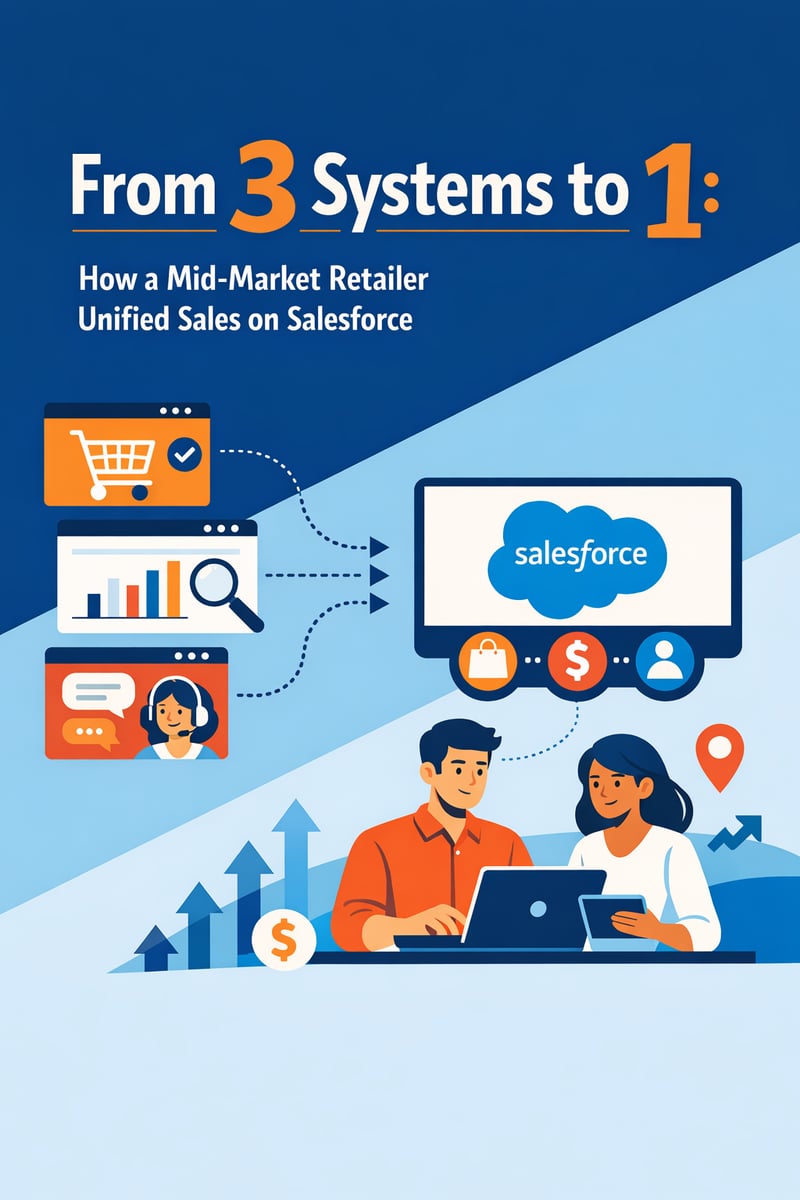
- The Challenge: A mid-market retailer with 200+ employees was running three disconnected systems — a legacy CRM, an on-premises ERP, and a standalone ecommerce platform — resulting in siloed data, manual workarounds, and lost revenue.
- The Approach: Vantage Point designed a phased CRM system consolidation onto Salesforce, using MuleSoft to integrate data flows across all channels and migrate years of historical records into a single source of truth.
- Key Results: 40% reduction in order processing time, 360-degree customer visibility across all channels, and a 28% increase in cross-sell revenue within the first year.
- Timeline: 16-week phased rollout with zero unplanned downtime.
- Bottom Line: With the right integration strategy, mid-market retailers can compete with enterprise-level capabilities — without enterprise-level complexity.
Introduction: When Three Systems Hold You Back
For mid-market retailers, growth is a double-edged sword. As sales channels multiply and customer expectations intensify, the patchwork of tools that once worked "well enough" starts to fracture. Orders slip through cracks between systems. Sales reps toggle between three screens to answer a single customer question. Marketing campaigns target customers who already purchased — or worse, who churned months ago.
This is the story of a growing multi-channel retailer that reached a tipping point. With a legacy CRM, an on-premises ERP, and a standalone ecommerce platform all operating in isolation, their data told three different stories. None of them were complete.
By partnering with Vantage Point, the retailer consolidated everything onto Salesforce, leveraged MuleSoft for real-time data integration, and transformed their disconnected sales operation into a unified, scalable revenue engine.
Here's how they did it — and what other mid-market companies can learn from the journey.
What Happens When Your CRM, ERP, and Ecommerce Don't Talk to Each Other?
The retailer had built their technology stack organically over a decade. Each system was chosen to solve an immediate need:
- Legacy CRM: Managed customer contacts and sales pipeline for their in-store and field sales teams.
- On-Premises ERP: Handled inventory, fulfillment, purchase orders, and financial reporting.
- Standalone Ecommerce Platform: Powered their growing online storefront and digital marketing.
On paper, these systems covered the basics. In practice, they created a web of inefficiency.
The Data Silo Problem
Customer records existed in all three systems — but rarely matched. A customer who bought in-store might appear as a separate contact on the ecommerce platform. Returns processed through the ERP didn't always sync back to the CRM. The result: sales reps lacked a complete picture of who their customers were, what they'd bought, and what they might need next.
The Manual Workaround Tax
Staff spent an estimated 15 hours per week on manual data entry — copying order information between systems, reconciling inventory counts, and building reports by exporting spreadsheets from three different dashboards. These workarounds weren't just time-consuming; they introduced errors that cascaded through downstream processes.
The Revenue Leak
Without a unified view of customer behavior, the company couldn't effectively cross-sell, upsell, or personalize outreach. Marketing and sales operated on incomplete intelligence. The sales team estimated they were missing 20-30% of cross-sell opportunities simply because they couldn't see what customers had purchased through other channels.
The Scalability Ceiling
The retailer was expanding into new regional markets and adding product lines. Every new channel or location amplified the existing integration problems. Leadership recognized that scaling on a fragmented foundation would only multiply costs and complexity.
Why Salesforce for CRM System Consolidation?
The decision to consolidate onto Salesforce wasn't made lightly. The retailer evaluated several platforms, but Salesforce emerged as the clear choice for several reasons:
- Multi-channel commerce capabilities: Salesforce supports in-store, online, and field sales within a single platform, giving the retailer a single source of truth for all customer interactions.
- Scalability: As a cloud-native platform, Salesforce could scale with the retailer's growth plans without the infrastructure headaches of on-premises software.
- Ecosystem strength: The Salesforce AppExchange offered pre-built solutions for retail-specific needs, from inventory management to loyalty programs.
- Integration-readiness: Salesforce's native connection to MuleSoft meant the retailer could integrate remaining backend systems (like their ERP) without rip-and-replace disruption.
But choosing Salesforce was only the first step. The real challenge was getting there.
How Did Vantage Point Approach the Consolidation?
Vantage Point applied its VALUE methodology — Vision, Adaptability, Leverage, User-Centric, Excellence — to ensure the consolidation delivered lasting business impact, not just a technology swap.
Vision: Defining the Unified Future State
Before writing a single line of configuration, Vantage Point facilitated discovery workshops with stakeholders across sales, marketing, operations, and IT. The goal: define what "unified" actually meant for this business.
Key outcomes from the Vision phase:
- Single customer identity across all channels (in-store, online, field sales)
- Real-time inventory visibility accessible to every sales channel
- Automated order routing based on inventory location and fulfillment capacity
- Unified reporting with dashboards that told one consistent story
This wasn't about replicating what the old systems did. It was about designing the workflows the business actually needed to compete.
Adaptability: Phased Migration, Not Big Bang
A "big bang" migration — shutting down all three systems simultaneously and switching to Salesforce overnight — would have been high-risk for a business that couldn't afford downtime. Vantage Point designed a phased approach:
Phase 1 (Weeks 1-4): Foundation & CRM Migration - Deployed Salesforce Sales Cloud and Service Cloud - Migrated customer records from the legacy CRM, deduplicating and enriching data during the process - Configured sales pipelines, opportunity management, and account hierarchies
Phase 2 (Weeks 5-10): MuleSoft Integration & ERP Connection - Deployed MuleSoft Anypoint Platform to create real-time APIs connecting Salesforce and the existing ERP - Built bidirectional sync for inventory, orders, and fulfillment status - Implemented error handling and data transformation layers to reconcile format differences between systems
Phase 3 (Weeks 11-14): Ecommerce Unification - Connected the ecommerce platform to Salesforce via MuleSoft APIs - Unified online and offline customer profiles into a single Salesforce record - Enabled real-time order and browsing data to flow into Salesforce for sales and marketing use
Phase 4 (Weeks 15-16): Optimization & Go-Live - End-to-end testing across all channels - User acceptance testing with frontline sales and operations teams - Performance tuning of MuleSoft integrations for peak traffic handling - Full cutover from legacy CRM with rollback plan in place
Leverage: MuleSoft as the Integration Backbone
MuleSoft was the linchpin of the entire consolidation. Rather than building point-to-point integrations (which would have recreated the fragility of the old setup), Vantage Point built a reusable API layer:
- Customer API: A single canonical customer record that unified identities across all source systems
- Order API: Standardized order format regardless of whether the purchase originated in-store, online, or through a sales rep
- Inventory API: Real-time stock levels accessible to all channels, preventing overselling and enabling smart fulfillment routing
- Product API: Centralized product catalog with pricing, descriptions, and availability synced across platforms
This API-led connectivity approach meant the retailer could swap out or add systems in the future without rebuilding integrations from scratch — a critical advantage for a growing business.
User-Centric: Designing for Adoption, Not Just Functionality
Technology consolidation fails when users don't adopt the new system. Vantage Point prioritized user experience at every stage:
- Role-based dashboards: Sales reps, store managers, and marketing teams each got a Salesforce view tailored to their daily workflows — not a one-size-fits-all interface.
- Mobile-first design: Field sales reps could access full customer histories, place orders, and check inventory from their phones.
- Guided selling paths: Salesforce guided reps through best-practice sales processes, reducing training time and improving consistency.
- Training program: Vantage Point delivered hands-on training sessions for each user group, plus quick-reference guides and a recorded video library for ongoing support.
Excellence: Quality Gates at Every Phase
Each phase included rigorous quality gates before proceeding:
- Data migration accuracy validated to 99.5%+ before legacy system decommission
- Integration latency tested under simulated peak load (Black Friday-level traffic)
- User acceptance sign-off from stakeholders in every department
- Security and access controls audited against the retailer's compliance requirements
What Were the Results of the Salesforce Consolidation?
The impact was measurable within the first quarter — and compounded over the first year.
Operational Efficiency
| Metric | Before | After | Improvement |
|---|---|---|---|
| Order processing time | 22 minutes avg. | 13 minutes avg. | 40% reduction |
| Manual data entry (weekly) | 15 hours | < 2 hours | 87% reduction |
| Inventory discrepancies (monthly) | 120+ incidents | < 10 incidents | 92% reduction |
| Report generation time | 4-6 hours (manual) | Real-time dashboards | Near-instant |
Revenue Impact
- 28% increase in cross-sell revenue within 12 months, driven by unified customer profiles that revealed cross-channel purchase patterns
- 15% improvement in customer retention as service teams could resolve issues faster with complete order and interaction histories
- 35% increase in email marketing conversion by targeting customers with personalized recommendations based on unified purchase data
Team Productivity
- Sales reps saved an average of 45 minutes per day previously spent switching between systems and manually entering data
- Managers gained real-time pipeline visibility, reducing weekly forecast preparation from half a day to minutes
- The operations team eliminated the monthly "data reconciliation sprint" that had consumed an entire week each month
Scalability
Within six months of go-live, the retailer expanded into two new regional markets — onboarding new locations in days rather than the weeks it previously took. The MuleSoft API layer meant new storefronts and channels could plug into the existing infrastructure without custom integration work.
What Best Practices Apply to Mid-Market CRM Consolidation?
Based on this engagement, here are the practices that made the difference — and that apply to any mid-market company facing a similar consolidation challenge.
1. Start with Data Quality, Not System Features
The retailer's biggest risk wasn't Salesforce configuration — it was dirty data. Duplicate customer records, inconsistent product codes, and incomplete order histories could have undermined the entire project. Vantage Point invested heavily in data cleansing and deduplication before migration, using automated matching rules supplemented by manual review for edge cases.
Key takeaway: Budget 20-30% of your migration timeline for data quality work. It's not glamorous, but it's the foundation everything else rests on.
2. Build APIs, Not Point-to-Point Integrations
Point-to-point integrations between three systems would have required six separate connectors — and every time one system changed, multiple integrations would break. MuleSoft's API-led approach created a loosely coupled architecture where each system communicated through standardized APIs. Changes to one system required updating only one API, not every connected endpoint.
Key takeaway: If you're integrating more than two systems, an API platform like MuleSoft pays for itself in reduced maintenance and future flexibility.
3. Phase the Rollout to Manage Risk
A phased migration let the retailer validate each stage before moving to the next. When Phase 2 revealed unexpected data format differences between the ERP and Salesforce, the team had time to build additional transformation logic in MuleSoft without delaying the overall timeline.
Key takeaway: Big bang migrations are tempting for their simplicity but risky for their fragility. Phased rollouts give you room to learn and adjust.
4. Design for Users First
The most technically elegant solution fails if users revert to spreadsheets. Vantage Point's user-centric approach — role-based dashboards, mobile access, and guided selling — drove adoption rates above 90% within the first month.
Key takeaway: Involve end users in design decisions early. Their buy-in during the project translates to adoption after go-live.
5. Plan for What Comes Next
The retailer didn't just consolidate — they built a platform for growth. The MuleSoft API layer, Salesforce's extensibility, and the clean data foundation positioned them to add AI-powered recommendations, loyalty programs, and additional sales channels without starting from scratch.
Key takeaway: Every consolidation project should answer the question: "What will we want to do in 18 months that this makes possible?"
What Does the Future Look Like for Unified Retail Sales?
This retailer's story reflects a broader trend among mid-market companies: the era of "good enough" technology stacks is ending. As customers expect seamless, personalized experiences across every channel, the companies that win will be those with unified data, integrated systems, and the agility to evolve.
Salesforce and MuleSoft provide the platform. But the strategy — the phased approach, the data-first mindset, the user-centric design — is what transforms a technology project into a business transformation.
For mid-market retailers evaluating their own CRM system consolidation, the message is clear: you don't have to be an enterprise to operate like one. With the right partner and the right approach, consolidation is achievable in weeks, not years.
Frequently Asked Questions
How long does a typical CRM system consolidation take for mid-market companies?
Most mid-market CRM consolidation projects, including data migration and integration work, take between 12 and 20 weeks. The timeline depends on the number of source systems, data volume, and complexity of integrations. In this case, the phased approach allowed a complete consolidation in 16 weeks with zero unplanned downtime.
What is MuleSoft and why is it important for system integration?
MuleSoft is an integration platform (now part of the Salesforce ecosystem) that enables companies to connect applications, data, and devices through reusable APIs. Instead of building fragile point-to-point connections, MuleSoft creates a flexible integration layer that can adapt as systems change — making it particularly valuable for multi-system consolidations.
Can mid-market companies afford Salesforce and MuleSoft together?
Yes. Both Salesforce and MuleSoft offer licensing tiers designed for mid-market organizations. The cost of the platform is typically offset by operational savings (reduced manual work, fewer errors) and revenue gains (better cross-selling, improved retention) within the first 12-18 months. The key is right-sizing the implementation to your current needs with room to grow.
What happens to historical data during a CRM migration?
Historical data — customer records, past orders, interaction logs — is migrated to the new system during the consolidation process. Vantage Point's approach includes data cleansing, deduplication, and validation to ensure historical records are accurate and complete in the new environment. This is typically handled in the early phases of the project to allow thorough testing.
How do you ensure user adoption after consolidating systems?
User adoption starts with design. By creating role-based dashboards, mobile-friendly interfaces, and guided workflows, the new system should feel easier than the old one — not harder. Training programs, quick-reference materials, and executive sponsorship reinforce adoption. In this engagement, adoption exceeded 90% within the first month.
What industries benefit most from CRM system consolidation?
Any industry with multi-channel sales benefits from consolidation. Retail, financial services, healthcare, insurance, and manufacturing all frequently operate multiple disconnected systems. Mid-market companies in these sectors are often at the sweet spot where the pain of fragmentation is high but the complexity of consolidation is manageable with the right approach.
How does Vantage Point differ from other Salesforce consulting partners?
Vantage Point is an employee-owned consultancy that staffs engagements exclusively with senior consultants — never junior resources learning on the job. With 150+ clients and 400+ engagements, Vantage Point brings deep expertise in Salesforce, MuleSoft, HubSpot, and Data Cloud. Their VALUE methodology (Vision, Adaptability, Leverage, User-Centric, Excellence) ensures every project delivers measurable business outcomes, not just technical deliverables.
Ready to Unify Your Sales Systems?
If your team is toggling between disconnected systems, manually reconciling data, or missing cross-sell opportunities because your tools don't talk to each other, it may be time for a consolidation conversation.
Vantage Point helps mid-market companies design and execute system consolidations that deliver measurable results — without the risk, disruption, or complexity you might expect.
Schedule a consultation with Vantage Point →
Vantage Point is an employee-owned Salesforce and HubSpot consultancy with 150+ clients and 400+ engagements. We specialize in CRM implementation, system integration, data migration, and AI-powered personalization for mid-market and enterprise organizations.