
Key Takeaways (TL;DR)
- The Challenge: A 500-employee insurance brokerage was losing competitive edge with legacy on-premise systems, spending more time chasing data than closing deals
- The Solution: Full Salesforce ecosystem implementation (Financial Services Cloud, Marketing Cloud, Account Engagement (Pardot), and Einstein AI) replacing a legacy Applied Epic environment
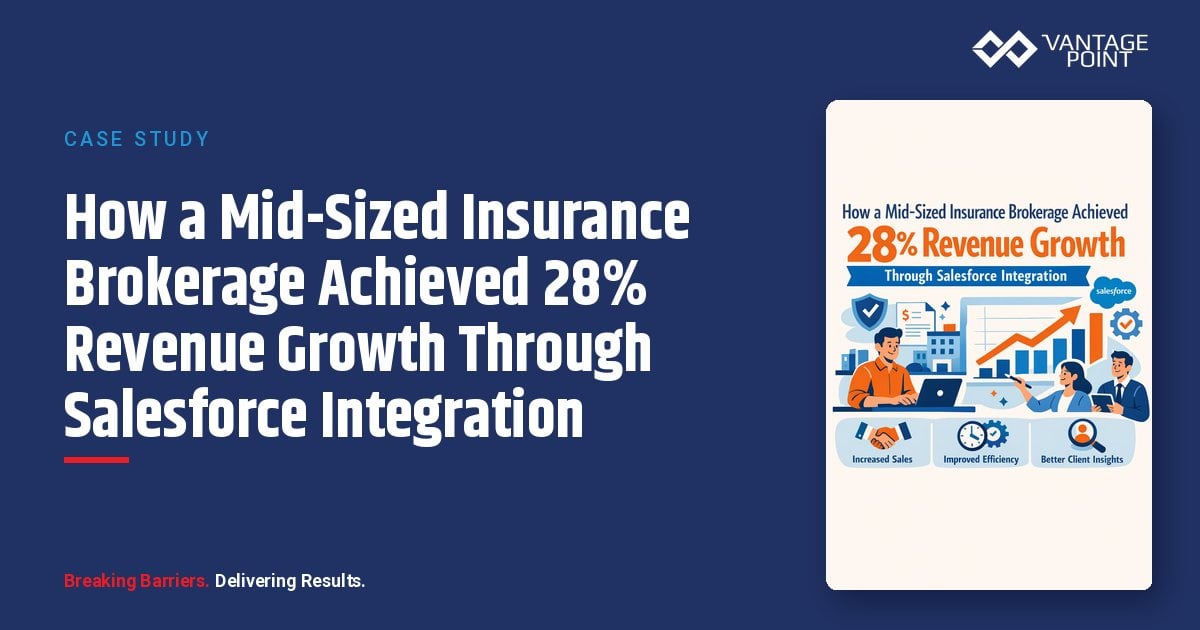
- Key Results: Annual revenue grew from $74M to $95M (+28%), sales close time cut by 50%, and client retention jumped from 82% to 95%
- Timeline: Phased implementation with role-based training for 200+ employees
- ROI Highlights: 22% operational cost reduction, 15 FTEs freed for strategic work, and 1,500 qualified leads generated quarterly
Introduction: When Legacy Systems Hold Back Growth
What happens when a growing insurance brokerage's technology can't keep pace with its ambitions? For a mid-sized insurance brokerage and risk management firm with over 500 employees and $74 million in annual revenue, the answer was clear: stalled growth, inefficient processes, and missed opportunities in key lines of business.
Specializing in commercial insurance, employee benefits, risk management, and transportation coverage, the firm had built a strong reputation across regulated industries. But their legacy on-premise systems, anchored by Applied Epic, were creating bottlenecks that threatened their competitive position.
This is the story of how a strategic Salesforce integration transformed their operations, unlocked a high-growth transportation line of business, and drove a remarkable 28% increase in annual revenue.
What Challenges Do Insurance Brokerages Face with Legacy Systems?
The firm's leadership team recognized a critical inflection point. As the Chief Information Officer described it:
"We were losing competitive edge because our teams spent more time chasing data than closing deals."
The Core Challenges
The brokerage faced several interconnected problems common across the insurance industry:
-
Siloed Data Across Departments: Policy information, claims data, client communications, and financial records lived in disconnected systems, making it nearly impossible to get a 360-degree view of any client relationship.
-
Manual, Error-Prone Processes: Policy quoting relied heavily on manual data entry, leading to high error rates and slow turnaround times. Claims processing averaged 10 business days: well above industry benchmarks.
-
Underperforming Digital Marketing: Email campaigns saw only a 15% open rate, the website converted at just 2%, and there was no systematic lead nurturing in place. Marketing efforts were largely generic and untargeted.
-
Transportation LOB Bottleneck: The firm's transportation insurance line of business (covering fleet tracking, driver risk assessment, and specialized commercial coverage) was particularly hampered. Complex underwriting requirements and fragmented data made it difficult to scale.
-
Lengthy Sales Cycles: From initial prospect engagement to policy binding, the average close time was 90 days: a timeline that lost deals to more agile competitors.
-
Limited Analytics and Forecasting: Leadership lacked real-time visibility into pipeline health, renewal risk, and cross-sell opportunities, making strategic planning more guesswork than science.
What Was the Salesforce Solution Architecture?
Working with a Salesforce implementation partner experienced in regulated industries, the firm designed a comprehensive solution built on the Salesforce ecosystem.
Platform Components
| Component | Purpose |
|---|---|
| Salesforce Financial Services Cloud (FSC) | Core CRM: client management, policy tracking, household and business relationships |
| Marketing Cloud & Account Engagement (Pardot) | Automated lead nurturing, email campaigns, journey orchestration |
| Einstein AI | Predictive lead scoring, renewal risk identification, next-best-action recommendations |
| Custom Objects | Transportation-specific modules for fleet tracking, risk scoring, and DOT compliance |
| Dynamic Web Personalization | Industry-specific website content tailored to visitor segments |
Transportation LOB Custom Build
One of the most impactful elements was the creation of custom Salesforce objects purpose-built for the transportation insurance vertical:
- Fleet Risk Scoring: Automated risk assessment models that evaluated driver records, vehicle types, routes, and claims history to generate real-time risk profiles.
- DOT Compliance Tracking: Integrated Department of Transportation compliance monitoring to flag regulatory issues proactively.
- Specialized Quoting Workflows: Streamlined the complex underwriting process for commercial fleet coverage, reducing the steps required to generate accurate quotes.
Integration Architecture
The migration from Applied Epic to Salesforce was designed as a phased approach rather than a risky "big bang" cutover:
- Phase 1: Foundation: Core CRM deployment with Salesforce FSC, data migration from Applied Epic, and basic workflow automation.
- Phase 2: Marketing Modernization: Marketing Cloud and Account Engagement implementation, dynamic website personalization, and automated lead nurturing sequences.
- Phase 3: AI and Advanced Analytics: Einstein AI deployment for predictive scoring, advanced reporting dashboards, and real-time pipeline analytics.
- Phase 4: Transportation LOB Expansion: Custom object development, specialized quoting tools, and fleet management integrations.
How Was the Implementation Executed?
Change Management and Training
A critical success factor was the firm's commitment to change management. With 200+ employees requiring training, the team developed a role-based training program:
- Sales Teams: Focused on pipeline management, lead scoring interpretation, and mobile CRM access for field work.
- Claims Teams: Trained on automated workflows, digital document management, and client communication tools.
- Marketing Staff: Upskilled on Marketing Cloud journey builders, A/B testing, content personalization, and analytics dashboards.
- IT and Infrastructure Teams: Focused on system administration, integration monitoring, and security configurations.
- Leadership: Executive dashboards, forecasting tools, and strategic reporting.
As the Director of Infrastructure & Security noted:
"Salesforce's flexibility allowed us to tailor the platform without overhauling our entire IT stack."
Compliance-First Approach
Operating in regulated industries (including insurance, employee benefits, and transportation) the firm ensured the Salesforce implementation met strict compliance requirements:
- Data encryption at rest and in transit
- Role-based access controls aligned with regulatory requirements
- Audit trails for all client data modifications
- Automated compliance reporting for state insurance regulations
- Secure document storage with retention policies
What Results Did the Salesforce Integration Deliver?
The transformation produced measurable results across every dimension of the business.
Revenue and Growth Metrics
| Metric | Before | After | Improvement |
|---|---|---|---|
| Annual Revenue | $74M | $95M | +28% ($21M) |
| Transportation LOB Revenue | Baseline | +$20.7M | +28% incremental |
| Sales Close Time | 90 days | 45 days | 50% reduction |
| Client Retention Rate | 82% | 95% | +13 percentage points |
Operational Efficiency
| Metric | Before | After | Improvement |
|---|---|---|---|
| Claims Processing Time | 10 days | 6 days | 40% reduction |
| Policy Quoting Errors | Baseline | -50% | 50% reduction |
| Operational Costs | Baseline | -22% | 22% savings |
| FTEs Freed for Strategic Work | N/A | 15 | 15 employees redeployed |
| Employee Satisfaction | Baseline | +35% | 35% increase |
Marketing and Digital Performance
| Metric | Before | After | Improvement |
|---|---|---|---|
| Email Open Rates | 15% | 32% | +113% |
| Website Conversion Rate | 2% | 7.5% | +275% |
| Qualified Leads (Quarterly) | ~500 | 1,500 | 3x increase |
Transportation Line of Business Impact
The transportation vertical saw the most dramatic transformation. With custom fleet tracking, automated risk scoring, and streamlined quoting, the firm was able to:
- Scale underwriting capacity without proportional headcount increases
- Win larger fleet accounts by offering faster, data-driven proposals
- Reduce claims costs through proactive risk identification
- Improve policyholder satisfaction with faster claims resolution
What Are the Key Lessons for Insurance Brokerages Considering Salesforce?
1. Phased Implementation Reduces Risk
Rather than attempting a complete system overhaul, the firm's phased approach allowed teams to adapt incrementally, maintain business continuity, and build internal expertise progressively.
2. Custom Objects Unlock Vertical-Specific Value
Generic CRM configurations rarely address the specialized needs of insurance verticals like transportation. Investing in custom objects (fleet tracking, risk scoring, compliance monitoring) delivered outsized returns.
3. Change Management Is Non-Negotiable
Technology alone doesn't drive transformation. The firm's investment in role-based training for 200+ employees was critical to adoption and ultimately to achieving the results documented here.
4. AI Amplifies Human Expertise
Einstein AI didn't replace the firm's experienced producers and underwriters. It amplified their judgment by surfacing insights, predicting risks, and recommending next-best actions. This led to faster decisions and more consistent outcomes.
5. Marketing Automation Compounds Over Time
The jump from 15% to 32% email open rates and from 2% to 7.5% website conversion didn't happen overnight. Persistent optimization of content, segmentation, and personalization, enabled by Marketing Cloud, compounded results quarter over quarter.
What Does the Future Look Like?
The Chief Operations Officer captured the broader significance of the transformation:
"Salesforce did not just digitize our processes; it empowered our people to focus on what matters."
Building on this foundation, the firm is now exploring:
- Salesforce Data Cloud integration for real-time data unification across all touchpoints
- Advanced AI models for predictive underwriting and automated risk assessment
- Expanded self-service portals for policyholders to manage coverage, file claims, and access certificates
- Additional vertical expansions applying the transportation LOB playbook to other specialized insurance lines
Is Your Insurance Brokerage Ready for a Similar Transformation?
Legacy systems don't just slow you down: they actively cost you revenue, client relationships, and competitive positioning. As this firm demonstrated, a strategic Salesforce implementation can transform an insurance brokerage's operations, marketing, and growth trajectory in measurable, meaningful ways.
Vantage Point specializes in Salesforce and HubSpot implementations for regulated industries including insurance, financial services, healthcare, and banking. We bring a compliance-first approach to every project.
👉 Schedule a consultation at vantagepoint.io to explore how Salesforce can drive growth for your brokerage.
Frequently Asked Questions (FAQ)
How long does a Salesforce implementation take for an insurance brokerage?
A comprehensive Salesforce implementation for a mid-sized insurance brokerage typically takes 6-12 months depending on scope, data complexity, and customization requirements. A phased approach (starting with core CRM and expanding to marketing automation and AI) helps manage risk and accelerate time-to-value.
Can Salesforce replace Applied Epic for insurance agencies?
Salesforce Financial Services Cloud can serve as the primary client relationship and policy management platform, though many firms maintain integrations with agency management systems for specific insurance workflows. The key is designing an architecture that consolidates client data while preserving specialized functionality.
What ROI can insurance brokerages expect from Salesforce?
ROI varies by firm size and implementation scope, but this case study demonstrates outcomes including 28% revenue growth, 50% faster sales cycles, 22% operational cost reduction, and 13-point improvement in client retention. Most firms see positive ROI within the first 12-18 months.
How does Salesforce handle insurance industry compliance requirements?
Salesforce provides robust compliance capabilities including data encryption, role-based access controls, comprehensive audit trails, and automated compliance reporting. For insurance brokerages, these features can be configured to meet state regulatory requirements, data privacy standards, and industry-specific mandates.
What is Salesforce Einstein AI and how does it help insurance brokerages?
Salesforce Einstein AI is an embedded artificial intelligence layer that provides predictive lead scoring, renewal risk identification, next-best-action recommendations, and automated insights. For insurance brokerages, Einstein can predict which policies are at risk of non-renewal, identify cross-sell opportunities, and prioritize the highest-value prospects.
How does Marketing Cloud improve insurance brokerage lead generation?
Marketing Cloud and Account Engagement (Pardot) enable automated, personalized lead nurturing across email, web, and social channels. For insurance brokerages, this means industry-specific content journeys, dynamic website personalization for different verticals (commercial, transportation, benefits), and sophisticated lead scoring that identifies sales-ready prospects.
What training is required for insurance teams adopting Salesforce?
Successful Salesforce adoption requires role-based training tailored to each team's workflows. Sales teams focus on pipeline management and mobile CRM, claims teams learn automated workflows, marketing staff master journey builders and analytics, and leadership trains on dashboards and forecasting. Ongoing reinforcement and a dedicated internal champion accelerate adoption.
Published by Vantage Point | March 2026 For more insights on CRM transformation in regulated industries, visit vantagepoint.io