Key Takeaways (TL;DR)
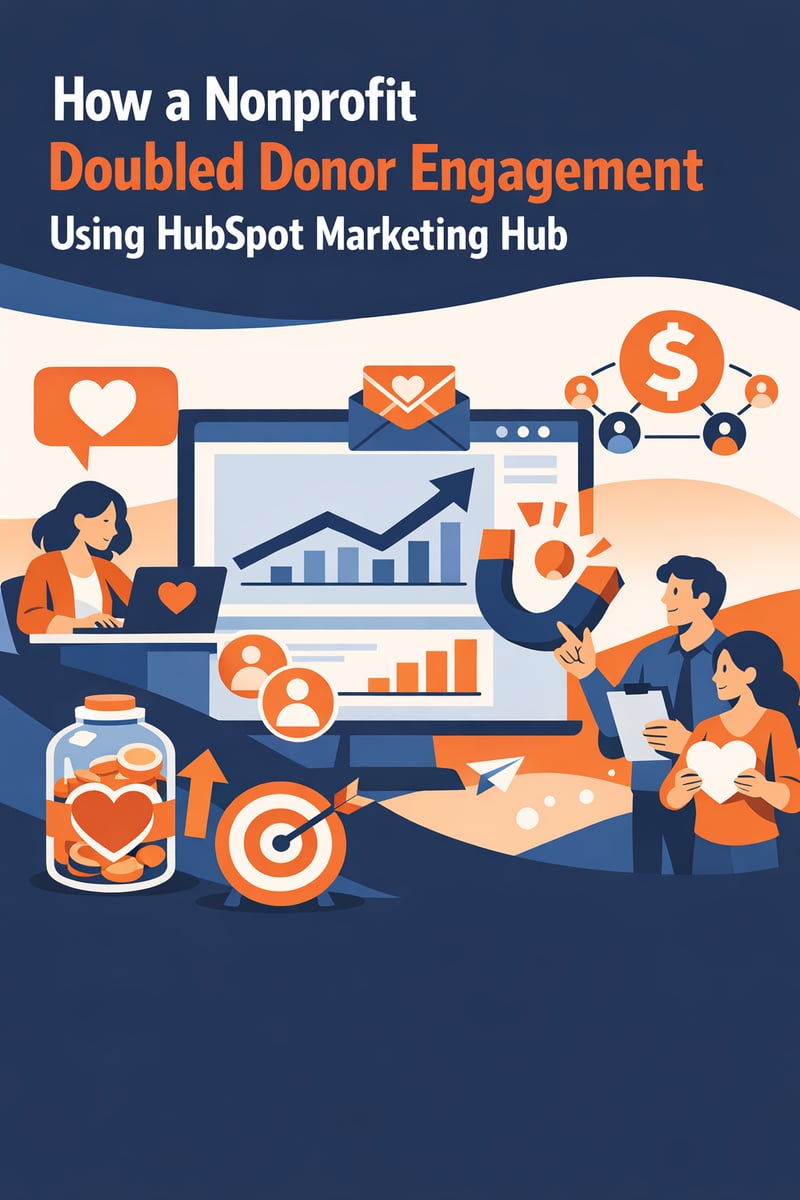
- What we achieved: An anonymized nonprofit doubled donor engagement by moving from basic email blasts to segmented, behavior-based HubSpot Marketing Hub campaigns.
- The challenge: The organization had limited donor visibility, inconsistent data hygiene, and one-size-fits-all communications that made it difficult to build lasting supporter relationships.
- Key results: Donor engagement doubled, campaign execution became more consistent, and teams gained clearer insight into lifecycle stages, preferences, and next-best actions.
- Timeline: The transformation followed a phased rollout: strategy and data cleanup, lifecycle design, workflow implementation, enablement, and continuous optimization.
- ROI: The nonprofit improved campaign relevance, reduced manual coordination, and built a scalable foundation for long-term fundraising and stewardship.
Introduction: Can HubSpot Marketing Hub Help Nonprofits Build Stronger Donor Relationships?
Nonprofits depend on trust, timing, and relevance. Supporters want to understand the mission, see the impact of their contributions, and receive communications that feel personal rather than generic. Yet many organizations still rely on disconnected spreadsheets, basic email newsletters, and manual follow-up processes that make it difficult to nurture long-term donor relationships.
This anonymized success story shows how Vantage Point helped a nonprofit organization modernize donor engagement using HubSpot Marketing Hub. The organization wanted to move beyond broad email blasts and create a more intentional engagement model based on donor lifecycle stages, communication preferences, and behavior-based automation.
Vantage Point partnered with the team to implement a practical HubSpot foundation: clean data, clear segmentation, smart content, automated workflows, and reporting that leadership could use. The result was a more connected donor experience and a measurable lift in engagement, without overcomplicating the operating model.
As a senior-only, employee-owned, US-based consulting partner, Vantage Point brings deep Salesforce, HubSpot, integration, AI, and data governance expertise to implementation work. That experience mattered here because the goal was not simply to launch new marketing tools. The goal was to create an engagement engine that the organization could trust, manage, and improve over time.
What Challenge Was the Nonprofit Trying to Solve?
The nonprofit had a committed mission, a loyal supporter base, and a growing need to communicate more effectively. But its donor engagement process had become difficult to scale.
The team faced several common challenges:
- Generic email communications: Most donors received the same messages, regardless of giving history, interests, volunteer activity, or engagement level.
- Limited segmentation: Supporter lists existed, but they were not consistently tied to lifecycle stages or actionable campaign logic.
- Manual campaign coordination: Staff members spent too much time preparing lists, checking data, and coordinating follow-up across teams.
- Inconsistent data governance: Donor records contained gaps, duplicates, outdated attributes, and inconsistent field usage.
- Low visibility into performance: Leadership could see campaign-level results, but it was harder to understand which segments were moving toward deeper engagement.
- Fragmented user experience: Internal teams did not have a shared operating model for how donor journeys should work inside HubSpot.
The organization did not need a bloated transformation. It needed a focused implementation that connected strategy to execution. The team wanted better donor engagement, but it also needed a system that was practical for staff to use every day.
Why Did Vantage Point Recommend HubSpot Marketing Hub?
HubSpot Marketing Hub was a strong fit because the organization needed a platform that could combine segmentation, email marketing, smart content, automation, landing pages, forms, and performance reporting in a single operating environment.
For this nonprofit, the value of HubSpot was not just campaign management. It was the ability to create a repeatable donor engagement model:
- Capture supporter interests and behaviors.
- Assign donors to meaningful lifecycle stages.
- Deliver more relevant content at the right moment.
- Automate appropriate follow-up steps.
- Measure engagement by segment, campaign, and journey stage.
- Improve the model over time based on data.
Vantage Point also focused on implementation quality. HubSpot can be simple to start, but lasting value depends on thoughtful configuration, data governance, workflow discipline, and user enablement. The nonprofit needed a system that would support fundraising, marketing, and stewardship without creating administrative burden.
How Did Vantage Point Design the Solution?
Vantage Point designed the solution around five implementation priorities: donor lifecycle strategy, data quality, segmentation, automation, and adoption.
1. Donor Lifecycle Stages That Matched the Organization’s Reality
The first step was defining lifecycle stages that reflected how supporters actually interacted with the nonprofit. Instead of relying on generic labels alone, Vantage Point helped map practical stages such as new supporter, engaged subscriber, first-time donor, recurring donor, lapsed donor, major gift prospect, volunteer participant, and advocate.
These stages gave the team a shared language. They also created a foundation for campaign targeting, reporting, and automated next steps.
A lifecycle model is only useful if teams understand it and trust it. Vantage Point kept the design straightforward so staff could see why contacts were assigned to specific stages and how those stages should inform communications.
2. Data Cleanup and Governance Before Automation
Automation amplifies whatever data is already in the system. If donor records are incomplete or inconsistent, workflows can create confusion rather than clarity.
Before building complex campaigns, Vantage Point helped the nonprofit strengthen its HubSpot data foundation. The work included:
- Standardizing key contact properties.
- Clarifying required fields for segmentation.
- Identifying duplicate or outdated records.
- Aligning naming conventions for lists, workflows, campaigns, and forms.
- Defining ownership for ongoing data quality.
- Documenting how new supporter information should enter HubSpot.
This governance step made the later campaign work more reliable. It also helped staff understand that data quality is not a one-time cleanup exercise. It is an operating discipline.
3. Smarter Segmentation for Donor Relevance
The nonprofit’s previous email strategy depended heavily on broad lists. Vantage Point replaced that with a more targeted segmentation approach based on behavior, interests, lifecycle stage, and engagement history.
Examples of segmentation logic included:
- New supporters who had subscribed but had not yet donated.
- First-time donors who needed impact-oriented follow-up.
- Recurring donors who should receive stewardship updates.
- Lapsed donors who needed re-engagement communications.
- Volunteers who may also be strong advocacy candidates.
- Supporters who had engaged with specific program content.
This segmentation made campaigns more relevant and more respectful. Donors were less likely to receive messages that did not match their relationship with the organization, and internal teams gained more control over audience strategy.
4. HubSpot Workflows That Reduced Manual Follow-Up
Once the lifecycle and segmentation model was defined, Vantage Point configured workflows to support consistent donor journeys.
The workflows were designed to be useful, transparent, and maintainable. Rather than creating a confusing web of automation, the team prioritized core journeys with clear business logic:
- Welcome series for new subscribers.
- First-gift stewardship sequence.
- Recurring donor appreciation journey.
- Re-engagement path for inactive supporters.
- Event follow-up based on attendance and interest.
- Internal task notifications for high-priority supporter activity.
Each workflow included defined triggers, enrollment criteria, suppression rules, and exit criteria. That structure helped prevent over-messaging and gave staff confidence that automation was working as intended.
5. Smart Content and Personalized Messaging
Vantage Point also helped the nonprofit use smart content to make communications feel more relevant without creating unsustainable content complexity.
Instead of attempting one-to-one personalization everywhere, the team focused on high-impact areas:
- Tailoring calls to action by lifecycle stage.
- Adjusting impact messaging based on donor interests.
- Presenting different next steps for donors, volunteers, and advocates.
- Using dynamic content in emails and landing pages where it improved clarity.
This approach balanced personalization with maintainability. The nonprofit could deliver more relevant experiences without requiring staff to create entirely separate campaigns for every audience.
What Results Did the Nonprofit Achieve?
The nonprofit doubled donor engagement after implementing the new HubSpot Marketing Hub foundation. Just as important, the organization gained a more scalable way to sustain that improvement.
Key outcomes included:
| Outcome Area | Before | After |
|---|---|---|
| Donor engagement | Broad email blasts with limited personalization | Engagement doubled through segmented journeys and relevant content |
| Campaign execution | Manual list preparation and inconsistent follow-up | Repeatable workflows supported timely, consistent communications |
| Data visibility | Limited insight into lifecycle movement | Clearer reporting by stage, segment, and campaign |
| User experience | Fragmented process for staff | More intuitive HubSpot structure and documented operating model |
| Data governance | Inconsistent properties and record quality | Cleaner fields, naming conventions, and ownership practices |
| Stewardship | Reactive follow-up | More proactive donor appreciation and re-engagement journeys |
The success was not based on a single campaign trick. It came from aligning data, process, content, and automation around the donor experience.
How Did Better Data Governance Improve Donor Engagement?
Data governance may not sound like a fundraising strategy, but it was one of the most important parts of the transformation.
When donor records are messy, teams hesitate to personalize. They worry about sending the wrong message to the wrong person. They create manual workarounds. They delay campaigns. They lose confidence in the system.
By improving property standards, lifecycle definitions, list logic, and ownership, the nonprofit could use HubSpot more confidently. Campaign managers knew which fields mattered. Leaders had more reliable reporting. Staff had clearer rules for how supporter information should be captured and maintained.
That confidence made personalization operationally realistic.
What Made the Implementation Successful?
Several implementation choices helped the project succeed.
The Solution Was Designed Around Users, Not Just Features
Vantage Point focused on how staff would actually use HubSpot. The implementation avoided unnecessary complexity and prioritized clear naming, documentation, and workflow visibility.
The Team Started With Strategy Before Building Automation
The nonprofit did not jump straight into workflows. First, Vantage Point helped define lifecycle stages, audience segments, and donor journey goals. That made automation more purposeful.
The Data Model Was Clean Enough to Trust
Data cleanup and governance gave the organization confidence that segmentation and reporting were accurate enough to support decisions.
The Rollout Included Enablement
The implementation included practical enablement so the team could manage campaigns, review workflow performance, and make improvements after launch.
The Operating Model Was Built for Continuous Improvement
The nonprofit gained a foundation for ongoing optimization, not just a one-time launch. Future campaigns could build on the same lifecycle and segmentation structure.
Key Takeaways for Nonprofits Considering HubSpot Marketing Hub
- Start with the donor journey. Technology should support the relationship you want to build with supporters.
- Clean the data before scaling automation. Reliable personalization depends on reliable records.
- Use segmentation to increase relevance. Donors should not all receive the same communications.
- Keep workflows understandable. Maintainable automation is more valuable than overly complex automation.
- Measure movement, not just opens and clicks. Track whether supporters are progressing through meaningful lifecycle stages.
- Train teams on the operating model. Adoption improves when staff understand why the system is configured the way it is.
- Optimize over time. Donor engagement improves when teams continuously refine messages, segments, and journeys.
What Is the Future Vision for the Organization?
With a stronger HubSpot foundation in place, the nonprofit can continue expanding its donor engagement strategy. Future opportunities may include deeper reporting, more advanced attribution, AI-assisted content personalization, event engagement scoring, integration with fundraising systems, and more proactive stewardship journeys.
The organization also has a clearer path to managed optimization. As donor expectations evolve, the team can continue refining HubSpot instead of rebuilding from scratch.
For many nonprofits, this is the real value of a thoughtful implementation. The first milestone is better engagement. The long-term value is an adaptable operating model that can grow with the mission.
FAQ: HubSpot Marketing Hub for Nonprofit Donor Engagement
What is HubSpot Marketing Hub for nonprofits?
HubSpot Marketing Hub is a marketing automation platform that helps nonprofits manage supporter communications, segment audiences, create email journeys, personalize content, capture leads through forms and landing pages, and measure campaign performance.
How can HubSpot improve donor engagement?
HubSpot can improve donor engagement by helping nonprofits send more relevant communications based on lifecycle stage, interests, giving behavior, volunteer activity, and engagement history. Better segmentation and automation make follow-up more timely and consistent.
Why is donor segmentation important?
Donor segmentation is important because supporters have different relationships with an organization. A first-time donor, recurring donor, volunteer, and lapsed supporter should not always receive the same message. Segmentation helps nonprofits communicate with greater relevance.
What should nonprofits clean up before launching HubSpot workflows?
Nonprofits should clean up contact properties, lifecycle stages, duplicate records, subscription preferences, source data, list criteria, naming conventions, and reporting fields before launching workflows. Clean data makes automation more accurate and trustworthy.
Does HubSpot replace fundraising strategy?
No. HubSpot supports fundraising and engagement strategy, but it does not replace the need for clear messaging, donor stewardship, campaign planning, and internal alignment. The platform works best when it is configured around a defined operating model.
How should nonprofits measure donor engagement in HubSpot?
Nonprofits should measure donor engagement using a mix of email engagement, form submissions, event participation, lifecycle stage movement, repeat giving indicators, re-engagement rates, and campaign influence. The best metrics connect activity to relationship growth.
When should a nonprofit ask for HubSpot implementation help?
A nonprofit should consider implementation help when its data is messy, workflows are difficult to manage, reporting is unclear, teams lack alignment, or donor communications are not producing the desired engagement. Expert guidance can reduce rework and improve adoption.
CTA: Ready to Strengthen Your Donor Engagement Engine?
If your organization is using HubSpot but not seeing the engagement, adoption, or reporting clarity you expected, Vantage Point can help.
Vantage Point is a senior-only, employee-owned, US-based team with deep expertise across HubSpot, Salesforce, MuleSoft integration, Data Cloud, AI personalization, and compliance-first implementation. We help organizations build systems that are practical, scalable, governed, and aligned to real business outcomes.